|
RETIREMENT SECURITY MATTERS
A forum for retirement innovation information sharing
focused on states, supporters, and service providers.
Vol 62 | September 22, 2022
| | |
Greetings! Lisa, welcome to Retirement Security Matters – where we talk about retirement readiness innovation by the public sector, private sector, and policy organizations. | |
Can you feel it? A slight change in the air. A crispness that you don’t remember being there last week. It’s true! Autumn is coming in two days and we’re ending the month with plenty-o-updates. So grab a milkshake (we take ours malted) and settle in:
- Research docket and wealth gap surprises with Morningstar’s Aron Szapiro
-
State Auto IRA metrics – 36,000 new funded accounts in one month
- A closer look at … Maine, Maryland, New Jersey, New Mexico, and New York
- Can friction benefit retirement savers? Yes! Behavioral scientist Lindsay Juarez explains
-
Hot Sauce! Fresh research and some brain expanders
-
And, Pix of the week
| Comments or content suggestions? We welcome both. Have something about your program you’d like to share? We are all ears. | |
|
RSM wants your support! Be seen here.
Click here for more information.
| |
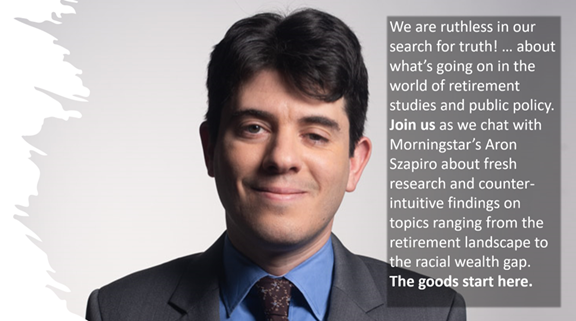
New Stuff in the Center for Retirement and Policy Studies: Morningstar’s Aron Shapiro on Research Surprises, and more.
| |
|
Aron, we’re interested to know: what has Morningstar’s Center for Retirement and Policy Studies got in the cooker right now.
It’s great to chat with you! We've got several things coming out in short order. I’ll start with our first look at the lifetime income landscape. We're calling it our ‘lifetime income assessment,’ and we're doing a few things in this paper that haven't been done before.
First, we're only evaluating lifetime income solutions that we see today in retirement plans. So they have to exist in the wild.
‘Surprise experiences’ are where some of these products are really supposed to shine. This especially includes annuity products that preserve some liquidity. We’re looking at, for example, in what cases do SPIAs do better than variable annuities. For what types of outcomes are variable annuities maybe going to work better. So I think that's going to be really interesting.
What else have you got in the hopper?
We are doing a deep dive on Social Security bridging and under what scenarios would it stop working as well as it can under ‘model’ circumstances.
And then we also are going to have our first report using the Morningstar model of retirement outcomes.
We are looking across more than a hundred million people in America to understand who’s on track for an adequate retirement, and who's not, based on some demographic delineations.
From your work, what interesting findings are jumping out at you?
Here’s one. We look at stuff like “at what ratio of wealth to income needed, net of Social Security, do annuities stop making sense.” I can’t give away the answer before we publish, but I think that will be really interesting to people. Yes, it's pretty intuitive, and it has important implications for things like, should we do QDIA annuities?
Two more things jump out. I think a lot of people think of the racial wealth gap in 401(k) systems as a function primarily of access, or a lack of access. But among people who have access, you still see a pretty big racial wealth gap.
So people say, well then it's probably mostly a function of income, but you really don't see that as the biggest contributor either. (What the heck IS the biggest contributor? More here.)
The inimitable Aron Szapiro is head of retirement studies and public policy for Morningstar Investment Management LLC. Aron is responsible for developing research reports on policy matters, coordinating official responses to regulatory proposals, and providing investor-focused comments on policy issues to clients and the press. He also chairs Morningstar’s Public Policy Council and heads the Morningstar Center for Retirement & Policy Studies. Aron’s research has been covered in The New York Times, The Wall Street Journal, The Washington Post, The Journal of Retirement, and on National Public Radio. Impressive! You can connect with Aron on Twitter: @AronSzapiro.
| |
*Fresh!* State Auto IRA Program Metrics | |
|
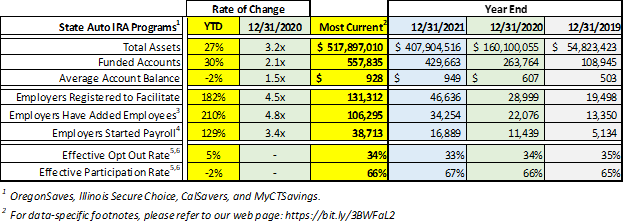
What we see: August figures are rolling in.
Highlights: Saver assets are keeping steady from our last report, up 27% year-to-date and 3.2x since December 2020. Average account balances are up bit again, at $928. (Longer term account balances have higher averages.)
Across the four programs, we now see over 550,000 funded accounts. For comparison, funded accounts are up 30% this year so far, up 2.1x since December 2020 and up about 5.1x since December 2019. We expect the funded account surge to continue as CalSavers continues to digest the large number of employers included in its Wave 3 deadline. The program achieved a new milestone this month, passing the mark of 350,000 funded saver accounts.
Over 131,000 employers are now registered to facilitate a state Auto IRA program across the live state programs.
| |
State Facilitated Retirement Programs - Fresh Highlights | |
|
Maine (workforce 677,000) – The Maine Retirement Savings Board met September 21, 2022. The agenda included an update from Treasurer Henry Beck on the feasibility study in collaboration with the Pew Charitable Trust. While the agenda also included a motion to approve contracting Bangor Savings Bank to provide payroll processing services for program staff, this motions was tabled until next meeting. Finally, a number of motions remain tabled while the program focuses on hiring its first Program Director.
| |
|
Maryland (workforce 3.1 million) – MarylandSaves has Launched State-wide with some good news for early employer adopters! Starting September 15, 2022, thousands of small business owners and more than a million Marylanders they employ have a new way to save for emergencies and retirement. In addition, while the services are free for businesses, employers that enroll with MarylandSaves by December 1, 2022, won’t have to pay the State of Maryland’s $300 annual report filing fee for 2023. Better yet, businesses that already offer a qualified retirement savings plan to their employees will also qualify for the fee waiver.
“MarylandSaves is an advance on traditional retirement savings,” said MarylandSaves Board Chair Joshua Gotbaum. Click here to view the press release, for a great summary check out ASPPA’s recent post).
In other news, the Maryland Small Business Retirement Savings Board met September 12, 2022. The agenda included an update on its pilot program, design, communications plan, and discussion around potential partnerships and RFP. Also, MarylandSaves welcomes new board member, Marco Priolo who brings strategic financial planning experience to the Board.
Finally, MarylandSaves has *extended the deadline* for its External Auditing Services RFP, now closing on October 3, 2022. A copy of the updated RFP can be requested directly from the Maryland team and here’s a great place to stay informed.
| |
|
New Jersey (workforce 4.4 million) – The New Jersey Secure Choice Savings Program Board met September 9, 2022. The Board is presently working on program implementation, including an update from Executive Director Search Committee, which is planning to schedule interviews in October. Back in June the New Jersey Secure Choice Savings Program Board selected EFL Associates for an ED search.
| |
|
New Mexico (workforce 1 million) – The New Mexico Work & $ave Board met on September 8, 2022. The agenda included a summary report from Executive Director Claudia Armijo, and presentation from the Marketplace Consultant on RFI response evaluations and Public Relations Consultant on marketing and outreach strategic plan. Also included in the meeting discussion was committee reports from the Education & Outreach Committee on recommendations to adopt Marketing & Outreach Strategic Plan, and the Rules Committee on recommendations to approve draft of the Marketplace and General Provisions Rules and begin stakeholder outreach meetings.
Partnering with the US Department of Labor and Kathleen Kennedy Townsend, New Mexico hosted a Retirement $avings Symposium in Albuquerque this week, featuring notables from the state retirement savings innovation space, along with elected officials and legislators interested to learn more and to engage with the Symposium’s employer and expert panels. The state’s “cost of doing nothing” is forecast to be $2 billion, or more. Kennedy Townsend’s keynote message in a nutshell: change the system if you want to change the outcomes.
| |
|
New York (workforce 9.2 million) – the New York State’s Secure Choice Savings Program implementation phase is progressing as the Program announced the intended award of its program consulting services contract to AKF Consulting Group.
| |
|
C O M I N G U P
Join where you’d like, and count on us to follow these meetings for you:
-
Oregon (workforce 2.1 million) – The next meeting of the OregonSaves Board is scheduled for November 15, 2022.
-
California (workforce 19.0 million) –The next meeting of the CalSavers Board is scheduled for November 21, 2022.
-
Maryland (workforce 3.1 million) – The next meeting of the Maryland$aves Board is scheduled for December 12, 2022.
| |
Helping Users Plug the Leaks | | |
|
|
Behavioral science is a popular topic. We want to know: can tuning our designs lead to better user outcomes?
In the last of our four-part series, expert Lindsay Juarez of Duke University’s Common Cents Lab builds on the ideas shared by her colleague Perry Wright in three recent pieces on Laying the Groundwork, Using Defaults and Anchors, and Leveraging Precommitment.
We think this is news you can use.
| |
|
As a retirement program manager, one of your biggest hurdles is getting people to open and fund an account. Behavioral science and a careful look at human decision making can help overcome this first step. Using defaults can increase the proportion of employees enrolled in a program. Leveraging precommitments can help people overcome procrastination and keep contributions in line with inflation. These changes can shift participation by impressive amounts!
But once the money is in an account, how do you encourage savers to leave it there? The value of a retirement savings account is in its ability to grow quietly over time, undisturbed. Even tiny amounts of leakage, around 1.5%, compound into cumulative retirement savings that are as much as 20% lower.
At the same time, access to these funds can be a lifeline during emergencies. Balancing accessibility with long-term growth is an exercise in careful design and choice architecture. While many behavioral science interventions focus on making things easier for users and removing friction, here are 3 ways in which friction can actually benefit retirement plan savers.
- Avoiding temptation
- Asymmetric feedback
- Cooling off periods
Here are some examples of what I mean:
| |
Promising outcomes.
Retirement plan administrators already design using some of these features, with promising outcomes. Removing unwanted barriers to make productive behaviors easier are one important design element. Another one is adding small barriers – speed bumps – in spots where you want to make sure a user thinks twice before pressing “go” on an action that could be detrimental to their own bigger picture goals.
Behavioral science matters! / Lindsay
Lindsay Juarez is a Behavioral Researcher at Duke University's Common Cents Lab and Irrational Labs, using behavioral science to create solutions that aim to increase the financial well-being for low- to moderate-income people living in the United States and abroad. Lindsay has a Ph.D. in social psychology and specializes in goal pursuit and self-control. The Common Cents Lab is funded by the MetLife Foundation and supported by BlackRock as part of BlackRock's Emergency Savings Initiative. For more information and to connect directly, you can reach Lindsay by email here.
| |
|
Ben. Friends at the NAST Annual Conference this week, we see on LinkedIn that you’re sharing a lot of great moments together! Report back, please.
I’m a Gig Worker. Financial literacy and financial education can help increase retirement security – but what about nontraditional workers? A recent brief by The Pew Charitable Trusts examines whether higher financial literacy is associated with increased rates of planning and saving among nontraditional workers, among other issues. Their headline says it all: nontraditional workers exhibit high levels of financial literacy, yet half are worried they will run out of money in retirement.
Just Do It. Do payroll autosave programs make a difference in helping employees to get started with saving? YES! Early trial results suggest opt-out payroll saving approach could meaningfully boost employee financial resilience, says Nest Insight. Read the report here on preliminary results from its trial of an opt-out, or 'autosave', approach to workplace emergency saving in the UK.
Are We Just Bigger Worriers? As for insights on workers fears of running out of money in retirement, US employees have a more positive view of their overall well-being than employees in Europe, yet report feeling more intimidated by financial matters, according to Alight research. Check out PLANSPONSOR’s recent article.
Big Green Checkmark. … And the most liked LinkedIn post this month in the Auto IRA space goes to… our friend Angela Antonelli. What is OregonSaves? We love progress and Jeopardy too!
What We Are Reading. Well in fact we are reading the manual to this little beauty. Is it possible to love an appliance? We love her and welcome her. We’re going to call her Emma.
| |
... It's time for some PIX! | |
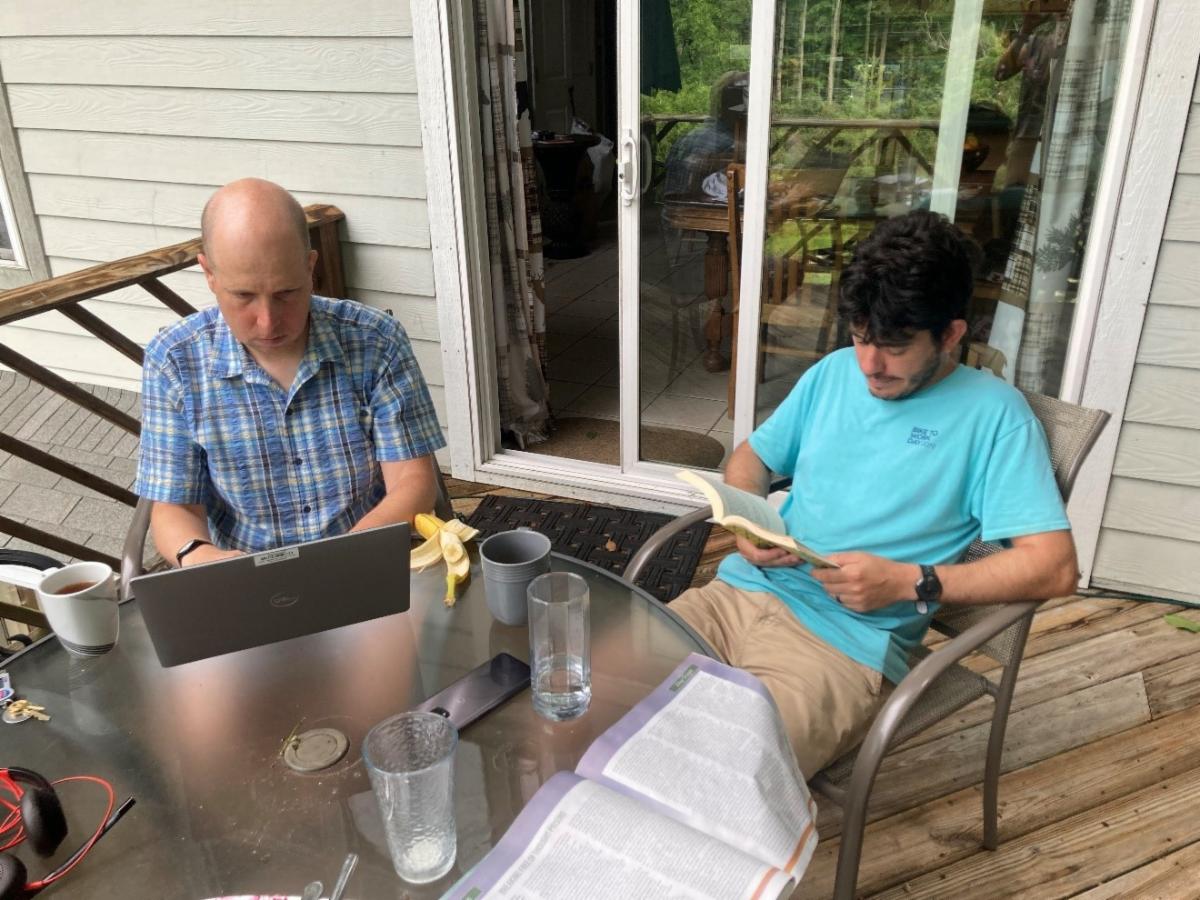
When he’s not doing research, our friend Aron Szapiro is … reading … in peace, while on vacation in Asheville, North Carolina. That looks very pleasant, Aron. Who’s your friend? | |
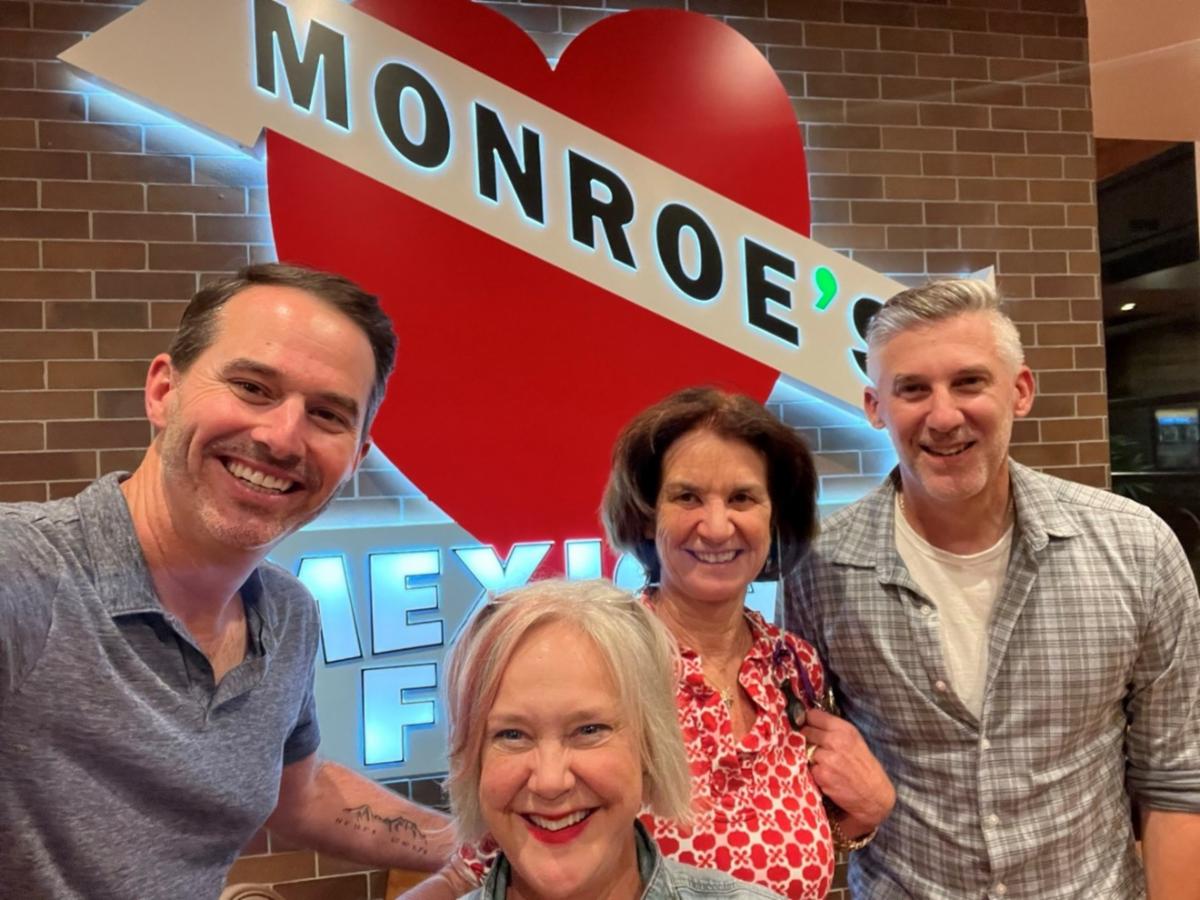
And when we’re not reading we are naturally … goofing off. | |
We’re in good company though! With David Bell and Michael Parker, from Jeopardy Star #OregonSaves, and the Honorable Kathleen Kennedy Townsend, #Lobo making things happen in the retirement security world. | |
|
That’s it for this edition. ❤️ Hug your people and change the world.
If you like this piece, please stick with us. We’ll be back in about two weeks. If you don’t like it, please unsubscribe below. Comments for us? Please let us know. Want your own subscription? Request one here. All information shared is from public sources or used with express permission.
| |
Massena Associates provides process, policy, and implementation consulting on retirement savings programs and products.
Our clientele includes public entities, policy organizations, and private sector providers. Our specialty – efficient, targeted results. We are an active speaker on retirement security topics, including state-facilitated programs, MEPs and more.
If you’d like to explore working together, we welcome the conversation. Connect with us here, and at 339-236-0684.
| |
|
Looking for a great retirement savings innovation resource? Led by Dr. Alicia Munnell, the Center for Retirement Research at Boston College develops and hosts terrific content and proprietary research related to states, financial security, social security, and more.
The Georgetown Center for Retirement Initiatives, Exec Angela Antonelli, provides excellent information on state-based and other retirement security innovation and policy.
Pew’s Retirement Savings Project studies the challenges and opportunities for increasing retirement savings and is another great resource - check out the work of John Scott and his terrific team.
If you want a great source of broad-based, consumer-focused retirement news, Jeffrey H. Snyder’s The Morning Pulse is your ticket. You can subscribe here.
| | | | | |