|
Have you ever been in a kayak racing toward that tight spot in the river where the current picks up speed and the roar rises in your ears? Your heart rate goes up—and then zip, paddle, sploosh, zang!—you’re out the other end looking backward at what you’ve just done, marveling to see you are still afloat.
We think this will be 2027 for all of us.
And so, for this late summer outing, the one that carries us into next year, let’s make sure we are ready. Before we take our backpack to school, we're going to take it on one last summer adventure.
Let’s start with the tent: federal initiatives. Here are four that could make for a better, bigger tent:
SECURE 3.0 is taking shape. The next major federal retirement law is moving from concept to concrete proposals. The Plan Sponsor Council of America (PSCA) shared their perspective in July on potential elements, with financial advisors playing a growing role in shaping priorities. The Insured Retirement Institute (IRI) has issued a formal wish list to Congress, pushing for expanded annuity access, stronger auto-enrollment rules, and better portability. Mercer is tracking all federal retirement legislation from 2025–2026 in a running roundup. We care a lot about automatic enrollment and portability on these lists.
The DOL's regulatory agenda is out. The Department of Labor released its 2026 retirement policy agenda in early July. Top items include investment guidance, auto-portability rules, and a fiduciary-related proposal. NAPA and PLANSPONSOR both highlight fiduciary rules as the centerpiece. We like the intersection in a few key areas, including the “autos”.
The Saver’s Match is front & center. In August the Treasury and IRS issued Notice 2026-48, providing the first substantive technical guidance on the Saver's Match program—important since Secure 2.0 and now a key component of TrumpIRA.gov's implementation. The Notice lays out an early view of operational frameworks for how plan administrators, financial institutions, and the IRS will coordinate, and asks for input in key areas.
TrumpIRA: implementation gets real. The White House's signature retirement access initiative is moving from announcement to action. As noted above, it is prominently included in guidance connected to the Saver’s Match. In readiness for platform launch at the start of the year, there’s a lot going on behind the scenes. In public, we bring you these resources:
The official home base is TrumpIRA.gov, the White House-launched portal where workers without employer plans can explore retirement savings options. The White House Fact Sheet and the full Executive Order lay out the program's mandate and structure. For regulatory substance, the most current document is IRS Notice 2026-48, which provides the first operational guidance on the Saver's Match component. On the analysis side, Fidelity and Cary Street Partners have published plain-language explainers for individuals, AEI and the Economic Policy Research Institute offer policy-focused analyses from different vantage points, AARP has published a supportive but watchful assessment, and Morningstar frames the broader policy debate the program has reignited.
We’re sure that tent fit into your backpack elegantly. Now how about some power bars to boost your energy. Let’s call that the states activity.
State programs—and a City one—are spreading and working. You’ll be pleased to hear—a July PSCA report found that state retirement programs continue to close the coverage gap. We like multiple perspectives. In April, the Pew Charitable Trusts published evidence that states with Auto IRA programs are also seeing growth in private retirement plan formation—a major proof point for advocates who argue these programs complement rather than compete with the private market. LOVE. And, NAPA reinforced this finding in April. The Georgetown Center for Retirement Initiatives continues to track all state-level programs. Much appreciation. ❤️
States are moving the needle in a range of ways this year. Three established programs lowered their employer coverage thresholds in 2026—Virginia (from 25 to 5 employees, effective July 1), New Jersey (from 25 to 10 employees, effective on a schedule TBA), and Vermont (from 5 to 2 employees, effective February)—bringing hundreds of thousands of additional workers into coverage.
Minnesota launched its Secure Choice MN program on January 1, becoming the newest state to open enrollment. Illinois relaunched its program under a new name, My Illinois Savings, with lower fees and upgraded technology. Rhode Island's RISavers, which opened in late 2025, reached 500 registered businesses in its early rollout.
Utah enacted a voluntary private-market exchange model (signed March 24) that connects employers with private retirement plan providers—a different approach from the Auto IRA model, and one that is challenging to get uptake with—BUT WE APPLAUD YOU. We want to see success. Mississippi also enacted new legislation (signed April 8) creating a voluntary payroll-deduction IRA for private-sector workers, though the program won't be operational for contributions until 2028. GODSPEED Mississippi.
Most notably, Philadelphia became the first U.S. city to pass a mandatory retirement savings program, approved by voters on May 19, with contributions set to begin July 1, 2027. The Philly City Council is working actively to establish its program board and governance structure.
And finally, where would we be without the ingredients for S’mores? JUST NOWHERE. We need graham crackers, a toasty mallow, and melty chocolate. Not sure this is all that, but it is definitely MORE:
Auto Portability—Gaining Real Traction. We care about this. A July NAPA piece makes the case for why portability matters, and a May report showed that larger 401(k) plans are increasingly embracing auto portability as plan sponsors become more confident in the concept. The DOL's regulatory agenda explicitly names auto-portability as a priority. Retirement Clearinghouse is the main private operator and is publishing regular updates. The goal: help workers—especially lower-income workers—avoid cashing out their retirement savings when they change jobs.
Social Security—Bipartisan senators are pushing for reform. In mid-July, a bipartisan group of senators formally proposed a Social Security reform process, ahead of the looming funding shortfall. Newsweek is tracking three major change proposals now on the table. The 2026 Trustees Report (explained by the Bipartisan Policy Center) confirmed the urgency. Focus is good.
Not everyone agrees on the solution set. AARP formally opposed the leading bipartisan proposal, signaling that the advocacy community is not aligned. Brookings has published a critique arguing current reform efforts are moving in the wrong direction. Penn Wharton's Budget Model has modeled six options for restoring solvency. The Committee for a Responsible Federal Budget is advocating for a six-figure earnings cap on Social Security contributions.
Institutional Retirement Annuities: Two Markets, Two Stories. Our friend Claude says that the annuity market is booming, but almost all the action is happening outside the workplace. Experts—do you agree? Retail annuity sales hit a record $464 billion in 2025 and continued strong in early 2026 at $107 billion in Q1, driven largely by advisor-sold products—particularly Registered Index-Linked Annuities (RILAs, +20%) and Single Premium Immediate Annuities (SPIAs, +22%), per LIMRA. Inside the 401(k), the picture is more modest: Fidelity, Vanguard, and BlackRock have all entered the in-plan lifetime income space, and the Vanguard-TIAA Target Retirement Lifetime Income Trust is the most significant new product launch.
But actual employer adoption remains light—only about 5% of plans currently offer in-plan annuity options, representing less than 1% of the $4.8 trillion target-date fund market, per TheStreet. The IRIC calls 2026 the year of "exploration to execution"—and DOL rulemaking may help by clarifying fiduciary safe harbors—but for now, the guaranteed income revolution is happening mostly in advisors' offices, not plan menus. It’s hard to break this particular ice. At the same time, we know folks want it. Slow and steady builds out the retirement paycheck? We should interview someone from this space. Recommendations welcome.
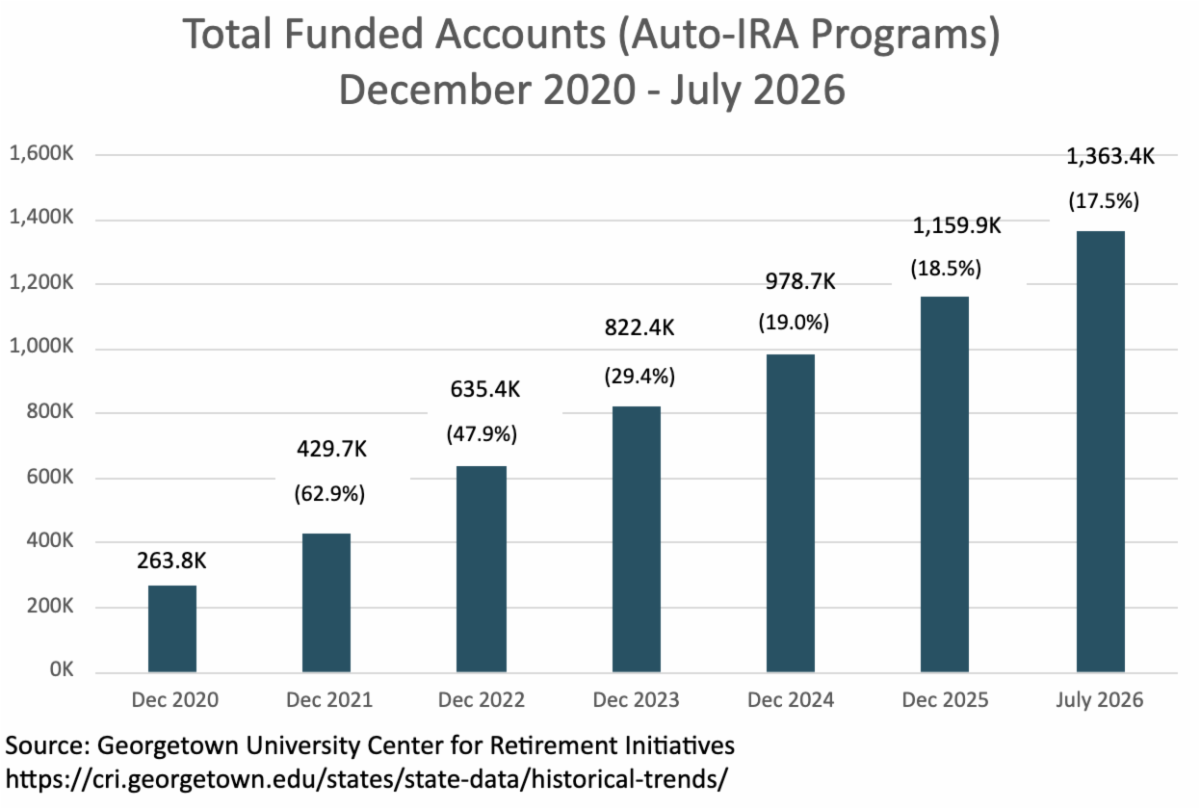
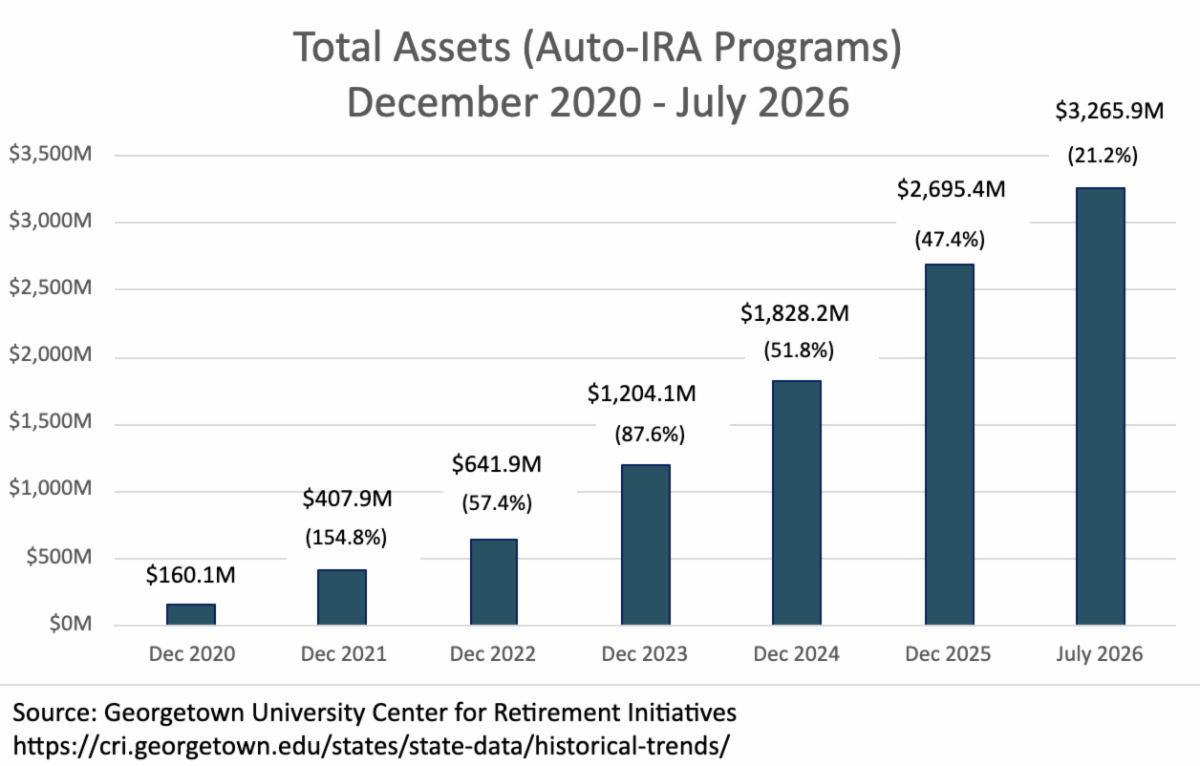
Is your backpack bulging? We definitely think this analogy is wearing thin 😂. You’ve got a tent, a power bar, and some s’mores. You’ve also got $3.3 billion and 1.4 million funded accounts, growing, and the opportunity for MUCH much more. We hope this summary gives you the sense of having an excellent boat and paddle for the middle of this fast-moving stream. And we do mean it: won’t we all be looking back in 2027 thinking “Wow, what just happened there.” STAY TUNED. STAY FOCUSED, FRIENDS.
|