|
Why withholding beats payroll deduction, and how we could reach every American worker
Jack Towarnicky has spent nearly five decades shaping America's retirement landscape—from leading benefits strategy at Fortune 100 companies to serving as Executive Director of the Plan Sponsor Council of America. His work spans the pivotal years when 401(k) plans emerged, when automatic enrollment revolutionized participation, and when state-mandated Auto IRAs attempted to close the coverage gap. But Towarnicky believes we're still missing the mark.
Drawing on a proposal he first drafted for AARP in 2007—and building on decades of plan sponsor experience—he's advocating for what he calls "100% Participation": a withholding-based system that would reach every wage earner in America, not just those whose employers offer retirement plans.
This is an excerpt of a deeper conversation – read the full piece HERE.
The Core Critique of State Auto IRAs
Here's Towarnicky's fundamental issue with state Auto IRA programs: they're built on payroll deduction, which means they only work when you have a stable employer relationship. "Only about 10% of workers contribute to IRAs today, even though IRAs have been universally available since 1982," he notes. "We've optimized our retirement system for people who stay with one employer for 30 years, but median job tenure has been under five years for decades."
Jack says: when you look at the actual results from state programs, the numbers tell the story. In OregonSaves, workers save an average of about $110 per month, or roughly $1,320 per year. The average account balance across state programs is around $2,400. Compare that to the contribution limits for IRAs ($7,000 for 2026, $8,500 for those 50+), and you see the gap.
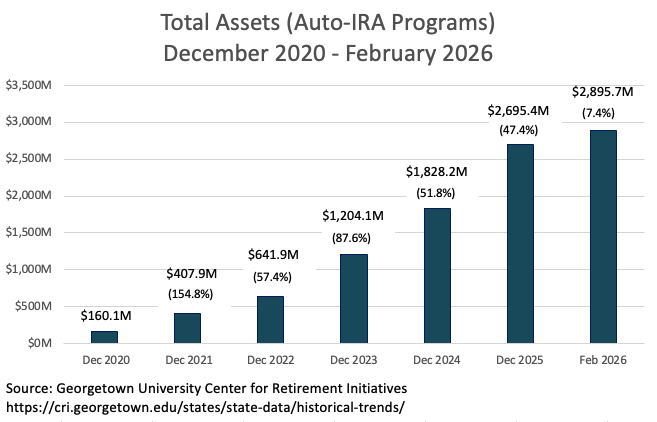
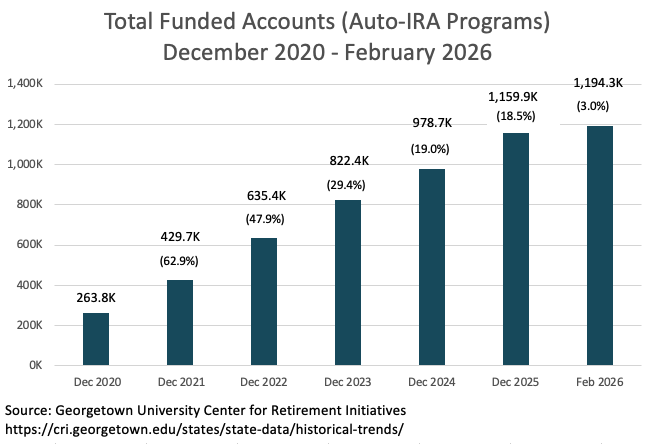
"These programs have reached maybe 1.2 million workers," Towarnicky observes. "That sounds impressive until you realize we're talking about reaching maybe 2-3% of the 50 million private sector workers who lack employer plans."
The Withholding Alternative
Towarnicky's solution: leverage federal income tax withholding instead of employer payroll systems. Here's how it would work:
The Tax Form Nudge: When workers file their W-4 (Employee's Withholding Certificate) or adjust their withholding, they'd see a supplemental withholding option for retirement savings, with a suggested 3-6% default.
Twice-Annual Reminders: The IRS would send personalized reminders in January and July—before each major tax deadline—prompting workers to start or adjust retirement withholding. These "perennial nudges" reach everyone filing taxes, not just those at covered employers.
The IRA Connector: Funds withheld would flow to a centralized "IRA connector" system—similar to how state 529 college savings programs work. Workers could direct funds to their existing IRA, select from a menu of low-cost index fund IRAs, or have funds automatically invested in age-appropriate target-date funds.
Universal Portability: Because withholding is tied to the individual, not the employer, savings continue automatically across job changes. No orphaned accounts. No leakage from cashing out small balances.
What About Employers?
One of Towarnicky's key selling points: this approach places zero new burden on employers who don't already sponsor plans. The employer's role is identical to current tax withholding—remit funds to the IRS based on employee elections. No fiduciary liability, no ERISA complications, no administrative overhead beyond what they already do for payroll taxes.
Employers who do sponsor 401(k) plans benefit too. The "deemed IRA" provisions (IRC Section 408(q)) allow 401(k) plans to accept IRA contributions, creating what Towarnicky calls an "asset magnet"—making the 401(k) plan the natural destination for consolidating retirement savings across a worker's career.
The Federal vs. State Debate
Towarnicky is direct about his concerns with the state-by-state approach. Beyond the coverage limitations, he points to:
-
Portability problems: Move from Oregon to California? You might need to close one account and open another
-
Employer confusion: Multi-state employers face different rules, deadlines, contribution rates, and penalties
-
Missing features: Most state programs don't include loan provisions, hardship withdrawals, or in-service distributions that 401(k) participants take for granted
-
Fee structures: Many state programs use per-account fees that can be high for small balances
"I'm not saying state programs haven't done good work," he clarifies. "They've demonstrated that automatic enrollment works and that workers will save when given access. But we're trying to solve a national problem with 50 different state solutions. Federal withholding already reaches everyone. Why not use it?"
The 2026 Agenda
What would it take to make this real? Towarnicky outlines the steps:
Legislative: Congressional action to implement supplemental withholding for retirement and create the IRA connector system framework.
Regulatory: Treasury guidance clarifying deemed IRA provisions so 401(k) plans can easily accept IRA contributions and rollovers.
Administrative: IRS systems updates (which Towarnicky argues are modest given existing infrastructure for tax withholding, direct deposit, and electronic filing).
Industry adoption: Encouraging 401(k) plans to become "asset magnets" rather than pushing participants out at separation.
"I've spent nearly 50 years working on retirement security," he reflects. "I've been a plan sponsor, consultant, association executive director, teacher, and writer. I'm convinced this approach—using tax withholding to create perennial nudges, leveraging existing infrastructure, providing universal coverage without employer mandates, creating portability across jobs and state lines—is the missing piece."
"We've had IRAs for over 40 years, and only 10% of workers contribute to them. We've designed retirement plans for people who stay with one employer for 30 years, but median job tenure has been under five years for decades. We haven't adapted our systems to how people actually work."
READ THE FULL INTERVIEW for Jack's complete vision, including technical details on deemed IRAs, loan provisions for IRAs, how this approach handles the gig economy, and why he believes the demographic imperative of 75 million Baby Boomers retiring over the next 15 years creates urgency for comprehensive solutions.
About Jack Towarnicky: Jack Towarnicky, LLM, JD, MBA, CEBS, is Of Counsel at Koehler Fitzgerald, LLC. Over a 45-year career, he has held plan sponsor leadership positions at four Fortune 500 companies, served as Executive Director of the Plan Sponsor Council of America, and advised on retirement policy at the highest levels.
|