|
RETIREMENT SECURITY MATTERS
A forum for retirement savings innovation, together.
Vol 92 | June 12, 2025
| | |
Greetings! Lisa, welcome to Retirement Security Matters – where we talk about retirement readiness innovation by fresh thinkers, states, service providers and policymakers. | |
You might have noticed we went on newsletter holiday and took an intermission early last year. Cuz if you think it takes a minute to read this newsletter, imagine what it takes to gather up all the juicy content and organize it for you. We needed a break! But we missed you ❤️ and we’re back for more.
We’re calling this the Campfire Series and we imagine it this way: in a world full of adventure, sometimes you need to huddle up in a brightly-lit circle and share stories. These are mostly stories about good things, great things even, and sometimes things that feel ordinary but aren’t. Sometimes there are ghosts and monsters. Best to stick together and stare them in the eye – see who blinks first. In this edition:
View as Webpage. Comments or content suggestions? We welcome both. Have something about your program you’d like to share? We are all ears.
| |
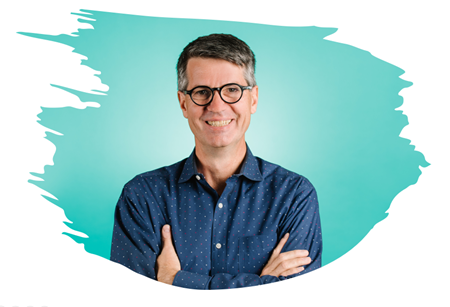
Especially Now - Building Financial Security for the Future: A Conversation with Tim Flacke, CEO of Commonwealth
| | |
In this first leadership interview of our Campfire Series, we’re excited to share some very fresh thinking from Tim Flacke, Chief Executive Officer and Cofounder of Commonwealth. For 30 years he’s focused on solutions that help workers and families in the US become more financially secure. Five years ago we talked about what the retirement system would be, if it could be. Today we’re talking about benefits for the future. Will it surprise you to hear the two are linked? Cool stuff ahead. In case you’re meeting Tim here for the first time, we’ll start with an intro.
Tim, thank you for joining us. To start, could you briefly introduce yourself and what Commonwealth is focused on right now?
Sure. I'm Tim Flacke, Cofounder and CEO of Commonwealth. We're a national nonprofit committed to building financial security and opportunity for people living on low and moderate incomes. We do this by innovating and partnering with market actors, policymakers, and social sector organizations to design and scale solutions that help financially vulnerable families. We’re not a direct service provider—instead, we work behind the scenes to help systems work better for these families.
One of the key areas where you’re doing that is savings—especially emergency and education savings. Can you tell us more about that work?
Absolutely. From the start, we’ve believed that it's not just income people need—it’s assets. Wealth can feel like a tricky term when talking about families living paycheck to paycheck, but building assets is critical to long-term stability. Over the years, we’ve realized you can’t talk about long-term wealth without acknowledging the financial anxiety people feel in the short term.
| |
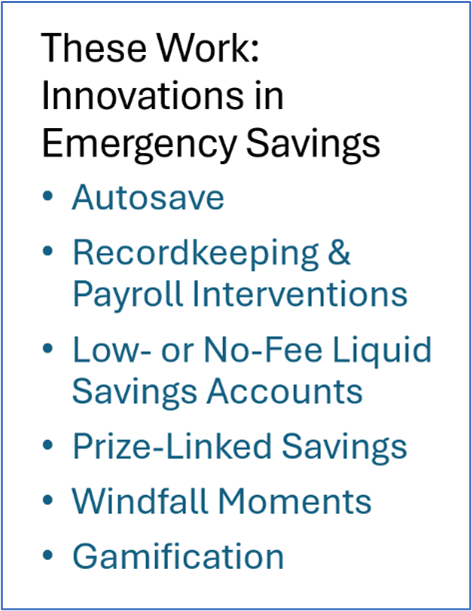
That’s why we focus on both ends of the spectrum: helping people build liquid savings for emergencies and helping them start down the path of long-term investing. We've been deeply involved in BlackRock's Emergency Savings Initiative, which has made real strides in normalizing the idea that employers, retirement providers, and even state treasurers have a role in supporting liquid savings.
In parallel, we’re working to make education savings more accessible. One way we’re doing that is by integrating short-term savings features into 529 plans—making these accounts more flexible and appealing to families worried about liquidity. We’re also encouraging employers to drive use of 529 accounts by building awareness, offering payroll deduction, and considering contributions to employees’ accounts—making investing for education credible, convenient, and in some cases, even incentivized.
That brings us to your Benefits for the Future initiative. What is it, and why is it important now?
Benefits for the Future—made possible by generous support from JPMC—is our effort to identify, test, and refine what the next generation of workplace financial benefits could and should look like—especially for hourly workers and those living paycheck to paycheck.
Good stuff ahead! - don’t miss: more Benefits for the Future / Employer Recruitment / High Impact in 2025 / and Tim’s thoughts on what AI can do – see the full piece here.
To close us out, what’s keeping you motivated in 2025?
Honestly, it’s the people we serve. So many families are doing everything right, and yet the system makes it hard for them to get ahead. If we can shift that—even a little—by making savings accessible, benefits smarter, and institutions more responsive, then we’re helping build the kind of economy we all want to live in.
Thank you, Tim. This has been an informative and inspiring conversation.
Want to connect with Tim? You can here on LinkedIn. You can also follow Tim and Commonwealth’s work on X @buildcommwealth and LinkedIn.
Timothy Flacke is Chief Executive Officer and Cofounder of Commonwealth, a national nonprofit that builds financial security and opportunity through innovation and partnerships. The efforts of Flacke and his teams have repeatedly impacted the federal tax code, and sparked new financial products and public policies that have resulted in nearly $8 billion saved by over 2 million households.
| | By the Numbers: State Auto IRAs Today | | |
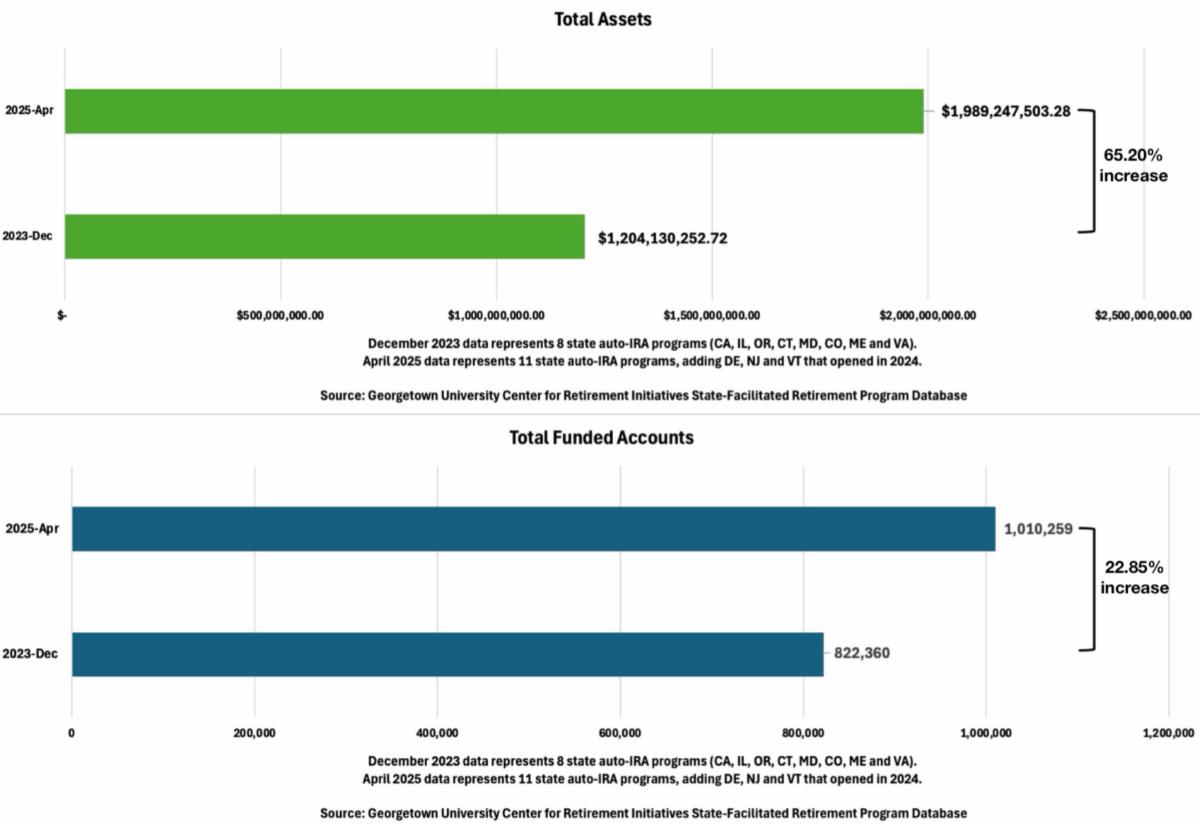
Ding ding ding – you can't see it in our April chart above, but as of May 31 2025 we’ve passed the $2 billion saved mark. We’re so pleased for the savers and families who have socked this money away. When we last met Auto IRA assets had capped the 2023 year at just over $1 billion in assets. That was less than 18 months ago. #Welldone folks.
A special thank you to Angela Antonelli and the Georgetown Center for Retirement Initiatives for this data. You’ll find more detailed metrics and information on their site, here. Stay tuned as well for their more official announcement of the $2B mark.
| | From Zero to Hero? Auto IRAs on the Rise. | | |
Back in 2017, the concept of state-facilitated automatic individual retirement accounts was as fresh as a new pair of sneakers. Nike sneakers perhaps? Part of the three-pack of early founders, OregonSaves was first out of the gate. (Yeah, we’ll keep saying it 😂.) By the end of the year, the program was rolling out statewide and had garnered about $360,000 in saver assets from its first few hundred participants. Not bad, but definitely small potatoes by institutional standards.
Illinois and California launched their programs in 2018. For a time, these three states were the pioneers – showing that there was more to gain than to fear in this space, and slowly (slowly) winning respect among their retirement savings peers. Fast forward to today and the true power of these programs is becoming more apparent.
As of December 31, 2024, state Auto IRA programs collectively managed approximately $1.8 billion in assets across about 965,000 funded accounts. ChatGPT tells us this growth represents a compound annual growth rate of roughly 150% for assets and 100% for funded accounts since inception. As you see above, by May 31, 2025, these numbers had climbed even higher, with over $1.93 billion in assets and more than 1 million funded accounts across ten reporting state programs. https://cri.georgetown.edu/states/state-data/current-year/
Assets and funded accounts have grown to be institutional in size—but more importantly is the family-level impact of these accounts. When you consider that most of these funds were accumulated $50 and $60 at a time, and that the accounts may represent some participants’ single largest asset and first financial account, you begin to see the seeds of change.
What’s Working - Key Growth Drivers
America has a great retirement superhighway—start early, save steadily, and you are likely to be in good financial shape when retirement comes. Still, that superhighway has been missing onramps in a number of “neighborhoods”—leaving a lot of workers out of the system. Better access and good design are making a difference:
-
Mandatory Employer Participation: Programs require employers without retirement plans to facilitate Auto IRA enrollment, significantly increasing participation rates. Employer facilitation = employee access.
-
Automatic Enrollment: Auto-enrollment features have proven effective in encouraging participation, especially among lower-income workers who might not otherwise save—for a lot of reasons—including unfamiliarity with the system and a plethora of puzzling choices.
-
More Programs, More Access: To date, 17 states have enacted Auto IRA programs for private sector workers. Eleven of these programs are live with assets in (CA, CO, CT, DE, IL, ME, MD, NJ, OR, VA, VT). Several important programs should enter high growth phases over the next year, including New Jersey and, just launching, New York State and Nevada. California is extending access to its smallest employers and expecting to see a swell of new account growth.
Outside the programs this is happening too:
-
Private Sector Complementarity: Rather than displacing private retirement plans, state Auto IRAs have spurred many employers to establish their own plans, enhancing overall retirement savings coverage. Ask your favorite new plan specialist. #itsworking
Looking Ahead: Whatsee?
The momentum behind Auto IRA programs shows few signs of slowing. With just the existing states, projections suggest that by the end of 2026, programs could collectively manage over $3 billion in assets, with more than 1.5 million funded accounts. By 2027, these numbers could surpass $5 billion in assets and 2-3 million funded accounts, further solidifying the role of Auto IRAs in enhancing retirement security for American workers.
2025 brought program tune-ups, but no new enabling legislation. If current conversations are an indication, we are likely to see a breakthrough into some of the more conservative states. They, too, are interested in seeing more and better access to retirement savings. And the fiscal benefits that come with it.
Retirement security matters! / Lisa
This piece was written by Lisa Massena and the views expressed are her own.
| | |
… and the rooms. Here are some snippets garnered while out and about.
NAST TMTS in Baltimore, June 4 and 5. Hot topics:
Retirement Security 3.0. Moderated by Kim Olson, the Pew Charitable Trusts.
1 - Vanguard’s Fiona Greig shares from their data that when workers change jobs, income goes up by an average of 10%, but savings drops by an average of 1%. Why? If you have voluntary enrollment, some workers forget to do it. If you have automatic enrollment, your auto savings rate may be lower than the saver’s previous rate. Opportunities? When you ask for 402(g) contribution $ data, ask for rate data too, and default savers to the higher of your automatic savings rate, or their previous savings rate. It’s still #automatic. (PS there’s a version of this that works in the Auto IRA world too.)
2 – From Jessica Lasky-Fink of The People Lab at Harvard Kennedy School: for effective communication—Simplify. Shorten. Share Norms. Make your content Easy to Navigate. Make your call to Action Easy to See and Do. And in the Auto IRA space, make sure to say you’re from the government. When communicating deadlines to employers, formality helps.
3 – Have you heard of MyFriendBen? Incubated in Colorado, this nonprofit startup connects families with benefits for which they’re eligible. What’s the connection to retirement, you ask—well, what if the Saver’s Credit, Saver’s Match, and your state’s Auto IRA were on the menu? We like it. Thank you for a great presentation from Sekhar Paladugu.
Other Throughlines at NAST: Automatic features are incredibly powerful. Re-enrollment and “under-saver” sweeps are almost as powerful as automatic enrollment at getting folks in and saving. Asset limits and public benefit programs—check your state / exempt retirement assets / may require legislation. Partnerships for innovation and research are bringing new players and new information to the space. Barriers to saving are real—consider what they are and how to reduce or eliminate them for your target audience/s.
DCIIA/SPARK Public Policy Forum in Washington DC, June 3.
About Social Security – Dr. Gopi Shah Goda of Brookings Institution and Joel Eskovitz of AARP with State Street’s Melissa Kahn. If we got any of this wrong, it’s our fault, not theirs. Also better note-taking would have enabled us to do a better job of crediting content by speaker. Our regrets.
1 – 69 million Americans are receiving $1.6 trillion a year in benefits from Social Security – 80% of these are retirement payments.
2 – There’s a well known solvency issue. By 2035, only 83% of forecast benefit payments will be covered by annual payroll tax contributions to Social Security. Headlines cite this as “going broke,” which doesn’t help Americans have calm conversations about it.
3 – Interestingly, an overwhelming chunk of Americans—young and old alike—would prefer an increase in funding to the program (e.g. taxes) over a reduction in committed benefits.
We also liked that access and automatic enrollment were cited as a continuing policy priority during the session that featured a member of the House Education and Workforce Committee. A reference to an index new to us—the Cost of Thriving Index, as published by American Compass (thank you Karen Andres). A note in the Lifetime Income space that the DOL is in favor, but/and defines lifetime income more broadly than annuities alone.
| | |
We’re drawing it to a close, folks, but it wouldn’t be us without some cool stuff. Here’s what we’ve curated for you today.
Our friend Geoffrey Sanzenbacher of Boston College finds A Welcome Unintended Consequence of State Auto-IRAs – we invite you to do the same.
Our friends at the Georgetown Center for Retirement Initiatives have a fantastic newsletter you may like, and are holding their mid-year Policy Innovation Forum next week, June 16-17.
Could retirement security get a boost well before we start working? If you believe that a retirement savings account balance is the sum of a lifetime’s financial success or struggle, maybe so. With this in mind our friends at the Aspen Institute Financial Security Program are taking a close look at proposals for Child Savings Accounts included in the Big Beautiful Bill. Take a look at this recent conversation. Nothing good gets done without a lot of work, and this idea would be no exception. Interesting.
We do make it sound like we’re very friendly, don’t we.
OK – that’s enough work! If you get too hot this summer, here’s a quick remedy (warning, TikTok, yes we’re still on it).
Traveling to France anytime soon? Guys and Gals - look cool be cool.
Need a cool, new-ish summer read? Here’s a short one, with Jeff Daniels. Here’s a long one, with Doris Kearns Goodwin. Both worth it.
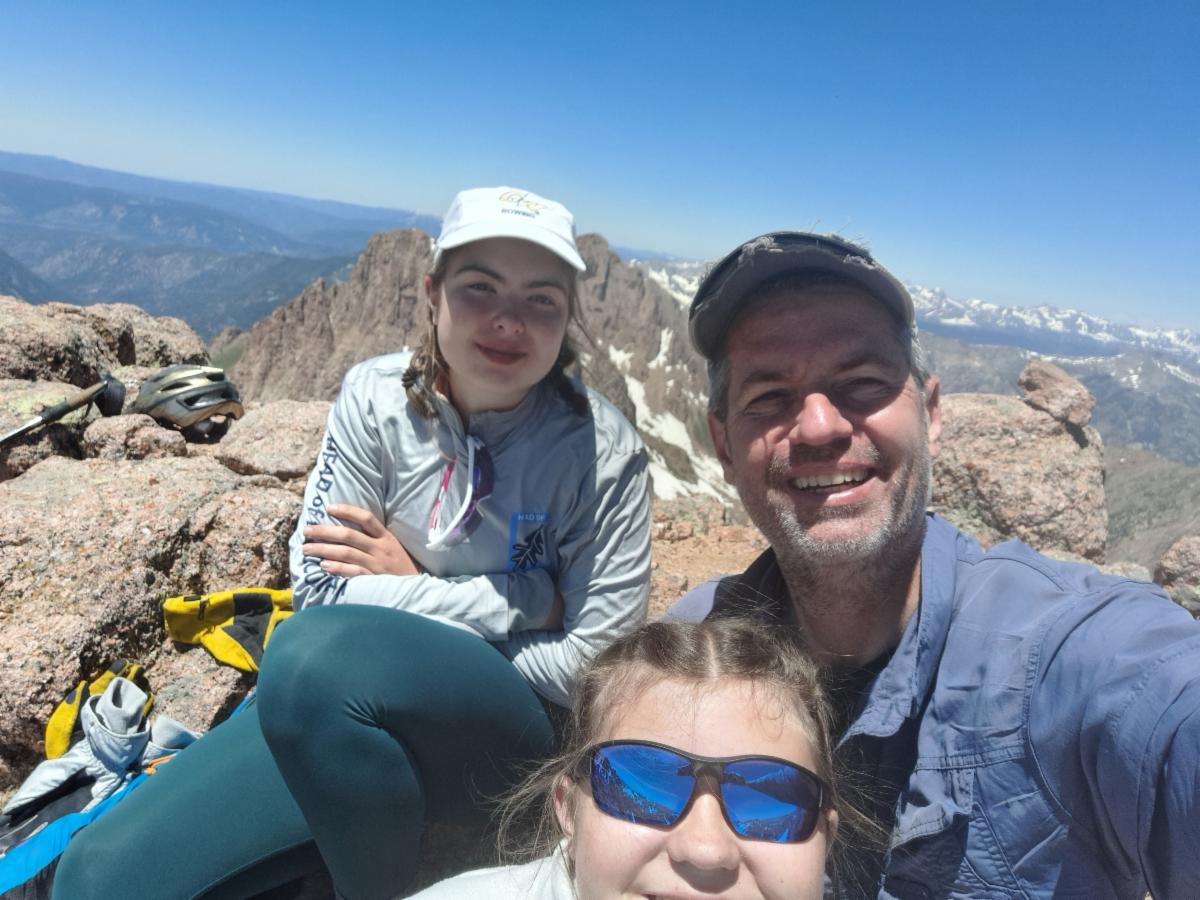
| | And Finally, ... we bring you Pix of the Week! | | We’re thinking about the out-of-doors this season and our friend Tim Flacke was kind enough to oblige us. We hear this is Mount Eolus in Colorado—one of the famous 14ers in the state. Tim’s here with his amazing daughters. ❤️ We think we see some technical gear in the background. Well done, Tim and Team! We like it when other people do the heights and share their experiences. | | At sea level this past week we enjoyed some Oregon sunshine and Manzanita beachiness. Even on a sunny day, our coast can be a little moody. IYKYK. | | If you find yourself in Manzanita, do stop in for a bite at Yolk. Cuz they do indeed serve delicious local food. At the chef's counter you might find yourself getting schooled on precision shared-kitchen cooking by one of these two great guys. They were amazing, and so was brunch. 🍳 | | |
That’s it for this edition. ❤ Hug your people and change the world.
If you like this piece, please stick with us. We’ll be back in about two weeks. If you don’t like it, please unsubscribe below. Comments for us? Please let us know. Want your own subscription? Request one here. All information shared is from public sources or used with express permission.
| |
Massena Associates provides process, policy, and implementation consulting on retirement savings programs and products.
Our clientele includes public entities, policy organizations, and private sector providers. Our specialty – efficient, targeted results. We are an active speaker on retirement security topics, including state-facilitated programs, MEPs and more.
If you’d like to explore working together, we welcome the conversation. Connect with us here, and at 339-236-0684.
| | |
Looking for a great retirement savings innovation resource? Led by Dr. Alicia Munnell, the Center for Retirement Research at Boston College develops and hosts terrific content and proprietary research related to states, financial security, social security, and more.
The Defined Contribution Institutional Investment Association (DCIIA) is dedicated to enhancing the retirement security of America’s workers. To do this, DCIIA fosters a dialogue among the leaders of the defined contribution community who are passionate about improving defined contribution outcomes. DCIIA's site provides a range of public and member-specific resources.
The Georgetown Center for Retirement Initiatives, Exec Angela Antonelli, provides excellent information on state-based and other retirement security innovation and policy.
Pew’s Retirement Savings Project studies the challenges and opportunities for increasing retirement savings and is another great resource - check out the work of John Scott and his terrific team.
If you want a great source of broad-based, consumer-focused retirement news, Jeffrey H. Snyder’s The Morning Pulse is your ticket. You can subscribe here.
| | | | |