|
RETIREMENT SECURITY MATTERS
A forum for retirement savings innovation, together.
Vol 96 | October 16, 2025
| | |
Greetings! Greetings! welcome to Retirement Security Matters—where we talk about retirement readiness innovation across public and private spaces. | |
We’re here for the fall campfire—leaves are changing, the air has crisped, and on some days it is raining buckets. When that happens we take ourselves indoors to sit in front of a nice fire and cozy up with the cider. Come along with us—grab your mug—and enjoy a moment of peace catching up with the news from our corner of the world. Go on, grab a blanket too. You might as well be comfy.
Here’s what we’ve got for you today:
- I Am Saving—Not!: Tracey Foley of Principal Says More
- Did you say $2.5 billion? It just gets better
- What Employees Want
- Good Stuff and Other Stuff
- Spicy Stuff ... and
- Pix of the Week!
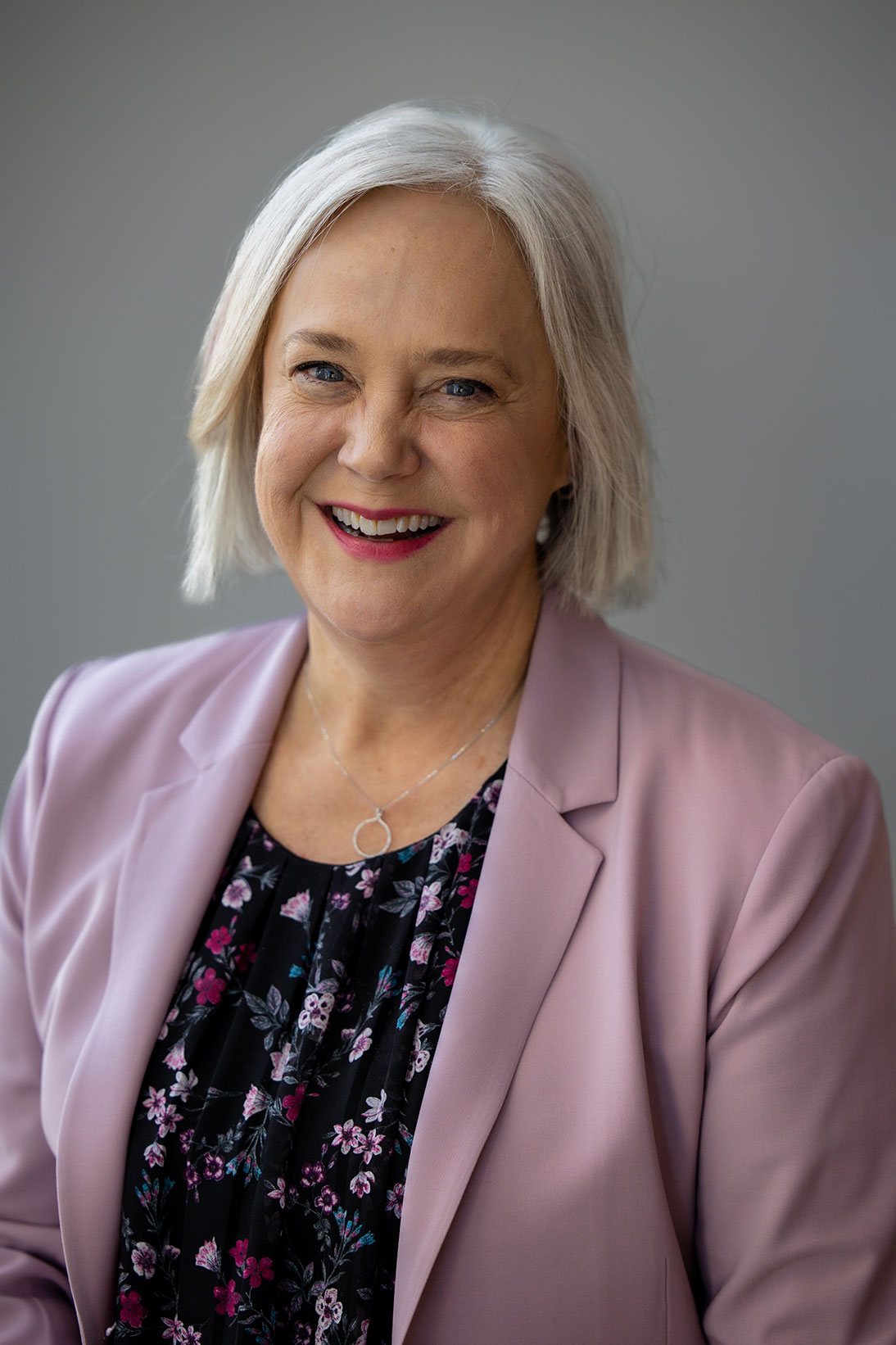
| | Surprising Findings: the ‘Auto’ Trifecta, a 15% Sweet Spot, and Workers Who Think They’re Saving | | A Conversation with Tracey Foley, Director—Retirement & Income Solutions Marketing, Principal Financial Group | |
Key Takeaways
-
Confusion is real: Nearly 60% of nonparticipants thought they were contributing; 64% of those were Gen X.
-
Defaults matter: 6% default with 1% auto-increase up to 10–15% is a strong baseline; 7–10% defaults don’t spike opt-outs (≈93% stay in).
-
Non-desk workers need earlier, higher savings: Automated features are especially critical.
-
Retirement income is a comfort gap: Sponsors feel responsible and want to retain assets, but many plans lack income components; advisors/consultants need to be comfortable recommending them.
-
Direct, well-timed, personalized communications outperform glossy, generic outreach.
| When nearly 60% of nonparticipants believe they’re already in their employer’s retirement plan, something’s off. Tracey Foley and her team at Principal dug into why—and what they found has major implications for participation, defaults, and retirement income. From Gen Xers thinking they’re saving when they’re not, to non-desk workers facing unique risks, to the comfort gap around retirement income solutions, Tracey shares insights every sponsor, policymaker, and practitioner should hear. | “It’s not just an access issue. It’s a participation and adequacy issue.” — Tracey Foley | | By the Numbers: State Auto IRAs Today | | |
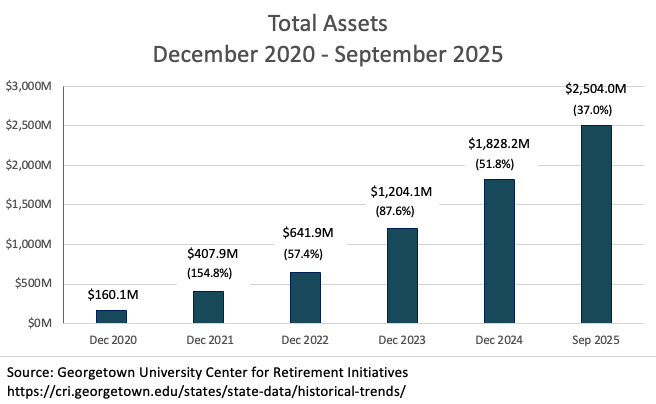
You may have seen a little hullabaloo online. We are excited by, #1 was cool—Well Done New York! And #2 was super cool. Big kudos to the states who, through their efforts to make more paycheck-based saving available have begun to have some real impact. At $2.5 billion, program assets are up 37% year to date.
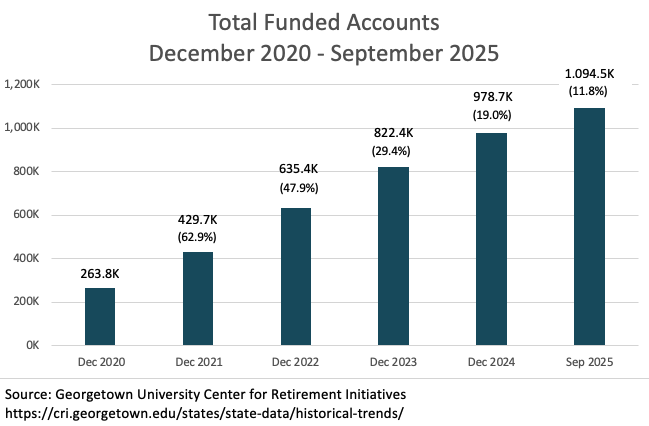
This savings has been achieved through about 1.1 million funded accounts. That’s 1.1 million families in better shape, friends. It is a big deal. And we have a feeling our state friends are just getting started.
You gotta look beyond the headlines, but this month’s Goldman Sachs Retirement Survey & Insights Report 2025 shares some interesting data – see esp page 26. Access to a 401(k) plan is predicted to increase the savings-to-income ratio by 29%, When surveyed, workers with access to a plan were much more positive about the status of their retirement savings, and their confidence in meeting retirement goals and needs. It just makes sense. Goldman’s research team references Auto IRAs as well. We love that. ❤️
A walk through the archives – thoughtful work from John Sabelhaus in July of 2022, The Current State of U.S. Workplace Retirement Plan Coverage, indicated that as of five years ago 47.7% of the US workforce, or 56 million workers, were not covered by a workplace retirement plan. TLDR: see page 28. So let’s keep after it, friends. Your work to create more access is working.
A special thank you to Angela Antonelli and the Georgetown Center for Retirement Initiatives for this data. You’ll find more detailed metrics and information on their site, here.
| | |
… Don’t we all want to know! Well fret no further, the Alight Employee Mindset Study 2025 is here. Thank you to Head of Thought Leadership Rob Austin for bringing this to our attention. He (and we!) especially loved a few of these fresh findings. DO READ them in the original, you’ll be glad you did:
- Employee engagement is trending UP. Yes, UP.
- Folks still find the ability to work remotely more satisfying than coming onsite (jammies, anyone? — ok maybe it’s because we can pick the kids up on time for once!).
- Wellbeing reports are mixed—and there’s good data here for employers and employer supporters alike.
- Benefits awareness is outpacing usage—and usage increases confidence and loyalty scores.
- AI adoption is up—nearly a quarter of employees are using AI tools every day, and a third worry about job impact.
- Communication: balance and clarity are key—can we get it “just right” for volume and content?
Retirement, naturally, figures in as a core benefit—and employees appreciate both the benefit, and related guidance and support. See esp page 28 for more info on the impact of the fully supported employee. We like the idea of engagement trending up … both directions!
Retirement security matters! / Lisa
| Consider—Some Good Stuff and Some Other Stuff | | |
1. Participation + Plan Design Still Drive Outcomes
- A new report by Vanguard—thank you Fiona Grieg and Team! —finds just 42% of Americans are “on-track” for retirement, and notes that if all workers had access to defined contribution (DC) plans, readiness would rise to 61%. Wow, that would be a great outcome.
- Bet you knew this: auto-enrollment and higher default savings rates are major levers.
- Bankrate has got a bit to say about this too. From the 2025 survey: 58% of workers feel behind on retirement savings; ~60% are contributing the same or more year-over-year. Credit to James Royal, PhD and Lisa Danmyer for their writeup of this work.
Bottom line: Plan access + smart default design remain foundational. Newness and innovation attract attention, but the basics still move the needle.
2. … and Policymaking Can and Does Help Support Those Outcomes
- The Insured Retirement Institute (IRI) released its 2025 Federal Retirement Security Blueprint, which includes proposals to expand lifetime income options, preserve tax treatment, and push innovation. See the five elements here.
- We’re keeping Social Security in our sights: from our friends at Boston College’s Center for Retirement Research, comments on the 2025 Trustees Report confirms the 2033 depletion date and a projected 23% cut in benefits if fixes aren’t made.
Here’s a TikTok take from a different (consumer) perspective. What do you think?
Bottom Line: Policy wheels are spinning. Proposals to support lifetime income, tax incentives, and structural reforms are emerging, while Social Security’s solvency pressures anchor urgency.
3. … In the Real World
- We know from recent personal experience that the person on the street just needs us to keep it simple and well organized for them. Sometimes true expertise is displayed best in simplicity, clarity, and empathy. Let’s keep that in mind for the next things we build.
- In an interesting period, savings that is or will become retirement savings is steadily, slowly, increasing. We see the commitment of the program and plan sponsors we engage with every day. We see it from the service provider community. We see it in the policy space from a range of different perspectives and with interesting proposals and innovations.
Bottom Line: Keep up the good work, friends. It matters.
| | |
So. Much. Research. There was more we wanted to share but we held back. You’re welcome.
1 I’m not menopausal, you’re menopausal. OK, we are going to lose some readers here but … we think there’s a tie-in between the work of Mary Claire Haver and healthy longevity for women, and happy retirements. Um seriously, we should talk about this more.
2 Frogs and Naked Bike Riders. Oh, Portland—we just roll, and hop, this way. These two are worried.
3 In our ears – something new from cellist Yo-yo Ma and friends, Our Common Nature. It’s an EP. It’s a podcast. It is collaboration. It will soothe you if those nutty frogs got you wound up.
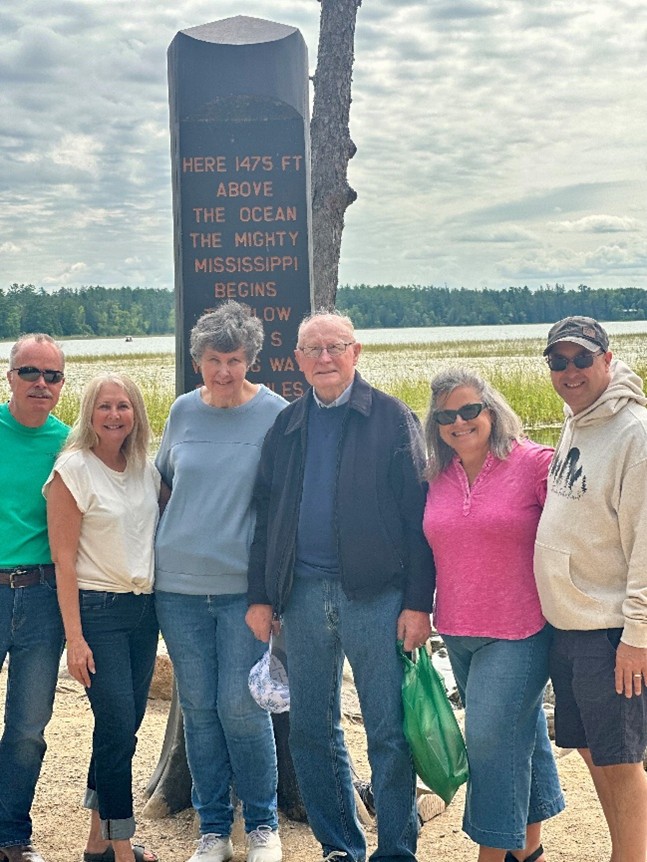
| | And Finally, ... we bring you Pix of the Week! | | It does not get better than this … what a great looking pair. Leader Tracey Foley enjoys some quality camping time with her husband, Tony. We never look this good camping, just sayin! | | … and taking in the headwaters of the mighty Mississippi in Itasca State Park in northern Minnesota. Very cool. We welcome to the pages of RSM Tracey’s amazing family -- L to R) brother Todd, sister-in-law Karla, stepmom Avon, and dad Richard, alongside Tracey and Tony. | | Interestingly, we are on the banks of the Mississippi ourselves this week, in Minneapolis for the DCIIA Academic Forum hosted by DCIIA member firm Allianz. Stay tuned for our report out. Oh, and, spotted on the streets of the Mini Apple … is that … RSM? | | In the Campfire era, no edition would be complete without a dog in a cabin. Here’s our little Harry, 13 weeks old, held by Tom Lambert. Photo credit: Christian Lambert. | | |
That’s it for this edition. ❤ Hug your people and change the world.
| | |
Massena Associates provides process, policy, and implementation consulting on retirement savings programs and products.
Our clientele includes public entities, policy organizations, and private sector providers. Our specialty – efficient, targeted results. We are an active speaker on retirement security topics, including state-facilitated programs, MEPs and more.
If you’d like to explore working together, we welcome the conversation. Connect with us here, and at 339-236-0684.
| | |
Looking for a great retirement savings innovation resource? The Center for Retirement Research at Boston College develops and hosts terrific content and proprietary research related to states, financial security, social security, and more.
The Defined Contribution Institutional Investment Association (DCIIA) is dedicated to enhancing the retirement security of America’s workers. To do this, DCIIA fosters a dialogue among the leaders of the defined contribution community who are passionate about improving defined contribution outcomes. DCIIA's site provides a range of public and member-specific resources.
The Georgetown Center for Retirement Initiatives, Led by Angela Antonelli, GCRI provides excellent information on state-based and other retirement security innovation and policy.
Pew’s Retirement Savings Project studies the challenges and opportunities for increasing retirement savings and is another great resource - check out the work of John Scott and his terrific team.
If you want a great source of broad-based, consumer-focused retirement news, Jeffrey H. Snyder’s The Morning Pulse is your ticket. You can subscribe here.
| | | | |