|
In This Issue:
- Rice Millers Will Want to Learn How to: "Follow the Money: Closing the Rice Milling Profitability Circle"
- Rice Market Update
- New Horizon Ag App Provides Farmers Key Management Tool
| |
|
Follow the Money
Closing the Rice Milling Profitability Circle
| |
|
|
Only millers who shift their tactics on processing techniques and work smarter, not harder, will come out ahead!
Save the date: May 31st, 2022
Exclusively at the Rice Market Technology Convention
| |
|
SuperBrix and Applied Milling Systems are honored to invite you to their seminar "Follow the Money - Closing the Rice Milling Profitability Circle."
The eight-hour seminar focuses on maximizing the profit potential in every grain of paddy that enters the rice milling process, providing the attendees with all our experience and information needed.
If you would like to add the seminar to your existing registration, click the link on your confirmation email and follow the steps to edit or feel free to contact us by phone at: 713-974-7423 or via text/WhatsApp: 832-305-7485
We look forward to meeting you there.
| |
Learn more about the Rice Milling Seminar! | |
Don't Miss Out! Register Today! | |
|
Hilton Cancun
Group Rate Ends May 9!
| |
|
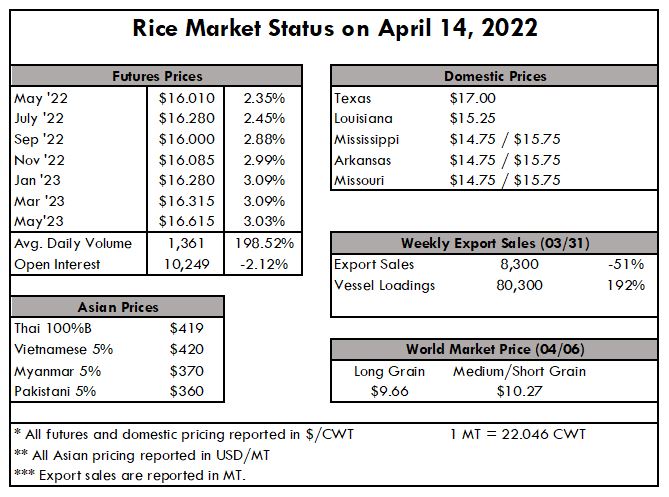
The crop progress report has finally come out, and reports significant plantings across much of the long grain production region. Louisiana is showing 64% planted as of April 10, which would indicate we have passed the 70% threshold as of the time of writing. This is right on par with normal for Louisiana. Texas is also right in line with normal, registering 60% planted. Those are the two leading states, with Arkansas just kicking off at 4%, Mississippi and Missouri at 1%, and then California still at 0% on the west coast for medium grain.
In Asia, prices have held steady at the $405pmt range for Thailand, little changed from last week. Vietnam has shaved off $5pmt, not at $410pmt, hanging right in line from the prices three months ago. India and Pakistan are holding steady at $355-$365pmt, holding close to last week’s prices, and those from the last several months. As discussed in previous reports, long grain rice has escaped the inflationary surge that is plaguing so many markets, largely on account of India’s farm subsidies that have led to oversized production and record exports.
While the U.S. rice industry is actively working to hold India to account for its violations of WTO agreements and excessive subsidies, it is in tandem working to rekindle its relationship with Cuba. With what could be our largest market only 90 miles away, bilateral trade agreements are still in the discussion phase, hoping to materialize into legitimate business for the future. With milled exports relying largely on Haiti, having another customer so close would be revolutionary for the U.S. rice market. It is a highly politicized issue, however, and enabling credit to the Cuban government in the extension of payment terms is an issue that has to be handled by the current Biden administration. USRPA is an active supporter of opening this line of business, and encourages these talks to re-open the Cuban market to the U.S. rice industry.
The weekly USDA Export Sales report shows net sales of 50,100 MT, up noticeably from the previous week and up 33% from the prior 4-week average. Increases primarily for Colombia (15,300 MT), Costa Rica (15,000 MT), Saudi Arabia (8,700 MT, including decreases of 500 MT), El Salvador (4,400 MT, including decreases of 100 MT), and Mexico (3,300 MT), were offset by reductions for Guatemala (500 MT), Nicaragua (100 MT), and the United Kingdom (100 MT). Exports of 47,300 MT were down 41% from the previous week and 14% from the prior 4-week average. The destinations were primarily to South Korea (20,000 MT), the United Kingdom (9,900 MT), Saudi Arabia (9,200 MT), Mexico (3,300 MT), and Canada (2,700 MT).
The futures market was mostly sideways this week, avoiding any large moves based on the opaque nature of the crop being planted and light export activity. It is rare that there is such disparity on the size of the crop; but with landlords wanting rice, and farmers wanting alternate crops, the 10-15% reduction the industry is expecting lies in stark contrast to the USDA’s projection.
| |
New Horizon Ag Mobile App Provides Farmers Key Management Tool | |
|
MEMPHIS, Tenn. (APRIL 12, 2022) — Horizon Ag has created and launched a new mobile app that rice farmers will find a valuable resource when it comes to variety selection and planting.
The Horizon Ag Proven to Perform app provides easy access to seeding rates information and a drill calibration tool for 2022 Horizon Ag Clearfield® and Provisia® varieties. It also makes it easy to connect with retailers in your local area who sell top-performing Horizon Ag varieties like CLL16, CLL17 and PVL03.
“The new Horizon Ag app is an example of our ongoing commitment to continuing to help rice farmers have quick, simple access to the varieties and information they need to manage for improved production and profitability,” says Dr. Tim Walker, Horizon Ag general manager.
The app is available by searching “Horizon Ag” in the App Store or Google Play or by going to http://onelink.to/zrpbkn on your mobile device.
| |
‘We’re not quitting’: Inside Louisiana rice farmers’ 10-year legal fight for $8M in harvest fees
Inside Louisiana rice farmers' 10 year legal fight for $8M in harvest fees
Click for the Article
| | | | |
|
Have Hoppy and Safe Holiday! | |
The US Rice Producers Association office will be closed on Friday, April 15, 2022.
| | |
Osiriz/InterRice Monthly Report n°217 | |  |
Food and Ag Regulatory and Policy Roundup | | |
|
Venezuelan Agricultural Imports Grew 85 percent since 2019
Venezuelan agricultural imports grew by 33.1 percent in 2021 due to a stabilization of the economy and a recovery in consumer demand. Agricultural imports from the United States totaled $634 million last year, up 44.8 percent compared to 2020.
| | |
Jordan: Grain and Feed Annual
The Russian war on Ukraine has a direct impact on Jordan, as most of Jordan's wheat and barley come from Black Sea. U.S. corn and rice imports are forecast at 100,000 MT and 70,000 MT respectively, and the U.S. is the leading supplier of rice to the Jordanian market.
| | |
|
Rice area and production in MY 2022/2023 are forecast to remain practically unchanged from MY 2021/2022. Rice exports are projected up at 900,000 tons, milled basis.
| | |
|
MY2022/23 rice production is forecast to decline 50,000 MT to 1.15 MMT due to renewed efforts from COA to manage rice production. MY2021/22 rice production is estimated to recover 100,000 MT to 1.2 MMT, due to a combination of increased area but decreased yield after the 2020-21 drought.
| | |
|
Post forecasts a slight decrease in rice area and production, owing to competition with other crops and lower profitability of rice vis-a-vis other crops. Unlike with the corn and wheat trade, Post does not anticipate a big uptick in external demand for Brazilian rice next year.
| | |
|
MY 2022/2023 rice production is forecast at 125 MMT, from 46 million hectares planted area, with yields of 4.08 MT/hectare (rough rice). In MY 2021/2022, farmers saw comparatively better returns from these two grains over other crops as the above-normal 2021 monsoon and weather conditions supported record yields.
| | |
|
Arkansas Rice Update
This update contains information on crop progress, update on AV-1011, herbicide plant-back restrictions, and markets.
| | |
| | |
| |
RiceTec Field Day (in-person), Harrisburg, Arkansas | |
USRPA does not discriminate in its programs on the basis of race, color, national origin, gender identity, sexual orientation, religion, age, disability, political beliefs, or marital/family status. Persons who require alternative means for communication of information (such as Braille, large print, sign language interpreter or translation) should contact USRPA at 713-974-7423. | | | | |