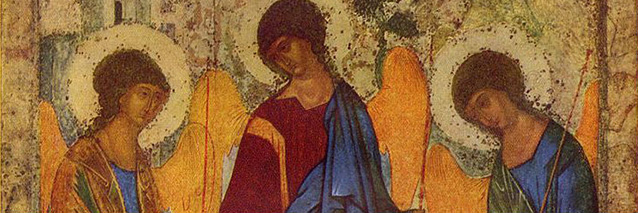
| Just as some Eastern fathers saw Christ's human/divine nature as one dynamic unity, so they also saw the Trinity as an Infinite Dynamic Flow. The Western Church tended to have a more static view of both Christ and the Trinity--theologically "correct" but largely irrelevant for real life, more a mathematical conundrum than invitation to new consciousness.
In our attempts to explain the Trinitarian mystery, the Western Church overemphasized the individual "names" Father, Son, and Holy Spirit, but not so much the quality of the relationships between them, which is where all the power and meaning lies! You can make all the names feminine, masculine, or neither, if you prefer neutral words. Each naming will have both its strengths and limitations because we are dealing with metaphor and unknowability. So do not spend too much time arguing about gender. The real and essential point is how the three "persons" relate to one another--infinite outpouring and infinite receiving.
The Mystery of God as Trinity invites us into full participation with God, a flow, a relationship, a waterwheel of always outpouring love. Trinity basically says that God is a verb much more than a noun. Some Christian mystics taught that all of creation is being taken back into this flow of eternal life, almost as if we are a "Fourth Person" of the Eternal Flow of God or, as Jesus put it, "so that where I am you also may be" (John 14:3).[1] The Cappadocian Fathers of the 4th century first developed this theology, though they readily admit the Trinity is a wonderful mystery that can never fully be understood with the rational mind, but can only be known through love, prayer, and suffering. Any serious contemplation of God as Trinity was made-to-order to undercut the dualistic mind. This view of Trinity invites us to interactively experience God as transpersonal ("Father"), personal ("Christ"), and impersonal ("Holy Spirit")--all being true in different stages of life. The Cappadocian teaching did move to the West, as we find Catholic mystics are invariably Trinitarian--though it was never the mainline doctrine. Richard of St. Victor, who died in Paris in 1173, still reflects this early theology. He taught at great length that for God to be truth, God had to be one; for God to be love, God had to be two; and for God to be joy, God had to be three![2] Any true Trinitarian theology will always offer the soul endless creativity, an utterly open horizon, and delicious food for the soul. Trinitarian thinkers do not seem to have much interest in things like hell, punishment, or any notion of earning or losing. They are only overwhelmed by infinite abundance and flow (e.g., Meister Eckhart, Julian of Norwich, John of the Cross, Thérèse
of Lisieux).
Our supposed logic has to break down before we can comprehend the nature of the universe and the bare beginnings of the nature of God. Niels Bohr, the Danish physicist who was a major contributor to quantum physics and nuclear fission, said the universe is "not only stranger than we think, but stranger than we can think." Look at any of the Hubble telescope pictures to get a taste for this strangeness. We now know that 95% of the universe is "dark energy"--even though we can't define it--and that there are 200 billion other impossibly immense galaxies! Stars and planets now seem uncountable. The doctrine of the Trinity is saying the same thing: God is not only stranger than we think, but stranger than we can think. Perhaps much of the weakness of the first 2,000 years of reflection on most of our doctrines and dogmas is that we've tried to understand them with a logical or rational mind instead of through love, prayer, and participation itself. This is how God brilliantly remains in charge of the whole process. In the end, only lovers seem to know what is going on inside of God. To all others, God remains an impossible, distant, and uninteresting secret, just like the stars and planets.[3]
|