|
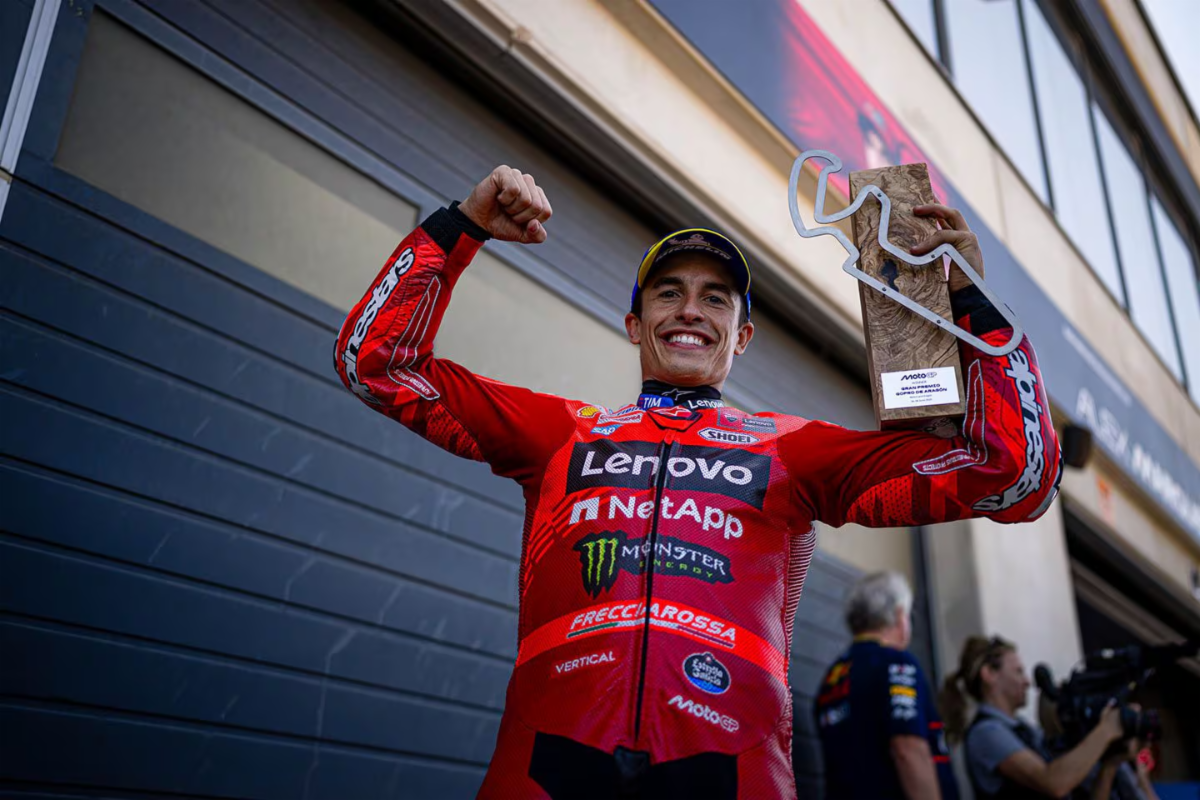
The Sunday finish in Aragon was Marc and Alex Márquez, then a revived Francesco Bagnaia—all on Ducatis. Then 5.5 seconds back from them (in not quite a different race, but almost), the bonded pair of Pedro Acosta (KTM) and Franco Morbidelli (VR46 Ducati), who provided in good measure what so many racegoers come to see: riders closely engaged, with lead changes.
There are three big and interesting questions in MotoGP now, plus a host of smaller ones.
1. Why does Ducati appear to be the only serious, full-spectrum team, while the others appear in varying degrees lost? Sometimes it is their riders, who cannot reliably start fast on Friday, qualify 1st or 2nd row on Saturday, and then rake in points in the Sprint and Final. Sometimes it’s the equipment. Despite Acosta’s finish, he said, “We didn’t have the speed for the top-three. It was a battle we would have lost, but I really enjoyed the first five laps.”
2. Why, despite so often showing an easy winning pace Friday and Saturday, does Marc Márquez ride as he, years ago described his first year in MotoGP, “Every lap like qualifying?” He now leads in points by 32 over his brother, but would have many more had he not crashed out on occasions when there was no haste. He said, “It is crucial to ensure the best possible result without making mistakes.” And then: “Today I was very focused and with six, seven laps remaining I started to think about those mistakes, how to manage the situation. But then I was looking at the lap time and I was riding in 1:47s low without full concentration. Then I decided to increase the speed to be focused again.”
3. Do Bagnaia and Marc Márquez share a common “GP25 illness” as Bagnaia has asserted? Both riders have lost the front when nothing in the data suggests a definite cause. Bagnaia says his GP25 lacks front-end “feel”—that it fails to give him cues that tell him how close he is to the edge. Marc said, “At Silverstonewe had more difficulties (He finished 3rd after crashing and re-mounting, behind Marco Bezzecchi’s Aprilia and Johann Zarco’s Honda) and after four set-up changes, I realized that the fault was mine and that I had to work on my riding style.” Marc has always thrived in conditions of limited grip, which Aragon provides (although grip gradually improved as the track “rubbered-up”). Is this the result of intensive concentration that can discover cues others cannot?
How should we decode what Marc is saying above, in point 2? We know that a most dangerous time for a rider is a “cool-off” lap, because under those conditions of reduced pace, none of the usual safeguards is in place. But at race-pace those safeguards are fully on duty: braking points, concentration on what the bike is saying, and trying to work out an opponent’s worst corner as a place to pass. But tire conservation is imperative, which can call for winning at the lowest possible speed. Yet that reduced speed can equal reduced concentration and vigilance, possibly allowing an accident to occur through being less focused.
|