Weekly update from the National Housing Conference | | News from Washington | By Brittany Webb | | |
House releases new version of 21st Century ROAD to Housing Act
Leaders from the House of Representatives released their response amendment to the Senate-passed 21st Century ROAD to Housing Act, marking the latest step in efforts to pass affordable housing legislation. The new text includes key edits advocated for by housing stakeholders, notably to provisions around institutional investors that would have effectively ended the build-to-rent market. The House version also restores over 20 provisions excluded from the Senate’s version that were in the House’s original Housing for the 21st Century Act, centered around community banking streamlining, accelerating housing production, making small-dollar mortgages more available, establishing a national eviction hotline, exploring tenant protections, and enhancing federal oversight of housing providers. The Reforming Disaster Recovery Act and PRICE Act were removed, along with Rental Assistance Demonstration (RAD) and Moving to Work (MTW) provisions.
House Financial Services Committee Chairman French Hill (R-Ark.) and Ranking Member Maxine Waters (D-Calif.) have been negotiating the bipartisan legislation while simultaneously facing pressure from the White House to take up and pass the Senate version of the bill. President Trump directly called for the passage of the Senate text via social media last week as negotiations had continued in the House, prompting House representatives to express a commitment to advancing language that is both bipartisan and bicameral. The House is expected to vote on the amendment this week, and Senate reactions to the amendment are ongoing. HUD Secretary Scott Turner also sent a letter to House Speaker Mike Johnson (R-La.) and Majority Leader John Thune (R-S.D.) expressing concerns over the eviction hotline and institutional investor provisions.
“As I said at my State of the Union Address on February 25th, the American Dream of Homeownership is under attack… I called for Congress to save the American Dream of Homeownership,” the President’s post reads. “Senators Bernie Moreno and Tim Scott have worked to ensure my call becomes a reality, and have a Bill which has passed the Senate with nearly 90 votes. I am asking Congress to pass that Bill, the 21st Century ROAD to Housing Act, which would ensure that homes are for people, not Corporations.”
“I share in President Trump’s commitment to delivering a housing bill that puts American families first, expands access to home ownership, and enhances affordability. Over the last couple of months, we’ve heard clear concerns from hundreds of members and stakeholders, and this bipartisan amendment reflects that feedback,” said Chairman Hill. “It cuts unnecessary barriers to new home construction, modernizes HUD programs, and allows banks to more freely deploy funding into their communities. We must get this right – and I am committed to working hard to do that.”
NHC issued a statement in strong support of the House text.
“We encourage the House leadership to bring the bill to the floor as soon as possible, and appoint conferees so the Senate can act expeditiously with the House to send a bill to the President,” it reads. “The revised House bill makes significant improvements to provisions affecting the build-to-rent sector and institutional investment in single-family housing. The updated language more appropriately targets large-scale acquisition practices while avoiding unintended consequences that could have undermined much-needed housing production and rental supply. These revisions create a more balanced framework that protects consumers and communities without discouraging responsible investment that helps expand housing availability.”
| | | |
Sponsorship Opportunities Available
Aligning your organization with the Gala and its honorees enhances your visibility, engagement, and networking opportunities. Supporting one another and working collaboratively across sectors, we strengthen our collective ability to address the nation’s most pressing affordable housing challenges.
Please consider supporting this year’s honorees and NHC by purchasing a ticket and/or becoming a Gala sponsor. Sponsorship opportunities begin at $3,500. You can also show your support by placing an ad in the Gala Tribute Book. New for 2026, we’re offering the opportunity to display a digital ad onsite at the Anthem.
It’s a meaningful way to celebrate the accomplishments of this year’s honorees or highlight your commitment to our shared mission. Tribute Book ads start at $750 and digital ads start at $325. You can also choose to have your name listed in the Gala Tribute Book for $250. Click here to learn more about these opportunities and here to view a list of current sponsors.
| |
Secretary Turner testifies on HUD budget
HUD Secretary Scott Turner appeared before House and Senate Appropriations subcommittees to defend the administration’s fiscal year 2027 budget request for HUD, facing bipartisan questions about proposed funding reductions, streamlining HUD processes, housing affordability, homelessness, and the future of federal rental assistance programs.
During the May 12 hearing before the House Appropriations Transportation, Housing and Urban Development (THUD) Subcommittee, Secretary Turner opened his testimony with a statement defending the administration’s proposed restructuring and funding reductions, stating, “Taxpayer dollars are finite. Our responsibility is not. The President’s proposal reflects that approach. It reins in wasteful spending, stops the ballooning of federal welfare programs, and continues HUD’s focus on serving the American people. We are mission minded.” Turner also argued that “With limited resources, HUD must prioritize initiatives that deliver results. Ending CDBG [Community Development Block Grants] allows us to focus funding on programs with clear accountability and a direct impact on housing supply and affordability. If a program cannot demonstrate results, we have a responsibility to reevaluate it. We are taking inventory.”
Appropriations Committee Chair Tom Cole (R-Okla.) and THUD Subcommittee Chair Steve Womack (R-Ark.) both stated their intention to fund HUD programs above the President’s requested amounts. Markups are scheduled for May 21 and June 4.
At the May 14 Senate Appropriations THUD Subcommittee hearing, Secretary Turner faced heated questions often centered around HUD’s attempted restructuring of the Continuum of Care program, as well as lowering the cost of building housing and helping seniors age in place.
| |
Warsh confirmed as Fed chair
The Senate confirmed Kevin Warsh as chair of the Federal Reserve (Fed) in a 54-45 vote. Warsh, a former Fed governor, replaces Jerome Powell, who plans to remain on the Fed’s board of governors through 2028. Warsh will take over the central bank as policymakers continue to grapple with inflation that remains above the Fed’s 2% target. The Fed has held interest rates steady in recent meetings amid divisions among policymakers over the path of future rate cuts.
Warsh’s nomination had been stalled but moved forward after Senator Thom Tillis (R-N.C.) reversed his opposition following the Department of Justice’s decision to drop an investigation into whether Powell misrepresented the costs of the Federal Reserve’s headquarters renovation during congressional testimony.
Republicans praised Warsh’s economic experience, while some Democrats raised concerns about whether he would maintain the Fed’s independence from President Donald Trump, who has repeatedly pushed for lower interest rates. At his confirmation hearing, Warsh said he would act independently if confirmed.
| |
Housing groups urge preservation of FFB Program
A group of affordable housing stakeholders, including NHC, are urging the Trump administration to preserve the Federal Financing Bank (FFB) Risk Sharing program, calling it “one of the most effective and cost-efficient tools in the federal housing finance toolkit.” In a letter to Treasury Secretary Scott Bessent, HUD Secretary Scott Turner, and Office of Management and Budget Director Russell Vought, the groups point to President Trump’s March 2026 executive order directing federal agencies to remove regulatory barriers to housing construction. The groups state that preserving the FFB Risk Sharing program would align with the administration’s goal of increasing housing supply and lowering housing costs.
The letter was prompted by concerns over the administration’s Fiscal Year 2027 budget proposal, which stated that HUD “does not project that any new firm commitments will be issued in 2027” while the administration reviews the program’s role within the federal credit portfolio. The groups warned that housing finance agencies “ready to close deals are being turned away,” putting affordable housing developments at risk. The organizations further note that the program lowers borrowing costs and expands access to financing for affordable housing projects, particularly in rural communities and smaller developments, and the initiative has committed more than $7 billion in loans supporting over 56,000 affordable rental homes nationwide.
The groups urged HUD and Treasury to continue issuing new financing commitments and expand the program to additional states and agencies.
|
| | |
HUD’s 2026 income limits released
HUD released its fiscal year 2026 income limits on May 1, establishing new eligibility thresholds for federally assisted housing programs and affordable housing developments financed through the Low-Income Housing Tax Credit (LIHTC) program and tax-exempt private activity bonds.
The updated limits are used to determine eligibility for a broad range of federal housing programs, including public housing, Housing Choice Vouchers (Section 8), Section 202 housing for older adults, Section 811 housing for people with disabilities, and LIHTC developments.
HUD reported that the average annual increase in income limits across all HUD-designated areas was 3.4% for FY 2026. The maximum allowable increase this year is 10%, with 221 areas reaching that cap.
The new limits took effect on May 1.
| |  | |
Inflation spikes in April
New Consumer Price Index (CPI) data showed inflation accelerating in April, with headline inflation rising 0.6% month-over-month and 3.8% year-over-year, the largest annual rate gain in three years. Core inflation, which excludes food and energy, rose 2.8% annually and 0.4% from March. Energy prices remained a major driver of inflation, while shelter costs also continued to contribute significantly to overall price growth. The shelter index increased 0.6% for the month and 3.3% over the past year, with rent and owners’ equivalent rent both rising 0.5% in April.
Economists noted that some of the shelter increase may reflect statistical adjustments tied to disruptions in federal housing survey collection during the government shutdown rather than a sudden jump in rents. Still, the issue led to underestimation of shelter costs for the last six months, and housing costs remain one of the largest contributors to inflation due to the significant weight shelter carries within the CPI formula. The latest report is expected to reinforce the Federal Reserve’s (Fed) cautious stance on interest rate cuts as policymakers continue working toward the Fed’s 2% inflation target.
| | | |
Regional multifamily supply trends diverge
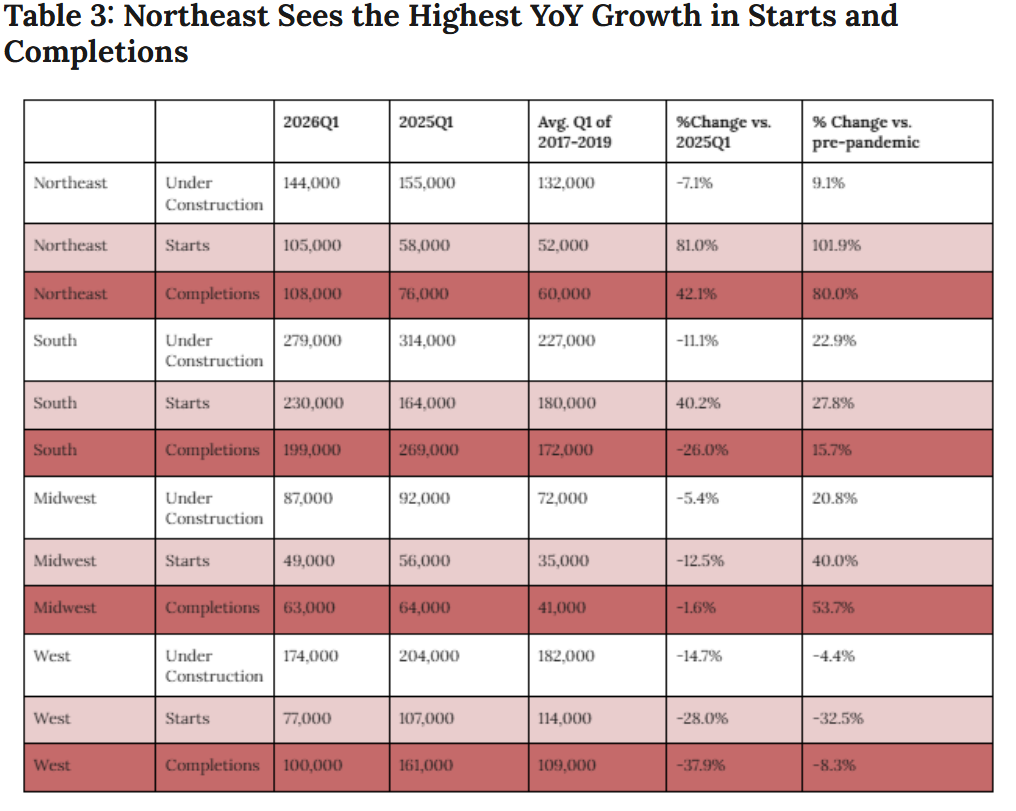
An April 2026 rent report from Realtor.com shows U.S. rents still easing after a long post-pandemic run-up as multifamily supply remains a central driver of conditions across the country. All four regions experienced year-over-year declines in multifamily construction but remain above pre-pandemic levels. The Northeast had the strongest momentum in early 2026, with starts rising to 105,000, up 81% from 2025Q1 and 101.9% above pre-pandemic average, while completions reached 108,000, up 42.1% year-over-year and 80% above the pre-pandemic benchmark. That combination suggests the region is not just building more but also converting that pipeline into finished units at a strong pace. The South still has the largest overall volume, but its pattern is less balanced. Under construction fell 11.1% from a year earlier, starts increased to 40.2%, and completions dropped 26%. The Midwest shows smaller absolute numbers, yet it remains meaningfully above pre-pandemic norms, especially for completions that are 53.7% higher than the 2017-2019 average.
| | |
The Urban Institute published a blog post arguing that building wealth from homeownership often requires more than getting into a home in the first place, because title problems, deferred repairs, and weak estate planning can block families from passing property down cleanly. The article highlights case examples from Pennsylvania to show how unresolved title issues can make it hard to borrow, sell, or legally pass a home to heirs, while deferred repairs can undermine the home’s value and livability. It emphasizes heirs' property as a major barrier to generational wealth, especially in low-income communities where legal support is limited.
Smart Cities Dive highlighted three cities recognized by Ivory Innovations for specific housing-affordability efforts. Boston was cited for a revolving loan fund that helps mission-driven developers buy multifamily housing, with the goal of preventing displacement and preserving affordability. New Rochelle was recognized for zoning changes that allow 90-day approvals for multifamily projects in targeted areas, making it faster to move housing forward. Chattanooga was honored for a tax-abatement program that supports mixed-income development, showing how local governments are using different tools to try to expand housing options.
The Bipartisan Policy Center published a poll that shows strong public support for congressional action on housing affordability. It says 89% of voters believe the House and Senate should work together and pass legislation to make housing more affordable, and 79% say housing costs are extremely or very important to them. It also reports that 63% of voters would be more likely to support their representative or senator if they helped pass housing legislation. The article further notes broad agreement across party lines on major policy ideas such as zoning reform, expanded affordable financing, and limits on large corporate homebuying.
| | The National Housing Conference is a diverse continuum of affordable housing stakeholders that convene and collaborate through dialogue, advocacy, research, and education, to develop equitable solutions that serve our common interest. | | Defending Our American Home since 1931 | | Copyright © 2024. All Rights Reserved. | | | | |