Volume 5 Issue 1 | January 2024 | |
January is a great month to celebrate conifers. Read on... | |
The Root of It newsletter ends with our monthly quotation. If you find your newsletter has been clipped by your email provider please click HERE for a webpage version of the newsletter. | |
|
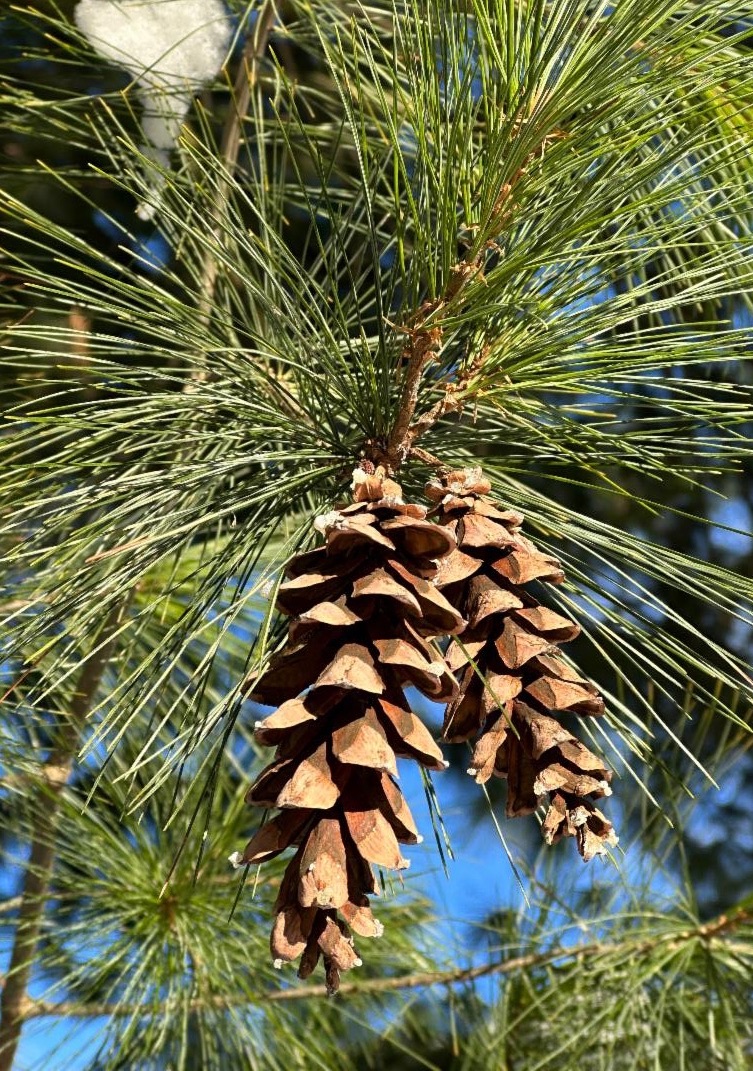
Cones on an Eastern white pine.
photo by E Barth-Elias
| |
|
Conifers – those evergreen (or sometimes not!) beauties that grace the winter landscape and make the hearts of Coneheads (lovers of all things conifer) go pitter-pat. We begin this month’s Root with a few words about conifers.
The word conifer comes from the Latin conus (cone) and ferre (to bear) – all conifers bear cones. Conifers are monoecious (each plant contains both male and female reproductive organs – cones). The male and female cones occur in distinct parts of the plant – usually towards the top for the female cones and below for the less conspicuous male cones. This arrangement reduces the likelihood of self-fertilization during pollination, thus ensuring genetic diversity, and allows the fertilized, winged seeds to disperse farther from the mother plant.
| |
|
Their smooth, waxy needles and the classic conifer silhouette – stately branches arching gracefully downward – allow conifers to shed snow in cold climates. Their ability to move water out of their needle or scale cells during freezing periods keeps cells from rupturing. These plants are survivors!
Have you ever noticed resin on the tips of conifer cones or coming from a wound on a conifer's trunk or branches? This scented, sticky secretion hardens when exposed to air and acts as a “band-aid.” Not only do resins seal off and protect wounds and openings, but they contain terpenoids, chemical compounds that offer protection from insects and fungal pathogens. Throughout history resins have been harvested and used for medicines, fuels, adhesives, varnishes, and perfumes.
Forests may not be considered “clean,” but conifer forests certainly are. The uniformity of their trees and the relatively clear forest floor result in a lower airborne bacteria count. During Victorian times medical facilities were often built near conifer forests to take advantage of this “clean” air.
And about those non-evergreen conifers – what a surprise to the casual conifer observer to see that dawn redwoods, bald cypress, and larches drop their needles in fall. There have always got to be some outliers in the group!
Conifers are extraordinary plants. The world’s tallest tree, a coast redwood, tops out at 360 feet. A Great Basin bristlecone pine (named Methuselah) is considered the earth’s oldest living plant (4800+ years!). Giant sequoias have been measured at over 30 feet in diameter. But it’s not their immensity and longevity that endear conifers to my Conehead associates – it’s the variability of shape and size, the gracefulness of their silhouettes, the wide spectrum of their colors, the texture of their needles and scales, and their countless applications in the landscape. Look Around!
K Edgington
| |
Leaf Brief - Pinus parviflora | |
|
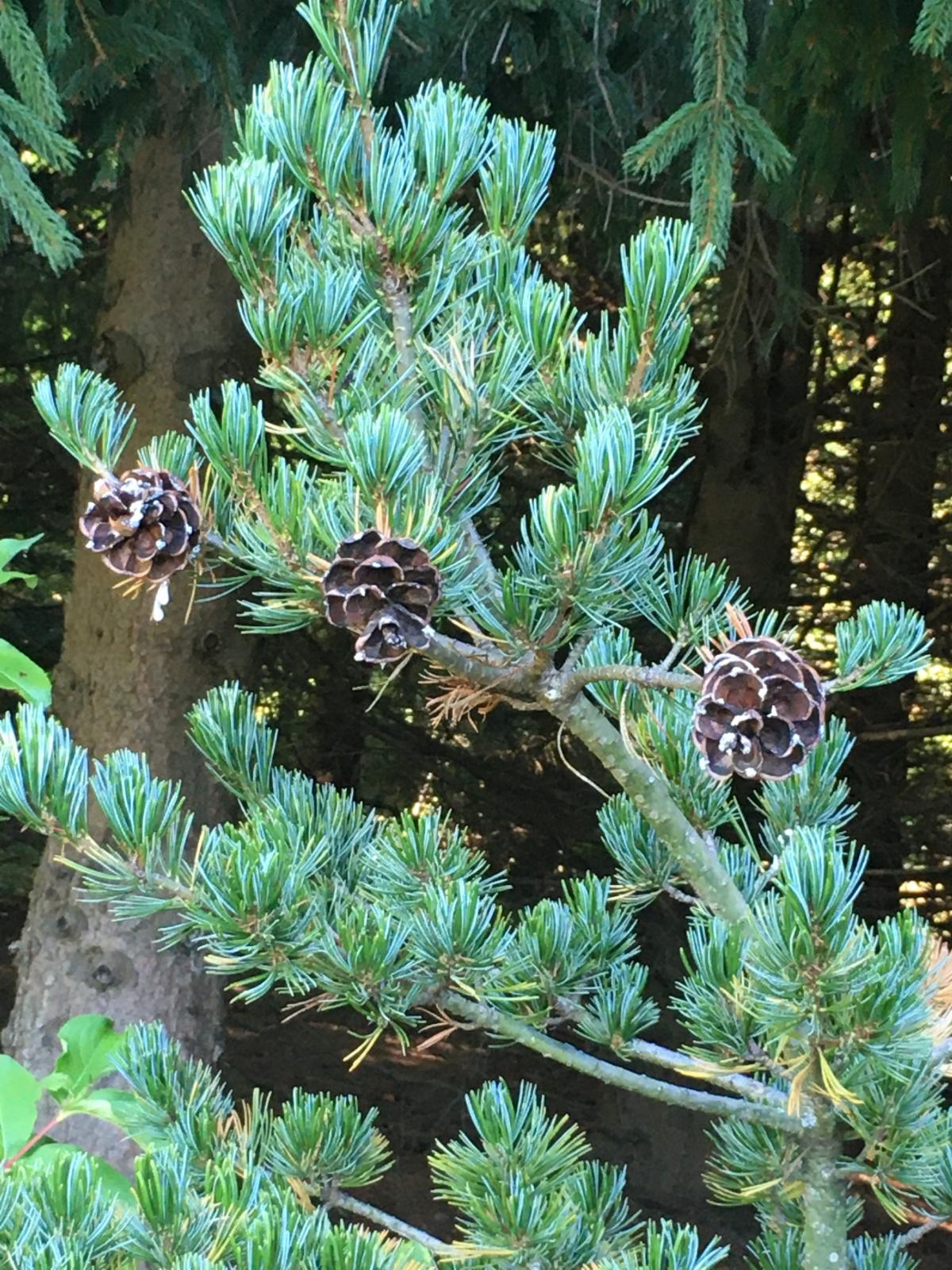
The elegant silhouette and tufted-like needles of Pinus parviflora 'Glauca Nana'.
photo by E Barth-Elias
| |
Think evergreens are boring? Think again. Not every pine out there has to look like a Christmas tree and the Japanese white pine (Pinus parviflora) gives you lots of alternatives. A striking landscape tree, it starts life with the typical pyramidal shape, then develops a spreading habit, giving it a flat-top, bonsai-style silhouette. You won’t find it in the wild here in the States because it’s native to Japan and Korea, but it is often seen as a specimen plant or focal point in a well-cared-for park or garden. It has earned a special place in Japanese culture and is revered for its beauty and grace, symbolizing strength and resilience. | |
|
Not only does the Japanese white pine have a unique silhouette, its relatively short needle groups form clusters of five at the branch tips, giving it a charming, tufted appearance. Though its mature height and spread is 25-50 feet, it is a slow grower. This makes it a perfect choice for smaller planting spaces, especially the dwarf varieties. Japanese white pine should be planted in full sun in well-drained soil with adequate moisture. It does well with clay, loam, sandy, or acidic soil in zones 4-6.
The botanical term parviflora translates to ‘small flower,’ indicative of their small-sized pine cones, just 2.5 to 4 inches in length. In its natural habitat, the seeds are dispersed by the Eurasian nutcracker (Nucifraga caryocatactes), a brown and white bird that ranges from Scandinavia to Japan. Since this bird is not native here, there’s little chance of the pine self-propagating in the wild or becoming invasive.
We are lucky that many unique cultivars are available locally or online. Keep in mind that nurseries may be sold out this time of year so keep checking back or preorder your favorite. Their beauty is worth the effort to seek them out. Keep an eye out for these cultivars:
-
Bergman has blue-colored twisting needles with a tighter dense habit and pyramidal shape. In the spring its brightly colored pollen cones are quite striking. It may reach 4-6' in 10 years. This pine is extremely showy and will stand out in the garden.
-
Fukai is a hard-to-come-by dwarf form that sports green and yellow variegated needles. Plant it where you can admire it up close. Its ten-year size is 6-8’.
-
Glauca is the most common Japanese white pine variety cultivated and has an open, windswept silhouette with blue-tinted needles. Its ten-year size is 6-10’ and it is a winner of the prestigious Award of Garden Merit by the Royal Horticultural Society.
-
Goldilocks has a sweeping habit and some of the brightest gold you will see in an evergreen, making a statement even from a distance. It will tolerate some shade, but well-drained soil is a must. It grows to 8’ in ten years.
-
Gyoko sho hime is a dwarf with an upright form and twisted silver-blue needles. In spring, its new, green growth contrasts beautifully with light purple juvenile cones. It’s a popular choice for a bonsai. Expect a 5-6' height in ten years.
Japanese white pine is a fascinating plant and perhaps you can find space for this gem in your garden. Once established, Japanese white pine requires little if any pruning and is rarely bothered by deer or pests. Complement the beauty of the tree with a low-growing ground cover or feature it in a rock garden. It also provides shade and works well as a windbreak. Keep grass cleared away from its thin-barked trunk to avoid damage from lawnmowers or string trimmers.
Japanese white pine’s use as a bonsai captures its natural shape and beauty, bringing this exquisite living sculpture indoors. If you’re looking for an eye-catching specimen plant that shines in all seasons, look no more. There’s a Japanese white pine out there for you!
PINUS PARVIFLORA, JAPANESE WHITE PINE: US Forest Service
J Gramlich
| |
Creature Feature - The Conifer Condo... | |
|
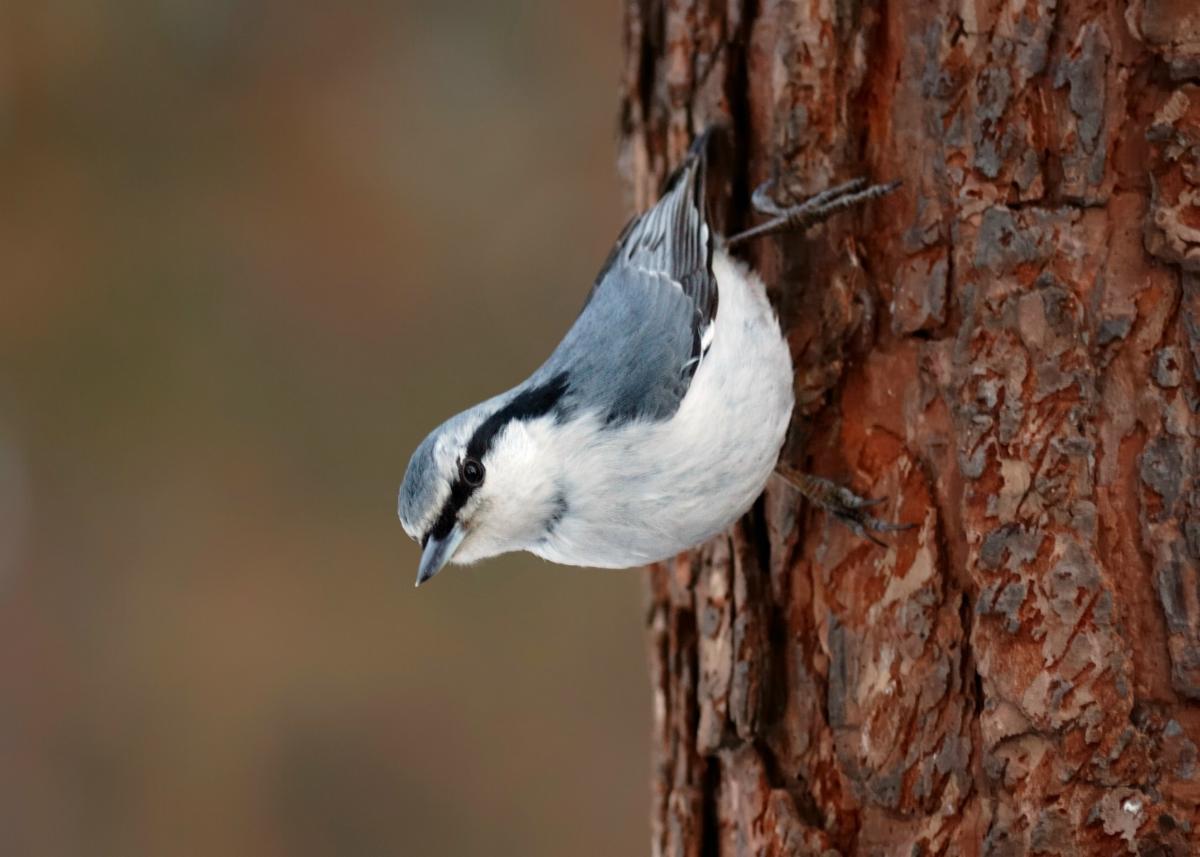
Nuthatches feast on the insects hiding in pine bark.
photo by E Barth-Elias
| |
Conifers are a lot more than just another pretty face in the forest. Like all trees, conifers provide valuable support for wildlife. Birds and small mammals feast on the insects found in its branches (moths, gnats, mosquitoes, aphids, mites, ants, and beetles, as well as spiders), while dead bark and needles litter the forest floor, providing habitat for fungi and millipedes. | |
|
But when the weather outside turns frightful, conifers become life-savers—literally. Like us, outdoor creatures have 3 choices when things get tough: leave (migrate), hide under the covers (hibernate), or adapt—which in this case means finding food and shelter in freezing conditions. Conifers supply those two essentials. The year-round dense foliage of evergreens (most conifers) provides protection from wet, cold and snow, as well as cover from predators. In addition, conifers are an excellent source of nutritious food—seeds in cones, needles and bark. While these majestic trees may appear silent and still in a frozen landscape, a closer look reveals a vibrant community. Let’s meet the winter residents of your neighborhood conifer condos.
Starting at the top, the penthouse is often occupied by—who else?—the majestic bald eagle. When real estate shopping, bald eagles look for mature trees 50-100 feet tall that tower above their surroundings, providing easy access and great visibility. Conifers fit the bill. Check out these CONIFER-LOVING EAGLES. For similar reasons, the great horned owl also may be found in conifers (but not if there’s an eagle neighbor—they do NOT get along).
Although our feathered friends may prefer their summer diet of berries and insects, when the snow flies conifers quickly become their favorite dining establishment (after your birdfeeder). Finches (pine siskin, pine grosbeaks, purple finches and crossbills) particularly enjoy seeds from pine cones. The white-winged crossbill’s beak is uniquely shaped to extract seeds from cones (they prefer spruce), and they can gobble up to 3,000 seeds a day. Jays, nuthatches (often hanging upside down), tufted titmice, house sparrows and woodpeckers will eat seeds from cones or on the ground. Some woodpeckers wedge cones into tree bark and then peck out the seeds. Others will dig out insect larvae and pupae from bark. Talk about requiring the right address—the formerly endangered Kirtland’s warbler will only nest in young jack pines in northern Michigan. You might spot one in Ohio’s Magee Marsh during their migration. Read about it HERE.
Squirrels favor conifers for food and shelter, and red squirrels are special fans of spruce trees—they loooove those cones. Red squirrels can snarf down 150 per day (that’s a real conehead)—CHECK IT OUT. Instead of burying food like their squirrel-y cousins, red squirrels store unopened cones with the remnants of those they’ve already gnawed the scales off in large red-brown piles (middens) in the middle of groups of conifers. They ferociously guard these treasures, and routinely pilfer from each other’s piles. Look for a red squirrel nest (a ball-like entity of twigs and leaves lined with grasses and fur, called a drey) in spruce trees.
Snowshoe hares and cottontail rabbits also use conifers as winter shelter—low hanging branches provide cover and hinder the accumulation of snow, which makes it easier for animals to find food. The bunnies will nibble on bark, twigs, and even needles. Watch HERE.
White-tailed deer shelter under conifers too, but as usual, they take it to a whole other level. Let’s talk stands—a group of similar trees distinguishable from those surrounding them. A stand of evergreen trees over 35 feet tall with canopy closure (from a single viewpoint the portion of the sky obscured by the trees) of over 50%, can have 40% less snow underneath it than surrounding areas. These stands, which may encompass hundreds of acres, are basically condo neighborhoods for deer (deer yards). Besides providing shelter, stands encourage deer to collectively develop trails, conserving valuable energy. And deer will munch on conifer cones, bark and needles.
Next time you see a conifer condo on a frosty morning, tip your hat to its wintry wildlife residents.
C Christian
| |
|
Selecting conifers deserves thoughtful consideration and the application of some fundamental design elements. Whether designing a new garden bed or amending an existing one, incorporating conifers will provide attractive year-round beauty and enhance the overall quality and appeal of the space.
Start the garden plan by selecting a strong vertical shape as a focal point. Verticality brings a sense of structure and elegance to a landscape.
| |
|
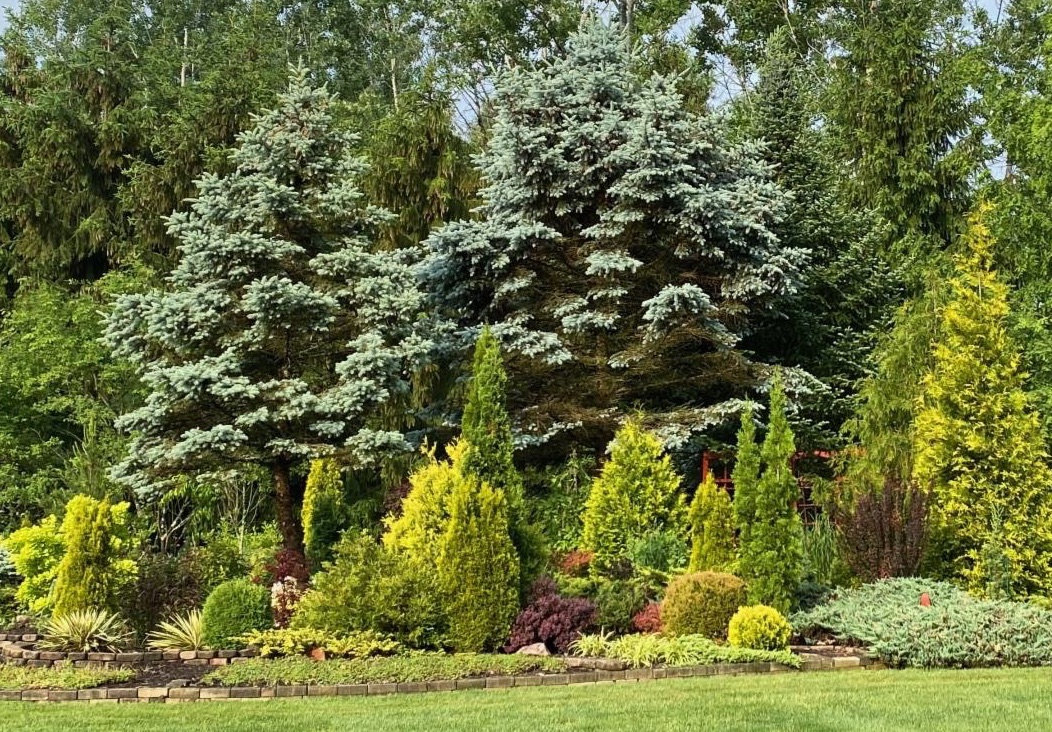
Notice how the shapes in this conifer bed compliment each other.
photo by E Barth-Elias
| |
|
Picture the classic conical form of a dwarf Siberian spruce (Picea omorika ) or perhaps a columnar DeGroots Spire arborvitae (Thuja occidentalis 'Degroot's Spire'). Placed on the perimeter, this tree or small grouping of trees (depending on available space) draws the eye in and upward.
Once the primary form is selected, resist the temptation to fill in the area with particular plants, but rather continue to work with shapes, penciling in a variety of smaller conifer shapes around the focal area. This grouping establishes another layer to the garden, expanding the area of interest, softening the contrast of silhouettes, and integrating these plantings with the rest of the garden. Using a mix of upright, globose, mounding, and creeping conifers creates depth and dimension. Experimenting with geometric arrangements and creating repetition adds cohesion and a sense of intention to the landscape.
This is the time to gather your resources and explore the myriad options for each shape on your plan. Some websites such as coniferkingdom.com provide easy searching and filtering options to narrow down your preferred color and growth rate. Carefully consider how each addition will play off other plants to maximize desirable contrasts in color and texture, offering the visual thrill you seek. Pay attention to zone and sun requirements.
When reviewing an existing landscape, look at areas that would benefit from an anchor or feature conifer with weeping forms such as the graceful branches of the weeping blue atlas cedar (Cedrus Atlantica ‘Glauca Pendula’) or the fine foliage of the Eastern hemlock (Tsuga canadensis), which introduces a softer and more whimsical quality. These varieties are excellent for framing doorways or paths or adding a little drama to the garden.
A few conifers of note:
-
Pinus sylvestris 'Hillside Creeper': Hillside Creeper Scots pine prostrates beautifully on a bank or hillside. It has uniquely exposed branches which extend beyond 8’ wide, yet rarely exceeds 8-12” high. It is tough and adaptable.
-
Pinus mugo ‘Sunshine’: Sunshine mugo pine is a charming dwarf variety with a mounding form. Its needles are variegated with bright creamy yellow stripes that are especially pronounced on spring’s new growth. It will grow to 2’x3’ in 10 years.
-
Pinus strobes ‘Mini Twists’: Mini Twists eastern white pine boasts a dense, globose habit with small, blue, twisting needles. This striking dwarf will reach 2’x3’ in 10 years.
-
Abies concolor ‘Archer’s Dwarf’: Archer's Dwarf white fir has blue needles which soften the appearance of its dense pyramidal form. It will reach 7’x3.5’ in 10 years and makes a stunning specimen.
-
Picea glauca ‘Norway Spruce’: Norway white spruce has a tall, narrow form which reaches 9’x3’ in 10 years. Its weeping habit has an unusual but pleasing stacked or layered appearance.
Starting your design by determining the shape of a focal point conifer and its supporting plants is the foundation when creating an interesting and beautiful garden bed. Then choosing from the myriad of available conifer textures and colors brings that design to life.
Check out the website of the American Conifer Society for great information about designing with conifers: https://www2.conifersociety.org/
E Barth-Elias
| |
A Word About Conifer Size | |
|
Choosing a conifer to plant in a trough, as a tall focal point, or as a ‘supporting player’ in your landscape becomes easier when attending to the size categories that have been developed with the assistance of the American Conifer Society. Conifers are classified by annual growth rates, not ultimate size, for the very good reason that plants never stop growing, and the size of a plant will vary according to how long it has lived.
There are four categories of conifer growth rate:
Miniature (M): Miniature conifers grow less than 1 inch each year. They are good candidates for troughs and planters or miniature gardens. Their 10-year height would be 1 foot or less.
Dwarf (D): Dwarf conifers grow from 1 up to 6 inches per year, with a 10-year height of 1 up to 5 feet. They are good choices for front of the border plants.
Intermediate (I): Intermediate conifers grow from 6 up to 12 inches per year and grow from 5 to 10 feet tall in 10 years. They can be focal points in smaller landscapes or fillers in a larger area.
Large (L): Large conifers grow 12 inches or more per year with a 10-year height of 10 feet or more. Think white pines or Green Giant arborvitae.
Look for the abbreviations M, D, I, and L when researching plant possibilities, and also look for the 10-year growth estimate, which is commonly included in plant descriptions, knowing that after 10 years the conifers will continue to put on annual growth.
K Edgington
| |
A Guiding Hand at Stan Hywet - Tom Hrivnak | |
|
It all started when Tom Hrivnak’s father suggested he and his brother “turn over a new leaf” after being punished for childhood misdeeds. Taking his father’s admonition to heart, that new leaf has sprouted at Stan Hywet Hall and Gardens, where Tom is superintendent of all things horticultural.
Actually, it’s no surprise Tom wound up doing something involving trees and plants. He grew up in the country, playing in the woods, enjoying camping and other woodland activities. After he graduated from the Ohio State University with a degree from the School of Natural Resources in Forest Industries, a minor in business, and further education in tree preservation, he began his career as arborist for the E.F. Pouley company in Orrville.
| |
|
Tom Hrivnak
Photo by E Barth-Elias
| |
|
An ad for an arborist at Stan Hywet caught Tom’s eye, and in 1998 he began tending the trees throughout the 70-acre property. The rest, as they say, is history. He moved up the ranks from arborist to director of horticulture to superintendent of all aspects of horticulture and structures at Stan Hywet. Experience in construction added to his ability to shepherd the many restoration projects the estate has undergone in the past few decades.
It's an ideal situation for someone who enjoys seeing a project from start to finish. Some of those projects include restoration of the mansion's exterior landscaping to its original footprint, the Lagoon, the Japanese Garden and the Great Garden, from which come all the arrangements found throughout the manor house’s 65 rooms.
Tom says he enjoys the challenge of bringing the landscape up to current standards while ensuring it looks as it did in the early 1900s. The Great Garden proved quite a challenge because the original blueprints, created by renowned landscape architect Warren Manning, were destroyed during a basement flood. Fortunately, the horticulture staff could rely on the thousands of photographs Penfield Seiberling took while he lived on the estate, as well as Manning's original plant list. The staff knew they were on the right track when, as they used string lines to differentiate the various beds in the Great Garden, they discovered the historic waterlines at the corners of the perennial beds.
Some former features can’t be brought to the present. While the front orchard was grown from cuttings from the apple trees established in the Manning plan, tour buses prevent training the trees to arch over the drive as they once did.
Tom is never far from his first love, trees. Having been at Stan Hywet for 25 years, he is now able to take a step back and watch as trees respond to pruning, to watch the quarry lagoon settle in after restoration, to see the Japanese Garden as it was originally designed.
With the holiday season not quite over, people all over northeast Ohio have benefited from his skill, probably never meeting him, but appreciating his guiding hand on the outside manifestation of the Seiberlilng family estate's Deck the Halls celebration.
Tom and his staff have taken to heart the Seiberling motto, non nobis solum, “not for us alone.” They oversee the gifts designed by Mannin and offered by the Seiberlings to the community in which Stan Hywet has taken root. True gifts, indeed.
S Vradenburg
| |
|
January Checklist
- Comb through online seed, bulb, and nursery catalogs and plan for warmer times. Be mindful of optimal planting times for seed starting indoors, as well as bloom times for summer/fall bulbs.
- Consider the structure of your garden in mid-winter to assess what changes to make to your landscape this coming growing season.
- Read and learn—check out local and internet sources for garden-related books, classes, and conferences. Your local Master Gardeners website is a good place to start. http://summitmastergardeners.org
- Trim oak trees in the winter to prevent the spread of oak wilt.
- Recycle winter greens as mulch around vulnerable plants.
- Take advantage of local indoor botanical gardens, greenhouses, and nature centers, many of which host special winter events.
-
Keep the birds happy by keeping feeders stocked. THE DOS AND DON'TS OF WINTER BIRD FEEDING: Audubon Great Lakes
J Gramlich
| |
More learning opportunities:
| |
|
Between every two pines is a doorway to a new world.
John Muir
| |
We invite you to share The Root of It with your friends and family. If you would like to subscribe to our mailing list please visit our website, scroll to the bottom, and follow the link under Join our email list. | |
The Root of It staff: Karen Edgington (Editor), Emma Barth-Elias (Photo Editor), Carolyn Christian, Jennifer Gramlich, Sarah Vradenburg, and Geoff Kennedy (Technical Advisor)
| |
We Would Like your Feedback
Contact us at: newsletterscmg@gmail.com
To discontinue receiving this newsletter please click on the UPDATE YOUR PROFILE link below. You may then choose what types of information you would like to receive from us.
| | | | |