Planning, planting, tending, and harvesting have filled spring and summer days. The August heat and humidity invite us to pause to appreciate and observe. As we pause here at the Root we consider the beauty of plants with fuzzy leaves, and an insect that "tends" them.
|
|
The Root of It newsletter ends with our monthly quotation. If you find your newsletter has been clipped by your email provider please click HERE for a webpage version of the newsletter. |
|
If you reach out to stroke a fir bough, lean over to smell a lilac, or look for that single dark flower in the center of a queen Anne’s lace flower head, you are likely also drawn to plants with fuzzy leaves. Lambs ears, artemisia, mullein, silver sage, rose campion and wooly thyme are plants that beg to be touched.
Leaves or stems with short, soft hairs are called pubescent. Those with matted, wooly hairs are described as tomentose. The individual hair-like structures on leaf surfaces are called trichomes (pronounced trai - kowms). The world of botany is filled with these wonderful words that describe plant characteristics and aid in plant ID. (Click HERE for a list of words that describe hairy leaf surfaces.)
|
|
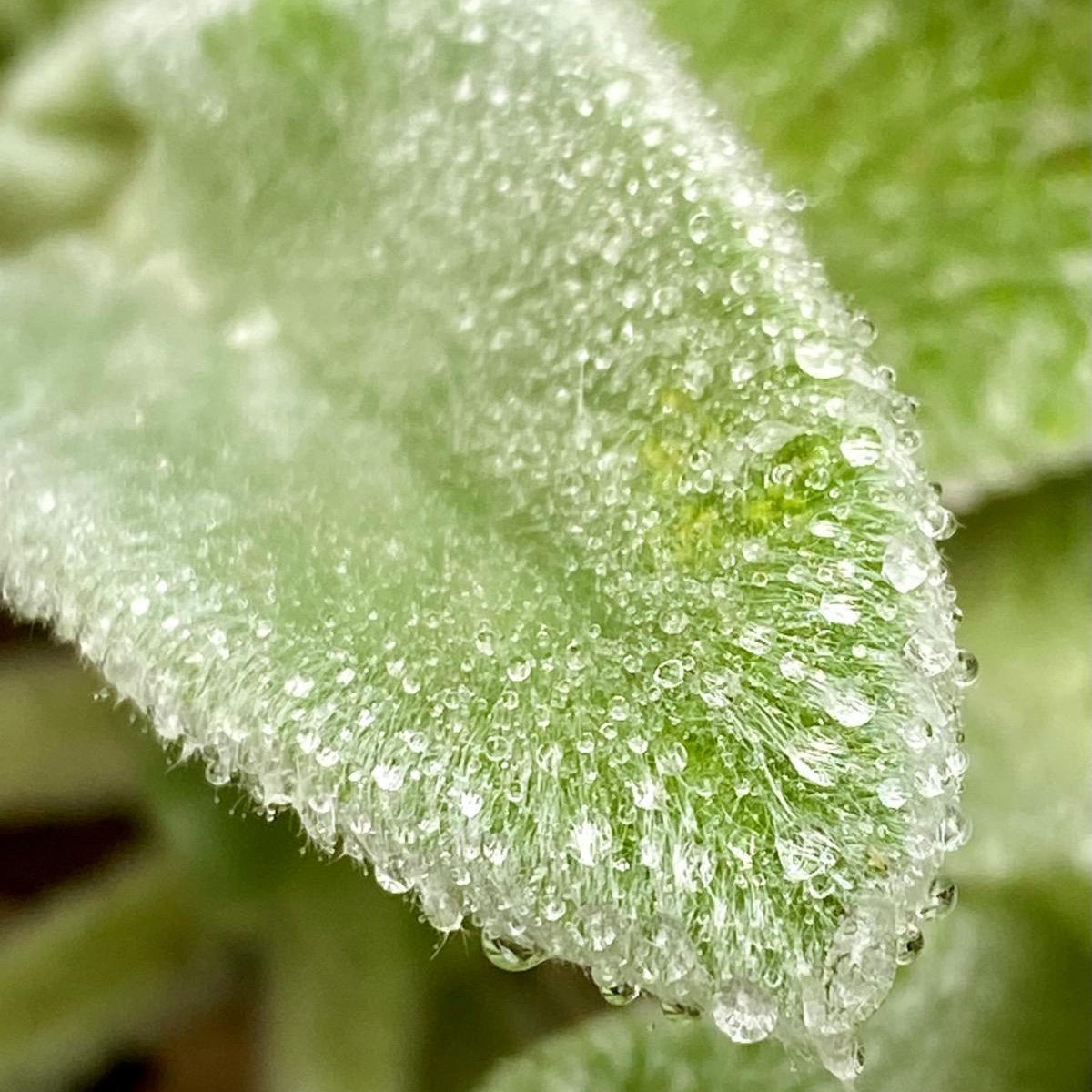
Water droplets sparkle on pubescent lamb's ear leaves.
photo by E Barth-Elias
|
|
Why those downy leaf surfaces? Many of these silvery, soft plants are native to arid climates. Their transparent leaf hairs reflect light and trap water, increasing the plant’s tolerance for high temperatures and low moisture levels. Trichomes can be located on the lower surface of the leaf to keep openings, called stomata, from releasing too much moisture when they open to take in carbon dioxide and release oxygen and water. Leaf surfaces take on a silvery cast when trichomes reflect the light. When trichomes are short and tightly packed, leaves can look white, such as dusty miller. When longer hairs become saturated with water, they shift the light to reveal the green leaf below.
Pubescent leaves have evolved to protect plants in other ways as well. While still in the leaf bud, pubescent leaves are folded differently than glabrous (hairless) ones and may be a means of preventing growing leaves from fusing together. Leaf hairs can help protect against feeding by mites, beetles, and larger animals. Trichomes in some plants, such as live oaks, contain bad-tasting or toxic chemicals that deter feeding animals. In many plants young leaves, which have a thin outer layer so that they can easily expand as they grow, are pubescent. Their leaf hairs have chemicals that protect these leaves by absorbing excess UV radiation. As these young leaves grow and their epidermis thickens, adding UV protection, their leaf hairs become less dense and gradually wear off.
Whatever the reason, our world is richer because of the touch of velvety leaves, the texture and color they add to the plant world, and the bit of a light show they provide on a wet day. Look Around.
K Edgington
|
|
Leaf Brief - Rose Campion |
|
|
|
Darn it. Forgot again. What’s the name of that medium-sized, hot pink perennial with the light silver-gray leaves? Ah yes, the rose campion! Why can I never think of that? Maybe because it has nothing to do with a rose and well, what is a campion?
Let me tell you. Rose campion (Lychnis coronaria) is a short-lived perennial or biennial, a member of the carnation family. Although it is short-lived it comes back year after year via self-sowing. While most familiar to us with its bright pink flowers, it may also sport white, fuchsia, and magenta blooms, all in vivid hues. The silver-gray pubescent leaves and white stems, covered in tiny hairs, have a fuzzy
|
|
appearance. Pollination occurs through butterflies and bees. Deer are deterred by the hairy foliage.
Growing two plus feet in height, this plant fills in those awkward mid ranges of the perennial border, hovering daintily above shorter plants but not blocking the taller back of the border. Like most gray foliage plants, rose campion takes full sun, but will also tolerate a little shade. It likes it hot and humid, and thrives in a wide range of soils. This makes it a winner in a cottage garden, cutting garden, rock garden, or in xeriscapes. Rose campion blooms reliably beginning in late May into August with continued deadheading.
Propagation is usually from seed and while it self-seeds, it isn’t invasive. If you already have some and want more, simply let it go to seed and the plant will take it from there. Or you can harvest the seeds after they have dried and turned black. Sow seeds elsewhere by planting in the ground below the mulch in the late summer or fall. They require 3 weeks of cold temperatures and prolonged moisture to germinate. Rose campion can be a bit finicky to grow in pots because of its tap root, so it may be difficult to find at your local nursery. If you see one, snag it!
Rose campion is a native of northern Africa, southern Europe, and the Middle East, but has naturalized through Europe and most of the United States. Its Greek name, coronaria, is derived from the word coronation and the plant stems were originally fashioned into a garland used to crown champions at ancient athletic events. So, I get it now. My rose-colored (sort of) campion is a champion. I can’t speak for the ancient Greeks, but this one is a champ in my Ohio garden where it performs admirably all summer.
J Gramlich
|
|
Creature Feature - Wool Carder Bees |
|
An invasive, non-native, aggressive male that body-slams anything that dares enter its territory, including humans? All to procure, ahem, “dates” with not particularly willing females, who are busy collecting soft, fuzzy material to line their nests? This is the creature my dear editor chose for this month’s feature?
Yep. And while Anthidium manicatum certainly has some not-politically correct traits, it also has a fuzzier side that fits in nicely with the theme of this month’s Root. And nobody has said (yet!) that nature must be politically correct…
Commonly known as the wool carder bee, this pollinator is a native of Europe and parts of western Asia and North Africa.
|
|
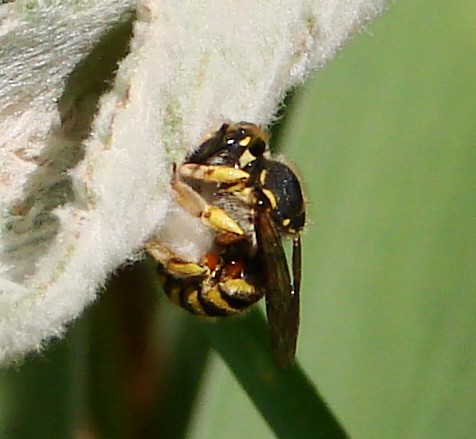
Female Anthidium manicatum gathers "wool" from the underside of a lamb's ear leaf.
photo by woolcarderbee
|
|
First discovered in the U.S. in the 1960’s, the bee’s arrival was probably accidental, arriving as larvae in plants or wood. University of Akron researchers documented discovery of the bees around Akron in 1996, and they have spread as far west as California. Their expansion is attributed to their generalist feeding habits, although some think they prefer blue and purple flowers.
Wool carder bees are similar in size to honeybees but have bright yellow markings on black bodies covered with yellow-grey hairs. Females have a hairy face. The much larger male sports five spines on their abdomens which they use as weapons (but they are not stingers). This family of bees carry pollen on their abdomen instead of their hind legs like most bees.
The two sexes are busy as bees (naturally) but in very different ways. Solitary females build their own nests in hollow cavities in stems, rotting wood or abandoned beetle holes (called “tunnel” nests). The ladies collect nectar and pollen from many plants for food, but also gather soft fibers to cushion the nest. Using her mandibles, a female wool carder scrapes trichomes (small hairs) from pubescent leaves such as lamb’s ear, mullein and plants in the mint family (Laminaceae) to line each nest cell. The motion is akin to how wool fibers were straightened by a combing process called “carding”; this gave the species its name. Watch carding HERE.
After lining each nest cell with fibers she has gathered, the female adds a ball of food consisting of pollen and nectar, lays an egg on top and closes the cell with more fibers. Male bee eggs are laid in the innermost part of the nest to give them more time to develop. After each cell has been filled the mom-to-bee closes the entrance to the nest with fibers, pebbles or wood.
In the meantime, males are busy choosing a territory with flowers that will attract females, and then aggressively defending that territory from, well, anything. Known to attack other bees and even small birds such as hummingbirds, our bee Casanova may even attempt to keep humans away from his flowery bachelor pad. A wool carder was falsely accused of murdering honeybees on a “blood-soaked battlefield” to protect his territory, in a report that went viral in Sacramento. Read about wool carder fake news HERE.
A beefy male wool carder (let’s call him “Buzz”) may guard a particular plant, fending off competitors, for up to 3 weeks (kind of like his favorite stool at the local bar). Smaller males stay out of Buzz’s way or pay a price. Blink and you’ll miss Buzz take this competitor out!
A female foraging for food in Buzz’s territory (let’s call her “Honey”) will fast succumb to Buzz’s charms, practicing “convenience polyandry” — the wool carder equivalent of Buzz buying Honey dinner and Honey returning the favor. Honey may repeat this 12 times a week, while Buzz can “date” every 6 minutes. I’m not commenting further, but you can watch a highly sophisticated re-enactment HERE.
There is always a concern that non-natives may become pests, and the wool carder bee’s propensity to attack other bees (including the non-native but valuable honey bee) fosters its reputation as a bee bully. However, the bee’s service as a pollinator currently appears to outweigh any harm it does to other bees—and their egos!
C Christian
|
|
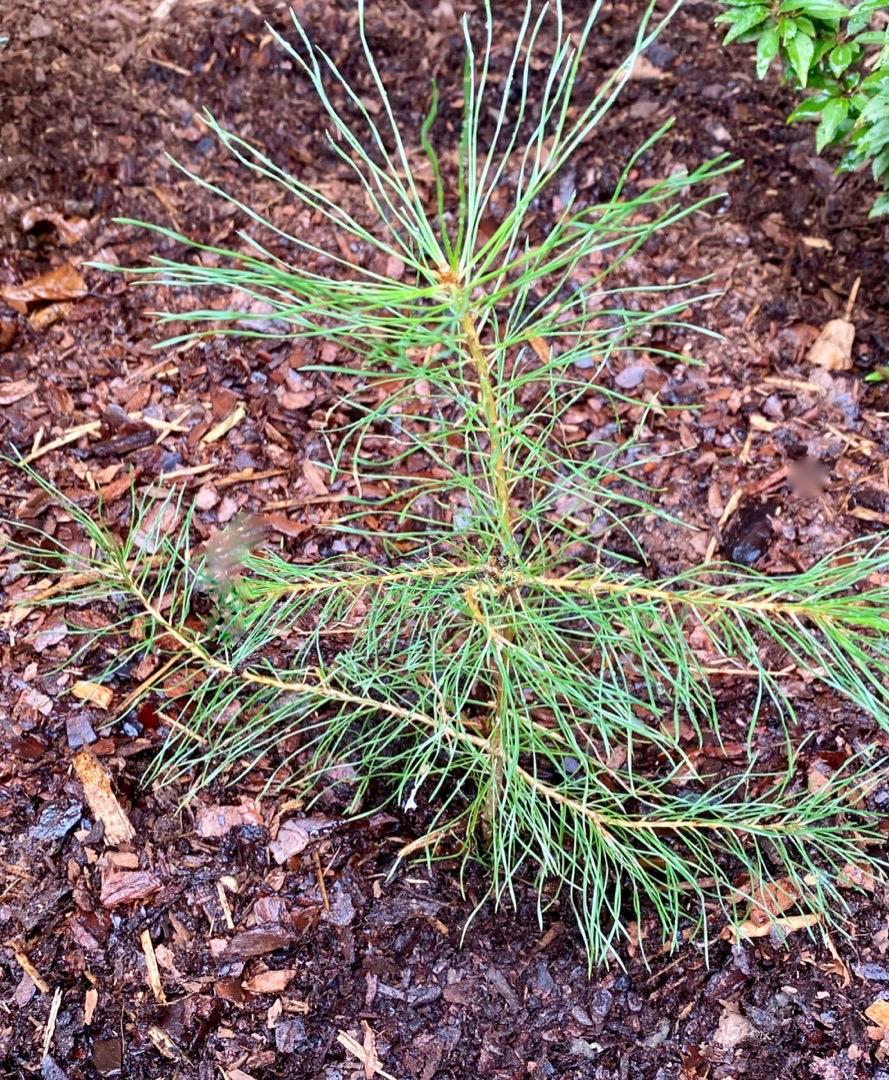
White pine seedling
photo by E Barth-Elias
|
|
Remember a time when you were about to receive a very special gift? The wish, the wait, and the wonder swell as anticipation builds, slow yet steady, all the way to that final crescendo….! You could set up a similar scenario for yourself again. Follow along and discover the sheer joy of (metaphorically) unwrapping a new baby conifer—and maybe some siblings and cousins as well!
Consider the conifer: Conifer translates to “cone bearer.” They are monoecious (male and female parts exist separately on the same plant) and the parts are sometimes referred to as pollen cones and seed cones. No insect pollinators are required, since conifers are wind pollinated. Resilience is the name of their game: they are gymnosperms (naked seed, unprotected by fruit). Their woody trunks and stems provide long term ecosystems for myriad creatures.
|
|
Conifer leaves are shaped either like needles or scales (think arborvitae) and are tough and resistant to water loss. Most conifers are evergreen. (Exceptions include bald cypress, dawn redwood, and larch.) Contrary to popular opinion, conifers offer a wide variety of textures and colors, both in their bark and foliage.
These are not just any old plants! Conifers are truly fascinating, with countless layers of intrigue. Starting them from seed is not only enjoyable, but seedlings offer constant surprises with their varying characteristics. Here are some steps to start your own conifers from seed. *
GATHER AND PREPARE SEED
Pines - Collect cones from late August to early December. The ideal harvest time is when previously green cones have reached maturity and start to appear dry, turning to shades of brown and grey. As the cone dries it begins to loosen and opens its scales to reveal the seed which is tucked snugly against the core of the cone. Collect them now, before the cone naturally expels the seeds. Once harvested, place them in a paper bag on your sunniest windowsill to encourage drying and opening. Shake, tap, or tumble to remove seeds and blow away the fliers. The seeds are now ready for stratification. You may also store them in a clean, sealed jar in the refrigerator to stratify later.
Spruce - Look for spruce cones in September and October or when cones begin to dry and turn light brown. Gather and prepare as for pines.
IDENTIFY VIABLE SEED
Float your seeds in a container of tepid water and allow to stand for 2 days. Those that sink are viable and can be gently added to a plastic bag of damp growing medium or paper towel. Label with the date and refrigerate.
STRATIFY
Even if you don’t care about identifying the viable seed, soaking for two days is part of the stratification process which has been proven to result in more prompt and consistent germination. Stratification is a simulation of how nature stores and chills seeds in a damp environment for a period of 30-60 days and then proceeds to draw them out of dormancy. Click the link below for stratification times for common conifers.
PLANT
Outdoors - Plant seeds just beneath the soil’s surface in fall and let winter stratify them. You might consider securing a piece of screen over your seeds to deter foraging creatures.
Indoors - Once stratification is complete, plant in a soilless mix (or combine 1 part sharp/ coarse sand with 1 part sphagnum moss.) Keep soil moist through germination, then back off a little, allowing the soil to dry on top before watering.
BE PATIENT, particularly if planting outdoors as numerous conditions must be met to achieve germination. Imagine your satisfaction and pride when you bring forth such a gem!
* These guidelines were compiled with the pine and spruce species in mind but can generally be applied to all conifers. However, please note that it is well worth the effort to perform a quick online search for your particular conifer— to verify the amount of time required for the most stratification benefit and to get a sense of when you can expect germination.
E Barth-Elias
|
|
It’s easy for us in our relatively wet Northeast Ohio to take water for granted. While our recent dry spell has caught our attention, we still treat water as ever-present, available merely by turning on the tap. And there’s no reason to think anything will change much soon.
But water is not a renewable resource. As we sweated temperatures above normal and rainfall well below normal during June and July, it would be a surprise if people didn’t begin to think of ways to garden with less water, if for no other reason than to cut down on water bills.
|
|
|
Gardeners in the arid West have long been water conscious. THIS fact sheet from the Utah State University offers a step-by-step guide as you design your garden.
Beyond the principles of balance, unity, rhythm and accent, which apply to all garden design, water-wise landscaping is another considerations. Those water-conscious steps are known as xeriscaping.
Design your garden to suit its varying water needs. Break it into zones with irrigation needs increasing, from 0 to 4. Zero would mean the plants in that zone need no extra watering. Zone 1 means the plants need to be watered once a month, Zone 2 plants, twice a month, Zone 3 need weekly watering and Zone 4, twice a week.
Once the zones are set, soil preparation is next, and that, of course, means soil testing. Following soil test recommendations for pH balance, nutrients and organic matter, and having a soil depth at least 8”, you have the best possible environment for plant success.
This brings you to the point you’ve been waiting for: plant selection. Choose plants most suited to the zones’ requirements, bloom times and uses in the landscape. THIS Utah fact sheet includes a link to several lists of plants suited to xeriscaping.
Turfgrass shouldn’t be eliminated. It’s needed for foot traffic and recreation. It gives flower beds definition, allows movement around the landscape and takes abuse without much ill effect. It allows rainwater to seep into the ground. Many turf plants are very drought tolerant.
Mulch helps retain moisture and control weeds. Organic mulches – bark, leaves, grass clippings –enhance soil quality as they break down and return to the soil. Inorganic mulches – gravel or crushed stone, tumbled glass, lava rock – provide many of the same services as organic mulch. They do not feed the soil, so plants need to be closely monitored for nutrient deficiencies.
At last! We arrive at actual watering. There are three ways to irrigate your landscape: by hand, by sprinkler and by drip irrigation.
Watering by hand is the least efficient and most tedious. Using a hose concentrates water on the leaves and requires someone to hold a hose for hours. Worst, it rarely gets enough water to the roots.
Sprinklers are often used to water turf, which needs moisture evenly spread over a wide area. Manual sprinklers such as fan or whirling sprinklers work but are difficult to adjust so that the water reaches everywhere it’s needed. In-ground systems, often automatic, are designed so that the grass is evenly watered. However, they require special installation and cost hundreds, if not thousands of dollars. And even if in-ground systems are located near flower beds, the water is concentrated on leaf surfaces, promoting moisture-loving plant diseases.
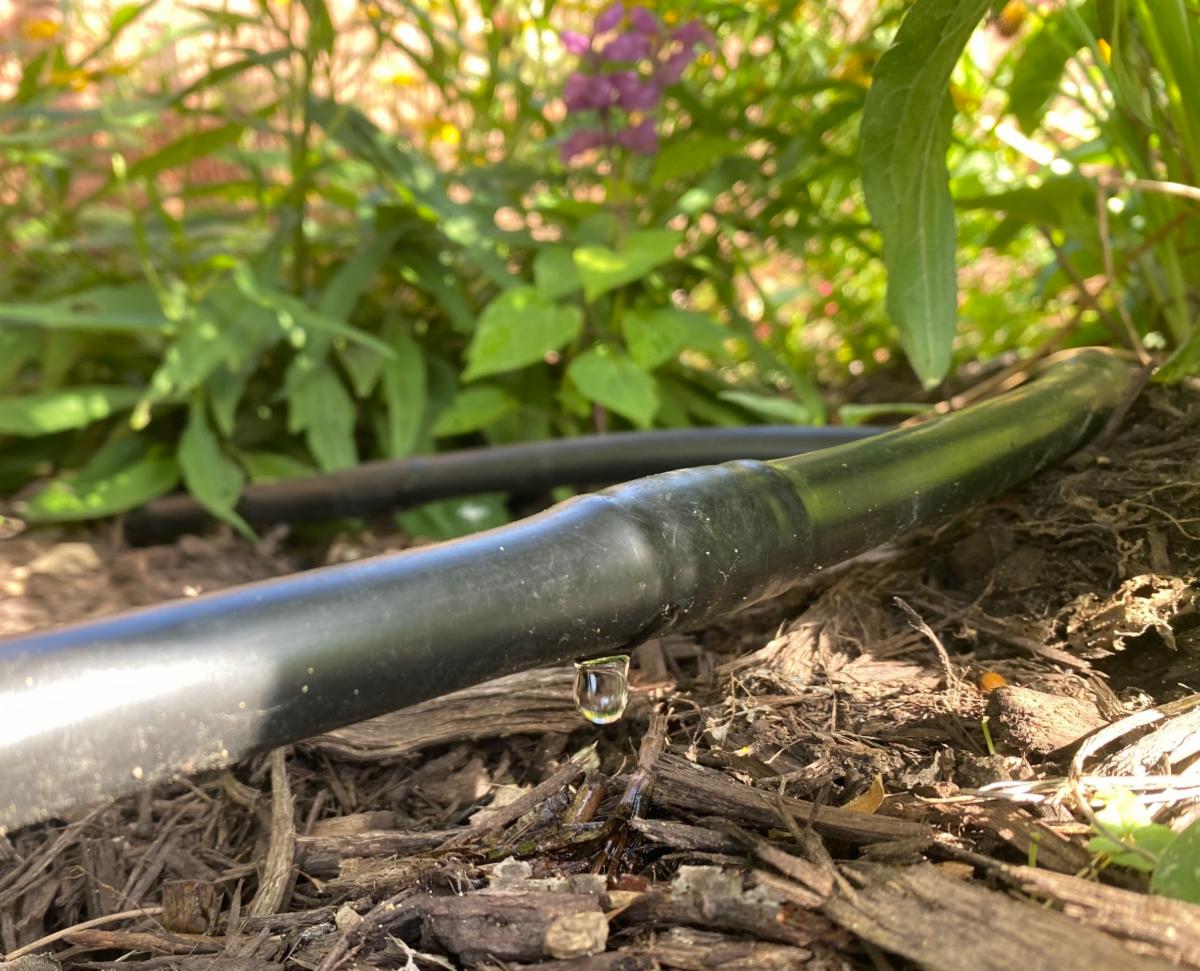
Drip irrigation offers efficient irrigation without big outlays of money. Drip systems get water to the roots. The water doesn’t as readily evaporate, and it uses far less water than any other irrigation system. Drip systems require several parts: varying lengths and sizes of hose, drip heads, pressure regulators and back flow preventers. Yet the parts are relatively inexpensive and many companies design systems according to an individual’s needs. Timers make drip irrigation automatic.
Water-wise gardening requires a lot of preparation, but once everything is in place, it requires very little maintenance and offers huge rewards: lush plants, smaller water bills and much less maintenance. What’s not to love?
S Vradenburg
|
|
August Checklist
- Keep deadheading perennials and annuals to promote blooms. Some annuals, like alyssum and petunias, can be pruned by half to rejuvenate.
- As perennials go dormant, be sure to collect seeds for next year or to share with friends.
- Reseed turf by late August so it has time to establish before cold weather.
- Continue watering. August is the hottest month.
- Clean up and divide daylilies and hostas.
- Maximize your garden’s bounty by freezing meals, canning fruits and veggies, and drying herbs.
J Gramlich
|
|
To learn more please check out this program :
Meet Me in the Garden Series. Offered in-person at Summit Metro Parks Nature Realm auditorium. Registration required.
-
Maximize Your Garden's Blooming Season with Karen Martin, Perennial Manager at Dayton Nurseries and Garden Center on Wednesday, July 27th at 7:00 pm.
Learn more about and register for this program on our website (link below).
|
|
More learning opportunities:
|
|
The change always comes about mid-August, and it always catches me by surprise. I mean the day when I know that summer is fraying at the edges, that September isn't far off and fall is just over the hill or up the valley. Hal Borland
|
|
We invite you to share The Root of It with your gardening friends and family. If you would like to subscribe to our mailing list please visit our website, scroll to the bottom, and follow the link under Join our email list. |
|
The Root of It staff: Karen Edgington (Editor), Emma Barth-Elias (Photo Editor), Carolyn Christian, Jennifer Gramlich, Sarah Vradenburg, and Geoff Kennedy (Technical Advisor)
|
|
We Would Like your Feedback
Contact us at: newsletterscmg@gmail.com
To discontinue receiving this newsletter please click on the UPDATE YOUR PROFILE link below. You may then choose what types of information you would like to receive from us.
|
|
|
|
|
|
|