The Root of It newsletter ends with our monthly quotation. If you find your newsletter has been clipped by your email provider please click HERE for a webpage version of the newsletter. |
|
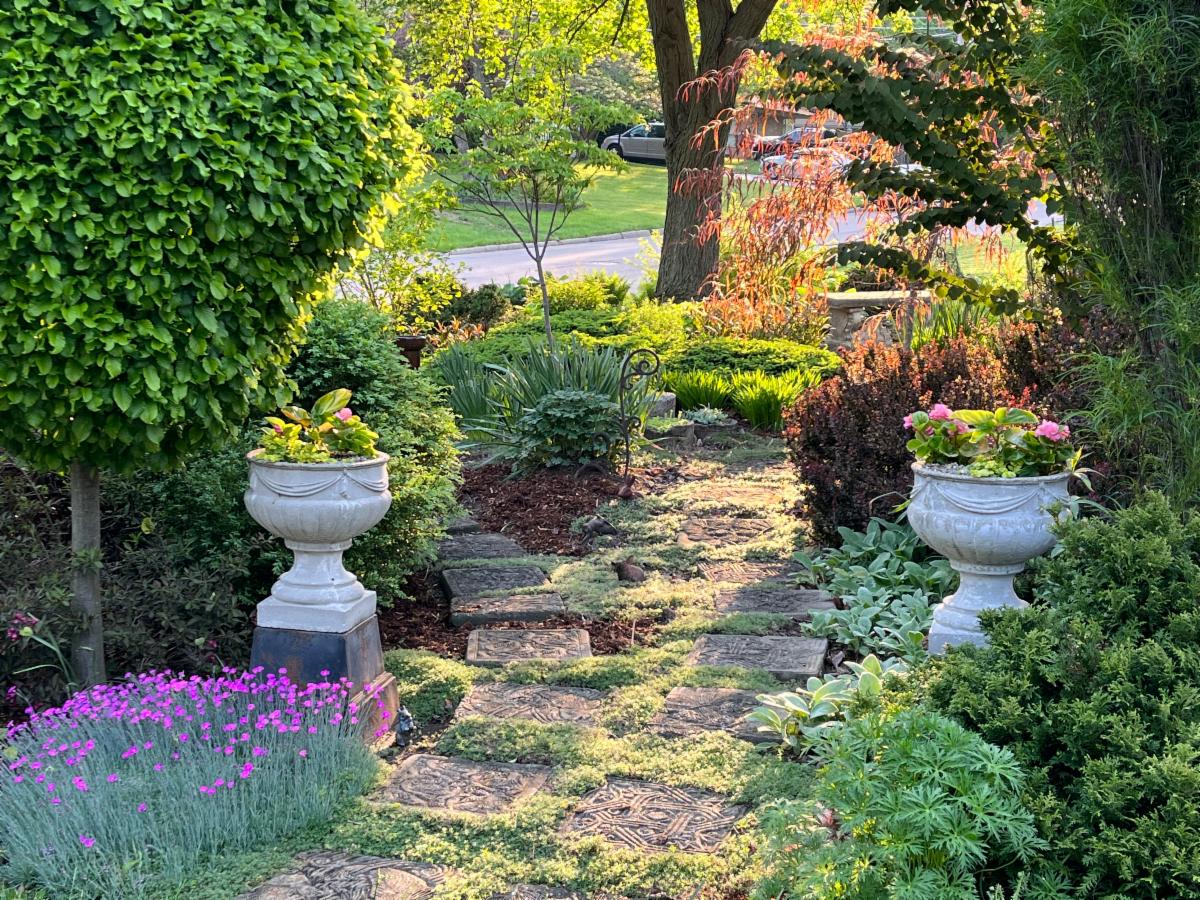
Look Around invites readers to slow down and focus on the plant world, to look at nature in a new way, to notice the commonplace that is actually quite marvelous, to appreciate the biology and interconnected ecology of plant systems. This writer will soon be “looking around” in a new way. After thirteen years of living on a 1/3 acre city lot, of going from a blank slate to a garden rich with beds and rooms, of learning about countless new plants and thinking through each square foot of valuable landscape area, my husband and I are moving to a new city. I can’t express the pleasure it has been to plan, plant, care for, and enjoy this landscape. Now it is time to start planning for a new landscape (which is as blank as ours was, and will be such fun to work with).
These are the weeks in which I’ll do a different kind of looking around. I’ll take photos of vignettes and favorite plants. I’ll take divisions of those plants that will enjoy coming along for the ride. I’ll make lists of “can’t live without” plants for the new landscape. I’ll walk our neighborhood more often, appreciating every tree and shrub I’ve come to love. In the coming months I’ll write articles about designing garden beds, and will have new, personal experience with that.
Leaving makes one more appreciate the having, and I’d like to encourage you to look
|
|
around your yard, your neighborhood, your parks, your trails and keep eyes open for the new and not-so-new, the way plants and animals work together, the diversity of color and texture, the way the light and time of year change our world. Pause to look, to smell, to see what happens. If you were leaving your home and garden, what would you file in your memory to savor in days to come? Look Around!
|
|
photo and article by K Edgington |
|
Leaf Brief - Dutchman's Pipe |
|
Most of the plants we profile make me want to rush out and find a home for them in my garden. This month’s plant, the Dutchman’s Pipe, fits into the category of “Gee, that’s interesting, but I think I’ll pass on this one!”
The Dutchman’s pipe (Aristolochia macrophylla) is a woody deciduous vine native to Canada and the eastern United States. It grows in moist sunny sites and can reach 15-40 feet high and 15-20 feet wide. Grown primarily as an ornamental, it climbs to form an impressive wall of leaves that make an excellent screen or shady retreat. While sizeable, it’s not considered invasive and can be managed by pruning. The name Dutchman’s pipe comes from the odd-shaped flowers that some say look like a smoker's pipe. Others say it resembles a fetal ultrasound photo with its curvy profile. Incidentally, Aristolochia means “best” and “childbirth” in Greek, and back in the day was used for pain and to treat infections during childbirth, hence its second nickname, broad-leaf birthwort. It is a relative of wild ginger which has similar heart-shaped leaves. Other varieties of Aristolochia, such as elegans and gigantea, have large, eye-catching flowers, but they are natives of tropical and subtropical climates.
This native plant is the host to the pipevine swallowtail butterfly, a gorgeous specimen with black and blue iridescent wings. Not only does it provide food for the swallowtail caterpillars, and a place to lay its eggs on the underside of its leaves, it also has a chemical in its leaves that make the resulting butterfly toxic to its predators. (More about the pipevine swallowtail HERE.) The Dutchman’s pipe blooms, which appear in May and June, are pollinated by small flies and gnats. As they travel down the pipe to the nectar source, they are trapped, sometimes for days, until the flower is fertilized and the blossom wilts, expelling the insect.
So, what’s not to like? Well, for one thing, Dutchman's pipe is toxic if ingested. I don’t mean a little stomach upset; we’re talking irreversible kidney damage caused by high concentrations of aristolochic acid. That goes for pets too, but deer are able to graze on it without a problem. When in bloom, the flowers have a putrid smell which mimics carrion and attracts flies for pollination. (You might not want them next to your picnic table.) The other big negative is it is flammable! I didn’t know there was such a thing as a flammable plant, but experts warn not to plant it on your house or deck supports, or anywhere near your 4th of July fireworks.
|
|
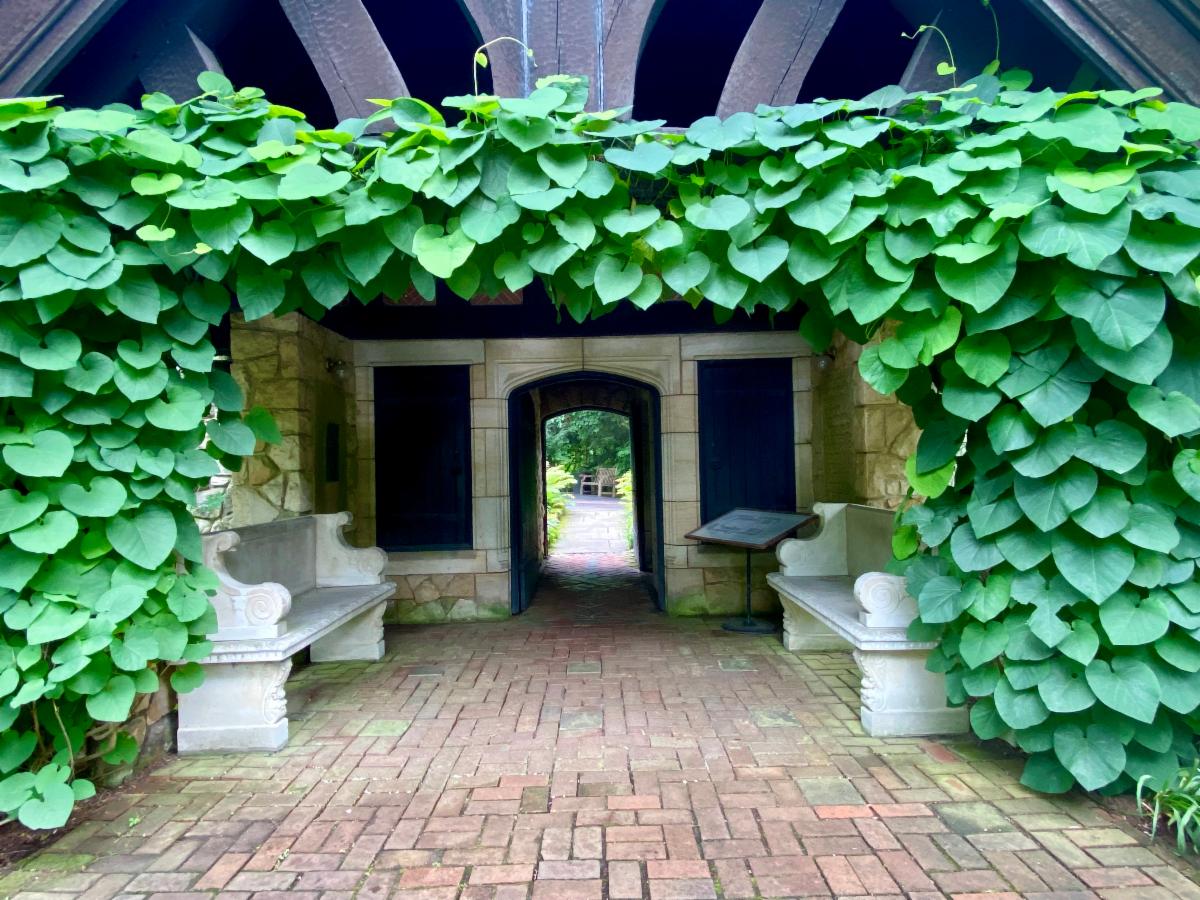
Dutchman's pipe framing the entrance at Stan Hywet's English Garden
photo by E Barth-Elias
|
|
Dutchman’s pipe is highly specialized to support the pipevine swallowtail butterfly and is a part of other insects’ ecosystems, which illustrates why it is important to have a variety of plants in the landscape. In the right roomy location, this plant can be quite the charmer and hosts an endless supply of butterflies. For me, this is a plant best admired from afar.
J Gramlich
|
|
Creature Feature: River Otters - Party in a Pool |
|
I love river otters. I want to be one. They have such a good time, even without chocolate, wine and Netflix. Of course whether animals feel emotions like happiness is open to debate—watch THIS interesting take.
But just for fun, let’s pretend…
Your head shrinks and flattens, your legs shorten, and you become sleek and tapered (OK, sleek-er).
|
|
River Otters covert at Cuyahoga Valley National Park, Beaver Marsh
photo by Jerry Cannon
|
|
You sprout thick, brown fur all over your body - more than a million hairs per square inch in spots – the densest fur of any animal. By comparison, the average human has a mere 100,000 hairs on their entire head. Long, stiff whiskers shoot out behind and below your nose, and you realize those whiskers will be useful in finding prey. “Prey?” You’re distracted from that thought by the skin appearing between your toes and the long, strong tail emerging from your you-know-what. Yikes! Suddenly semi-aquatic and built to swim, you just want to get wet!
Congratulations! You’re a Lontra Canadensis, a member of the Mustelidae family. Your closest relatives are stoats, weasels and wolverines, and the defining trait of your kind is using your scent glands and trademark musky odor to mark your territory—that’s fun! You are found throughout Canada and the U.S. (except for parts of the Southwest) in all kinds of watery habitats—lakes, ponds, marshes and rivers. It’s almost dark, you are nocturnal and there just happens to be a river nearby so — SPLASH!
The water is cold, but you don’t notice through your fur coat. You do, however, notice how fast you are. Your tail, which measures half your body length, powers you through the water. You can turn on a dime and hold your breath up to 8 minutes. And no plugs are necessary—you simply close your nostrils and ears to keep water out! The river water is dark, but your den is close by. Dens with underwater entrances are built along banks in burrows dug by other animals or in natural hollows. A tunnel leads to a nesting room lined with leaves and grass. You have no relationship drama—males and females only meet to mate, and males generally live alone while females will live in groups with their young.
There are no babies in the den — they’re born in nests on land in late winter/early spring, and litters generally average one to three blind pups. At around two months Mom tosses the babies into the water and teaches them to swim. Watch her lessons HERE.
Mom takes care of the pups until they are about 6 months old, after which the youngsters may travel up to 20 miles to find a new home. You leave the den and head back out into the water, and something flashes by. It’s a mom and two pups, swimming, diving, wrestling, chasing. It looks so fun you join in. WATCH HERE. The pups love the play, which also helps develop their hunting skills.
Your new friends bound out of the water, and you follow, sliding down the muddy riverbanks and leaping over river rocks. You realize that you are fast on your feet—up to 15 mph. In winter, snow and ice provide additional fun opportunities for play, and sliding on ice is faster than mud! (River otters do not hibernate.)
Now you’re hungry. Your high metabolism means you have lots of energy but require lots of fuel. What’s for dinner? Seafood of course. You dive back into your underwater restaurant in search of the plat du jour…fish, turtles, crabs, amphibians—aquatic plants are also tasty. Your sensitive whiskers search out prey in the dark water. You find something…feels like a sucker (how did you know that?) and …WHAM! You grab the fish with your mouth and your carnivore’s teeth do the rest—your claws will help hold on if necessary. Dinner is both served and eaten in the water—yum!
As you head back to land you keep an eye out for birds, bird eggs and small mammals like muskrats for dessert. Predators are not a concern for you, although coyote, raptors and alligators have been known to prey on otters. Otters are crafty—WATCH THIS ONE outsmart a pack of coyotes.
What’s next on your schedule? Grooming, which you do multiple times daily to keep that very important fur in top condition. Time to poop? You’ll learn that otter poop is quite odiferous due to your seafood diet—although some scientists say it smells like violets! Or perhaps you’ll make some new friends like THESE OTTERS did.
All good things come to an end, and it’s time to morph back into your human (but still sleek!) self. But if you haven’t had enough otter, you might CATCH A GLIMPSE OF REAL ONES at the Beaver Dam in the Cuyahoga Valley National Park. If not, THIS is a comprehensive, lovely film on European otters. And HERE'S a peek at how otters survive winter!
C Christian
|
|
|
|
Morning GLORIES you say? Those sweet little pinkish, funnel-shaped blossoms. Beautiful, you say? NOT!
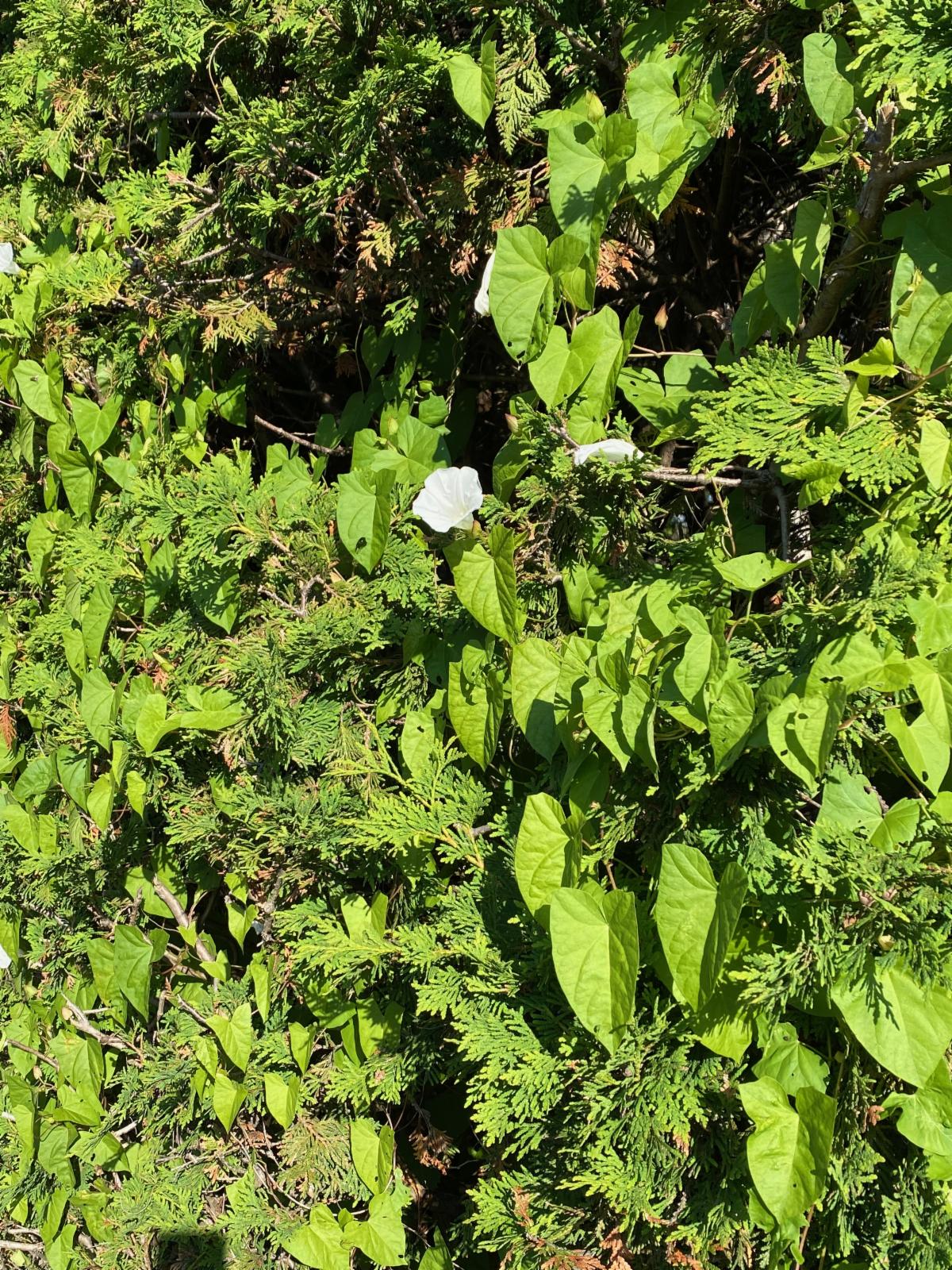
Those pretty little whorls are thugs, also known as bindweed, identifiable by fused, funnel-shaped flowers and arrow-shaped leaves pointing away from the stem. The plant is a member of the Convolvulaceae family native to Europe and Asia. It is a persistent, noxious weed that creeps up any vertical structure – a pole, fence or other plant such as beans – or spreads across an area, choking out just about anything in its path.
While field bindweed (Convolvulus arvensis) is more common to large agricultural areas and has roots that can go down nine feet, hedge bindweed (Calystegia sepium) has a shallower root system, spreading across the top two feet of soil. Hedge bindweed is what most home gardeners must contend with.
|
|
Bindweed spreads both by rhizome and seed, which can live in the soil for 50 years. One step in non-chemical management is to prevent the flowers from going to seed. Like another garden monster, Canada thistle, bindweed also sprouts from root fragments, making hand removal difficult. But not impossible.
If the infestation is relatively new and not widespread, it is possible to deprive the plant of needed food storage by cutting it as it emerges from the soil in spring. However, this is not a one-and-done process. Remember that cutting a plant often stimulates it to grow more vigorously. Bindweed will persist. It is necessary to be more persistent. Some sources recommend digging out the roots with a tool such as a garden fork, allowing them to be exposed and pulled. If the infestation is widespread, hand pulling becomes nearly impossible or at best a lifetime project.
If you want close to total eradication, herbicides are another option. Glyphosate is effective because, once sprayed on leaves, it travels down the stem and kills the roots. This treatment should be repeated several times in a season so that roots that escape one application will be killed with another. Spray early in the day to protect pollinators and on a still day so that nearby desired plants won’t get spray drift. As with all pesticides, read the label carefully. The label is the law. And watch out for bindweed in the following seasons so that stragglers can be removed before they spread.
Bindweed will take advantage of any lapse in vigilance. However, if you keep a close watch, it need not strangle your garden.
S Vradenburg
|
|
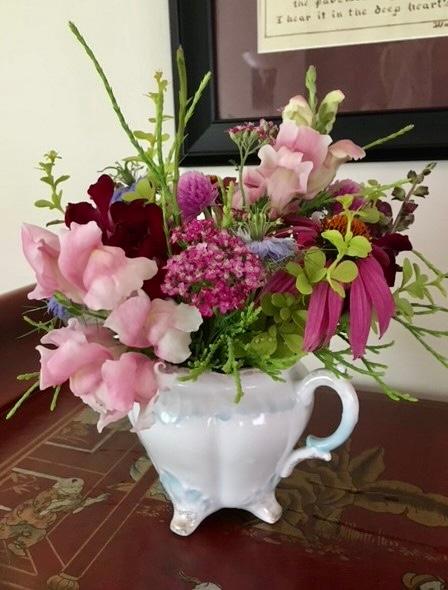
“Say it with flowers” has been the tag line for the floral industry for decades, and for good reason. Flowers said what words could not. The Victorian language of flowers spoke volumes: roses said love without ever an utterance, you will be missed was a pink carnation’s tale, yellow carnations expressed disdain for the receiver. Flowers speak eloquently today, as well, especially when they have been gathered and arranged by the giver. What better way to say, “I’m sorry for your loss”, “You are not alone”, or “’Thank you for preparing this lovely dinner”? Summer is prime bouquet-making time. Cutting flowers are in bloom, filler plants have matured, and a walk around the yard with a bucket of water in hand yields a wealth of material. Small vases filled with flowers and foliage from garden beds, shrub borders and the vegetable garden fit neatly in the corner of the desktop, are just right for an unobstructed view at the dinner table, and |
|
|
can be tucked here and there for an “ahhh” moment. They seem to say “charm” from the get-go, and arranging them is a simple process.
The first order of business is choosing a container. A valued crystal or porcelain vase will certainly do the trick, but a thrift shop find, a small cream pitcher, mustard jar, or sugar bowl, will do very nicely as well. The container sets the tone for the colors and textures to come – country, formal, whimsey, or modern .
Do your flower “shopping” early in the morning, when stems and buds are hydrated and firm to the touch. Use a sharp cutting implement. A knife, pruners, or clippers will do a better job than household scissors, which are not designed for thick stems and may crush plant tissue needed for water uptake. Take a lukewarm water-filled bucket or container and plunge each stem into the water as soon as it is cut. Cut flower stems at an angle to increase the area for water take-up.
Flowers for these arrangements need to be on the small side. The cut flowers planted in the veggie garden or borders work great: cosmos, gomphrena, zinnia, celosia, sweet pea. Some of the many perennial possibilities include yarrow, coneflower, astilbe, coreopsis, salvia and lady’s mantle. Don’t limit your shopping to the annual and perennial areas. Grasses, shrubs, and even trees can provide both flowers and fillers for bouquets. Viburnum, ninebark, spiraea, and many other shrubs have beautiful, cut-worthy flowers. Think outside the box - eggplant flowers are stunning.
A word about fillers: The garden is awash with plants that add texture and color to bouquets. Ferns, of course, enhance almost every arrangement. Ditto astilbe leaves. Hakonachloa grass blades, weigela tips, alternanthera stems, spiraea sprays, and clematis branches tuck in beautifully between blooms. Don’t forget the herbs and vegetables: asparagus buds, purple basil, and dill – the possibilities are endless.
Don’t worry about removing these blooms and stems from the landscape. Cutting flowers stimulates most plants, particularly annuals, to produce more. Do make shrub and tree cuts properly---cutting just above leaves or leaf buds to stimulate new growth. No ungainly stubs allowed.
After flowers and fillers are cut, if time allows “condition” them by placing the container in a cool, dark place for at least an hour, but usually 12 to 24 hours for maximum water absorption before arranging. A cool basement works well. Stems that are woody can be slit at the bottom to increase the absorption area. Stems that exude milky sap, such as euphorbia, should be seared to keep the sap in the stem from clogging the vascular system of other cut flowers. Sear by applying a flame to the cut end or immersing the cut end into boiling water for 30 seconds.
Once your flowers and fillers have been conditioned, it’s time to arrange them. It is helpful to use a floral preservative in your vase water (some arrangers put preservative in their conditioning water as well). These solutions provide carbohydrates for the plant, adjust the pH of the vase water, and reduce bacteria that break down plant tissue. Although readily purchased, preservatives can be made from ingredients commonly found at home. The Brooklyn Botanic Garden offers this recipe for a home-made floral preservative:
Mix 1 teaspoon sugar, 1 teaspoon household bleach, 2 teaspoons lemon or lime juice in 1 quart lukewarm water.
Gather your materials: flowers, filler, cutting implement, and your vase filled with luke-warm, preservative-enhanced water. Stems can be cut and placed individually in the vase, but a very effective technique is to create your bouquet by arranging flowers and fillers in your hand. Hold in the non-dominant hand and build with the dominant hand. Start with the flowers you’d like to see in the center. Remove all leaves that will be below the water surface. Add a bit of filler, then more flowers and filler and build the bouquet from the center out, continuing to remove lower leaves. The height should slope down slightly to the sides to position each bloom for viewing. When you’re satisfied with the arrangement, hold the bouquet up to the vase to determine the optimum flower height and use your pruners or clippers to cut the flower stems at an angle so that the stems will rest on the vase bottom. Immediately plunge the bouquet into the vase. Your arrangement may need a tweak here or there, but you will be pleased with how lovely it looks.
To keep your arrangement at its best, replenish the vase water as needed and keep the bouquet away from direct sunlight and drafts. Recut stems that are wilting and remove spent blooms.
So, say a little something with a small flower arrangement. What a great way to start a conversation!
K Edgington
|
|
July Checklist
J Gramlich
|
|
To learn more please check out this program :
Meet Me in the Garden Series. Offered in-person at Summit Metro Parks Nature Realm auditorium. Registration required.
-
Maximize Your Garden's Blooming Season with Karen Martin, Perennial Manager at Dayton Nurseries and Garden Center on Wednesday, July 27th at 7:00 pm.
Learn more about and register for this program on our website (link below).
|
|
More learning opportunities:
|
|
Nature will bear the closest inspection. She invites us to lay our eye level
with her smallest leaf, and take an insect view of its plain.
Henry David Thoreau
|
|
We invite you to share The Root of It with your gardening friends and family. If you would like to subscribe to our mailing list please visit our website, scroll to the bottom, and follow the link under Join our email list. |
|
The Root of It staff: Karen Edgington (Editor), Emma Barth-Elias (Photo Editor), Carolyn Christian, Jennifer Gramlich, Sarah Vradenburg, and Geoff Kennedy (Technical Advisor)
|
|
|
|
|
|
|