November: the season of gratitude, reminds us to take note of the bounty and the beauty. |
|
The Root of It newsletter ends with our monthly quotation. If you find your newsletter has been clipped by your email provider please click HERE for a webpage version of the newsletter. |
|
Fall is filled with the sounds of mowers and blowers. When leaves fall and temperatures plunge, we’re programmed to rake, trim, and remove; clear paths and beds mean a job well done. It’s time to rethink those tidy tendencies. There are many animals, big and small, that depend on leaf litter and spent stems for winter shelter. The Xerxes society, dedicated to the preservation of invertebrates (animals that lack a backbone), tells us One of the most valuable things you can do to support pollinators and other invertebrates is to provide them with the winter cover they need.
|
|
|
Our interest in monarch butterflies might lead us to believe that most butterflies migrate south for a winter sojourn. In fact, most butterflies overwinter in their northern locales, and leaf litter provides the majority of them their winter abode. Fritillary butterflies, tiger moths (the Isabella tiger moth begins as a wooly bear caterpillar), luna moths, and swallowtail butterflies are a few of the insects that tuck themselves into leaf debris for protection from both predators and cold weather. A layer of leaf litter protects overwintering bumblebee queens in their shallow dens. Snails, beetles, mites, centipedes, millipedes, worms, spiders – all share a winter leaf litter home, and provide food for winter foraging chipmunks, turtles, birds, and others. Leaf litter also shelters wintering amphibians, such as frogs and salamanders, supplying necessary moisture levels as well as protection.
Our rake, mow, and blow regimen is devastating to these small creatures. Perhaps a compromise is in order. While lawns would not thrive under the two to three inches of leaf litter necessary for their support, surrounding beds and gardens can tolerate and even benefit from a layer of leaves. Ecologists tell us to leave the leaves whole – the shredding process can destroy insects and their cocoons. Piles of debris can be hidden in out-of-the way sites.
The camouflage used by overwintering butterflies and moths is impressive. LUNA MOTHS bind their cocoons in a leaf sandwich, which renders them almost undetectable. SWALLOWTAILS and many other butterflies create a chrysalis that mimics the leaves or debris to which they are attached. Dr. Lara Roketenetz, University of Akron Field Station Director at Bath Nature Preserve, notes that she has found cocoons of the exquisite polyphemus moth, a member of the giant silk moth family, in leaf litter. The cocoons, which look like brown, dead leaves, turn into THIS 4-6" beauty. Think of the wonders that lie hidden in that brown, crunchy debris. Think of the delights to come when butterflies, moths, and other creatures grace our summer gardens. Look Around.
K Edgington
|
|
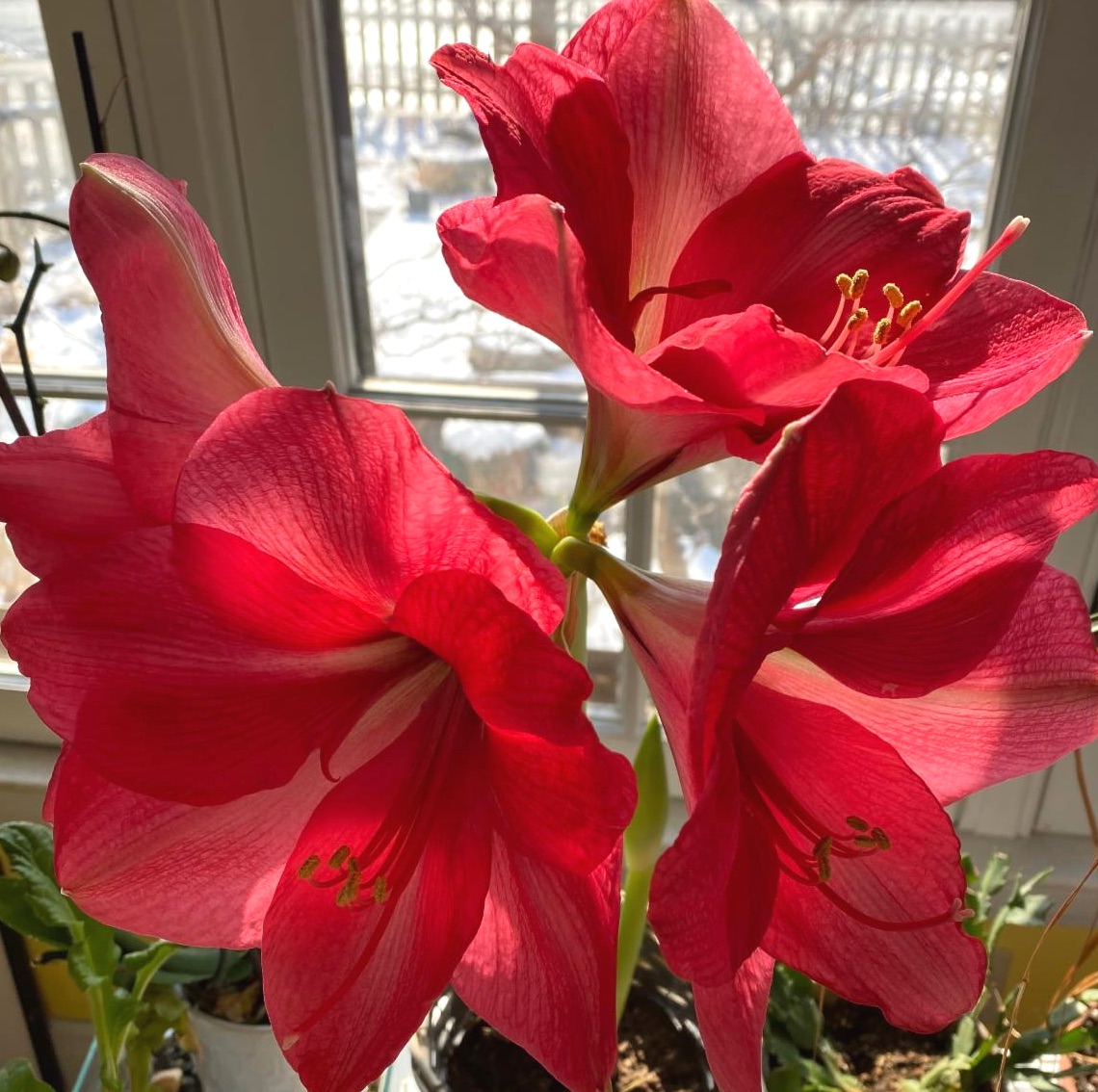
This single Red Lion Amaryllis bulb produced three stalks with four flowers each.
photo by E Barth-Elias
|
|
Anticipation, Anticipation…...is keepin’ me waitin’, we hum to ourselves as we plant our amaryllis bulbs, and watch as the stalk and strap-like foliage emerges and lengthens as the days grow shorter, hoping to get the timing right for Christmas blooms. Amaryllis is an equal opportunity thriller though, so no matter your holiday traditions, there’s a place for the vibrant trumpet-shaped flower in a season yearning for color. After all, the word amaryllis translated from Greek means ‘to sparkle’.
Commercial amaryllis bulbs sold in the United States are of the genus Hippeastrum and are native to South and Central America. The true Amaryllis, known as the Belladonna Lily, genus Amaryllis, is native to South Africa and is sold as a specialty bulb. Both are part of the Amaryllis family.
|
|
The amaryllis we are most familiar with were first bred in England in the 1700's. Today, growers from the US, the Netherlands, Israel, Japan, and South Africa produce 10 million bulbs a year and give us an array of eye-catching hybrids.
Making an amaryllis bulb sparkle is easy. A few simple steps give you a good chance at success. Generally, the bigger the bulb, the bigger the flower. Choose a bulb that is dry with no soft spots. Sprouted is ok. Place in soil halfway up the bulb with one inch of the pot exposed to avoid messes when watering. Situate in bright light, keep moist but drained, and wait… If you have a specific target date for bloom, consider the variety that you purchase. Generally, the larger the bulb, the longer till blooming, but it ultimately depends on the variety of the bulb. HERE'S information about timing your blooms. A little fertilizer is helpful to promote flowering. Rotate the pot every few days to keep it from leaning.
It’s possible to keep amaryllis from year to year but it takes a commitment. After flowering, remove the blooms and place the plant in a sunny window. Amaryllis is hardy in zone 9-11, so here in Ohio they must be brought outdoors after the danger of frost has passed. A sunny location and monthly fertilizing is necessary. Amaryllis will bloom again when brought indoors but if you want to extend the bloom time to the holidays you will need to let them go dormant by putting them in a cool, dark location. Then you can start the process all over again in 8-12 weeks. If you live in the southern United States you can plant them in the ground where they will multiply on their own. It takes 3-5 years to grow a productive bulb from seed. Learn more about growing and caring for amaryllis HERE.
The most common cultivar is Red Lion, a show-stopper in a deep crimson red. Other popular varieties are Picotee, white with red edging, and Apple Blossom, a white/pink combination. There are also double flowering and miniature varieties, which pair well with the taller ones. Be mindful that all parts of the amaryllis are poisonous to dogs, cats, and humans.
Trending this year are waxed amaryllis with the lower half of the bulb dipped in colored wax. They require no water and no special care (but will they tip over)? One downside is that they must be discarded after blooming.
Have fun with your amaryllis and experiment with groupings or unusual color combinations. Consider pairing with ferns or holly but a stand-alone flower has its own appeal too. They even make a great cut flower for bouquets. However you display your amaryllis, it will surely be worth the wait.
J Gramlich
|
|
Most people hate mice.
I’m not a big fan, but when my dear Editor suggested an article about the little rodents I had no idea of the extent of the fear and loathing I would discover. THIS sums it up well.
Almost all information about mice is written by pest control companies whose mission is to annihilate them. One article recommended using traps because “it permits the user to view a successful effort.” Gloating over mousy’s death is a benefit?
|
|
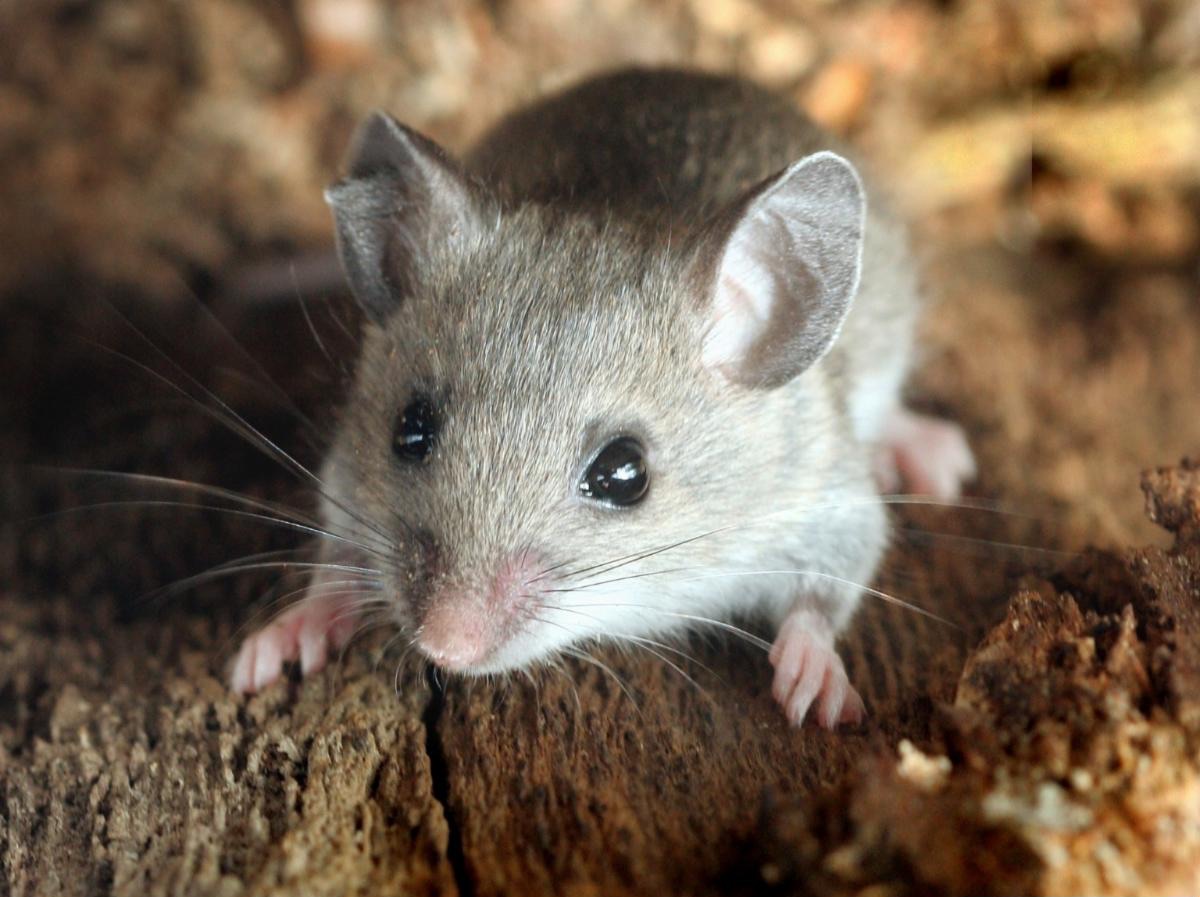
Deer Mouse
Photo courtesy of ODNR, Division of Wildlife
|
|
Let’s try a different perspective—a bit of empathy. After all, we could’ve been born mouse instead of person. So what’s it like to be one?
Lay down flat on your belly. Go on, I’ll wait. Even better if you’re outside —just make sure the neighbors don’t call EMS. Now observe what the world is like from 2.5 inches tall. Different, huh? The lawn is a forest, and the trees, well, they become skyscrapers. The driveway is a terrifyingly open expanse. Table and chair legs become thickets of obstacles.
Imagine trying to navigate that world. Outdoors, you’re a tasty snack for cats, snakes, hawks, owls and skunks. Inside, humans 3,000 times your size are armed with traps and poison. No wonder your tiny heart beats 700 times a minute! Poor “Wee, sleeket, cowran, tim’rous beastie/” (Robert Burns, To a Mouse).
Yet the tim’rous beastie survives, even thrives. How? Perhaps there’s more to a mouse than meets the eye…
Rodentia is the largest order of mammals, with over 1,500 species and several families. The Muridae family (Old World mice), includes Mus Muridae or house mouse, which is said to be the most common mammal in the U.S. This mouse is grayish-brown with a light-colored belly, and, as its name implies, is generally found close to humans, preferring to live indoors near a food source (some summer outdoors and move inside in the fall). The Cricetidae family (New World mice) found in Ohio include the eastern harvest mouse, the North American deer mouse and the white-footed deer mouse. The first two live outside but the white-footed deer mouse will happily be your roomie.
Outdoor mice construct elaborate burrows with tunnels, multiple exits and rooms for nesting and storage. They’re tidy—they keep their nests clean and groom themselves often. Indoors, mice build nests from cloth or paper and shred material to line them. Mice are nocturnal and can climb, jump, swim and run quite fast. They are highly social, and communicate with squeaks and pheromones and other odors about social position, families and dating. The grasshopper mouse even howls to defend its territory. Watch HERE.
Mice are omnivores. In the wild they eat plants, seeds, wood, insects, grains, nuts and carrion. A house mouse will eat anything he can sink his constantly-growing incisors into, including glue, soap and pet food. Mice eat 15-20 times a day, so they live close to their grocery store. And if food is scarce, other mice will be on the menu.
Mice don’t have great vision but possess excellent hearing and sense of smell. Their amazing whiskers help them navigate and sense changes in temperature. Scientists now believe that one genus of mice, Typhlomys, also uses echolocation (bouncing the echoes of high-frequency squeaks off objects) to navigate. Only bats and cetaceans such as porpoises, dolphins and whales are known to do this. Learn more HERE.
And mice are smart, with excellent memories. How smart? Caltech researchers studying new ways to test animal intelligence created a labyrinth for mice to navigate through, and the mice performed at the same level as the graduate students! Read about that slightly disturbing finding HERE.
Mice are highly adaptable and tough. How tough? The yellow-rumped leaf-eared mouse has the greatest elevation range of any mammal, living at both sea level and 20,340 feet up on Llullaillaco, a desolate volcano. HERE's the story. THIS cutey-pie eats scorpions. House mice on Gough Island in the South Atlantic have figured out how to gnaw the skin off living albatross and petrel chicks—without the chicks or their parents realizing it. I’m sparing you the video but you can learn more HERE. And THIS tough-guy leaped the equivalent of six stories to evade a hungry boa.
So mice survive because they are smart, tough— and have a staggering reproductive rate. House mouse moms have 5-10 litters a year with 3-12 offspring each. Young mice leave the nest after 3 weeks and are able to become parents themselves in 5 weeks. That’s a lotta mouse!
Surprisingly, the tiny mouse is a lot like us with respect to anatomy and physiology. We share 95% of our 30,000 genes, which is why mice are used in biomedical research and medical studies. Mice have been subjects of social experiments as well. This 1968 study on population growth provided a colony of mice with everything they needed to live—and the mice all died, prompting an interesting debate that still feels relevant. See HERE.
So have a little respect. Yes, mice eat your crops, contaminate the food in your pantry and chew up your woodwork, furniture, and electrical wiring. And they can carry diseases such as bubonic plague, salmonella, and murine typhus—even a virus linked to human breast cancer. Ugh. But they also aerate soil with their digging, act as seed dispersers and can help control insect populations.
And if you are a cat owner, the best thing about mice is they star on Cat TV, a phenomenon explained HERE. Your kitty might love 8 HOURS OF MICE.
C Christian
|
|
Branching Out - Johnson Woods State Nature Preserve |
|
|
|
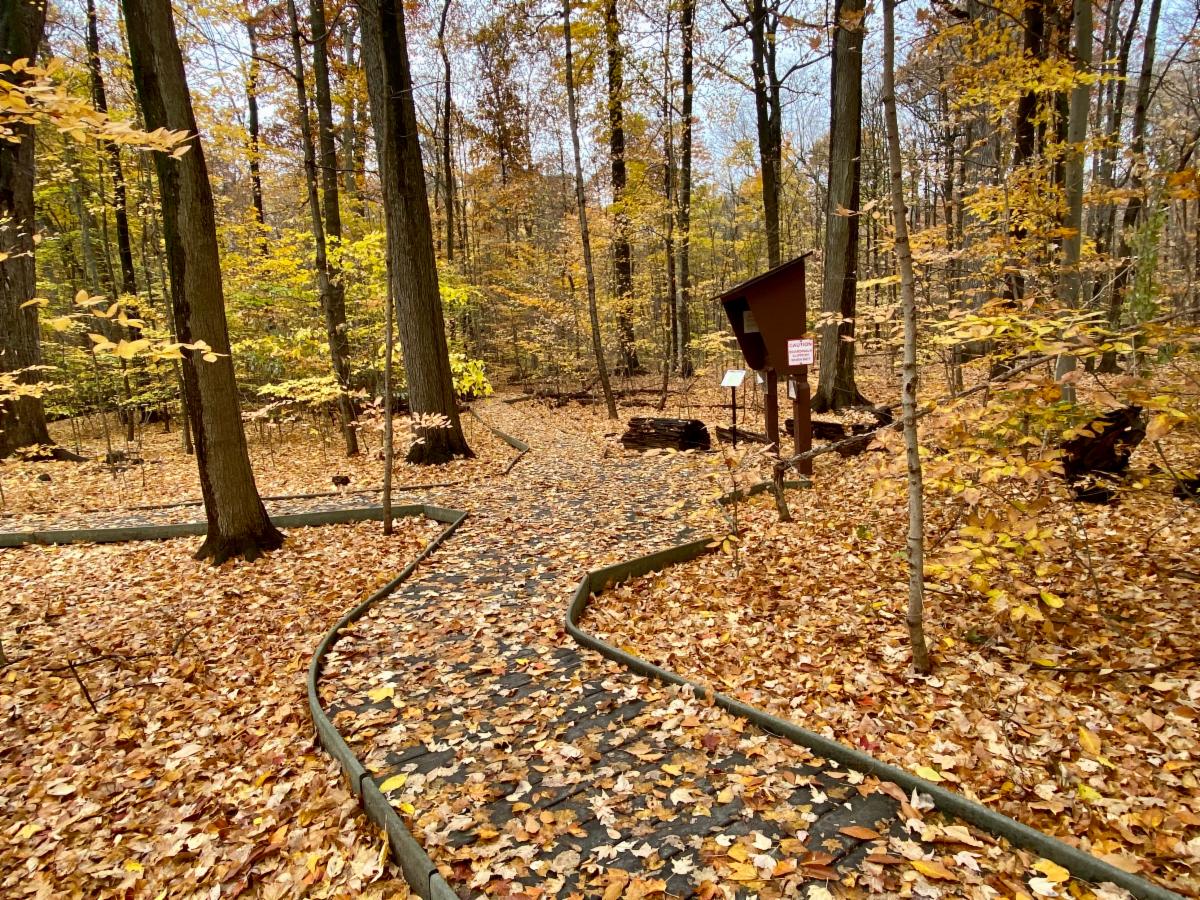
It’s hard to find a more perfect place in this area to contemplate the change of seasons than Johnson Woods State Nature Preserve. Located just south of Marshallville off State Route 94, it has an unassuming air, its sign appearing without fanfare as Fox Creek Road enters a stand of woods.
Donated by Clela Johnson in memory of her late husband Andrew C. Johnson, the 200-acre forest contains some of the best examples of old--growth trees in Ohio.
|
|
When it was settled in the early 1800s, this area sported trees that had existed before European settlers came to the New World. Given the inexorable march of settlement across the country, it is a miracle such primordial forests still exist. According to the Ohio Department of Natural Resources website, the woods have been protected by the Johnson family, starting with patriarch Jacob Conrad, who settled the land in 1823, to the donation in 1995 of the parcel to the state by Mrs. Johnson. They have even survived the pressure to log the oak and maple trees for money during the Depression. ODNR information says Johnson Woods is the largest and best old-growth forest in Ohio.
Still comprised of the original white oaks, red oaks and hickories, Johnson Woods is nonetheless undergoing succession. As the massive original trees succumb to age, they are being replaced by more shade-tolerant American beech and sugar maple. Dead old guard trees lie scattered across the forest floor, returning to their roots as humus created by the thousands of organisms simply doing their jobs.
That natural process only adds to the golden aura of these mid-autumn woods, leaves falling almost as fast as winter snowflakes. Although past their peak color, there are still plenty of rich reds and oranges joining with the yellows to put on a show.
I’m not a birder so I could appreciate but not differentiate among the chirps, whoops and trills that accompany anyone who walks the meandering, 1.4 mile TREX boardwalk. But there were lots of birds, along with a stray black squirrel munching on the beech nuts, acorns and other goodies on the forest floor. On this sunny autumn day there were enough visitors to the woods that most of the wildlife kept well hidden or perched hundreds of feet in the air.
Because of its size, Johnson Woods is large enough to serve as habitat for many woodland creatures, either as home or a waystation on their way somewhere else. It also serves as a reminder of a time long ago when hardwood forests ruled the land.
S Vradenburg
|
|
Selecting Plants with Purpose
Third in a series of four articles on the garden design and installation process.
|
|
Good garden design begins with assessing the area and determining needs. After using that information to create a garden design, it’s time to select the plants that will bring the design to life. The design indicates the size, shape and type of each plant (tree, shrub, conifer, groundcover, etc.). The next step is to replace those descriptors with specific plants that fit the parameters and add the color, shape, and texture that create beautiful spaces.
A good place to start the plant selection process is with the focal point plants. If the plan shows the focal point as a small, single-trunked, deciduous tree, you have the information needed to make a selection. Pull out your reference books or search online for plants with those qualities. HERE’s an example of a site that lists plants by their characteristics. Think about leaf color and seasonal interest. Consider whether the area is in sun or shade and what the moisture level is. Look at the list of favorite plants you created during your assessment and see if one fits the bill. Review the Pinterest page or file of photos and examples that you put together for inspiration.
After you have selected your focal point plants, fill in the supporting players. You’ve already determined the size and shape you are looking for. Think about plants that will contrast with and enhance your focal point. Remember that some of the plants are in groupings to add add substance to the bed, so choose plants that will fill in to create that mass. Use repeated plants throughout the landscape to unify the garden and draw the visitor in. Consider using different sizes of the same plant, for instance a miniature ninebark and a full-sized ninebark.
When choosing plants consider:
-
Zone. Summit County, Ohio is in zone 6. Remember that there are microclimates in the landscape which are more protected or subject to harsher conditions. Plant zone limits are included in most plant descriptions.
-
Water needs. If the area will receive little supplemental water, choose accordingly. If the area is wet a good part of the time, look for plants that can tolerate “wet feet”.
-
Available light. Full sun plants require at least six hours of sunlight per day. Part shade plants require 3-6 hours. Plant labels and descriptions will include this critical information.
-
Leaf color. Using red, yellow, and chartreuse foliage is a great way to add contrast and interest to an area. Be aware that there can be too much of a good thing.
-
Texture. Placing fine textured plants next to coarse textured ones adds interest and enhances the beauty of each.
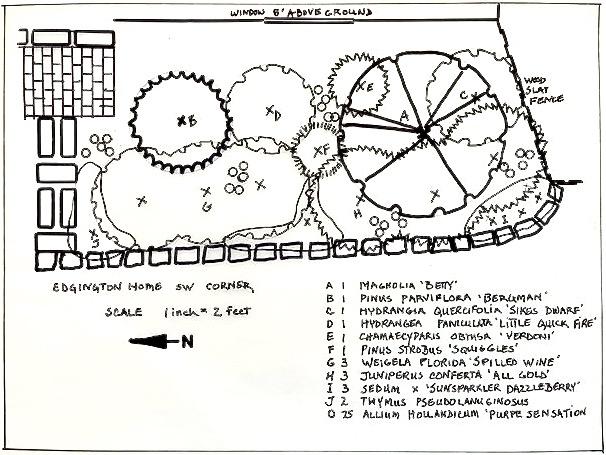
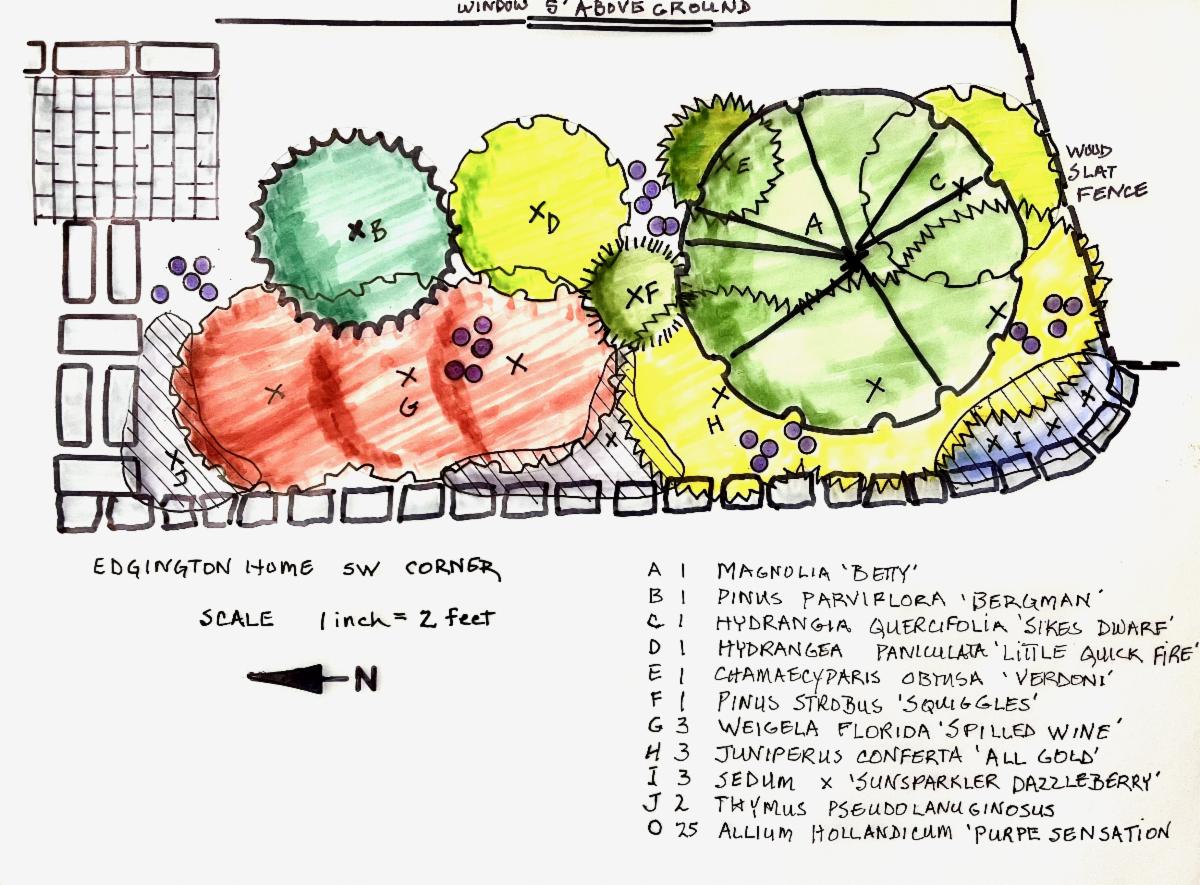
As an example, in the garden plan I created for my back yard corner I specified a multi-trunked, small-scale, deciduous tree. Trees that I considered were serviceberry, paperbark maple, fullmoon maple, magnolia (the Little Girl series, which is small in scale), and smoketree. This plant will anchor the corner of the house, and provide a focal point surrounded by conifers, deciduous shrubs, and a smattering of perennials. I settled on Betty magnolia, because of its rounded habit, graceful branches (a winter aspect), leaves that emerge coppery-bronze before turning deep green, and cup-shaped fuchsia flowers. Other deciduous plants I chose were Sikes Dwarf oakleaf hydrangea (white flowers, brilliant fall foliage, exfoliating bark), Little Quickfire panicle hydrangea (flowers that change from white to deep pink), and Spilled Wine weigela (deep purple foliage and dark pink flowers). Conifers that will give substance to this area and provide winter interest are All Gold Juniper (a stunning selection that grows only 6 inches tall), Bergman Japanese white pine (brightly colored cones and an architectural aspect), Verdoni Hinoki cypress (sprays of needles with yellow tips), and Squiggles white pine (a flattened globe with twisted blue-green needles). Dazzleberry sedum and wooly thyme will provide blue-grey edging and a season of flowers. Purple Sensation alliums add a summer pop of color (and will be spray painted thereafter to highlight their beautiful silhouette).
|
|
This design provides blooms in three seasons and loads of foliage color and texture. A number of the plants (Dazzleberry sedum, Hinoki false cypress, All Gold juniper, wooly thyme and Purple Sensation allium) will be repeated in other areas of the landscape.
Have fun with plant selection, and take advantage of your tracing paper to try out different combinations. This is a good time to take out that photo of the area that you took and print it on 8x11” white paper. Lay a piece of tracing paper over the photo and draw the hardscape lines. Refer to your plan and fill in the plants that you have envisioned at their mature size. Use your colored markers to color in the plants and you will have a rendering of the area as you have imagined it. If you want to go the extra mile, create this vertical view of your garden during the different seasons to make sure that you have created the interest and beauty you are looking for throughout the year.
When you have settled on a plant combination, fill in the plant names on your garden design plan. Most people indicate plants by assigning a letter to each plant species, starting with A. Label the plants on the drawing with those letters, and create a key below. At this point, you can color the various plants with markers to highlight the different colors or textures and add details to the plants to differentiate them on the drawing. You can add a north/south directional marker, a line indicating scale (for instance ¼” = 1’) and distinguish the types of paths with different patterns. This can be a work of art if you are so inclined, or a simple working rendering.
|
|
Most nurseries will work with you to acquire the plant material that you have selected, and there are many online sources as well. If you find that a plant you have selected is not available, go back into research mode and find a plant or two that will also fit the plan parameters. If you want to make sure the plants you are choosing for your plan are available, you can do your plant availability research before you label the plants on your plan. |
|
|
You now have a garden plan, correct to scale, with labeled plant material, and are ready for installation.
NEXT MONTH: From Plan to Planted
|
|
article and drawings by K Edgington |
|
November Checklist
- Plant your amaryllis bulbs now for winter sparkle.
- Continue to plant spring bulbs if the ground is not frozen.
- Mulch tea and floribunda roses and other tender perennials for winter protection.
- Clean and lubricate garden tools.
-
Consider grow lights for your houseplants as they adjust to darker interiors. HOW TO USE GROW LIGHTS FOR HOUSEPLANTS: Brittany Goldwyn
- Bring in garden hoses and ceramic pots.
- Take advantage of nice weather to remove weeds and rake leaves from lawns. Come spring you’ll be glad you did.
J Gramlich
|
|
More learning opportunities:
|
|
In the evenings I scrape my fingernails clean, hunt through old catalogues for new seed, oil work boots and shears. This garden is no metaphor -- more a task that swallows you into itself, earth using, as always, everything it can.
Jan Hirshfield, "November", Remembering Voltaire
|
|
We invite you to share The Root of It with your gardening friends and family. If you would like to subscribe to our mailing list please visit our website, scroll to the bottom, and follow the link under Join our email list. |
|
The Root of It staff: Karen Edgington (Editor), Emma Barth-Elias (Photo Editor), Carolyn Christian, Jennifer Gramlich, Sarah Vradenburg, and Geoff Kennedy (Technical Advisor)
|
|
We Would Like your Feedback
Contact us at: newsletterscmg@gmail.com
To discontinue receiving this newsletter please click on the UPDATE YOUR PROFILE link below. You may then choose what types of information you would like to receive from us.
|
|
|
|
|
|
|