Volume 4 Issue 10 | October 2023 | |
October's garden sings a sweet swan song. Dry leaves whisper in the wind. Colors turn to deep reds, golds, browns, and black. Spent plants are layered in the compost pile, soon to be next year's enriching mulch. Garlic and other bulbs are planted in the ground. The days shorten, and armchair gardening days are ahead. | |
The Root of It newsletter ends with our monthly quotation. If you find your newsletter has been clipped by your email provider please click HERE for a webpage version of the newsletter. | |
|
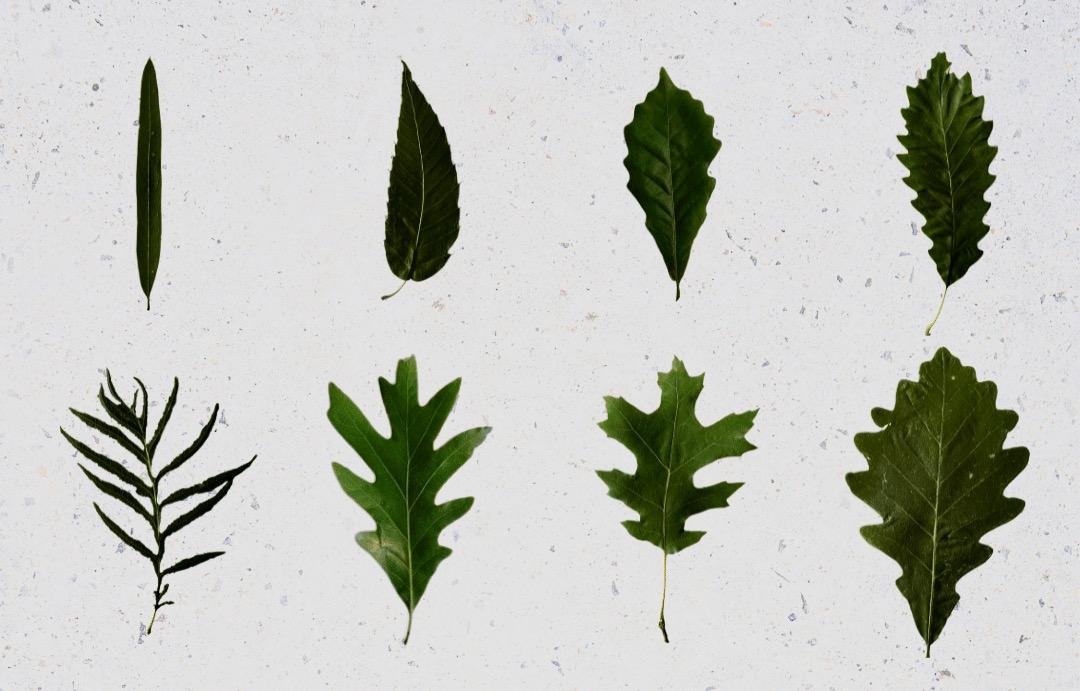
Oak species clockwise from top left: Willow Oak, Sawtooth Oak, Swamp Chestnut Oak, Chinquapin Oak, English Oak, Scarlet Oak, White Oak, Cutleaf English Oak
photos by K Edgington
| |
|
Leaves are drifting through the air, painting the ground with their fall colors. Maple, oak, honey locust, ginkgo – familiar leaf shapes help identify the trees above. But what’s that slender leaf over there? It looks like a willow leaf, but the tree’s shape and bark are nothing like a willow's. What a surprise to discover that it's an oak – a willow oak (Quercus phellos)!
It isn’t the shape of the leaf that makes an oak an oak, or a maple a maple. It’s the genetic similarity, which is most closely reflected by the reproductive parts of the plant – the acorns of oaks or the winged samaras of maples. All members of the oak genus (Quercus) will reproduce via similar male and female flowers and will have acorns – acorns that may vary in size or shape, but acorns nonetheless. Take a look at the collection of oak leaves in the banner above and note the variability. Compare the deep lobes of the white oak with the straight sides of the willow oak. Look for acorns to confirm that it is an oak that you see.
Hollies are another group of plants that exhibit great leaf variability. Think about the difference in leaf structure between winterberry, inkberry, Japanese holly, and our traditional, spiny-leaved holly plants, all members of the holly genus Ilex. Even more surprising, some members of this genus are deciduous (as are the winterberry hollies – Ilex verticillata) and some are evergreen (as are the native American hollies – Ilex opaca) They are all members of the holly (Ilex) genus, and ALL of them will reproduce via very similar flowers and fruits – holly berries. Count on it.
Why does this matter (other than being rather interesting and mind-expanding)? Leaf shapes can certainly help identify trees, especially when using one of the plant photo identification apps. For more accurate identification look to the flowers and the fruits. They more clearly indicate an affiliation, a connection one to the other. Look around!
A COMPARISON OF OAK LEAVES AND ACORNS: Michigan Arbor Day Alliance
7 KINDS OF HOLLY THAT THRIVE IN OHIO: Ohio State University CFAES
K Edgington
| |
Leaf Brief - Glorious Garlic | |
|
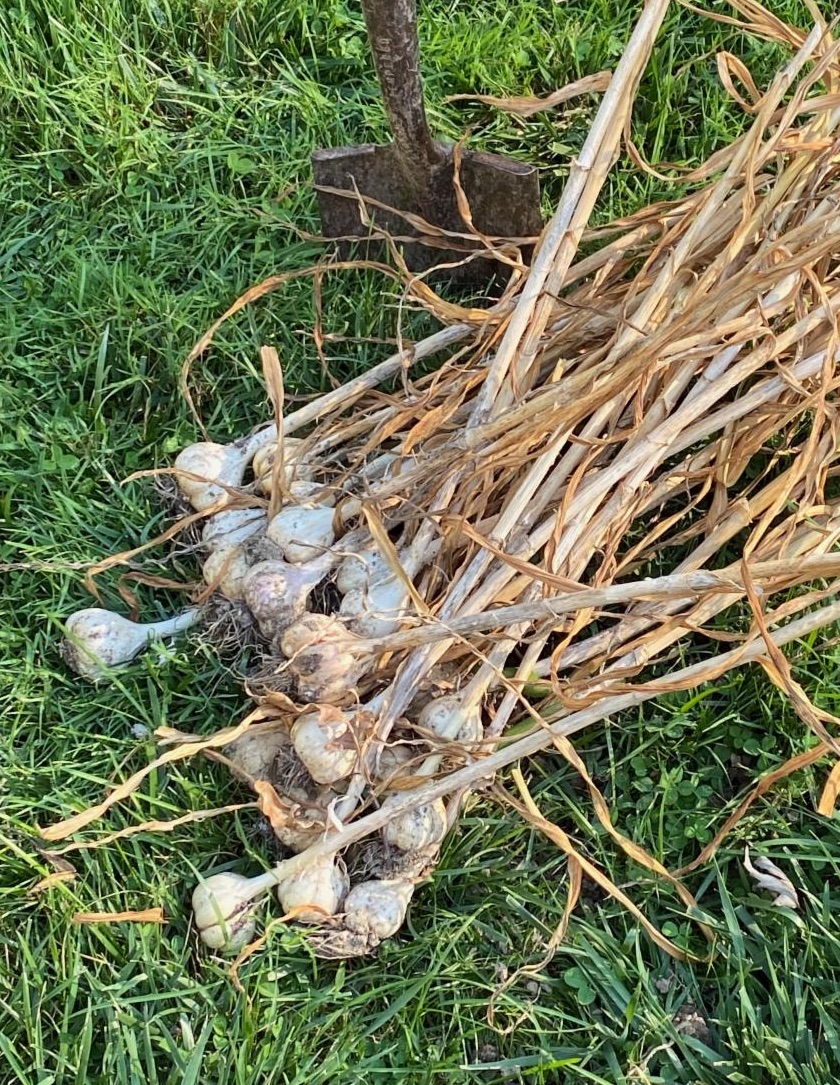
Hardneck Garlic Harvest
photo by E Barth-Elias
| |
|
Citizens the world over love their garlic, be it Europe, Asia, or the Americas. The signature garlic flavor is revered in appetizers, soups, main courses, and even desserts. (Garlic fudge, anyone?) It’s easy to grow, too; just a tiny corner of the garden can provide a year’s supply of deliciousness!
Garlic (Allium sativum) is a relative of the onion, leek, and shallot. It’s easy to spot the difference because garlic leaves are flat, whereas onion varieties are round and hollow. This perennial herb is a bulb that is usually treated as an annual. The bulb can be broken into numerous cloves that pack a punch of flavor (and aroma) and, like many herbs, it has medicinal uses. The sulfur-containing compound allicin is the active ingredient. It can kill bacteria, fungi, and parasites, boost immunity, and may even help regulate blood pressure. Though used topically for things like acne and sore muscles, it’s not recommended because it can irritate skin (and those around you).
| |
|
Of the three main types of garlic – hardneck, softneck, and elephant – hardneck grows the best in Ohio. It produces the familiar curly scape which is actually a seed head atop a woody flower stalk. Though flowering is minimal, it will form bulbils (small aerial cloves) that are fertile but take two to three years to develop. If the scape is removed, the plant puts its energy into the underground bulb which typically produces 4 -12 cloves. All this takes place from late fall, when individual cloves are planted, through a necessary cold period (vernalization) that is essential for development, to the spring when they sprout welcome green stalks. Don’t be in a hurry. Harvest only the scapes in the spring, which are milder in flavor and have lots of tasty uses. Read about it HERE. Wait until the leaves are turning brown to harvest the actual garlic bulb, usually in July in our area. Your patience will be rewarded with large bulbs and lots of cloves. Remember to set aside enough to plant in the fall.
While growing garlic is fairly straightforward, there are a few things you can do to avoid disappointment. Clean up the garden in the fall, getting rid of weeds and spent garden material. Garlic hates competition. Don’t plant grocery store garlic as it is most likely treated with a chemical that retards growth.
Garlic is a heavy feeder, so fertilizing throughout the growing cycle and adding organic material is beneficial. (HERE is more specific information.) A soil test is a good idea for any garden. A pH of 6.0-7.0 and well-drained, non-compacted soil is best. Poor drainage leads to bulb rot and fungal diseases.
Pests are generally not a problem unless you have the dreaded bloat nematodes in your soil or infected garlic. These microscopic worms burrow into the garlic, causing misshapen bulbs, tissue destruction, and yellowing leaves. It is difficult to eradicate so remember to rotate crops and buy bulbs only from a reputable source.
Whether you are a vegetable gardener or a cook (or both) there’s ample room in your yard for this culinary powerhouse. When you have your own supply, it’s easy to experiment or go with the classics. Either way, you can’t go wrong with garlic.
GARLIC, ALLIUM SATIVUM: University of Wisconsin Horticulture
J Gramlich
| |
|
The night sky from space.
Photo courtesy of NASA and taken by the Earth Observatory
| |
|
"Let there be light” is perhaps one of mankind’s oldest commandments. We have done just that, made light. Lots of it. And, as we have done with so much in the modern world, we have created too much of a good thing.
No one disputes that extending the day has enabled humans to be more productive, to travel, to create, to explore. However, for the billions of years before Thomas Edison invented the incandescent light bulb, the world was attuned to regular periods of light and dark.
For the past 144 years, however, the globe has become increasingly lit. We have all seen photos of the ever-widening web of lights that connects cities and countries. We are all — humans, animals, plants — paying a price for being caught in that web.
There are four kinds of light pollution, each with its own set of liabilities. Sky Glow is the general brightness of the sky, as in the urban night skyline. Glare is the harsh light that blinds, as in oncoming headlights. Light trespass occurs when light intrudes in a place it is not wanted. Clutter light pollution occurs when light is erratic, bright, and concentrated, as in Times Square.
What does this mean? Light disrupts the circadian rhythm, the physiological process that depends on regular intervals of darkness and light. For trees it means disrupting the ability to adjust to the seasons, changing flowering patterns and shortening dormancy. This keeps trees growing too long into the year, becoming vulnerable to harsh winters. Such off-kilter timing also changes phenology, so plants bloom earlier and drop leaves later in the year, throwing off signals for pollinators.
Fifty percent of animals are nocturnal. Frogs, moths, bats, owls, small rodents and carnivores spend their waking hours at night. Without dark periods, they are more vulnerable to predators and have less time to forage, find shelter and reproduce. Birds whose migration patterns take them over cities are attracted to and confused by the light and can be killed in collisions with buildings. An estimated 98 million to 1 billion birds die annually in such collisions throughout the United States. Insects killed when they collide with a hot lightbulb deprive birds of a valuable food source.
Humans, who are awake during the day, are not immune to the effects of light pollution. The brain needs a regular day/night routine for production of the hormone melatonin. If it is interrupted, we fall prey to a variety of health issues: sleep deprivation, headaches, stress, anxiety and depression. Recent research suggests a link between lowered melatonin levels and cancer.
There are ways to address light pollution. Homeowners can replace their exterior blue/white lightbulbs with amber light, which emits less harmful, longer spectrum light. Motion detectors turn lights on only when triggered. Outside light fixtures can be shielded so that beams are directed downward, not up, becoming part of the sky glow. The same holds true for shielding street and highway lighting. Cities can adopt “Lights Out” programs that encourage large office buildings to turn off lights when office workers are absent.
Yes, we did let there be light. Now we need to tone it down. This holiday season, ask yourself whether those extra white lights are really a true expression of the holiday spirit.
MISSING THE DARK: HEALTH EFFECTS OF LIGHT POLLUTION: National Library of Medicine
LIGHT POLLUTION: National Geographic
S Vradenburg
| |
Creature Feature - Hiding in Plain Sight | |
|
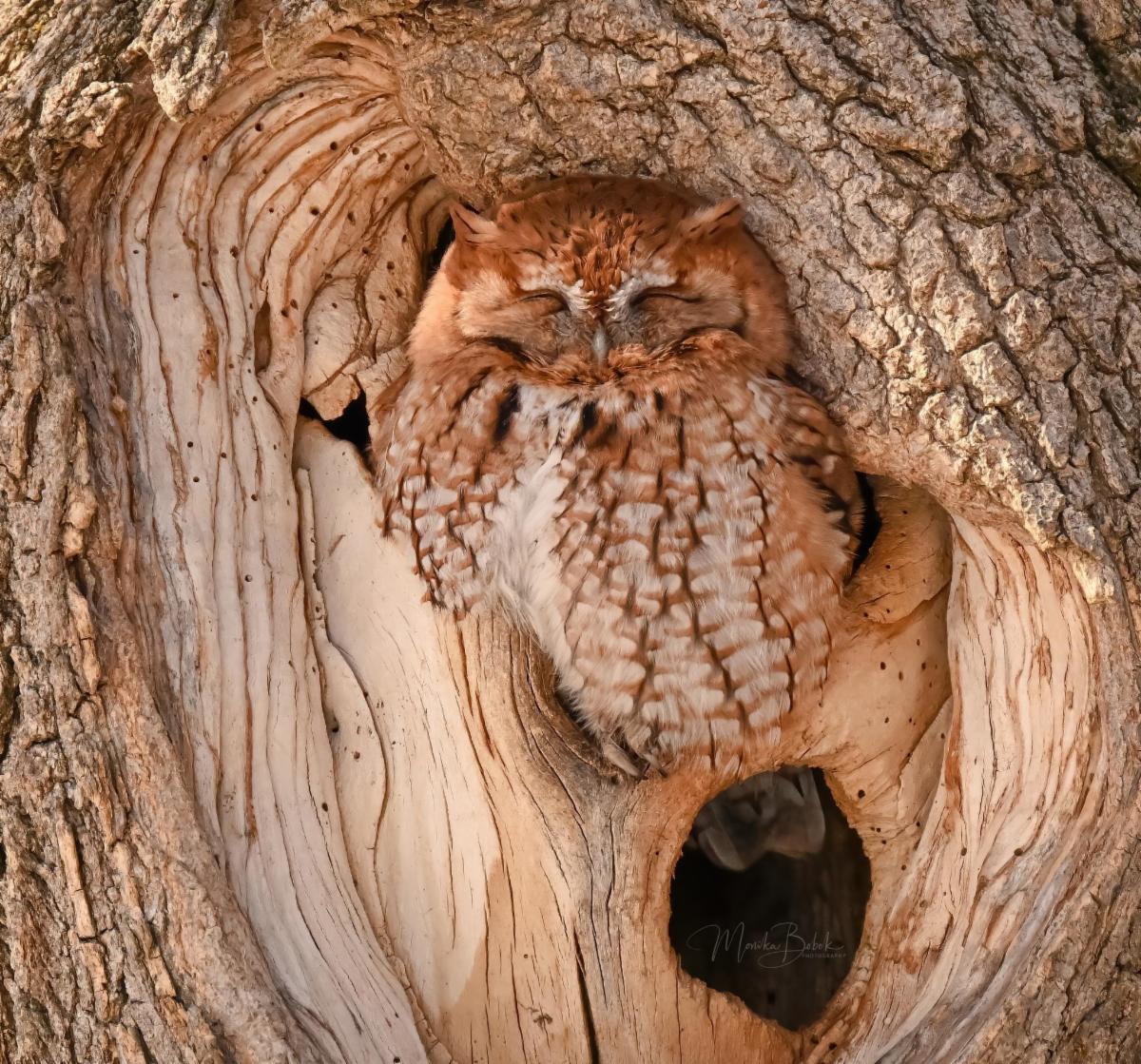
Camouflaged Eastern Screech Owl
photo by Monika Bobek
| |
|
October is the perfect month to meet a spooky creature who might be your neighbor. Long associated with Halloween for good reason—a nocturnal, silent predator with a fierce stare—owls are undeniably mysterious and a bit menacing (a lot if you’re a mouse).
There are over 200 species in the order Strigiformes worldwide; 19 are found in North America. Of the 12 species in Ohio, the eastern screech owl (Megascops asio) is the most common, though you’d never know it.
| |
|
Roughly the size of a robin—about 6 inches long and weighing under 8 ounces—these cute little raptors feature a light-colored beak, stout body, pointy ear tufts (which have nothing to do with hearing), and an amazing ability to hide in plain sight.
Found east of the Rockies, screech owls generally nest in cavities in living or dead trees or stumps, unoccupied woodpecker holes, and nest boxes if provided. They happily populate urban or rural environments as long as there are trees and nearby water, but avoid dense forests that attract bigger species, which view them as dinner, not cousins.
About two-thirds of screech owls are grey-colored, while the rest are reddish brown (rufous). A screech owl’s color may determine the kind of tree they blend into best—grey owls with sycamores and oaks, rufous owls with pines. But their complex feather patterns of black dots and bands are what allow them to vanish into the branches. See HERE. MORE incredible photos.
These crafty owls increase their camo when threatened by streamlining their feathers, stretching tall and giving their best Clint Eastwood squint. Watch HERE. (Squirrel).
Eastern screech owls look cuddly, but are living proof that appearances can be deceiving. Their tube-shaped eyes have more light-sensitive cells that detect motion and light (rods), than ones that distinguish color (cones). This allows them to easily spot movement in the dark and swoop down to gobble up unsuspecting mice, chipmunks, rats, frogs, snakes and flying insects. One owl can eat more than 1,000 mice in a year (who counted?). They also attack small birds like starlings, titmice and chickadees; a bird feeder might become an owl’s favorite diner. Fed-up songbirds fight back by noisily mobbing a screech owl if they spot one in daylight, to alert bird friends and drive the owl away. If you hear a bird-y ruckus look closely—you may spot a beleaguered screech owl.
A screech owl’s cute ear tufts are purely camouflage, serving to break up the line of its head. Their real ears are asymmetrical and located behind their eyes. Owl eyes don’t move, but owl necks famously compensate by swiveling 270 degrees (they have 14 neck vertebrae compared to our 7). Sound hits one ear slightly before the other, so as the owl turns its head to make the sounds simultaneous it pinpoints its prey. Like other owls the eastern screech owl’s fringed feathers allow it to fly silently and attack with no warning. Advantage—owls.
Owls don’t have a crop (an expandable pouch near the throat used by most birds to store food before digestion). They also lack teeth. This means they must swallow prey whole or bring it back to the nest to dismember it. Pleasant. Indigestible parts like bone and fur are formed into a pellet and regurgitated. Dissecting a pellet is a great activity for the right child.
Mostly solitary screech owls pair only during breeding season, February to March. Males patrol a territory that contains a number of cavities, spending a night in each one. The female chooses the nest site, usually the one best stocked by the male with food. Screech owls mate for life, but some ambitious males have two mates. The new sweetie throws the old one out, lays her own eggs in the same nest, and then raises both clutches. No “we’re all going to be friends” with these gals.
Clutch size ranges from 2-8 eggs that hatch asynchronously (at different times) in 26-30 days. Those cute little nestlings sometimes bump off their youngest, weakest sibling in a practice called siblicide. Somehow, I'm not surprised. The smaller, faster male provides food for the nestlings. Or else. THIS VIDEO shows Dad bringing home the bacon, so to speak.
You now know a lot about the adorable (albeit vicious killer) eastern screech owl, except why it is called that. I can’t help you. While you are far more likely to hear this owl than see it, it probably won’t be screeching. These owls generally make two types of sounds. A trilling noise (tremolo) is used to stay in contact with their mate. They whinny (yes, like a horse) to defend their territories. Listen
HERE. And HERE.
If you’d like to learn more about these fascinating creatures click HERE. If you want to attract a pair of the little darlings, consider putting up your own nest box—instructions HERE.
C Christian
| |
Watch Out for This Creep(er)! | |
|
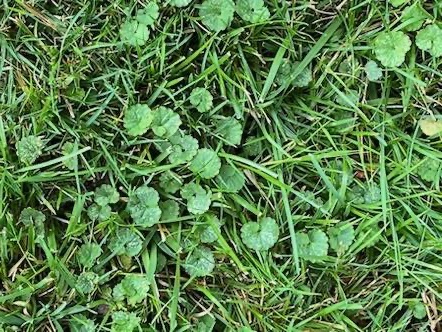
Ground Ivy
photo by K Edgington
| |
Your vision of a beautiful, healthy lawn may be a carpet of dark green grass blades or perhaps a mixture of grasses, clovers and other plants that provide a home and forage for insects. It likely does NOT include an ever-expanding mat of ground ivy. This invasive weed, also known as creeping Charlie, gill-over-the-ground, or cat’s foot, can outcompete and even replace turf grasses and other plants as it finds its way into beds, borders, and spaces in paving surfaces. | |
|
Ground ivy (Glechoma hederacea) was introduced to the United States from Eurasia by early settlers for its medicinal and herbal properties. As a non-native it spread rapidly, and can now be found in all fifty states, with the exception of Nevada, Arizona, and New Mexico. A member of the mint family, it spreads via square stolons, or above-ground stems, and can root at each leaf node. Its shiny, bright green, round leaves have toothed edges and are arranged in an opposite manner on the stem. Although it spreads primarily through rooting stolons, each of its purple flowers produces four nutlet-type seeds that are distributed by humans and animals. Ground ivy develops into a low, dense mat that shades out other plants, but when in flower stems grow upward to a height of 4-16”, after which it returns to its horizonal habit. When crushed, the leaves and stems emit a strong, distinct odor, a fragrance most gardeners in my acquaintance dislike. While it thrives in shady, moist areas, it is not restricted to them. Although used medicinally for centuries, ground ivy is poisonous to horses and some other mammals. Keeping it out of pastures is serious business!
Once established in lawns, ground ivy is difficult to control, much less eradicate. The first strategy should be to establish healthy, vigorous turf that does not have the bare spaces necessary for this invasive to take root. Grasses such as tall and fine fescue which thrive in shady areas are good choices. Mow at the proper height – around 3” depending on the type of grass. (Higher grass shades out weeds and provides the grass plant with more photosynthetic opportunity.) Irrigate to prevent plant stress – again, water needs vary for different types of grass. Fertilize at the right time and in the right amount. Researchers tell us that the most important feeding time for turf is fall. Lightly mulch and reseed areas of sparse grass. Learn to identify ground ivy so that it can be removed before it spreads. Click HERE for the University of Wisconsin Extension’s excellent publication on lawn care.
Hand pulling can feel satisfying and productive, but once ground ivy has become dominant removing all of the rooted (or potentially rooted) stolons is nearly impossible. Most researchers suggest that the best mechanical means of control is to pull up the sod or solarize the area and reseed! Chemical control presents an option, but effective chemicals are few. Using a broad-leaf, post-emergent herbicide that lists ground ivy on the label and following the directions in terms of weather conditions and timing is essential. This WISCONSIN MASTER GARDENER PUBLICATION details ground ivy control options, chemical options in particular. A good window for chemical control of weeds is when they are actively growing, and it is recommended to apply a post-emergent herbicide for ground ivy in the late autumn, after the first frost.
What about accepting, maybe even welcoming ground ivy into the lawn-scape as a source of nectar for pollinators? Ground ivy has developed a “Lucky Hits” strategy in which only a small portion of the flowers (8%) have a significant nectar load. This load is sufficient to encourage pollinators to keep looking, flower to flower, for the nectar bonanza, therefore servicing a large number of the flowers. Ground ivy’s pollen is not readily available to pollinators. While its nectar can be worth the expenditure for bees and other pollinators, pollinator experts discourage the cultivation of ground ivy, noting that lawns with the best environment for pollinators have a diversity of flowers that consistently produce both nectar and pollen.
Ground ivy is a challenging weed and the bane of many gardeners. Get to know it and the strategies to keep it from taking over lawns and garden beds.
K Edgington
| |
|
October Checklist
J Gramlich
| |
More learning opportunities:
| |
|
The scarlet of maples can shake me
like a cry of bugles going by.
And my lonely spirit thrills to see
the frosty asters like smoke upon the hills.
William Bliss Carman
| |
We invite you to share The Root of It with your friends and family. If you would like to subscribe to our mailing list please visit our website, scroll to the bottom, and follow the link under Join our email list. | |
The Root of It staff: Karen Edgington (Editor), Emma Barth-Elias (Photo Editor), Carolyn Christian, Jennifer Gramlich, Sarah Vradenburg, and Geoff Kennedy (Technical Advisor)
| |
We Would Like your Feedback
Contact us at: newsletterscmg@gmail.com
To discontinue receiving this newsletter please click on the UPDATE YOUR PROFILE link below. You may then choose what types of information you would like to receive from us.
| | | | |