|
Syilx Territory, Kelowna, B.C. – A Rotary-led community fundraising campaign has surpassed its goal, raising more than $580,000 to support the development of a rapid invasive mussel detection tool that could strengthen British Columbia's front-line defences against invasive mussels.
The campaign exceeded its initial $475,000 target for the two-year research phase of the project, which is being led by researchers at UBC Okanagan in partnership with the Okanagan Basin Water Board and collaborating institutions across North America.
“We are extremely grateful to the Rotarians, foundations, local governments and individual donors who recognized the importance of this work and stepped forward to support it,” said James Littley, Chief Operating Officer of the Okanagan Basin Water Board. “This is an excellent example of people coming together to address a major threat before it reaches our lakes.”
The project began with catalyst contributions of $200,000 from the Okanagan Basin Water Board, $100,000 from The Colin and Lois Pritchard Foundation and $75,000 from Mitacs. The City of Kelowna–UBC Okanagan Research Alliance contributed a further $100,000.
During a public fundraising drive launched by Rotarians, an additional $109,000 was raised, including from the Rotary Club of Kelowna Okanagan Mission, the Rotary Club of Kelowna, the Rotary Club of the Rivers as well as individual community donors, serving to strengthen and expand the project’s impact.
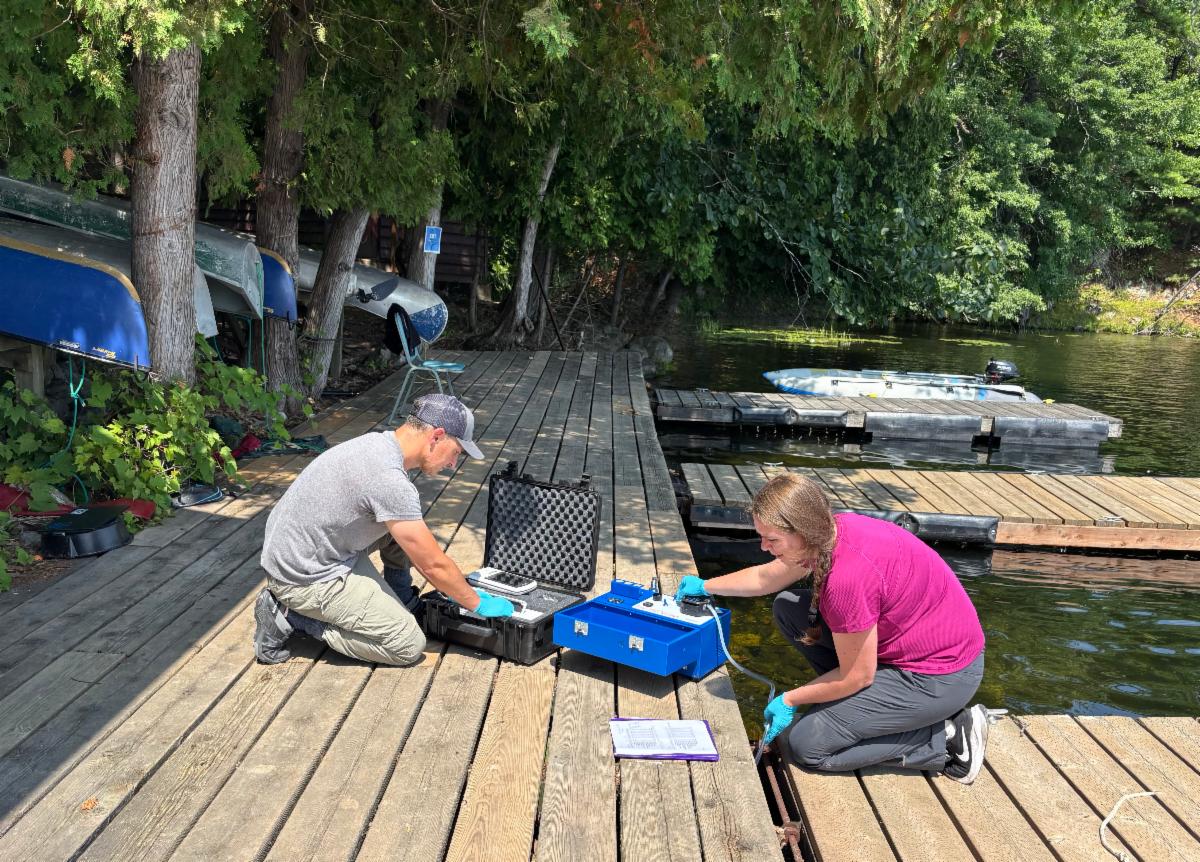
Researchers are developing a portable environmental DNA, or eDNA, detection system that could eventually be used at roadside watercraft inspection stations. The system is intended to collect and process small genetic samples from watercraft, helping inspectors identify boats that may be carrying invasive mussels and require decontamination or quarantine.
“This research is harnessing leading-edge genomic technologies to help address an issue of the utmost importance to the Province and our community,” said Dr. Michael Russello, Principal Investigator and UBC Okanagan Impact Research Chair in Conservation Genomics. “At the same time, the work is only possible because of our partnerships with researchers at the University of California, Davis and Queen’s University in Ontario, making this a North America-wide effort.”
Currently, B.C. supplements human inspectors with trained mussel-sniffing dogs, but there are only two of these specialized canines in the province. Colin Pritchard, a local Rotarian and donor who originated the concept of creating an “artificial dog’s nose” to detect invasive mussels, said the fundraising response demonstrated the community’s willingness to address significant environmental challenges.
“Rotarians have a mission to protect our planet and its resources and fund projects that have lasting impacts. We care deeply about our communities, and we are not afraid to tackle big issues,” Pritchard said. “When we learned about the threat invasive mussels pose, I knew we had to do something.”
“The additional funding may allow the project to move beyond the initial research phase and help put this technology directly into the hands of watercraft inspectors,” he added. “I am very pleased with the outcome and grateful to my fellow Rotarians and everyone else who stepped forward to support this work.”
The urgency behind the project is growing as invasive mussel threats continue to move closer to British Columbia.
Earlier this month, zebra mussel larvae were detected in Lake of the Prairies, a waterbody shared by Manitoba and Saskatchewan, while golden mussels, first detected in California in late 2024, have since spread rapidly through the state. Infested watercraft have also been intercepted travelling north toward Idaho.
Golden mussels present an additional threat as they can survive in a wider range of environmental conditions than zebra and quagga mussels, including brackish water. Their arrival in North America has expanded the range of B.C. waters and infrastructure that could be at risk, including coastal facilities such as the Port of Vancouver. The province has also added 16 lakes to its priority monitoring list in response to the changing threat.
The Arvin-Edison Water Storage District in California recently reported spending approximately US$3 million on a 30-day copper treatment of its water system, only months after golden mussels were first detected there.
Previous provincial estimates found that zebra and quagga mussels alone could cost British Columbia between $64 million and $129 million annually. Those estimates predate the arrival of golden mussels in North America and do not account for the additional risks they pose. With potential impacts to hydroelectric facilities, drinking-water systems, irrigation infrastructure, ports, marinas, tourism, real estate and ecosystems, the annual cost of an infestation could now reach hundreds of millions of dollars.
“Invasive mussels would affect nearly everything we value about British Columbia’s lakes — from ecosystems and recreation to agriculture, tourism and essential infrastructure,” Littley added. “Even people who never own a boat or visit a beach could see the consequences through higher electricity and water costs. Prevention remains our best and least expensive defence.”
Anyone transporting a boat or other watercraft into the Okanagan is reminded to Clean, Drain and Dry all watercraft and equipment, remove drain plugs during transport and stop at every open watercraft inspection station along their route.
“It’s the law, and it’s the right thing to do,” Littley said. “The success of this fundraiser is encouraging, and the technology could be a gamechanger, but we still need every watercraft owner to take responsibility and help prevent invasive mussels from reaching British Columbia.”
For more information about invasive mussels and how to prevent their spread, visit dontmoveamussel.ca.
|