| |
Energy, electricity and ICT for Africa
| | News and announcements from EE Business Intelligence | | |
You are receiving this email because of your past interactions with EE Business Intelligence and
EE Publishers. To unsubscribe, please click the SafeUnsubscribe link at the bottom of this email.
| | Roundup of major energy and electricity news and developments: 12 October to 25 October 2026 | |
1. Ekurhuleni gets green light for 2400 MW private power procurement.
2. Eskom seeks private partner for massive 1500 MW Tubatse pumped-storage project.
3. VPPs gather momentum as Cape Town and eThekwini launch pilot projects.
4. Tshwane substation explosion exposes vulnerability of Pretoria's electricity network.
5. SA nuclear news: Thyspunt delayed, Koeberg restored, uranium enrichment advances.
6. Cape Town expands municipal energy ambitions as renewables investment grows.
7. Zambia and Zimbabwe advance solar projects as Kariba faces another difficult year.
8. SA oil and gas sector in crisis as PetroSA battles liquidation and gas cliff looms.
9. Mozambique's gas ambitions gather momentum, while South Africa dithers.
| | |
1. Ekurhuleni gets green light for 2400 MW private power procurement.
The City of Ekurhuleni has received ministerial approval to procure 2400 MW of electricity generation capacity from independent power producers (IPPs), potentially attracting R16.2-billion in private investment and saving the municipality R36-billion in electricity purchases over 20 years. Electricity and Energy Minister Kgosientsho Ramokgopa announced the Section 34 determination under the Electricity Regulation Act on 19 October 2026, alongside Ekurhuleni Executive Mayor Nkosindiphile Xhakaza. The programme comprises 1237 MW of solar PV, including 100 MW procured through wheeling arrangements; 780 MW of gas-fired generation; 183 MW of waste-to-energy; and 200 MW of innovative generation technologies. Ekurhuleni currently spends more than R22-billion annually purchasing bulk electricity, predominantly from Eskom. The municipality anticipates commissioning an initial 357 MW of solar PV during 2027/28, with the remaining capacity targeted for completion by 2029/30. However, the projected savings remain estimates, dependent on actual procurement tariffs, financing, project performance and implementation costs. In perhaps a prelude of things to come, construction commenced on a R360-million, 25.6 MWp solar PV project at the Springs Fresh Produce Market on 22 October 2026. Developed by BluEnergy, part of JSE-listed Blu Label Unlimited, in partnership with IBS Crafts, the project will use market rooftops and adjacent land to generate approximately 40 GWh annually. The privately financed facility will supply electricity to Ekurhuleni under a 20-year power purchase agreement, without upfront municipal capital expenditure. Construction is expected to create more than 100 jobs. The announcements represent significant progress towards diversifying municipal electricity procurement and reducing dependence on Eskom. However, coming just weeks before the 4 November 2026 municipal elections, the ambitious programme faces questions about procurement transparency, financial sustainability, contractual commitments and continuity under a potentially changed municipal administration.
| |
2. Eskom seeks private partner for massive 1500 MW Tubatse pumped-storage project.
Eskom has launched a competitive process to secure a private-sector strategic partner for its proposed 1500 MW Tubatse pumped-storage scheme near Roossenekal in Limpopo, potentially South Africa’s largest pumped-storage facility. The project, being advanced through Eskom Green, would comprise four reversible pump-turbine units with approximately 21 GWh of energy storage, enabling generation at full capacity for up to 14 hours. Pumped storage uses electricity to pump water to an upper reservoir when power is plentiful, releasing it through turbines when demand rises. Tubatse is intended to help integrate growing volumes of variable wind and solar generation, reduce curtailment and provide frequency control, reserves and other grid-support services. Eskom’s request for qualification invites experienced, financially capable organisations to participate in developing, financing and delivering the project. Shortlisted bidders will proceed to a request-for-proposals stage, with responses due by 30 November 2026. Eskom says land has been secured, environmental authorisation granted, water availability confirmed from De Hoop Dam and technical and grid-connection studies advanced. The project is expected to be structured through a ring-fenced special-purpose vehicle, although ownership, funding and commercial arrangements remain to be determined. Eskom’s preferred revenue model involves a ministerial determination enabling a long-term power purchase or capacity agreement with the National Transmission Company of South Africa (NTCSA). Alternatively, the partners must assess bilateral contracts and opportunities in an emerging competitive electricity market. The announcement follows Eskom Green’s separate search for partners for up to 6 GW of renewable energy and storage projects by 2030. While Tubatse could make a substantial contribution to system flexibility, its ultimate viability will depend on construction costs, financing, bankable offtake arrangements and the allocation of project risks between Eskom and private investors.
| | |
3. VPPs gather momentum as Cape Town and eThekwini launch pilot projects.
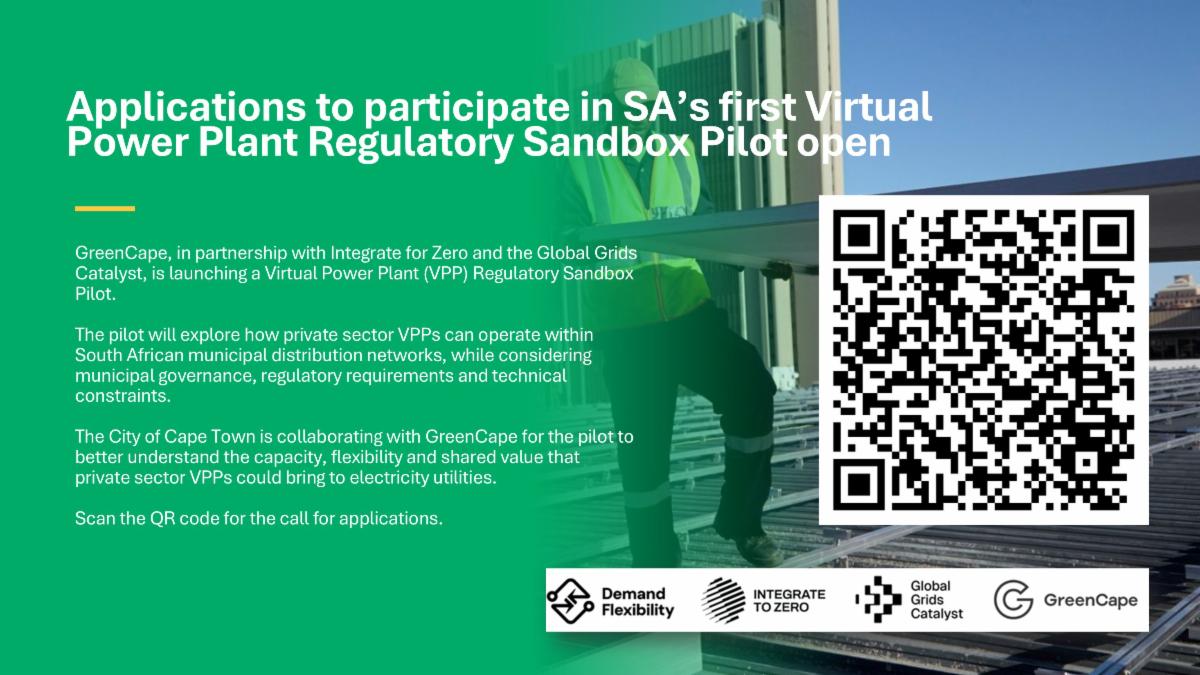
GreenCape has invited virtual power plant (VPP) providers to apply for South Africa’s first VPP regulatory sandbox pilot, designed to test how privately operated aggregators can support municipal electricity networks. Announced on 22 October 2026, the initiative is being developed with Integrate to Zero and Global Grids Catalyst, in collaboration with the City of Cape Town. It will examine regulatory, governance, technical and commercial arrangements for coordinating customer-owned solar PV, batteries and smart appliances. Rather than building conventional generating capacity, VPPs digitally aggregate distributed energy resources, enabling them to respond collectively to electricity system requirements. The Cape Town pilot will focus primarily on shifting consumption from expensive peak periods to off-peak hours, while exploring grid services including rapid dispatch, voltage control and ancillary services. Between one and four VPP providers will be selected, initially involving approximately 150 households, mainly using residential batteries. Incentive funding will support participating providers and selected technical infrastructure, including approved smart meters. Applications close on 15 November 2026, with participants expected to be appointed by 30 November. Technical testing is scheduled for December 2026 and January 2027, followed by an incentive programme from February to September 2027. The initiative complements other South African VPP developments. In eThekwini, Project Smart Solar, undertaken with local technology company Plentify and supported by European development partners, is recruiting up to 280 households to test coordinated management of rooftop solar, batteries and electric water heaters. Plentify has also announced plans with inverter manufacturer Deye for a larger residential battery aggregation programme. The pilots could help municipalities manage peak demand, lower bulk electricity costs and reward customer flexibility. However, viable business models will require clear aggregation rules, fair customer incentives, reliable metering and workable arrangements between municipalities, aggregators and electricity customers.
| | |
4. Tshwane substation explosion exposes vulnerability of Pretoria's electricity network.
Serious electricity infrastructure failures in the City of Tshwane left residents and businesses in several Pretoria suburbs without electricity for more than two weeks, raising renewed concerns about municipal network maintenance, reliability and accountability. The crisis began on 29 September 2026 when an explosion and fire at the Waltloo substation caused a 132 kV trip at the critical Njala infeed station, disrupting supply to at least 11 primary substations across Pretoria. Although electricity was progressively restored to most areas, residents of La Montagne, Meyerspark, Murrayfield and Willow Park Manor remained without power for up to 14 days or longer. The initial incident was followed by multiple underground medium-voltage cable faults, complicating restoration efforts. In the Murrayfield supply area alone, technicians identified at least ten separate faults, with repairs frequently revealing further damaged cable sections. Tshwane implemented emergency load rotation while technicians worked to restore supply without overloading remaining infrastructure. Residents reported substantial financial losses from spoiled food, damaged appliances, business interruptions and generator fuel costs. Some households faced prolonged outages while children prepared for matric examinations. Ward councillor Malcolm de Klerk accused the municipality of inadequate maintenance, claiming properly functioning standby transformers could have substantially reduced the duration of interruptions. These allegations have not been independently established. The municipality acknowledged the hardship and confirmed that affected customers could submit claims for damages, subject to establishing legal liability. The incident follows previous major substation failures in Tshwane, including fires at Wapadrand in 2018 and Mooikloof in 2022, which also caused prolonged electricity interruptions. The latest failures highlight the vulnerability of ageing municipal electricity infrastructure, raising questions about preventative maintenance, network redundancy, asset management and the adequacy of municipal capital expenditure on electricity distribution networks.
| |
5. SA nuclear news: Thyspunt delayed, Koeberg restored, uranium enrichment advances.
South Africa’s nuclear sector recorded developments in new-build planning, Koeberg operations and nuclear fuel production during October 2026, with progress accompanied by regulatory and commercial uncertainties. The environmental assessment for Eskom’s proposed 4800 MW nuclear power station at Thyspunt, Eastern Cape, has been extended. Environmental assessment practitioner WSP announced on 21 October that the draft environmental impact assessment report is now expected for public comment in the first quarter of 2027. The Department of Forestry, Fisheries & Environment (DFFE) has required further studies, including examination of the alternative Bantamsklip site and comparisons with other generation options. Although the scoping report has been accepted, no environmental authorisation to build has been issued. No reactor technology, vendor, final capital cost or financing arrangement has yet been selected. Meanwhile, Koeberg Unit 1 returned to service on 22 October 2026 after automatically disconnecting from the grid on 16 October 2026. The trip occurred during testing associated with Unit 2’s maintenance outage. Eskom attributed the response partly to a conservative protection-relay setting and said nuclear safety was unaffected. Unit 2 remains in planned maintenance. In a separate development, state-owned NECSA and Quantum Leap Energy, a subsidiary of US-listed ASP Isotopes, signed a binding heads-of-agreement for a joint venture to develop high-assay low-enriched uranium (HALEU) production at Pelindaba. Quantum Leap would hold approximately 80% and NECSA 20%. The proposed facility targets nuclear fuel for advanced reactors, with Quantum Leap citing supply agreements with TerraPower. A test bench has been constructed, but commercial-scale enrichment remains subject to development, financing and regulatory requirements. The above developments underline renewed nuclear ambitions, while leaving open fundamental questions about project economics, licensing, implementation schedules and delivery.
| | |
6. Cape Town expands municipal energy ambitions as renewables investment grows.
South Africa's renewable energy sector recorded further progress during October, with Cape Town advancing its municipal electricity ambitions, Redefine Properties commissioning a new solar wheeling project, and FirstRand launching a renewable energy financing platform. Cape Town executive director for energy Kadri Nassiep told the Solar & Storage 2026 conference that the city aims to establish its own electricity utility, increasingly supplied by municipal-owned solar PV, battery storage and independent power producers (IPPs). The city's first 7 MW solar plant has been completed, while a planned 70 MW facility would become South Africa's largest municipal-owned solar plant. Cape Town has also issued a 500 MW electricity procurement tender open to generators nationwide. Nassiep said electricity affordability, rather than load-shedding, was now a key driver, while regulatory constraints continued to hamper municipal generation development. Meanwhile, JSE-listed Redefine Properties commissioned a R106-million, 7 MWp rooftop solar installation at Massmart's Brackengate distribution centre in Cape Town. The facility will generate approximately 9.9 GWh annually, supplying electricity through Cape Town's municipal wheeling network to Kenilworth Centre, Blue Route Mall and The Towers office precinct. The project, supported by a 20-year commitment, demonstrates opportunities for commercial property owners to share renewable generation between geographically separated properties. Separately, FNB, WesBank and RMB launched nav.energy, an integrated platform offering businesses renewable energy solutions through financing, rental arrangements and power purchase agreements. Customers can own installations, rent equipment with eventual ownership transfer, or purchase electricity from systems owned and operated by third parties. The above developments highlight growing diversification of South Africa's electricity supply, with municipalities, property companies and financial institutions increasingly enabling private renewable generation, electricity wheeling and new commercial models beyond conventional utility supply.
| | |
7. Zambia and Zimbabwe advance solar projects as Kariba faces another difficult year.
Renewable energy developments across Southern Africa gathered momentum during October, with new solar capacity commissioned in Zambia, major project financing secured in Zimbabwe and rural electrification advancing in Mozambique, against renewed concerns about Kariba hydropower availability. In Zambia, Solarcentury Africa commenced commercial operations at its 34.5 MWp Mailo 2 solar PV plant, increasing operational capacity at the Mailo development to 59.5 MWp. The project, financed by BB Energy and Standard Bank, was completed within 12 months. It forms part of an eventual 118 MWp development and Solarcentury Africa's broader 350 MW Zambian project portfolio. The first phase has been selling electricity into the Southern African Power Pool (SAPP) merchant market since 2025. Meanwhile, Zimbabwean ferrochrome producer Afrochine Smelting secured a US $155.5-million financing package for the 115 MW Centrachine solar project at Selous. The development will supply Afrochine's smelting operations through a dedicated 5 km transmission line under a 25-year US dollar-denominated power purchase agreement. Commissioning is targeted for July 2027. However, the Zambezi River Authority reduced its combined 2027 water allocation for Kariba hydropower generation by 36%, from 36-billion to 23-billion cubic metres, shared equally between Zambia and Zimbabwe. The reduction reflects forecasts of below-normal rainfall associated with El Niño conditions, highlighting continuing vulnerability to hydrological variability. In Mozambique, the government's Energy Fund, FUNAE, commissioned a decentralised solar plant supplying electricity to Nsadzu village in Tete province, supporting households, refrigeration and local businesses. Separately, Zambia's ZESCO, Stanbic Bank and GreenCo are developing the ZamWatt renewable energy programme, combining solar, wind, hydro and battery storage to supply commercial and industrial customers. These initiatives demonstrate expanding private investment and electricity trading opportunities, alongside persistent regional energy security challenges.
| | |
8. SA oil and gas sector in crisis as PetroSA battles liquidation and gas cliff looms.
South Africa's troubled oil and gas sector faces mounting challenges, including a looming industrial gas supply crisis, offshore exploration delays and deepening financial distress at state-owned PetroSA. The Industrial Gas Users Association of Southern Africa (IGUA-SA) warns that declining supplies from Mozambique's Pande and Temane fields will force Sasol to discontinue pipeline gas supplies to industrial customers by mid-2028. Sasol's temporary methane-rich gas alternative is expected to last only until 2030, while proposed liquefied natural gas (LNG) import terminals are unlikely to become operational before 2031. IGUA-SA warns that more than 300 industrial gas customers face serious supply risks, potentially triggering plant closures, job losses and economic damage. Its updated Gas Roadmap calls for urgent government intervention, coordinated infrastructure development and bankable gas-to-power commitments. Meanwhile, TotalEnergies Exploration & Production South Africa MD Magali Pailhé criticised prolonged regulatory appeals delaying offshore oil and gas exploration. Speaking at African Energy Week, Pailhé said exploration permitting takes five to seven years in South Africa, compared with one to three years elsewhere. She called for streamlined appeals and greater regulatory certainty. PetroSA's financial difficulties have also intensified. Former trading partner Nako Energy has applied for PetroSA's liquidation over an unpaid R606-million fuel debt. PetroSA disputes the application, claiming Nako itself owes R833-million, leaving a net R227-million recoverable by PetroSA. The dispute follows controversial fuel transactions, while PetroSA reportedly faces approximately R10-billion in creditor claims, including substantial unpaid taxes. Separately, Central Energy Fund chair Ayanda Noah acknowledged inadequate oversight of PetroSA's controversial Gazprom-linked refinery revival arrangements, while maintaining that Mossel Bay operations could potentially restart within 24 to 36 months. The developments underline persistent weaknesses in security planning, regulatory certainty, governance and financial sustainability in the upstream oil and gas sectors of South Africa.
| | |
9. Mozambique's gas ambitions gather momentum, while South Africa dithers.
Mozambique is pursuing new gas infrastructure and power generation investments, with implications for South Africa’s looming industrial gas supply shortfall. State-owned Empresa Nacional de Hidrocarbonetos (ENH) is courting investors, including Sasol and pipeline operator ROMPCO, for a proposed US $250-million gas infrastructure project linking Mozambique’s coast to the existing pipeline supplying Secunda. The scheme envisages floating storage and regasification facilities at Inhassoro and the Port of Beira, connected to the ROMPCO system by a new 140 km pipeline. ENH chair and CEO Rudêncio Morais told Reuters that operations are targeted for 2030 or 2031, alongside major Rovuma Basin liquefied natural gas (LNG) developments. The proposal comes as gas production from Mozambique’s Pande and Temane fields declines, threatening supplies to South African industrial customers from 2028. The proposed commissioning date therefore leaves a potentially significant supply gap. Mozambique’s revised petroleum legislation requires at least 25% of oil and gas production, including LNG, to be allocated to the domestic market. However, the availability, pricing and transportation of gas for regional customers remain unresolved. Sasol said it was premature to speculate on possible investment commitments. Separately, Italian energy group Eni, through Eni Rovuma Basin, has invited international engineering, procurement and construction bids for a US $130-million, 75 MW gas-fired power station at Temane in Inhambane province. The plant will use reciprocating engines and operate in coordination with state utility Electricidade de Moçambique. Applications close on 31 October 2026, with Eni expected to finance the development. These initiatives could expand Mozambique’s gas infrastructure and generation capacity. Neither, however, constitutes an operational solution to South Africa’s approaching gas supply crisis, with investment decisions, delivery schedules and commercial arrangements still critical.
| | |
Independent Energy Pool (IEP Global)
Independent Energy Pool (IEP Global) is a business-to-business energy pool, allowing energy users and energy traders to buy and sell electricity. IEP's ecosystem allows transacting of electricity in a balanced and standardised environment. The pool incorporates the ability to trade renewable energy certificates, as well as the tracking and reporting of ESG criteria.
| | |
EE Business Intelligence
EE Business Intelligence strives to be a positive formative influence on policy, economic, social, regulatory, standardisation, training and business development in the energy, electricity sectors of Africa. Its activities and services include thought leadership, analysis, research, consulting, special assignments, business intelligence, strategic event facilitation and management, and public, corporate and media speaking engagements and commentary.
| | SHARE THIS ON SOCIAL MEDIA | | | | |