|
Rx for Resilience: Cicadas
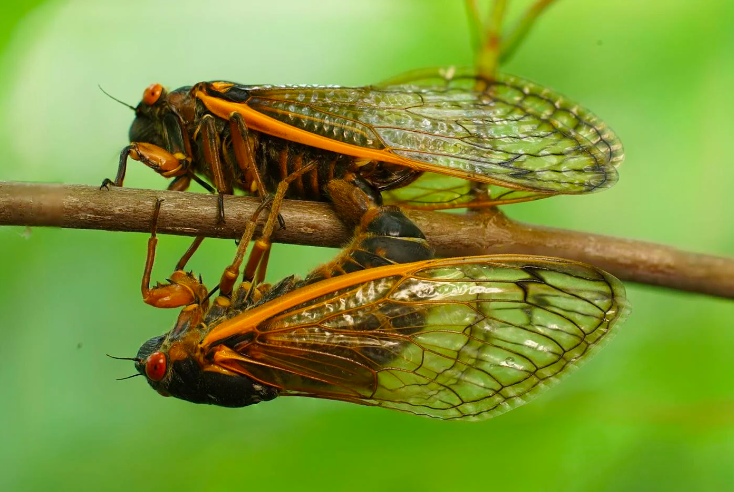
Tomorrow is Earth Day. As you reflect on how to reduce, reuse, recycle, eliminate plastic, be creative about water use, pick up trash, leave no trace, and eat for a sustainable future, we have another natural and wonderful occurrence— just a few weeks past the remarkable solar eclipse. This great wonder is in the bug world. You may have heard about the double cicada broods that are set to emerge starting at the end of the month. Those of us looking for inspiration in the natural world cherish the thrill of natural events that happen without our intervention and cause such wide-scale excitement. Here’s more from Aimee Ortiz, The New York Times:
Up to a Trillion Cicadas Are About to Emerge in the U.S.
In a rare occurrence, a trillion cicadas from two different broods are expected to begin appearing in the Midwest and Southeast regions of the United States at the end of April.
It’s the first time since 1803 that Brood XIX, or the Great Southern Brood, and Brood XIII, or the Northern Illinois Brood, will appear together in an event known as a dual emergence.
Thomas Jefferson was president the last time that the Northern Illinois Brood’s 17-year cycle aligned with the Great Southern Brood’s 13-year period. After this spring, it’ll be another 221 years before the groups, which are geographically adjacent, appear together again.
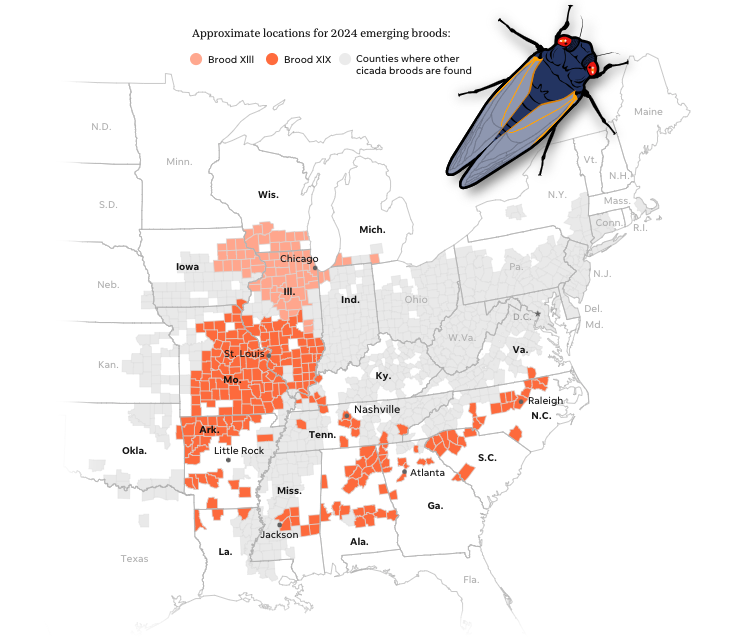
A roughly 16-state area will be center stage for these periodical cicadas, which differ from those that appear annually in smaller numbers. Forested areas, including urban green spaces, are more likely to see higher numbers of cicadas than agricultural regions.
To put into perspective just how many of these bugs could emerge, one trillion cicadas, each just over an inch long, would cover 15,782,828 miles if they were placed end to end, said Floyd W. Shockley, an entomologist and collections manager at the Smithsonian National Museum of Natural History. “That cicada train would reach to the moon and back 33 times,” Dr. Shockley said.
The soil needs to reach 64 degrees Fahrenheit, about six inches deep, and “then you get a good soaking rain, and that’s when they really pop,” he said. They’ll use their forelegs to tunnel out from the earth, their beady red eyes looking for a spot where they can peacefully finish maturing. A few days after they emerge and molt, the males will start buzzing in an effort to find a mate, a slow-building crescendo of noise that as a chorus can be louder than a plane.
The bugs don't bite or harm pets and are beneficial to the environment, acting as natural tree gardeners. The holes they leave behind when they emerge from the ground help aerate the soil and allow for rainwater to get underground and nourish tree roots in the hot summer months. The slits they make in trees can cause some branches to break, and the leaves then turn brown in a process known as “flagging,” which is a kind of natural pruning. When the branch grows again, the fruits it yields will tend to be larger. When they die, the cicadas’ rotting bodies provide nutrients that trees need. Here is where you will find the largest emergences this summer:
|