|
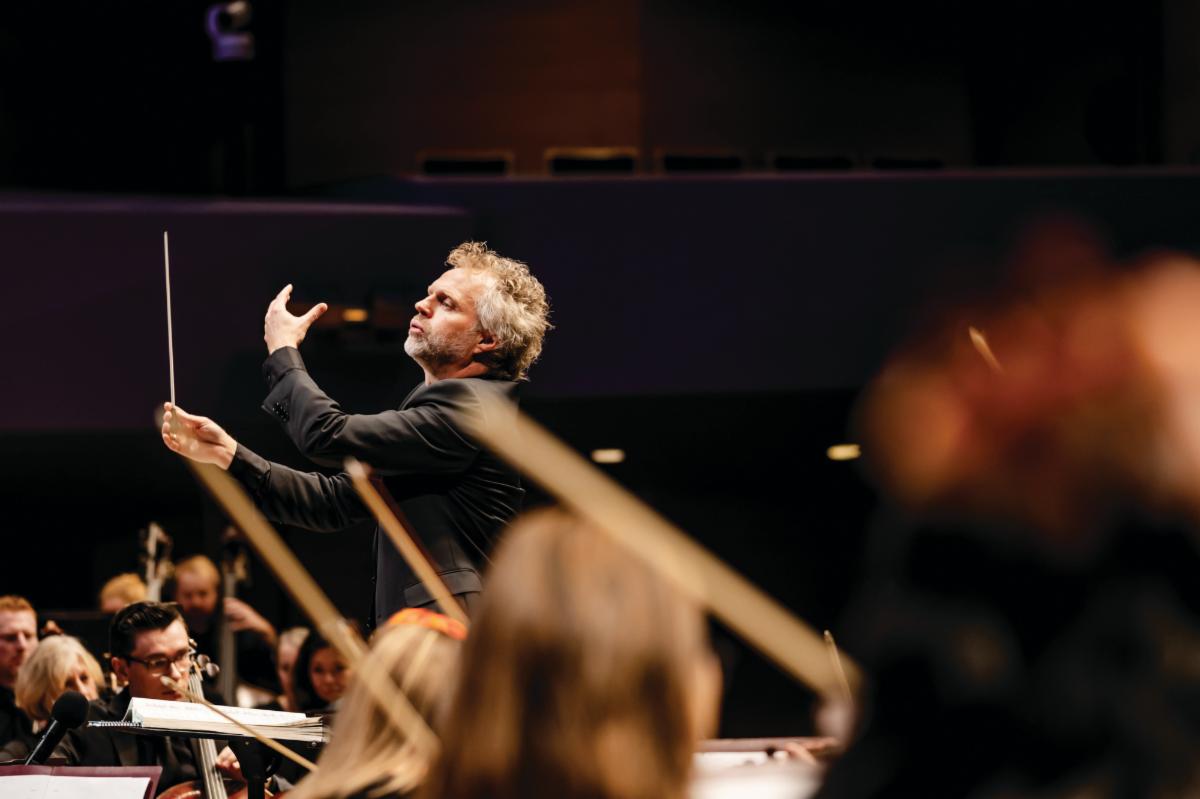
MINNEAPOLIS (August 31, 2026) — Music Director Thomas Søndergård opens his fourth season with the Minnesota Orchestra next month at Orchestra Hall focusing on the music of Russian composer Sergei Prokofiev—and offering an inventive multi-media take on Igor Stravinsky’s The Firebird, as part of the Sound Unbound series.
In the first set of Season Opening concerts, on Friday, September 25, at 8 p.m. and Saturday, September 26, at 7 p.m., Søndergård conducts Ukrainian pianist Vadym Kholodenko in Prokofiev’s monumental Piano Concerto No. 2. The program opens with George Walker’s Icarus in Orbit and culminates in Stravinsky’s complete ballet The Firebird, which will be visually brought to life through video, graphics and lighting by BAFTA-winning artist Tal Rosner, whose video creations have lent atmosphere to performances around the globe from operas to rock shows.
The second set of concerts, slated for Thursday, October 1, at 11 a.m.; Friday, October 2, at 8 p.m.; and Saturday, October 3, at 7 p.m., feature American violinist Stefan Jackiw in Mozart’s brilliant Violin Concerto No. 5, Turkish, bookended by Gabriella Smith’s Tumblebird Contrails and Prokofiev’s penultimate symphony, the Sixth. Søndergård and the Minnesota Orchestra will record these performances of the Sixth Symphony for a forthcoming album with PENTATONE that will also feature Prokofiev’s Seventh Symphony, which was recorded live in June 2026. The release will mark the Orchestra’s second recording on the PENTATONE label with Søndergård, following the 2025 album featuring works by composer Thomas Adès, which was recently shortlisted for a Gramophone Award.
The Season Opening programs mark the beginning of Thomas Søndergård’s fourth year with the Minnesota Orchestra, a season that features him leading large-scale orchestral works from Corigliano’s First Symphony to Mahler’s Fifth, a new installment of the popular Nordic Soundscapes festival, the Orchestra’s first tour to California in three decades and the Sound Unbound initiative, highly visual experiences in the concert hall that include Firebird and May 2027 performances of Puccini’s Tosca.
Søndergård Conducts Stravinsky’s Firebird (September 25-26, 2026)—
Igor Stravinsky was still an emerging composer in 1909 when ballet impresario Sergei Diaghilev approached him to compose music for a new ballet. Premiered at the Paris Opera, The Firebird tells the story of a female spirit bird who uses her powers to unleash 13 princesses from a sorcerer’s spell. The work was an immediate success, captivating audiences with its magical storytelling and the strength of Stravinsky’s score.
In these performances, London-based video artist Tal Rosner—known from projects as disparate as creating a vast dream-like video environment for the Metropolitan Opera’s production of Aindamar to providing video content direction for the Rolling Stone’s No Filter tour—will bring the mythical realm of the Firebird to life. His animations and projections are tailor-made to fit the architecture of Orchestra Hall and closely hew to the ballet’s music and narrative.
“It will be a maximalist experience, a real occasion, in which I’m using every avenue I can to explore the story,” says Rosner. “I want the audience to be moved by the music in combination with the visual experience and to leave with a lasting impression of the moment when The Firebird paid a visit to Orchestra Hall.”
The first half of the program opens with Pulitzer Prize-winning composer George Walker’s Greek mythology-based 2004 composition Icarus in Orbit and Prokofiev’s Second Piano Concerto. Written in 1912 when the Russian composer was 21 years old and a student at the St. Petersburg Conservatory, the turbulent, brooding concerto is often considered one of the most technically challenging works in the repertoire.
It’s a challenge that pianist Vadym Kholodenko embraces. He earned the Gold Medal in the 2013 Van Cliburn Competition partly through his performance of Prokofiev’s Third Piano Concerto, and he later went on to record all the Prokofiev concertos with Miguel Harth-Bedoya and the Fort Worth Symphony. Kholodenko makes his Minnesota Orchestra debut in these performances.
Søndergård, Mozart and Prokofiev (October 1-3, 2026)—
Prokofiev was still a student when he composed his Second Piano Concerto, but by the time he wrote his Sixth Symphony he was a veteran composer who had weathered the Russian Revolution of 1917 and the First and Second World Wars. Accordingly, the Sixth Symphony is tragic in tone, described by Prokofiev as a somber reflection on “the wounds that cannot be healed…One has lost those dear to him; another has lost his health. These must not be forgotten.” Prokofiev died just six years after its 1947 premiere, and his Sixth Symphony remains among his crowning achievements.
The program opens with Gabriella Smith’s 2014 evocative nature-scape Tumblebird Contrails, which she describes as imagining the ecstasy of wind in the wings, and then features Mozart’s Fifth Violin Concerto, the largest in scale and often considered the most technically demanding and experimental of his five violin concertos, interpreted by Stefan Jackiw.
Growing up in Boston, the son of two theoretical physicists, Jackiw started violin at age 4 and made his professional debut at 12 in 1997 with the Boston Pops. He appeared with the Minnesota Orchestra soon after, performing the Saint-Saëns Violin Concerto on New Year’s Eve in 1997. Described by The Washington Post, as having “talent that’s off the scale,” Jackiw went on to build a career of distinction, winning the Avery Fisher Career Grant, recording the complete Charles Ives violin sonatas to “a new standard” (according to The New Yorker) and touring with his Junction Trio. He served as artistic director of the 2026 Laguna Beach Music Festival and takes up a position as artist in residence in the current season with the Residentie Orkest in the Hague. He last appeared with the Minnesota Orchestra in 2019 performances of the Mendelssohn Violin Concerto.
|