August 27, 2021
This Week's Water Conditions Update
SCCF Research & Policy Associate Leah Reidenbach introduces our new weekly water conditions update featuring current aerial imagery off Sanibel's Lighthouse Beach Park, an explanation of current impacts on the Caloosahatchee estuary from Lake Okeechobee releases as well as watershed runoff, and updates on red tide and blue-green algae.

We'll send it out every Friday to help you plan your weekend!

Virtual Water Quality Tour from Lighthouse Beach
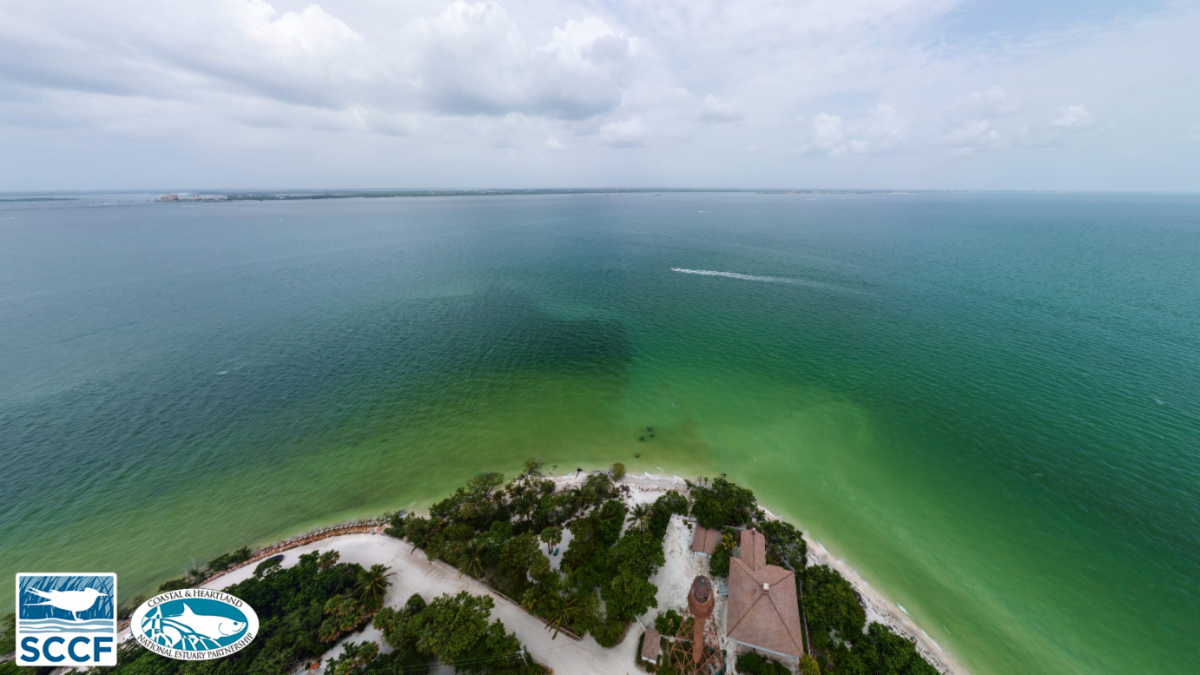
Click here or on the image above to take a virtual tour from above Lighthouse Beach Park to see how the water looked this week.

With minimal flows from Lake Okeechobee, water clarity and quality is only being affected by the watershed and stormwater runoff from rains earlier this month. Dry weather over the past week has resulted in an improvement in water clarity.

The break down of natural materials (e.g., soil and plants) release substances called tannins and other compounds into the water that cause it to look brown. Sometimes runoff from the landscape can also be high in nutrients such as nitrogen and phosphorus. Fortunately, limited flows from Lake Okeechobee have reduced high nutrients loads in our estuary coming from the lake so far this wet season.
Lake Okeechobee Levels & Caloosahatchee Flow Impacts

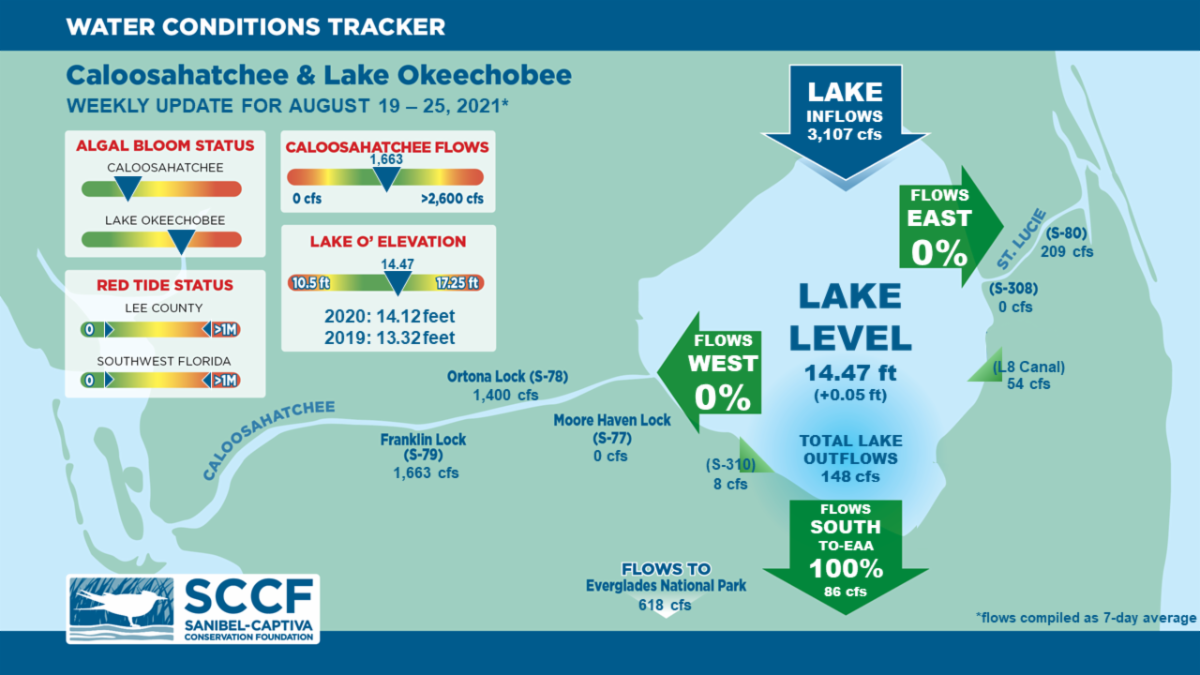
On August 25, 2021 Lake Okeechobee was at 14.47 feet, but because of the dryer than normal weather conditions in the region the lake rose relatively slowly with a 0.07 feet increase in the past week. The Army Corps’ operational goal for the lake is to maintain levels between 12.5 and 15.5 feet. As lake levels approach 15.5 feet, the Corps will consider making releases to the Caloosahatchee and St. Lucie estuaries to prevent levels from getting too high.

The volume of water reaching the Caloosahatchee from the watershed has also decreased. The Caloosahatchee estuary has received an average of 1,663 cubic feet per second — imagine a cubic foot as the size of a basketball — this would be 1,663 basketballs per second! This volume is measured at the Franklin Lock and Dam (S-79) in Alva.


For more information on Lake Okeechobee and estuary conditions go to the latest Caloosahatchee Conditions Report
Red Tide
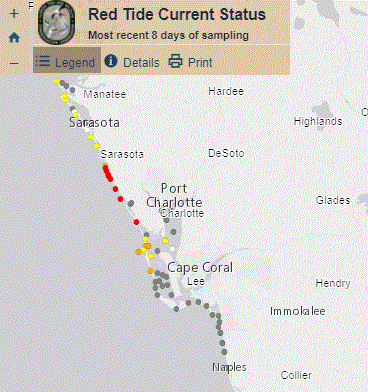
Currently, red tide has a patchy and rapidly changing distribution in Southwest Florida. Satellite imagery over the past week has shown high levels of chlorophyll off of the coast of Sarasota County. This imagery corresponds to water samples with bloom concentrations of Karenia brevis, and other algal species may be contributing to the high chlorophyll levels as well. In Lee County, FWC reported low to high levels of Karenia brevis in Gasparilla Sound and low to medium concentrations in Northern Pine Island Sound. SCCF staff reported a fish kill on North Captiva along with respiratory irritation caused by red tide. Samples taken by FWC around Sanibel Island and Estero Bay had no Karenia brevis. 
Blue-Green Algae
There have been no reports of blue-green algae in the Caloosahatchee and there is presently 50% bloom-potential on Lake Okeechobee.
Resources To Follow:
To learn more about our current water conditions, click on the following links:

A collaborative, weekly analysis, including recommendations for water managers regarding Lake Okeechobee flows.

SCCF's River, Estuary, and Coastal Observing Network is a network of eight optical water quality sensors deployed throughout the Caloosahatchee and the Pine Island Sound estuary to provide real-time water quality data.


Click here to subscribe to Connecting You to SCCF and other SCCF mailing lists.
Stay Connected!