This Week's Water Conditions Update

March 20, 2026

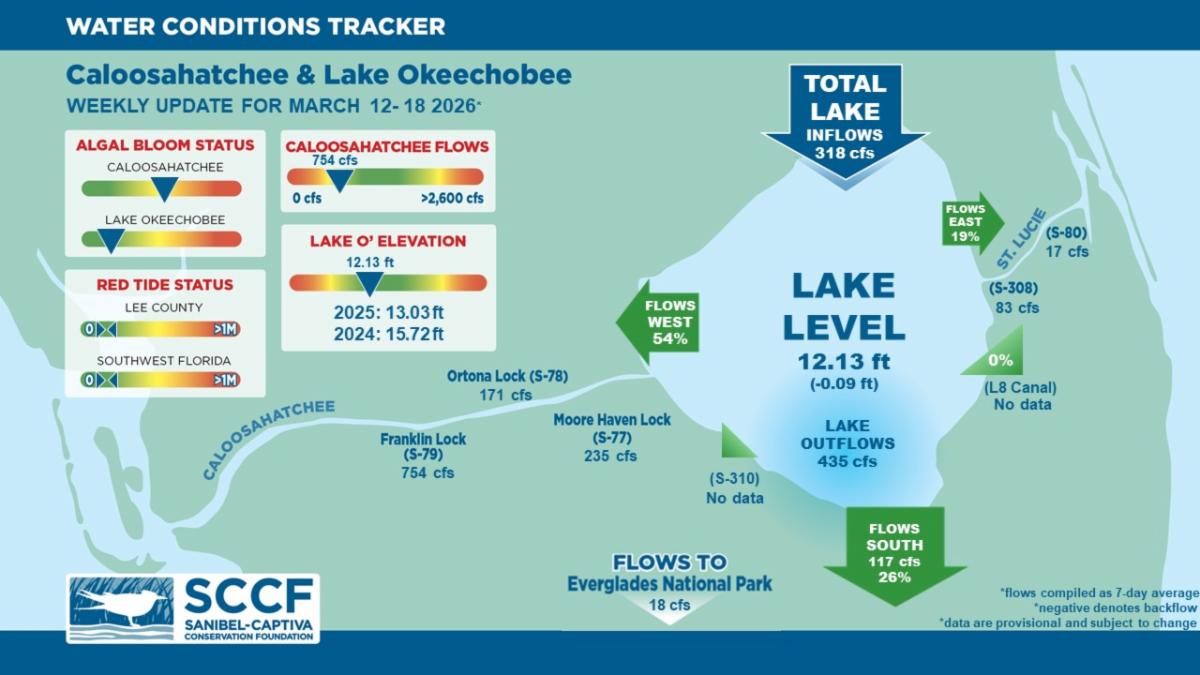
Water Conditions Tracker

Lake Okeechobee Levels & Caloosahatchee Flow Impacts

On 3/18/26 Lake Okeechobee was at 12.13 feet, decreasing by 0.09 feet in the past week. The weekly average flow at S-79 was 754 cfs (cubic feet per second) while flow from the Lake at S-77 was an average of 235 cfs. The 14-day average flow at S-77 was 357 cfs. The 14-day average flow at S-79 was 553 cfs and has been below the optimum flow envelope (<750 cfs; RECOVER 2020) for 144 days.

For more information on Lake Okeechobee and estuary conditions go to the latest Caloosahatchee Conditions Report.

Water Surface Temperature

This Week

Daily Average for March 18, 2026


Gulf of Mexico: 75.9°F

Caloosahatchee (Fort Myers): 70.3°F

Lake Okeechobee: 77.9°F

Last Week

Daily Average for March 11, 2026


Gulf of Mexico: 73.8°F

Caloosahatchee (Fort Myers): 80.6°F

Lake Okeechobee: 77.0°F


Estuary Suffers Due to Low Freshwater Flows

If you've been around the waters of the Caloosahatchee estuary recently, you've probably noticed how beautiful it looks. The turquoise waters of the Gulf have surrounded our islands, providing picturesque views stretching from the shore to the horizon. The gorgeous setting makes for a great postcard or social media post, but it belies the disaster that is currently unfolding beneath the surface.

Weekly Rainfall Totals

WP Franklin (S-79): 2.78" Ortona (S-78): 0.62" Julian Keen Jr. (S-77): 1.35"

Red Tide

 On 3/13/26, the FWC reported that the red tide organism, Karenia brevis, was observed in nine samples from Northwest Florida and one sample from Florida’s East Coast. In Southwest Florida over the past week, K. brevis was not observed.


Wildlife Impacts

In the past week, the CROW wildlife hospital on Sanibel admitted 3 patients for suspected red tide/toxicosis: 1 juvenile herring gull (deceased), 1 juvenile Wilson’s plover (still in care) and 1 adult northern gannet (deceased). 

Blue-Green Algae

On 3/16/26, sampling for cyanobacteria by the Lee County Environmental Lab reported Microcystis, Dolichospermum and cyano filaments as moderately abundant at the Alva Boat Ramp, appearing as streaks with some accumulation and as abundant upstream of the Franklin Locks as streaks with accumulation.

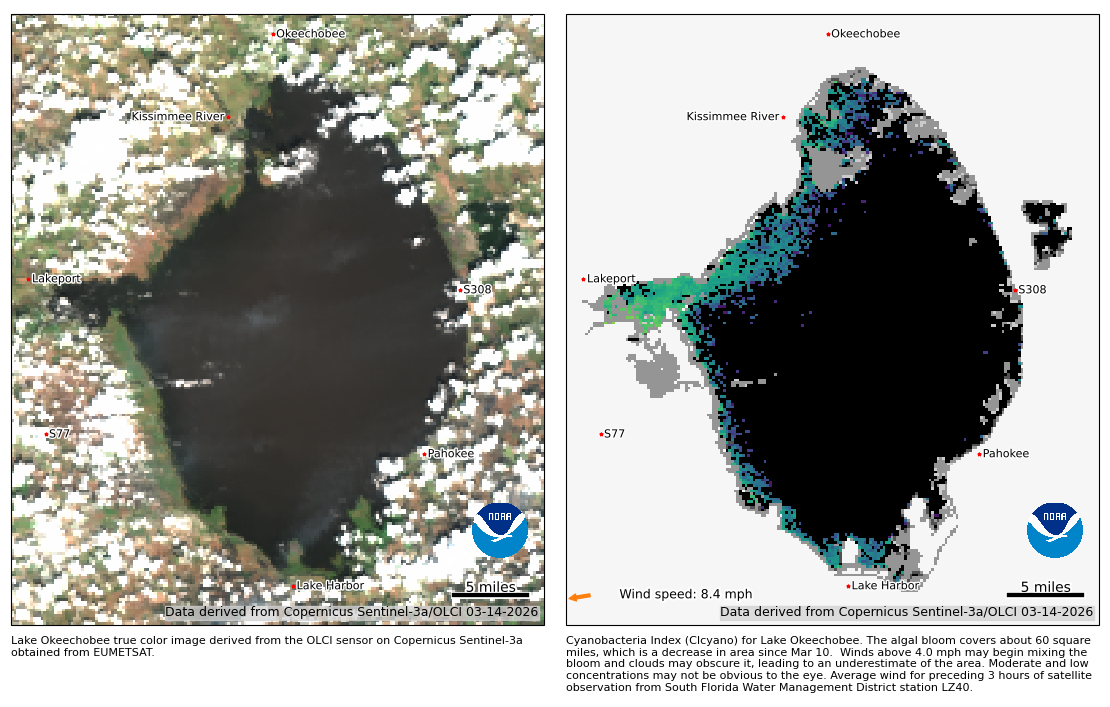
Lake Okeechobee Cyanobacteria

On 3/14/26 satellite imagery of Lake Okeechobee showed the presence of an algal bloom covering about 60 square miles or 13% of the lake.

Become a Citizen Scientist and Get the Algae Reporting App Today!

SCCF wants to know when and where all types of algae sightings occur to monitor conditions around the islands and to investigate algae bloom occurrence with patterns in seasonal weather changes and Lake Okeechobee water management practices.


Click on and bookmark this link to report an algal bloom sighting.

Resources To Follow:

To learn more about our current water conditions, click on the following links:


Water Quality Dashboard


Water Quality FAQ

Find answers to some of our most commonly asked questions regarding water quality and more.


Water Conditions Update Archive


Caloosahatchee Conditions Report

A collaborative, weekly analysis, including recommendations for water managers regarding Lake Okeechobee flows.


RECON

SCCF's River, Estuary, and Coastal Observing Network is a network of eight optical water quality sensors deployed throughout the Caloosahatchee and the Pine Island Sound estuary to provide real-time water quality data.


Caloosahatchee River Virtual Tour


Red Tide Resources


NOAA HAB Monitoring System - Lake Okeechobee

Click here to subscribe to the Weekly Water Conditions Tracker


Click here to subscribe to Connecting You to SCCF and other SCCF mailing lists.

LinkedIn Share on LinkedIn
Stay Connected!
Facebook  Instagram  Youtube