January 30, 2026


SCIL's Volunteer Data Scientist

Publishes New Peer Reviewed Article Regarding "Length of Stay" in

Animal Shelters

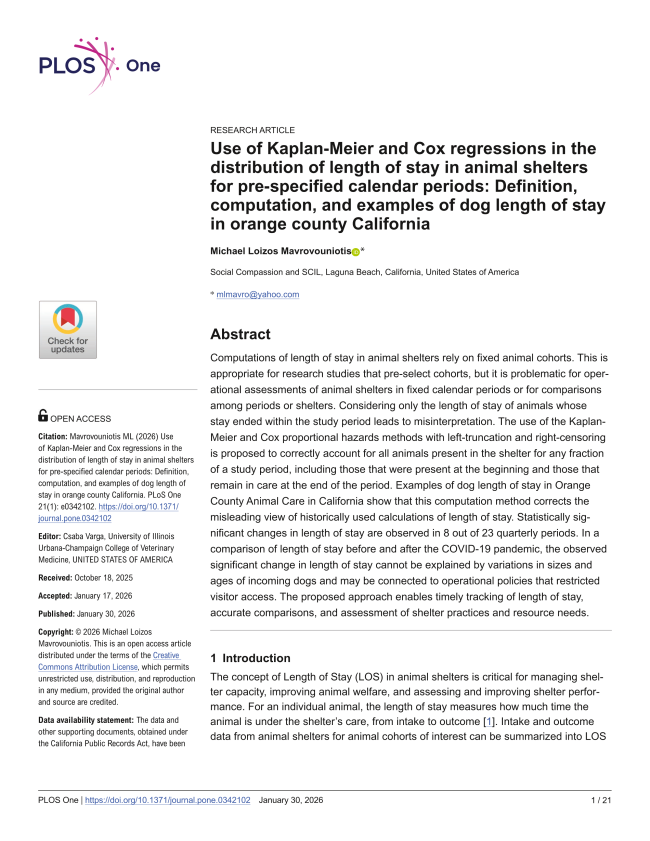
Today, we are proud to announce that a peer-reviewed scientific journal just published a study by our volunteer data scientist, Michael Mavrovouniotis


You can read the study HERE.


The study is about the “length of stay” in animal shelters, which affects animal welfare and shelter resources. 


We all know that animals are stressed if they spend too long a period in the shelter. If a shelter doesn’t get animals adopted, or returned to the owner quickly enough, the shelter can get overcrowded, often leading to sub-standard animal care and euthanasia.


Michael's inspiration to conduct this study was because many shelters are miscalculating their length of stay data. Sometimes, shelters do calculations that are grossly misleading, because they only look at animals that already left the shelter, and ignore long residents that are still in the shelter when the calculation is being done. Michael uses statistical tools to solve this problem.


Using the study as a guide, shelters can finally do reliable, correct calculations on their length of stay, which can help shape better shelter policy and procedures. Animal shelter managers, policymakers, and researchers can benefit from a close look at this study.


Michael’s examples involve dogs in Orange County Animal Care (OCAC), a county-run shelter in California that Michael knows well from previous research studies.


In late 2019, 10% of incoming dogs stayed more than 32 days in the shelter. In 2022, that grew to 42 days. That shows an accumulation of dogs with very long stays. An increase in length of stay translates proportionally to a change in shelter resident count, which in turn increases dog housing, staffing, and veterinary care.


OCAC kept some COVID-19-era restrictions into 2022–2023, particularly in visitor access and hours. These led to fewer adoptions and longer stays. Michael also studied this and published another article we highlighted last year. His work played a role in a decision by the county Board of Supervisors to restore visitor-friendly access and adoption hours.


The new study calculates that the higher length of stay in 2022-2023 translated to 73 additional dogs being at the shelter on any given day. Those 73 additional dogs require seven additional staff members just for kennel care. If housing and staffing fail to keep up with the need, the result is overcrowding and sub-standard care and increased euthanasia.


The OCAC Strategic Plan includes length of stay targets, but OCAC has never showed any length of stay calculations. If used as a guide, the calculations in the study can assist OCAC management better plan for needed resources.


We encourage all shelter professionals and policymakers to read the study.


Additionally, Michael plans to convert his method into a ready-to-use tool for animal shelters - we will share that tool when it is available! 

SCIL Visits to UCLA's California NanoSystems Institute!

Thanks to UCLA for advancing the future of science and medicine in a humane direction.


We had a great day learning about innovations at the California NanoSystems Institute at UCLA that help accelerate discovery while reducing reliance on animal testing, including seeing cutting-edge, AI-enabled cell and organoid research in action.


Grateful for the incredible people in our universities and legislature who are actively working to make the world a more compassionate place.

AB 1382 Passes the Full Assembly!


Click below to watch videos of SCIL's Fellow and Director of Legislative Affairs give an update on AB 1382, followed by Assemblywoman Castillo presenting the bill on the Assembly floor.

Yesterday, AB 1382, the Ethics Over Aesthetics Act, authored by Assemblywoman Leticia Castillo (R-Corona) and sponsored by political animal advocacy group, Social Compassion in Legislation (SCIL), passed the Assembly Floor with a vote of 73-0. The bill will prohibit the sale of animals that have been genetically modified for cosmetic purposes. For more on the bill please see our fact sheet.


“With today’s overwhelming vote, the California Assembly made clear that animals are not products, trends, or social-media novelties,” said Judie Mancuso, Founder and President of Social Compassion in Legislation. “I am deeply grateful to the Assembly Members who stood united in affirming that science must be guided by ethics, not aesthetics."


"AB 1382 draws a firm and necessary line—protecting animals from experimental genetic manipulation done solely for profit, while preserving responsible research that genuinely benefits animal and human health. We now look forward to working with the California Senate to advance this critical safeguard for animals and ethical science and ensure it is signed into law.” 


"Pet rabbits already face unnecessary neglect because all too often, people buy them on impulse, without knowing anything about their care," said Dr. Michelle Kelly, CEO, Los Angeles Rabbit Foundation. "Allowing "glow-in-the-dark" bunnies and other novelty, gene-altered animals to be sold in California would result in impulse purchases leading to even more suffering and abandonment."


“California’s animal shelters are overflowing with beautiful, adoptable animals ready for loving homes,” said Jill Tucker, CEO of CalAnimals. “We are immensely concerned about efforts involving the genetic engineering of pets to support commercial interests and/or fashion trends, as it is common for fashionable pets to land in our shelters once people lose interest. If you want a great pet, please visit your local shelter. You don't need a pet that glows. You need a shelter pet that will make YOU glow!”


Jennifer Lee, Executive Director of the San Diego House Rabbit Society, was aghast when she read the article regarding blue, green, or glowing rabbits, “As someone who runs a shelter that is devoted to the care of domestic rabbits, I’m deeply concerned about the rise of genetically modified animals for novelty. Not only could such modifications harm their health and well-being, but this trend also distracts from the pressing issue of overpopulation in shelters. Instead of creating new 'designer' pets, we should be focused on saving the lives of the countless rabbits already in need of care and homes." 


The bill will now go to the Senate Rules Committee to be assigned to a policy committee(s).

YOUTUBE SUBSTACK APPLE PODCAST SPOTIFY

See what's happening on our social sites

Facebook  Instagram  LinkedIn