SCIP's September Newsletter

09/01/2026

Suicide Prevention Month

By Nick Schickert


September is Suicide Prevention Month. Part of raising awareness is understanding that it is important to recognize that suicide prevention is everybody's business. More so, school staff and parents need to act as a front line of defense when it comes to suicide prevention. Taking the beginning of the school year to review the signs and best practices for prevention and early intervention.


The QPR Institute has split common signs into four categories to make recognition easier: direct verbal clues, indirect verbal clues, behavioral clues, and situational clues. Below are just a few common examples you may see in youth.

Direct Verbal Clues: a direct statement of intent

  • "I  want to end my life”
  • “I wish I were dead”


Indirect Verbal Clues: alluding to thoughts of suicide

  • “I just can’t go on”
  •  “Pretty soon you won’t have to worry about me”
  • “I just want out”

Behavioral Clues: changes in the way an individual acts

  • Isolating from loved ones
  • Giving away prized possessions
  • Unexplained anger and irritability
  •  Sudden depression or moodiness
  • Sudden drop in academic performance
  • Sudden loss of interest in passions and activities
  • Sudden increase in substance misuse

Situational Clues: events in the individual's lived experience that increase suicidality

  • Previous suicide attempt that has gone untreated
  • Being expelled or fired
  • Death of a loved one, especially by suicide


As a member of school staff or parent to youth, you will likely be one of the first to notice these behaviors. If you are concerned at all, you should be direct and ask if someone is thinking of suicide. Studies tell us that you cannot put the idea of suicide in someone's head by talking about it. The goal of recognizing these signs, checking in, and spreading awareness is getting at-risk youth to professional help


Keep in mind, after you ask someone if they are considering suicide, that opening up takes a lot of courage; so, making an individual feel safe to share how they are feeling is the most important step of your conversation. Foster an environment of compassion and understanding. For example, be an active listener and put other distractions like your phone or work away. Be careful to avoid judgement. Judgement may seem easy to avoid, but such a vulnerable conversation can cause a strong sense of worry and urgency. Avoid phrases like “you’re not thinking of doing anything stupid, are you?” or “suicide is a bad/selfish idea”. Those with suicidal ideation feel hopeless, and you may be the one person they reach out to; it is important they feel safe and heard.


This is a great time of year to review the resources you have access to. Know your school’s protocol when it comes to students with thoughts of suicide. Who should you refer to, who needs to know, and what additional services or supports does your school provide? One such resource available to everyone 24/7 is the 988 Suicide and Crisis Lifeline. Keep quick and easy access to your resources; someone can exhibit signs or open up to you at any time, and staying prepared could save a life. 

Mindfulness Basics

By Tessah

Now that school is back in full swing, the honeymoon phase of the first few weeks back has worn off. Students are starting to test new boundaries, and teachers are already breaking out their classroom management strategies. This might be a good time to introduce some mindfulness basics for the classroom to create a calmer and more focused learning environment.  


Mindfulness is the ability to be fully present and aware of what we are doing in the current moment. Over the past two decades, research has confirmed that mindfulness-based interventions can improve academic performance while supporting social, emotional, and behavioral development. These practices can enhance executive functioning, making it easier to concentrate on lessons and increase performance on tasks. 


Mindfulness also helps students regulate their emotions and behaviors, which can reduce anxiety, stress, and the number of meltdowns. When repeatedly practiced, mindfulness supports youth development of social-emotional skills and interpersonal relationships. Classrooms with positive learning environments and students with strong emotional regulation skills can improve their teachers' well-being and help reduce burnout. 


Classroom techniques can be completed rather quickly. Let’s look at some common techniques. 


Kindergarten through 2nd Grade

Pinwheel Breathing (3-5 minutes)

Give each student a pinwheel and guide them through several types of breathing.

  • First, ask students to blow on the pinwheel using a normal breath. What happens to the pinwheel? How does their body feel?
  • Next, have them use short, quick breaths. What changes? Does their heartbeat feel faster or slower?
  • Finally, ask them to use long, deep breaths. How does the pinwheel move? Do they feel calmer or more relaxed? Does their heartbeat feel slower?


5-4-3-2-1 Senses Exercise (3-5 minutes)

Students identify:

  • Five things they can see
  • Four things they can feel
  • Three things they can hear
  • Two things they can smell
  • One thing they can taste


3rd through 5th grade

Square Breathing (2–5 minutes)

Using a printed square or an imaginary one, students trace each side while following this pattern:

  • Inhale for four seconds.
  • Hold for four seconds.
  • Exhale for four seconds.
  • Hold again for four seconds.

Repeat the pattern for two to five minutes.

Five-Finger Breathing (2–5 minutes)

Students trace the outline of one hand with the index finger of the opposite hand, inhaling as they trace up each finger and exhaling as they trace down. Continue for two to five minutes.


6th through 12th Grade

Mindful Journaling (3–5 minutes)

Provide reflection prompts that encourage students to explore their thoughts, emotions, and experiences.

Example prompts: 

  • When you make a mistake, what’s the first thing you think? Was this thought helpful or unhelpful? 
  • What is something you worked hard at and are now good at? How did you keep practicing? 
  • What was one failure you’ve had? What did you learn from that failure? 
  • Think about a project or subject that was hard. How did you overcome that challenge? 
  • Think about a disagreement you’ve had with a friend. How did you do? Would you change anything?


Body Scan Meditation (15- 30 minutes, used only if time allows)

Using a prerecorded video, guide students through a brief body scan. 


Gratitude List (2–5 minutes)

Ask students to write down three to five things they are grateful for. Encourage them to reflect on why each item is meaningful.


These mindfulness techniques can be used both in school settings and at home. Research supports that mindfulness techniques benefit students with low self-regulation skills and students living with ADHD, anxiety, and conduct behaviors. With only a few minutes, daily mindfulness practices can support academic success, stress reduction, and prosocial emotional learning. 


To Engage or Not to Engage?

By Sarah


September ushers in the first full month of the school year. Student engagement and motivation are likely hot topics of conversation as educators approach the inevitable question: How do we get kids to learn and maybe even enjoy it—or, at the very least, turn in their work? Let's consider the following classroom scenario: A student spent several hours a day this summer playing Roblox and watching videos on YouTube. She has a hard time falling asleep and wakes up feeling exhausted. This student started her fifth-grade year of school this week. Historically, school never felt particularly challenging to her. This year, however, her teacher notices that she is distracted, irritable, and almost apathetic. Sound familiar?


It's easy to assume the student in the above scenario is being lazy or is simply uninterested in school but you need a wider lens to see the full picture. Gaming and social media are designed to capture and maintain our attention. Dr. Anna Lembke, a professor of psychiatry and addiction medicine at Stanford, identified three characteristics that can make a behavior particularly reinforcing: accessibility, potency, and novelty. When something is easy to access, provides a strong or immediate reward, and continually offers something new; it can become especially compelling.


Dopamine is a key player in motivating behavior. Dr. Masud Husain, Professor of Neurology and Cognitive Neuroscience at the University of Oxford, explains that dopamine plays several important roles in the brain and body, including functions related to movement, memory, learning, and motivation. Contrary to my past understanding, dopamine isn't simply the brain's “pleasure chemical.” It’s the driver that anticipates pleasure, learns from experiences, and determines whether an action is worth the effort. Dr. Husain describes each person as operating with a baseline level of dopamine, which can spike or drop in response to a stimulus. Ideally, our baseline isn’t too low or too high. When someone experiences too much dopamine, too often; it lowers their baseline dopamine level over timerequiring intense stimuli more often, just to feel “normal.” This makes sense when you consider the reward and reinforcement cycle of any behavioral habit.


The traditional learning environment often requires students to sustain attention for extended periods of time, work through tasks that may not feel valuable or interesting, tolerate frustration, and delay gratification. Those are important skills, but challenging when you’ve become accustomed to personalized content and instantaneous rewards. This doesn't mean every distracted student is spending too much time on YouTube. Sleep, anxiety, ADHD, depression, family circumstances, academic challenges, social relationships, substance use, and countless other factors influence a student's ability to focus and engage. The goal isn't to diagnose the cause but to stay curious about what might be underneath the behavior.


Students can rebuild and strengthen their capacity for attention, persistence, frustration tolerance, and delayed gratification. Rather than asking how to get kids to engage, maybe the better question is what conditions make meaningful engagement possible?

—Build a classroom where students know what to expect and feel safe enough to take risks.

—Incorporate the appropriate number of bells and whistles without making constant stimulation the norm.

—Celebrate effort, persistence, and growth—not just correct answers.

—Model how to transition from highly stimulating activities to calmer learning activities.

—Break complex tasks into manageable chunks and help students experience progress along the way.

—Resist the temptation to interpret disengagement as a character flaw.

—Provide meaningful human connection—something technology can never fully replace.


September also provides important opportunities to raise awareness and increase understanding of mental health and substance use disorder (SUD) recovery. SAMHSA reported that approximately 44 million Americans lived with a diagnosed substance use disorder in 2025. I’m part of that statistic, and I’m incredibly grateful for the support of the recovery community. Unfortunately, many people living with a SUD do not receive treatment or support. Fear of negative social judgment remains one barrier to seeking help. Thank you for working alongside us to decrease stigma, enhance prevention efforts, and increase access to youth substance use/mental health services across Nebraska.  —Sarah


SCIP Team Leader Meetings:


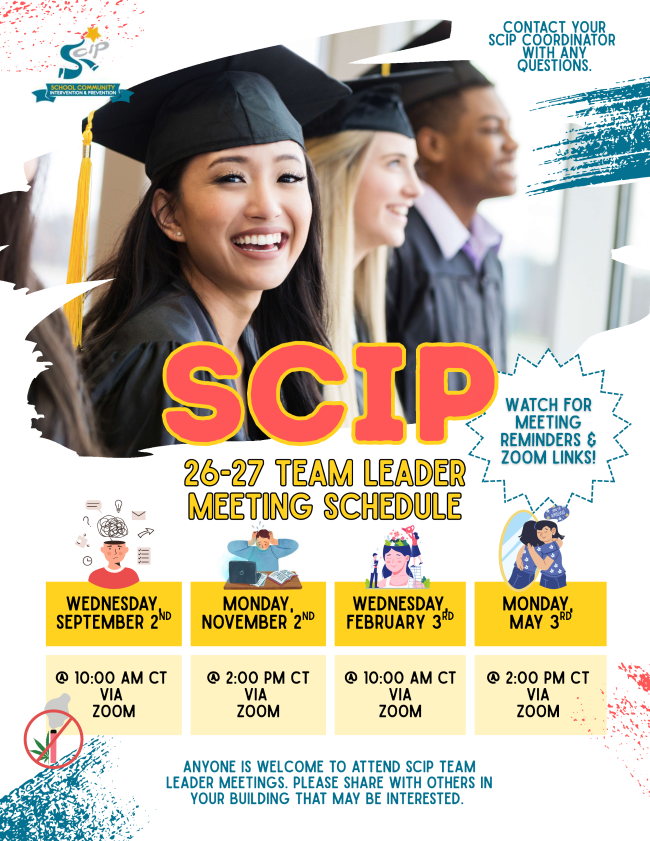
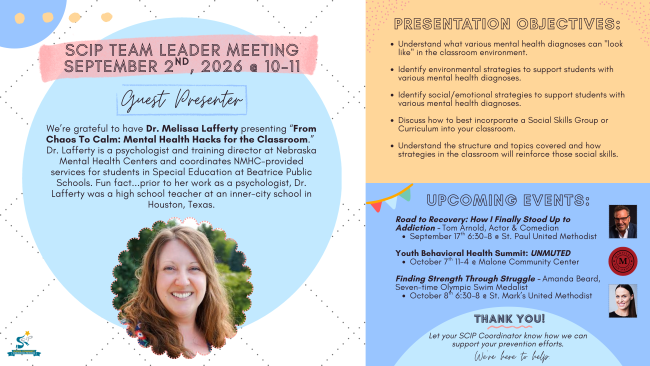
SCIP's Quarter 1 Team Leader Meeting is set for tomorrow, September 2nd, at 10 AM CST/ 11 AM MST. Keep an eye out for a link from Sarah!

Statewide/National Suicide Prevention Resources


Question, Persuade, Refer (QPR)

QPR is an evidence-based suicide prevention training. Each SCIP coordinator is a certified QPR Gatekeeper. Contact your SCIP coordinator to set up a training for your staff.


988 Suicide and Crisis Lifeline

Call or text 988 for free one-on-one assistance. Access their website for more chat options and resources.


Bryan Independence Center Emergency Telehealth

Bryan Medical Center works with 28 hospital emergency departments across Nebraska to offer telehealth support in a crisis 7 days a week from 7 AM to 11 PM. Click here for the map of hospitals.

Follow our Facebook for community awareness events; SCIP- School Community Intervention and Prevention

Facebook

Check out our website for additional resources at scipnebraska.com


Get our monthly newsletter and check out previous newsletters!