Issue 26 | June, 2020
Shared Decision Making in Practice at Partners
Dear ,

Welcome to the Shared Decision Making (SDM) program newsletter. In this quarterly newsletter you will find: patient decision aid updates, project updates, and useful resources and links to support decision making in practice. 
Elective Orthopedic Decision Aid BPA Now Live at MGH & BWH
Massachusetts General Hospital (MGH) and the Brigham and Women's Hospital (BWH) patients can now receive a decision aid at the time of referral to an orthopedic surgeon.

The Epic Best Practice Alert (BPA) allows primary care physicians at MGH and BWH to order a hip or knee osteoarthritis decision aid at the time of referral to an orthopedic surgeon. In one click, patients who are active on Patient Gateway will receive an electronic decision aid to interact with and engage in their decision making for the elective orthopedic procedures. Their completion of the decision aid and responses will document back into their medical record for review by either the surgeon or the primary care physician.
Free SDM Online Training Course for Partners Clinicians: 3 Risk Management CME/CEU Credits
This interactive training highlights the challenges to engaging patients in common decisions and provides practical strategies to overcome those challenges.

Learners practice having SDM conversations in three clinical cases: lung cancer screening, treatment of depression and treatment of lumbar herniated disc.


Free access for Partners clinicians with the coupon code: PARTNERSSDM
Orthopedic Clinics Overtake Primary Care for Most Decision Aids

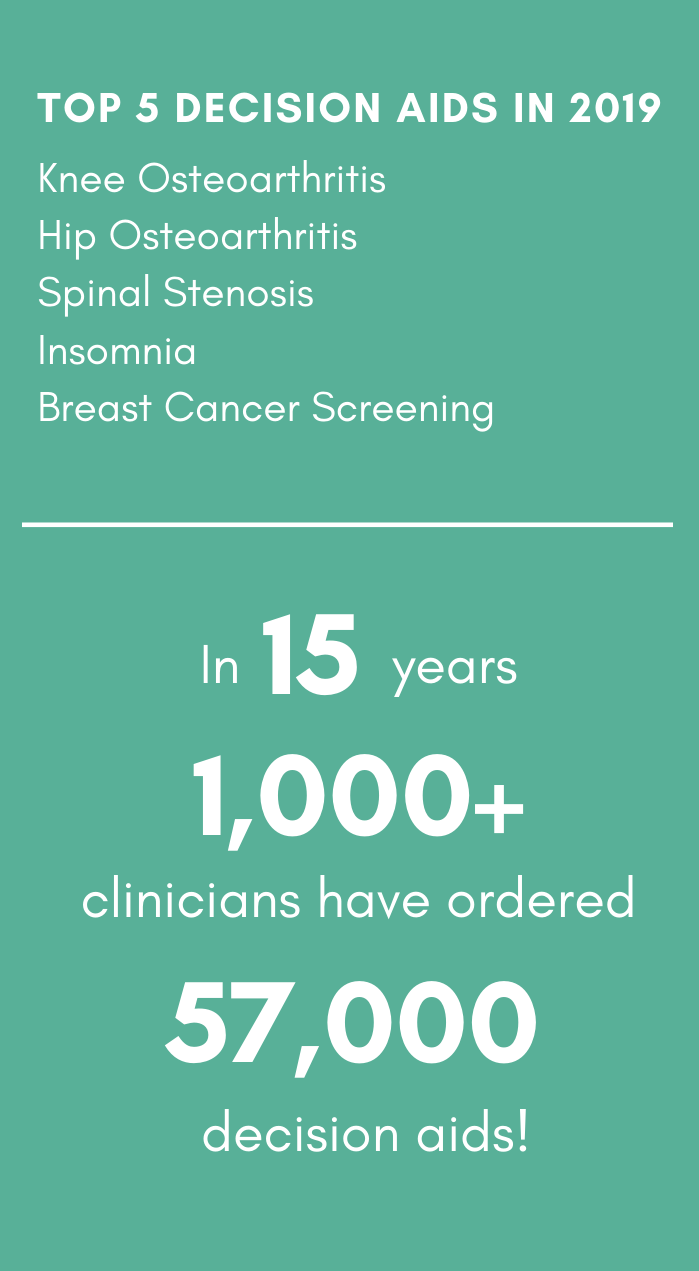
For the last 15 years, primary care practices have been the most active in sending decision aids, with common topics such as cancer screening and mental health decisions.

In 2019, orthopedics ordered 2,800 decision aids and beat out primary care who ordered 2,500. 

For the last few years, our team has collaborated with orthopedic departments across Partners to implement decision aids for patients with hip, knee or back problems. The orthopedic groups have engaged their schedulers, medical assistants and surgeons to order decisions aids for patients.

It will be interesting to see what happens in 2020. It's great to see that so many providers and clinics are supporting these efforts!

If you would like to learn more about decision aids and how to order them at your clinic, for any specialty, contact us at decisions@partners.org !

Informed Medical Decisions™ Program Update
The Informed Medical Decisions™ Program (IMDP) was established at Massachusetts General Hospital in April 2017 with generous funding from Healthwise. The IMDP continues the work of the Informed Medical Decisions Foundation, which was founded in 1989 with the mission to inform and amplify the patient's voice in health care decisions. The IMDP is housed within the Health Decision Sciences Center (HDSC) in the Division of General Internal Medicine and we work closely with the HDSC on many of our projects.

Here are a few highlights from our current projects!
Trust and Shared Decision Making

With funding from CRICO (Harvard’s medical liability carrier), we are exploring the impact of decision aids on building trust and reducing regret in patients undergoing elective orthopedic surgeries. We hypothesize that improving trust and decreasing regret should result in lower malpractice risk. In the first phase, we validated a 5-item measure of how trust is related to the quality of the interpersonal communication between the patient and surgeon.

By summer 2020 we will complete data collection from approximately 600 patients who had a surgical procedure and received a decision aid or not. We look forward to sharing our outcomes with you later this year.
What Engagement Looks Like (WELL) Scale  

The goal of this validation study is to develop a short measure of patient engagement in chronic condition management. We surveyed primary care physicians to determine how they rated their patients’ self-management effectiveness for type 2 diabetes and we correlated this with patients’ reports of self-management effectiveness as measured by the three-item WELL Scale.

The WELL Scale score was a significant predictor of physicians’ ratings of how much effort patients devoted to condition management. The manuscript describing our results is in preparation.

Patient’s Preference for a Statin

The aim of this project is to conduct a web-based pilot study on the “preference distribution” of informed patients for statin therapy for hyperlipidemia, based on their predicted 10-year risk of a CVD event.

We hypothesize that respondents who have lower CVD risk and are informed about the benefits and downsides of statins will prefer to take a statin less often compared to those who are higher risk.

Informed Medical Decisions is a trademark of Healthwise, Inc.
Quick Links