Issue 28 | March 2021
Shared Decision Making in Practice at MGB
Dear ,

Welcome to the Shared Decision Making (SDM) program newsletter. In this quarterly newsletter you will find: patient decision aid updates and a guide to newly published work about SDM.
Quarterly decision aid orders
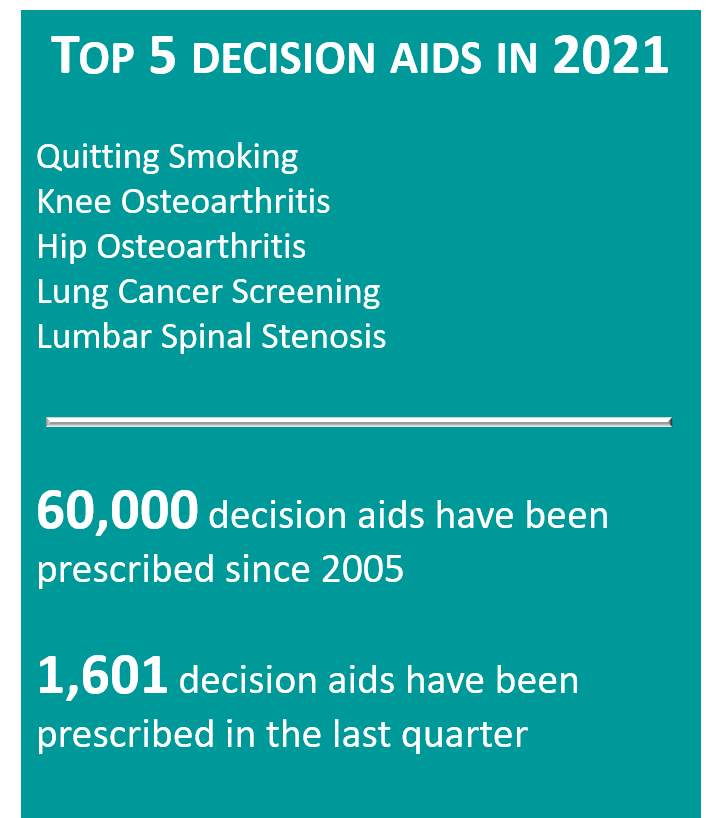
The Quitting Smoking and Lung Cancer Screening decision aids have hit the Top 5 decision aid list, for the first time, in the last quarter!

You can order a Quitting Smoking decision aid as part of the Tobacco Cessation SmartSet or from "orders".

NOTE: the USPSTF has changed their guidelines for lung cancer screening; now more patients are eligible. We'll let you know when updated materials are available.

Shared Decision Making in the Literature
Here are the latest work around shared decision making in print from the Health Decision Sciences Center, the Informed Medical Decision Program and other researchers from MGH. In this quarter's edition: the benefit of shared decision making for preventive healthcare during the pandemic, patient preference distribution for statins, and several measures validated and developed for research.
1. Pandemic has highlighted the importance of shared decision making with patients about which preventive tests to do

The COVID-19 pandemic has altered the landscape of healthcare, especially primary care. Dr. Daniel Horn and Dr. Jennifer Haas from the MGH Division of General Internal Medicine wrote an article published in the New England Journal of Medicine about the the pandemic, preventive care, and recommend a new way for primary care. Read the entire article here.
2. Patient Preference Distribution for Use of Statin Therapy

This paper defined the patient preference distribution for taking a statin for primary prevention after informing patients about the benefits and harms. A participant’s risk was based on the Pooled Cohort Equations (PCE). After viewing graphs that depicted the benefit of statins and viewing information about harms, participants were asked to self-report their preference for taking a statin. 45% reported they would choose a statin, and as risk increased, the number choosing a statin increased. However, a clear majority did not want a statin until the risk from the PCE was 20-50%. For those with a risk >10%, the desire for statins decreased as health literacy, numeracy and knowledge increased. The findings suggest a broad range of risk that would benefit from shared decision making. The paper was published in JAMA Network Open and can be found here.
3. Shared Decision Making Process Scale has been validated for several surgical decisions

The Shared Decision Making (SDM) Process scale is a short patient-reported measure the amount of SDM that occurs around a medical decision. SDM Process items have been used previously in studies of surgical decision making and exhibited discriminant and construct validity. Read more here in the Medical Decision Making journal about how the SDM Process scores showed resilience to coding changes and demonstrated a small, positive relationship with decision quality.
4. The WELL (What Engagement Looks Like) Scale. A 3-item scale to measure how engaged patient's feel in managing a chronic condition.

Patients' behaviors play a key role in chronic disease management, but how effective they are may depend on how engaged they feel. The objective was to develop a short measure of how much patients felt engaged in self-managing a chronic condition. The score was correlated with an existing measure of patient activation commitment and significantly predicated physicians' ratings of patient effort towards managing their condition.

Read more study details here in the Journal of Patient Reported Outcomes.
5. Publicly available scale, which measures the impact of a health issue on a patient, validated by the Health Decision Sciences Center for patients with knee and hip osteoarthritis

The Health Decision Sciences Center team validated the Impact Index in the context of knee and hip osteoarthritis. The team found that the Impact Index demonstrated strong validity, reliability, and responsiveness in hip or knee osteoarthritis patients. The study's results are published here, in the Quality of Life Research journal.
Quick Links