On Global Trade & Investment
Published Three Times a Week (with occasional bonus quotes) by
The Global Business Dialogue, Inc.
Washington, DC 20006
|
|
THURSDAY, SEPTEMBER 3, 2020
Click HERE for last Friday's China quote from
Canada's Nadia Bourély.
|
|
AN ANNOUNCEMENT FROM JAPAN
“As I am no longer in a condition to respond confidently to the mandate of the people, I have decided I should not stay in the prime minister's post."
Shinzo Abe
August 28, 2020
|
|
Editor’s Note: Our usual practice is to try to keep the factual context for these quotes separate from our thoughts about both the quotes and the issues they address. There are times, however, when the separation of those strands of thought seem artificial and unhelpful. In such cases, and today’s entry is one of them, we unapologetically blend them.
|
|
From the continuing violence in Portland, Oregon, to the build-up of warships in the South China Sea, the last week of August was anything but dull. It was, however, the headlines from last Friday’s (August 28) Tokyo press conference that immediately shot to the top of our list of important news. That was the press conference in which Shinzo Abe, Japan’s longest serving prime minister, announced he would be stepping down. Today, September 3, Mr. Abe is still the prime minster, but his successor will be chosen in the next couple of weeks. The current speculation (if not assumption) is that it will be Yoshihide Suga. A close ally of Mr. Abe’s in Japan’s Liberal Democratic Party, Mr. Suga has pledged to continue the security and economic policies of Mr. Abe’s premiership.
TPP And Beyond. Some of those policies can, even now, be viewed as solid, indeed remarkable achievements. For us, TPP, later CPTPP, is at the top of that list. Mr. Abe assumed office on December 26, 2012. By May of 2013, Japan was at the TPP negotiating table. As the world’s third largest economy, the addition of Japan transformed the significance of the TPP negotiations for all the participants, but especially for the United States and the U.S.-Japan relationship, as it offered a pathway to a U.S-Japan FTA. But then on January 23, 2017, the United States pulled out of TPP. To say that that early action by the Trump administration was a blow to Japan is an understatement. In the words of one Japanese expert:
“The U.S. withdrawal from T.P.P. was the biggest shock to the alliance since Nixon went to China.” -- Yoichi Funabashi
Beyond the shock to Japan, it would have been reasonable to conclude in January 2017 that TPP was dead. But it wasn’t. Shinzo Abe picked up the baton of leadership and on December 3, 2018, TPP, rebranded as CPTPP, entered into force for the first six members with others following. Now the question is, who else can join? Looking back, it is clear that Prime Minister Abe had hoped to persuade the United States to reconsider. In that, he was disappointed but not deterred. If we were in the business of conferring awards for achievements in trade policy, we would give the outgoing Prime Minister of Japan the highest possible award, not only for TPP, but for moving on to and then concluding a separate agreement with the United States, one that assures U.S. agricultural producers the same access to the Japanese market as that enjoyed by their competitors in CPTPP countries.
In our view, Japan needed that bilateral agreement every bit as much as the Trump administration did. The United States is Japan’s most important ally and top export market. So, permanently keeping U.S. exporters in a decidedly inferior position to others in Japan’s markets could not have been sustained. That reality, however, does not detract one bit from the significance of Mr. Abe’s achievement in negotiating the bilateral deal with the United States, which went into effect this past January.
In his announcement last Friday, Prime Minister Abe expressed regret for what he had not achieved. He said:
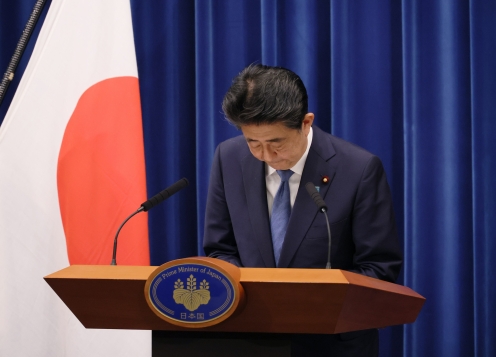
I apologize to the people from the bottom of my heart for having to leave the job amid the coronavirus pandemic while many policies are still halfway toward realization.
|
|
The humility expressed in Prime Minister Abe’s bow to the people of Japan is part of the glue of Japan’s democracy and we respect him for it. That said, major national goals – whether the return of the Northern Territories from Russia or some resolution to North Korea’s abduction of Japanese citizens -- are rarely accomplished in a single administration. Doubtless we, like Shinzo Abe’s successor, will return to some of those topics in the months ahead, certainly including the evolution of CPTPP.
We shall end this note with two assessments, two of the hundreds if not thousands to come. The first, quoted in full, is the Tweet President Trump sent out at 8:03 PM on August 30:
Just had a wonderful conversation with my friend Prime Minister [Shinzo Abe] of Japan, who will be leaving office soon. Shinzo will soon be recognized as the greatest Prime Minister in the history of Japan, whose relationship with the USA is the best it has ever been. Special man.
Over the top? Maybe, maybe not. In any case, one doesn’t praise a friend with half measures.
The second – less personal and more critical – is from the start of Michael Auslin’s Foreign Policy article, which appeared online shortly after Mr. Abe made his announcement. Mr. Auslin wrote:
Despite slumping polls, a stubbornly sluggish economy, and a nagging scandal over the 2016 sale of land for a school in Osaka, Abe nonetheless towered over Japanese politics since returning to the top office in 2012, and from that position he remained a staunch ally of the United States for nearly a decade.
For our part, we don’t find the two assessments all that far apart, especially on the critical question of the U.S.-Japan relationship.
|
|
TPP and CPTPP. In this entry we have used these two acronyms without explanation as most readers are familiar with both. For the record, TPP stands for the Trans-Pacific Partnership, which was a trade agreement, more accurately a negotiation, in which the administration of George W. Bush agreed to participate and which was later led by the Obama administration. In January 2017, President Trump withdrew the United States from these talks. The CPTPP is the Comprehensive and Progressive Agreement for a Trans-Pacific Partnership, in effect TPP without the United States, which was brought to a successful conclusion thanks in large part to the leadership of Japan under Prime Minister Abe.
As For CPTPP is a link to the TTALK Quote for August 26, which focused on Canada’s participation in CPTPP.
Dr. Yoichi Funabashi, a journalist, is Co-Founder and Chairman of Asia Pacific Initiative. The quotation attributed to him above is from Asia’s Reckoning, China, Japan, and the Fate of U.S. Power in The Pacific Century by Richard McGregor, where Dr. Funabashi is described as “Japan’s preeminent foreign policy commentator.”
Trump Hails Abe is a Bloomberg report on the Abe resignation, and it is where we found the text of the Trump tweet quoted above.
The Abe Era Ends takes you to the Foreign Policy article by Michael Auslin quoted above.
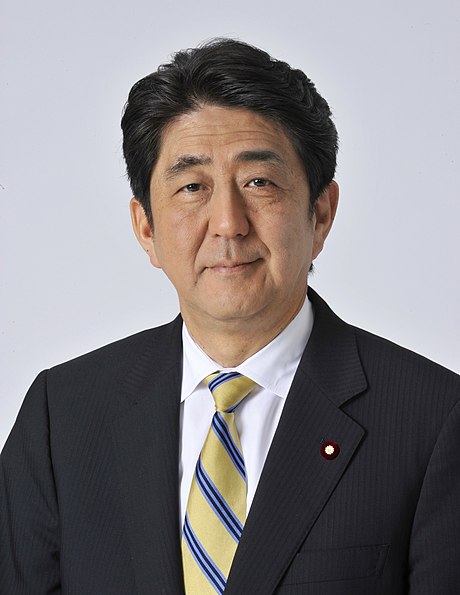
Photos. Of the two shown above, the first is Prime Minister Abe’s official photo from 2015. The second, also an official photograph, was taken at the Prime Minister press conference on August 28, 2020. Both photographs are by the Government of Japan, and both appear in the Wikipedia entry for Shinzo Abe.
|
|
TO GET THE TTALK QUOTES IN YOUR INBOX
Or Other GBD Notices, click below.
|
|
©2020 The Global Business Dialogue, Inc.
1717 Pennsylvania Ave., NW, Suite 1025
Washington, DC 20006
R. K. Morris, Editor
Joanne Thornton, Associate Editor
|
|
|
|
|
|
|