|
Classroom Highlights — Putting Learning into Practice
Throughout our classrooms, students are answering an important question: How can I use what I have learned?
Our commitment to project-based learning, performance-based assessments, and cross-curricular activities gives students opportunities to demonstrate understanding through investigations, writing, presentations, models, and practical solutions. Alongside daily lessons and skill development, these experiences help make learning meaningful. Students explain their thinking, consider different perspectives, and apply knowledge to work with a clear purpose.
Pre-K — Discovering Autumn through Observation
Mrs. Kelly’s Pre-K 4-1 students explored our campus on a leaf scavenger hunt, looking closely for different colors, lines, textures, and other features. They learned about the midrib, petiole, and veins of a leaf and connected their outdoor discoveries with the story The Leaf Thief. This experience brought science and literacy together while helping our youngest learners practice careful observation.
Kindergarten — Becoming Readers with Opinions
In Mrs. Ettinger’s class, students wrapped up October with a Halloween Book Challenge featuring Creepy Carrots!, Big Pumpkin, Room on the Broom, and The Little Old Lady Who Was Not Afraid of Anything. After rating the stories, students chose a favorite and wrote a sentence explaining their choice. Taking on the role of literary critics helped them connect listening comprehension with early writing and express their own ideas.
First Grade — Learning from the Saints
Our first graders are preparing to share what they have learned about a saint of their choosing. Students will dress as their saints and introduce classmates to interesting facts about their lives. This presentation gives children a meaningful way to demonstrate their learning while discovering examples of faith they can follow.
Second Grade — Understanding Numbers and Our World
In mathematics, students are building their understanding of place value through thousands, counting on place value charts, and representing three-digit numbers in unit form. They will also explore expanded form, strengthening their understanding of what each digit represents.
In social studies, students are studying landforms, bodies of water, and their representations on maps. They are also exploring how geography and climate influence communities, connecting map skills with an understanding of how people live.
Third Grade — Researching Lives of Faith
Students in Mrs. Chiaia’s and Ms. Fortuna’s classes selected saints, researched their lives, and wrote brief biographies describing their contributions to the Catholic faith. They also explored their saints’ patronages and reflected on ways to follow their examples. This project connects religion, research, and writing while asking students to consider how faith guides everyday choices.
Fourth Grade — Exploring Perspectives and Creating Models
In Mrs. Marchi’s ELA class, students reading The Cricket in Times Square explored first- and third-person narration. They chose a character and retold a chapter from that character’s first-person perspective, applying their understanding of point of view through creative writing.
In Ms. Brady’s science class, students will bring their landform studies together by creating topographical maps of the ocean floor. Incorporating images of animals they researched during their study of the Mariana Trench will connect scientific research with a visual representation of an underwater environment.
In Mrs. Coyne’s religion class, partners will examine the Good Samaritan through the perspectives of different people in the parable. Considering their thoughts, feelings, and choices will help students connect conscience, free will, and empathy with the ways they treat others.
Fifth Grade — Investigating Science and Representing Faith
In Mrs. Nunziante’s science class, students are rotating through stations that combine informational reading, interactive review on IXL, and a solubility experiment. Identifying solutes and solvents in mixtures gives students a practical way to apply scientific vocabulary and connect what they read with what they observe.
In Mrs. Coyne’s religion class, students are beginning their study of the Seven Sacraments. Working with partners, they will create sketch notes that combine words, key ideas, and illustrations, using visual expression to organize and demonstrate their understanding.
Sixth Grade — Applying Mathematics and Caring for Creation
In Mr. Chierchio’s mathematics class, students are building on decimal addition and subtraction as they move into multiplication and division. Exploring real-world applications helps them understand how these operations support practical problem-solving.
In Mrs. Coyne’s religion class, student groups are developing stewardship projects around environmental concerns within our school. They are researching an issue and proposing realistic plans of action, connecting care for God’s creation with ways to improve their own community.
Sixth and Seventh Grades — Exploring Culture through Creation
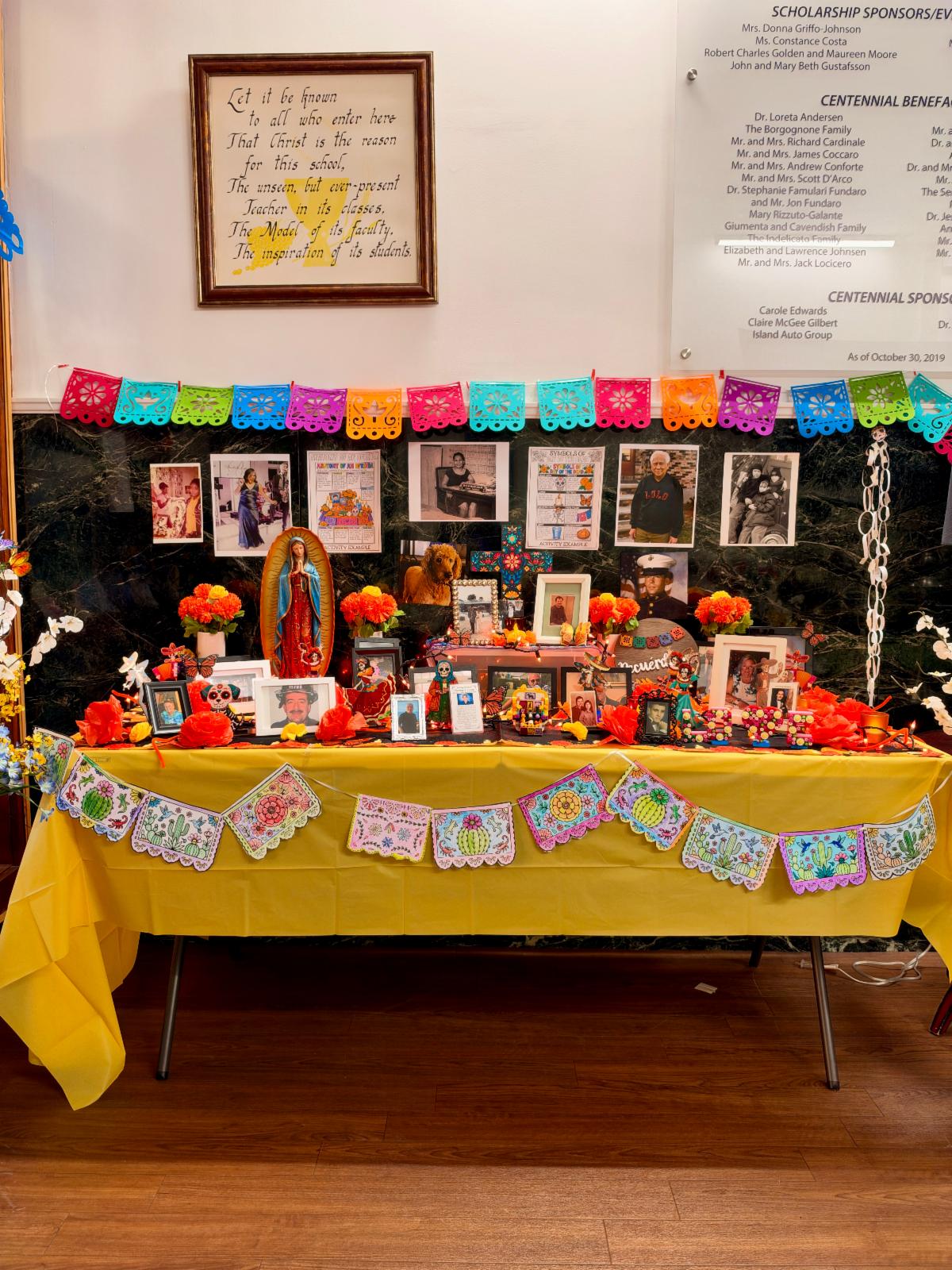
In Spanish, students will transform shoeboxes into miniature ofrendas using flowers, pictures, decorations, and traditional symbols. As they create, they will learn Spanish vocabulary and explore the meaning of Día de los Muertos. The project brings language, culture, and artistic expression together through a purposeful creative task.
Seventh Grade — Thinking Critically and Communicating Clearly
In Ms. D’Agostino’s social studies class, students are tracing the roots of American government and examining the early legal systems that influenced colonial ideas about self-government. In ELA, their study of The Outsiders continues through analysis of character development, social class, identity, and belonging.
In Mrs. Circosta’s mathematics class, students are learning to convert among fractions, decimals, and percents, calculate percentages, and recognize their uses in everyday life.
In Mr. Smith’s religion class, students will explore God’s covenants with Noah, Abraham, and Moses, considering how these promises reveal God’s relationship with His people.
In public speaking, Mr. Smith’s students will put persuasive writing into practice through structured debates. Presenting arguments, supporting claims with evidence, and responding to opposing viewpoints will give students an opportunity to demonstrate their reasoning and communication skills.
Eighth Grade — Measuring, Interpreting, and Leading
In Mrs. Catella’s mathematics class, students took learning outdoors for a Human Circles activity. They formed circles, measured circumference and diameter by counting steps, and compared the resulting ratios with π. Back in class, they examined why some results differed from approximately 3.14 and proposed ways to improve their measurements. Their work connected mathematical concepts with data analysis and the thoughtful revision of a method.
In Mrs. Longo’s social studies class, students will explore the Labor Movement through student-led activities and discussions, taking on the perspectives of workers, union organizers, and factory owners. Investigating wages, working hours, and safety through these roles will help them examine the competing concerns behind historical change.
In ELA, Mrs. Longo’s students are returning to The Pigman, exploring relationships, making predictions, and comparing word choices to determine which best express characters’ emotions and decisions.
In Mr. Smith’s religion class, students will study Origen, St. Jerome, and other early Christian thinkers, exploring their contributions to preserving, explaining, and sharing the teachings of the Church.
STEM and PLTW — Working as Medical Detectives
Ms. Maresca and Mrs. Benson are working together with students on the PLTW Medical Detectives bacteria investigation. Students will analyze bacterial growth and examine zones of inhibition—the clear areas where bacterial growth has been prevented—to compare the effects of different antibiotics.
Using observations and data to support their conclusions connects classroom science with the way laboratory evidence helps medical professionals make treatment decisions. The investigation gives students a purposeful opportunity to demonstrate scientific reasoning and apply what they have learned to a real medical question.
Kindergarten through Third Grade — Building Digital Independence
During technology classes, students are practicing the skills needed to access their Google accounts and navigate learning tools such as Clever and Google Classroom, with expectations suited to each grade. Targeted i-Ready reading or mathematics practice reinforces classroom learning while students build confidence and independence. These routines help children use technology more effectively as a tool for learning.
|