|
Current Mass Times
Saturday: 5 p.m.
Sunday: 7:30 a.m., 9:30 a.m., 11:30 a.m., 2 p.m. (Spanish), 5 p.m.
Monday-Friday: 9 a.m.
Monday-Wednesday-Friday: 12:10 p.m.
Watch a livestreamed or recorded Mass
Confession
Saturday: 10 a.m.-10:30 a.m. (English)
Sunday: 3 p.m.- 4 p.m. (Spanish)
| |
|
"Super Bowl LIX: Lessons for Living"
by Fr. Michael S. Murray, OSFS
| |
|
In the wake of the NFL Conference Championship games comes two weeks of sports commentators’ speculations and predictions concerning what it takes to win the Super Bowl. MVP quarterbacks, stellar running backs, ballet-like wide receivers, offensive aggressiveness, defensive opportunism, and the ability to make the “big play” are just some of the ingredients that many claim make for a potential championship season that will be achieved by one — and only one — team.
One commentator on ESPN recently went in a totally different direction, however, highlighting what he considers to be the deciding factor in any championship: paying attention to — and consistently executing — the basics. He made a convincing argument that however gifted the individual players, however savvy the coach, however high the salary cap or cohesive the team, it is paying attention to the small, seemingly insignificant skill sets — reinforced through repetitive and rigorous practice day in and day out — that results in a championship season.
In other words, if you want to win big, you start out by practicing what it takes to win small.
St. Francis de Sales could not have agreed more. In his “Introduction to the Devout Life,” he described what it takes to live a devout life — what we might describe as being spiritual champions — as nothing other than a thorough love of God and neighbor:
“Inasmuch as divine love adorns the soul, it is called grace, making us pleasing to the Divine Majesty; inasmuch as it gives us the strength to do good, it is called charity; but when it is arrived at that degree of perfection by which it makes us do good but also to achieve that good diligently, frequently, and readily, then it is called devotion. It must be practiced differently by the gentleman, the craftsman, the chamberlain, the prince, the widow, the young woman, the wife. Moreover, the practice of devotion must be adapted to the abilities, affairs and duties of each.”
In his Apostolic Letter to commemorate the four-hundredth anniversary of the death of Francis de Sales, Pope Francis observed: “Devotion becomes a style of life, a way of living immersed in our concrete daily existence. It embraces and discovers meaning by practicing the little things: food and dress, work and relaxation, love and parenthood, conscientiousness in the fulfillment of our duties. In a word, devotion sheds light on the vocation of each individual.”
Created in the image and likeness of God, we are called to become spiritual champions. Our goal is to make it to the ultimate Super Bowl: Heaven. And what is the secret strategy? To play every game, every quarter, and every down through every season of life on earth as intentionally, attentively, and consistently as we possibly can, practicing the basics of love day in and day out.
Perhaps that’s why we’re called practicing Catholics.
| |
The Hopeful Mysteries of the Rosary
by Fr. Sleeva Kala, OSFS
| |
|
Praying the Rosary is a beautiful devotion that enhances our Christian life and personal relationship not only with the Mother of God but also with Christ Jesus. I pray my Rosary daily and experience the guiding presence of Mother Mary in my life. As we know, we have four Mysteries of the Rosary approved by the Holy See and prayed all over the world. They are: Glorious Mysteries, Joyful Mysteries, Sorrowful Mysteries, and Luminous Mysteries. The church also encourages other local devotions as long as they don’t hinder the faith of the faithful or go astray of theological values. One such locally developed mystery of the Rosary is the Hopeful Mysteries of the Rosary.
The idea of the Hopeful Mysteries was conceived by a local parishioner in the Diocese of Pensacola-Tallahassee in April 2018. He proposed the idea to the Diocese where it was received with prayerful discernment and the reflections were checked for theological accuracy. After much thought and review, Bishop William Wack granted his permission to pray in the local diocese of Pensacola-Tallahassee. It was Bishop Wack's intention to clarify that the Diocese is not promulgating a new set of universal mysteries but proposing the worthiness of a devotion that has emerged in the local Church of Pensacola-Tallahassee. If indeed it is God's will that interest in the Hopeful Mysteries grows organically over time and is adopted by the faithful, then Divine Providence will make it as part of the universal promotion. Find out more about the origin of these mysteries here.
Unlike the other four Mysteries of the Rosary, these devotions are rooted in the Old Testament. When we contemplate the Old Testament, we are examining the same words that Mary pondered; the Scripture that Jesus memorized as a child and recited through His ministry. We are literally linked through time. The first four Hopeful Mysteries highlight events in our salvation history that were bolstered by hope and bridge us from the Old Covenant to the New Covenant—to the fifth and final decade: the Immaculate Conception, the creation of a pure vessel to bear our Savior.
In the present times, many people are struggling with hopelessness due to wars, chronic and terminal illnesses, family conflicts, financial struggles, or a variety of other challenges. It could be that the Hopeful Mysteries renew a sense of hope in the hearts of God's people. Praying with and through Mother Mary, may God bring hope to our lives and restore our faith in him. In this Jubilee Year as Pilgrims of Hope, what better time to embrace a devotion of hope.
The Five Hopeful Mysteries of the Rosary:
| |
The First Hopeful Mystery: CREATION
(Original Sin and the “First Gospel”)
In the First Mystery, we begin with the creation of Adam and Eve in the divine image and reflect on the fall of humanity from God’s grace as sin and death enter the world. We also ponder the first hints of the Good News as God promises “the woman and her seed” would triumph over the deception of the Serpent. This is the first promise of the Savior one day to be born of the Virgin Mary, the beginning of God’s loving plan of salvation.
| |
The Second Hopeful Mystery:
THE FLOOD
(God’s Universal Covenant)
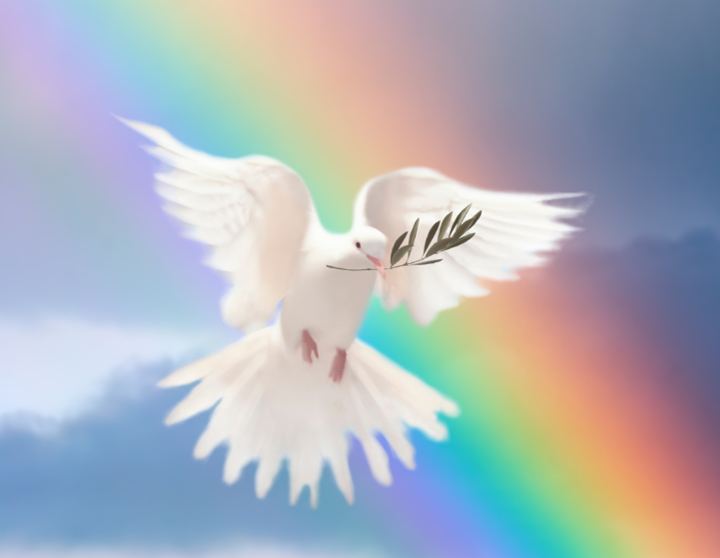
In the Second Mystery, we meditate on God’s judgment of sin in the world and His choice of Noah and his family as signs that His mercy endures forever. The rainbow, emblem of beauty and hope after the destructive storm has passed, foreshadows the covenant sign of God becoming human through the womb of the Virgin Mary who is the Temple of God’s eternal Light from Light.
| |
The Third Hopeful Mystery: ABRAHAM’S SACRIFICE
(God’s Promise of Fruitfulness)
In the Third Mystery, we are invited to remember God’s choice of Abraham to be the patriarch of God’s people, Israel. Abraham’s mission is to extend God’s blessing to all the nations, which will be fulfilled in Christ and His Church. In particular, we recall the binding of Isaac, when God commanded Abraham to sacrifice his beloved son on Mount Moriah. This reminds us that all belongs to God and must be surrendered in service to His mysterious Providential design. By Abraham’s act of radical trust and obedience, God’s Angel holds back His hand. Abraham receives his son back as a pure gift and God ratifies His covenant with Abraham to bless all nations through his descendants. This is also a foreshadowing of Jesus’ own death and resurrection.
| |
|
The Fourth Hopeful Mystery: PASSOVER
(God Saves His People, the Exodus)
In the Fourth Mystery, we reflect on God’s liberation of His people from slavery in the great Exodus out of Egypt through His chosen instrument, Moses. The Exodus story includes the sacrifice of the Passover lamb and the deliverance of the firstborn from death: Israel passing through the Red Sea into freedom: the feeding of God’s people in the desert with heavenly manna: the giving of the law on Mount Sinai in fire: and the forty-year journey to the Promised Land. These events remind us of our slavery to sin and need for a Savior, pointing to Christ’s saving death and resurrection, the giving of the Holy Spirit at Pentecost, the gift of the Holy Eucharist as a memorial sacrifice and the promise of eternal life.
| |
The Fifth Hopeful Mystery:
THE IMMACULATE CONCEPTION
(God Prepares a Mother for His Son)
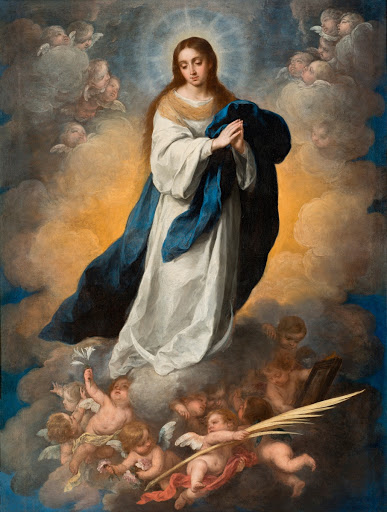
In the fifth mystery, we contemplate the Immaculate Conception of the Virgin Mary in the womb of St. Anne. Here, Mary was prepared by the Holy Spirit to be the worthy Mother of God, from whom God assumed our humanity as His own in Jesus Christ. From the very moment of her conception God preserved Mary from all stain of sin and from all the effects of sin, by the merits of her Son’s death and resurrection.
As we continue this Jubilee Year, as Pilgrims of Hope on our salvation journey, I invite you to pray the Hopeful mysteries. Please stop by the Welcome Desk to pick up a copy of the meditations.
| |
February 3: Feast of St. Blaise | |
|
February 3 is the feast of St. Blaise, traditionally celebrated with the Blessing of Throats.
St. Blaise, who lived in the 4th century, was believed to have been a physician as well as a bishop of the Church. Legend tells that he saved the life of a boy choking on a fish bone. He is also believe to have intervened when a wolf attacked a woman's pig. In gratitude, this woman brought him candles to light the dark cell where he was imprisoned for his Christian faith.
In the 14th Century, when the "Black Plague" ravaged Europe, Asia, and North Africa, Catholics invoked many saints to intercede for them through these desperate times. The devotion to St. Blaise, the patron saint of throat ailments, and the tradition of the Blessing of Throats originated from this time.
On February 3, many Catholics around the world will participate in the Blessing of Throats. (The Eastern Church celebrates this devotion on February 11.) Two candles, often tied with a red ribbon symbolizing the martyrdom of St. Blaise, are crossed in an "X" at the throat. The priest then blesses each person: “Through the intercession of St. Blaise, bishop and martyr, may God deliver you free from every disease of the throat, and from every other disease. In the name of the Father and of the Son and of the Holy Spirit.”
Like many traditions and devotions in our Catholic faith, we celebrate in community — not just here, but in the universal Church. This devotion that sprang from a time of fear brings not just a sense of our unity but also the awe of participating in a tradition that is larger than ourselves.
On Monday, February 3 at both the 9 a.m. and 12:10 p.m. daily Masses, we will celebrate the Blessing of Throats. All are welcome to participate in this beautiful tradition of our faith.
| |
Celebrating Black History Month
Profiles in Faith: Mary Lou Williams
by Elizabeth Connell Wright
| |
|
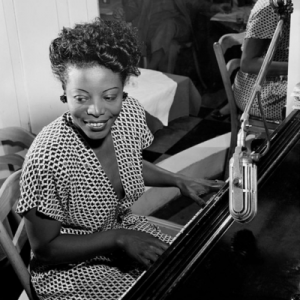
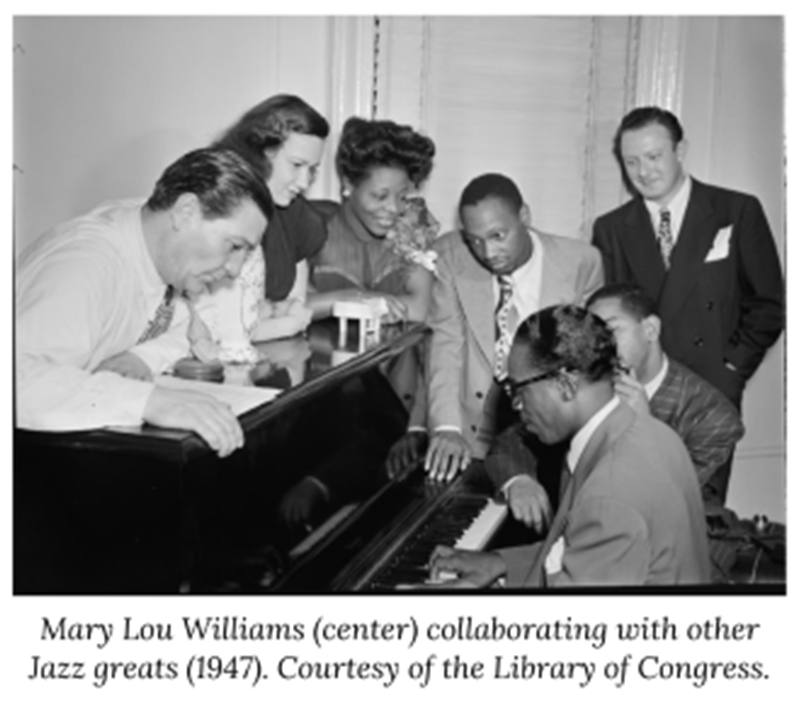
“The Little Piano Girl,” “The First Lady of Jazz,” and “The Lady Who Swings the Band” are just a few of the nicknames of Mary Lou Williams, but by her death in 1981, many more would come to know her as a healer, comforter, and inspiration. Deeply talented, Mary Lou Williams, famous pianist, jazz composer, and performer, was not satisfied until her heart rested in Jesus.
Born in Atlanta, Georgia in 1919, she was the second of eleven children. Mary Lou’s family moved from the South to Pittsburgh’s East Liberty neighborhood when she was nearly four years old and encountered neighbors who, sometimes violently, disapproved of their new Black neighbors. About this time, it became apparent that Mary Lou was a musical prodigy. From infancy, Mary Lou perched on her mother’s knee learning music by ear as her mother played the organ. By six years old, she was playing professionally and unwittingly, smoothing racial tensions as she performed at the parties of her white neighbors, who were suddenly more accepting of their new neighbors. By 15 she was traveling and performing with jazz bands. She was married by 16 and soon had moved to Kansas City where her career soared as she played and composed with jazz greats such as Benny Goodman, Louis Armstrong, and Duke Ellington. She later mentored Charlie Parker, Thelonious Monk, Dizzy Gillespie and other jazz legends.
| |
|
There isn’t exactly a time in American history that was easy for Black women, but mid-2oth century would have been a particularly trying time for a woman of color in a music industry that was dominated by men. Yet, trumpet virtuoso Dizzy Gillespie described her as “a truly, truly, truly great artist.” Despite the challenges of the time, her career blossomed, until she just had enough.
In 1954 at 44 years old, Mary Lou was performing at Le Boeuf Sur le Toit in Paris; mid-performance, she simply stood up from the piano bench and walked away. Mary abandoned her musical success and retreated for three years. It is believed that a combination of exhaustion and depression from the recent tragic death of her friend, Garland Wilson, drove her to this edge.
She remained in Paris and a friend of hers, pianist Hazel Scott, recommended the Psalms of the Bible for comfort — Mary Lou read all 150 and continued to study them. Another friend introduced her to a quaint garden for meditation — there she happened upon a statue of the Blessed Virgin Mary to accompany her prayer. Soon, Scott arranged for Mary Lou’s travel back to her home in Harlem, and the seeds of her rebirth were planted. Mary Lou wrote of Hazel Scott in her diary, “This great and wonderful talent introduced me to what really saved me—God—that is what I was searching for.”
Back home in Harlem, Mary Lou sought solace in church, longing to hear God. One night when the Baptist church she frequented was closed, she entered the doors to the only church she could find open, Our Lady of Lourdes, a Catholic church near her apartment in Harlem. There she discovered other people seeking peace, stepping off the busy streets of New York to have quiet conversations with Christ, prayers sent up in the middle of hectic days and complex lives. Mary Lou had found her home and a path to the peace she was seeking; along with her friend, Lorraine Gillespie (Dizzy’s wife), she converted to Catholicism through her baptism at Manhattan's St. Ignatius Loyola Church on May 7, 1957.
In the early days after her conversion to Catholicism, she preferred the keys of her Royal typewriter over the piano keys. She typed prayer instructions and mimeographed them to share with her friends and even strangers on street corners. She took Jesuit-led classes at St. Ignatius Loyola Church on Park Avenue and made pilgrimages to chapels and cathedrals throughout the city. She also focused on helping musicians who were struggling, particularly with addiction, by establishing the Bel Canto Foundation and opening a thrift store to fund it, while also welcoming them to her home as a place of recovery. Everything Mary Lou did was rooted in her newfound Catholic faith and personal relationship with Christ.
During this time, Dizzy Gillespie was on tour in Latin America when Redemptorist priest and jazz aficionado, Fr. John Cowley approached him to inquire about Mary Lou. When Fr. Crowley next visited New York, Lorraine brought him to see Mary Lou. Understanding her vocation as a jazz musician, Fr. Crowley guided her to consider her musical talents as a form of sacred worship and prayer.
| |
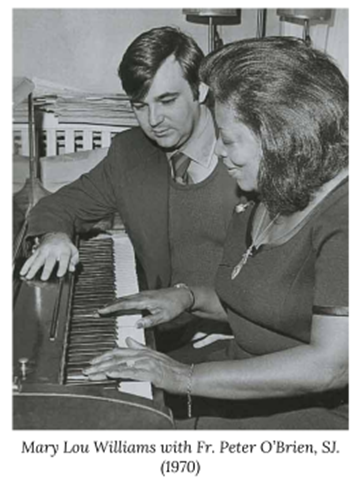
In 1957, Dizzy Gillespie persuaded Mary Lou to make her first public performance in three years at the summer’s Newport Jazz Festival. Soon after, Fr. Peter O’Brien, a Jesuit priest, became her manager and friend (remaining so until her death in 1981). In 1962, amendments to the Constitution of Sacred Liturgy by the Second Vatican Council led Mary Lou’s peers to steer her artistic talents toward sacred jazz music. (She was the first jazz composer commissioned by the Church to compose liturgical music.) Two years later, she released the album, “Black Christ of the Andes,” inspired by and including a hymn in honor of Saint Martin de Porres, the patron saint of racial harmony and the first Black saint of the Americas. She went on to perform this at New York’s Philharmonic Hall.
Mary had found her new calling and her career again flourished; she continued to compose music for three more Masses:
She composed the first Mass in 1966 while teaching jazz at a Catholic high school in Pittsburgh, where she had been sent by John Cardinal Wright. The Mass was performed only once at St. Paul’s Cathedral in Pittsburgh. Two years later, she composed “A Mass for the Lenten Season,” and this was celebrated for the six Sundays of Lent at St. Thomas the Apostle in Pittsburgh.
| |
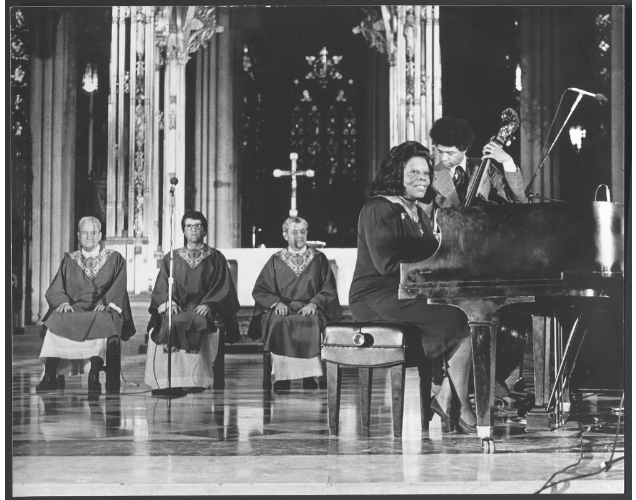
Mary Lou Williams at St. Patrick's Cathedral, 1975.
Copyright Presbyterian Historical Society
| |
Her third Mass was commissioned by Msgr. Joseph Gremillion, an American priest at the Vatican, after Mary Lou’s private audience with Pope Paul VI in 1969. This Mass, titled “Music for Peace,” (later, commonly called “Mary Lou’s Mass” after famous dancer, Alvin Ailey, choreographed the Mass) was celebrated at St. Patrick’s Cathedral on February 18, 1975, with 3,000 people in attendance. This Mass was planned as an opportunity to include the school children of New York and encourage their interest in the cathedral and the Mass. She told the New York Post, "Americans don't realize how important jazz is. It's healing for the soul. It should be played everywhere — in churches, nightclubs, everywhere. We have to use every place we can.”
Beyond composing and performing, Mary Lou was called to educate. She became a prominent advocate for jazz, dedicated to instructing young African American students about their musical heritage — the healing art of music that comforted their ancestors as they suffered through enslavement. She recorded, “The History of Jazz,” a combination of music and spoken word teaching of the evolution of jazz. “Jazz,” Mary Lou Williams said, is “spiritual and healing to the soul. The slaves used spirituals to forget what was happening. The spirituals came out of great suffering, and jazz was born from the spirituals.”
The final season of Mary Lou’s life was enjoyed as an artist in-residence at Duke University. She succumbed to cancer in 1981 and was laid to rest in the Calvary Catholic Cemetery in Pittsburgh. Mary Lou Williams’ biographer, Deanna Witkowski, says, “I always think of Mary Lou as someone who was a very compassionate person and had a heart for others. [She] was doing works of mercy before she was Catholic.” Mary Lou said of her own faith journey, “I am praying through my fingers when I play.” Once her restless heart was satisfied, Mary Lou Williams rested in the comfort of her faith and gave the gift of her music and selfless service to the world.
This February consider celebrating Black History Month by listening to Mary Lou Williams' many jazz compilations. Some of these are linked in the text; additionally, reflect on these favorites: "Praise the Lord," "Roll 'Em," "Ode to Saint Cecilie," or check out this playlist from NPR that you can listen to on Apple Music or Spotify. For more information on Mary Lou Williams, you can visit the Mary Lou Williams Foundation page, which also has all her recordings.
Happy Black History Month and happy listening!
| |
"Discovering Ourselves in Tumultuous Times"
by Tom Costello
| |
|
We live in challenging times. We are all hoping for a better world, yet the dynamics of the present are stressful and make it hard for us, compounding the uncertainties about the way forward. The challenges come in how we achieve, and who experiences, that better world. Opening ourselves to prayer, to the lessons and guidance provided by Jesus can help us to follow the right paths, not only for ourselves and our families but for our communities, our nation, our world. And Jesus can help lead us to sensible, sustainable action.
| |
Lent –a time to open ourselves to Jesus
Lent offers a powerful time for such prayer and reflection, guiding us to the power of sacrifice and the joy of Resurrection, as we seek ways to respond to the present challenges. This Lenten season one of those paths could be a series developed by JustFaith, incorporating the fundamentals of our Catholic faith tradition without isolating ourselves from those around us.
A six-part Lenten series, each weekly session just one hour, will offer prayer and discussion on key themes:
Lament — grappling with the world as it is, and recognizing that even in its brokenness it is worthy of our care;
Repent — recognizing our own role, both personal and collective, in doing harm and turning toward accountability;
Forgive — recognizing the harm that others have done and holding the possibility of transformation and new life.
We will draw on Gospel readings to stir our minds and hearts, awaken our senses to the possibilities around us, including the needs not only of ourselves but all those who reside in our community. All of the materials including readings will be in the participant packet you will receive after you register. For more information and upcoming registration, check the bulletin and website.
Catholic Social Teaching the Foundation for JustFaith
Catholic Social Teaching is concerned with human dignity and the common good in society. Social concerns were expressed in the Hebrew prophets, and are central to the message and actions of Jesus and the parables of Jesus as presented in the Gospels, as well as throughout the Letters of Paul. The concerns of human dignity, social justice and wealth distribution were concerns of Sts. Augustine and Thomas Aquinas and remain Christian concerns today.
The shaping of social concerns in the modern era were offered by Pope Leo XIII in his 1891 encyclical Rarum novarum. In the work of Vatican II, one of the Council’s published documents, Gaudium et spes, covered a range of issues governing the relationship of social concerns and Christian action. It asserts the fundamental dignity of each person, declaring the church's solidarity with those who suffer and those who comfort the suffering.
Pope John Paul II was especially concerned with the development of Catholic social doctrine:
On one hand there is a growing moral sensitivity alert to the value of every individual as a human being without any distinction of race, nationality, religion, political opinion, or social class. On the other hand these proclamations are contradicted in practice. How can these solemn affirmations be reconciled with the widespread attacks on human life and the refusal to accept those who are weak, needy, elderly, or just conceived? These attacks go directly against respect for life; they threaten the very meaning of democratic coexistence, and our cities risk becoming societies of people who are rejected, marginalized, uprooted, and oppressed, instead of communities of "people living together."(Evangelium Vitae)
He said that the social doctrine of the Church should be a non-negotiable component of the practice of the Faith.
| |
|
The Seven Tenets of Catholic Social Teaching (from USCCB)
In the last three decades, Catholic social doctrine has been refined further, and expressed in seven themes, or tenets of Catholic Social Teaching:
Life and Dignity of the Human Person — Human life is sacred, and the dignity of the human person is the foundation of a moral vision for society. Issues of abortion, the death penalty, targeting civilians in war, or terrorist attacks are always wrong.
Call to Family, Community, and Participation — The person is not only sacred but also social. How we organize our society — in economics and politics, in law and policy — directly affects human dignity and the capacity of individuals to grow in community. Marriage and the family are the central social institutions that must be supported and strengthened. We believe people have a right and a duty to participate in society, seeking together the common good and well-being of all, especially the poor and vulnerable.
Rights and Responsibilities — Human dignity can be protected and a healthy community can be achieved only if human rights are protected and responsibilities are met. Therefore, every person has a fundamental right to life and a right to those things required for human decency. Corresponding to these rights are duties and responsibilities--to one another, to our families, and to the larger society.
Option for the Poor and Vulnerable — A basic moral test is how our most vulnerable members are faring. In a society marred by deepening divisions between rich and poor, our tradition recalls the story of the Last Judgment (Mt 25:31-46) and instructs us to put the needs of the poor and vulnerable first.
| |
|
Dignity of Work and the Rights of Workers — The economy must serve people, not the other way around. Work is more than a way to make a living; it is a form of continuing participation in God’s creation. If the dignity of work is to be protected, then the basic rights of workers must be respected — the right to productive work, to decent and fair wages, to the organization and joining of unions, to private property, and to economic initiative.
Solidarity — We are one human family whatever our national, racial, ethnic, economic, and ideological differences. We are our brothers’ and sisters’ keepers, wherever they may be. Loving our neighbor has global dimensions in a shrinking world. At the core of the virtue of solidarity is the pursuit of justice and peace. Pope Paul VI said that if you want peace, work for justice. The Gospel calls us to be peacemakers. Our love demands that we promote peace in a world surrounded by violence and conflict.
Care for God’s Creation — We show our respect for the Creator by our stewardship of creation. Care for the earth is not just an Earth Day slogan, it is a requirement of our faith. We are called to protect people and the planet, living our faith in relationship with all of God’s creation. This environmental challenge has fundamental moral and ethical dimensions that cannot be ignored.
JustFaith: Learning Leads to Action
The first JustFaith program was offered at St. John Neumann Parish more than 15 years ago. More than 150 of our fellow parishioners participated and the fruit of this is evident in the full range of service programs and ministries at our parish today, from our annual hypothermia shelter to the many thousands of meals our parish prepares and serves to those in need. We have active community partnerships with Cornerstones and other faith organizations to collaborate in serving the needs of others. Our vibrant SJN ministries, including the Racial Justice Ministry, ACTION Committee, Pax Christi, Kairos Prison Ministry, Care for Our Common Home, and many others lead to opportunities to both learn and serve. Without question, all of these and other programs were made possible by the fertile environment provided by our Oblates of St. Francis DeSales. The continued flourishing of our service is based on SJN parishioners' commitment to Catholic Social Teaching.
| |
After Easter, we have more exciting JustFaith programs in the pipeline:
Faith and Immigration Justice — Designed to facilitate holy and healthy dialogue on immigration, a highly contentious topic that is intricately linked with our Christian faith. The program focuses primarily on immigrants crossing our southern border, though the program touches upon global migration and immigrants coming to the U.S. from non-Latin American countries. According to the United Nations, globally there are currently 82.4 million forcibly displaced persons.
In developing this program, JustFaith intentionally sought out resources from a variety of faith and political perspectives. Regardless of whether you consider yourself “conservative” or “progressive,” Catholic or Protestant, or if you don’t fit neatly into any of these categories, we hope that all participants will feel welcome in this program. Ultimately, participants should come to better understand migration in general, as well as motivate you to learn about — and learn from — immigrants from all countries and cultures.
Additional JustFaith programs being considered include:
-
An encore of the Faith and Racial Justice program series, first offered in 2020-21. In the first run, nearly 80 people, including parishioners and people from other congregations, participated in the program.
-
A four-program series on Poverty, including Biblical, solidarity, justice, and global responses.
-
The first Spanish language program from JustFaith.
The Tenets of Catholic Social Teaching are extraordinary. No other Christian denomination has such a summary of areas of social need. It is hoped that, with this background you will open yourself to the possibilities of a broader community of hope and love in these turbulent times.
| |
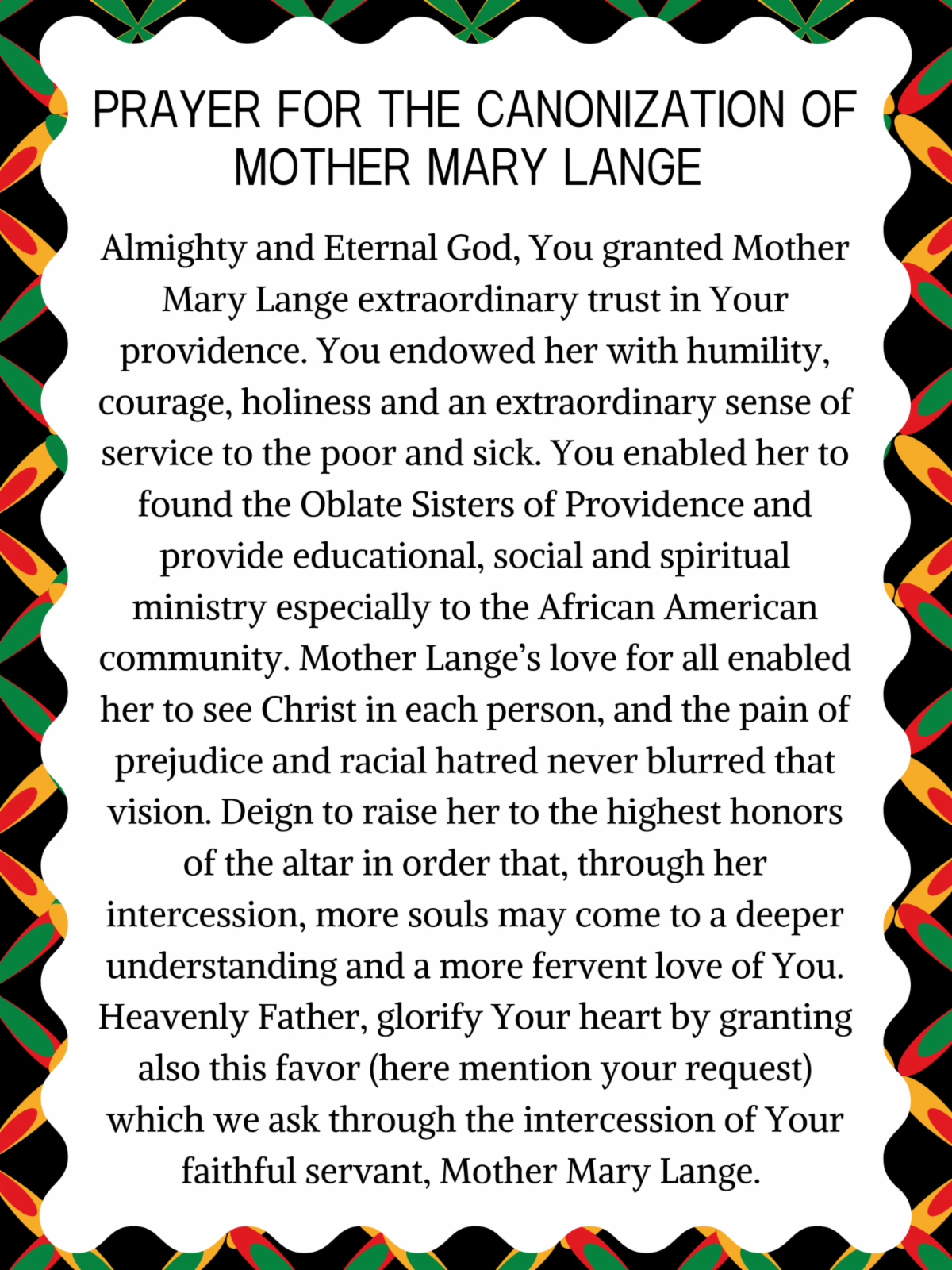
Prayer for Canonization:
Mother Mary Lange | |
This February celebrate Black History Month by joining in praying for the canonization of the Venerable Mother Mary Lange. | |
|
The Pope's Intention for Prayer and Action
for February
| |
|
For vocations to the
priesthood and religious life
Let us pray that the ecclesial community might welcome the desires and doubts of those young people who feel a call to serve Christ's mission in the priesthood and religious life.
| |
|
"Because he himself was tested
through what he suffered, he is able
to help those who are being tested."
Hebrews 2:18
| | | | |