September 2023 | Volume 15 Issue 9 | |
 | |
Happy September, Grassland Enthusiasts! I hope everyone had a great long weekend!
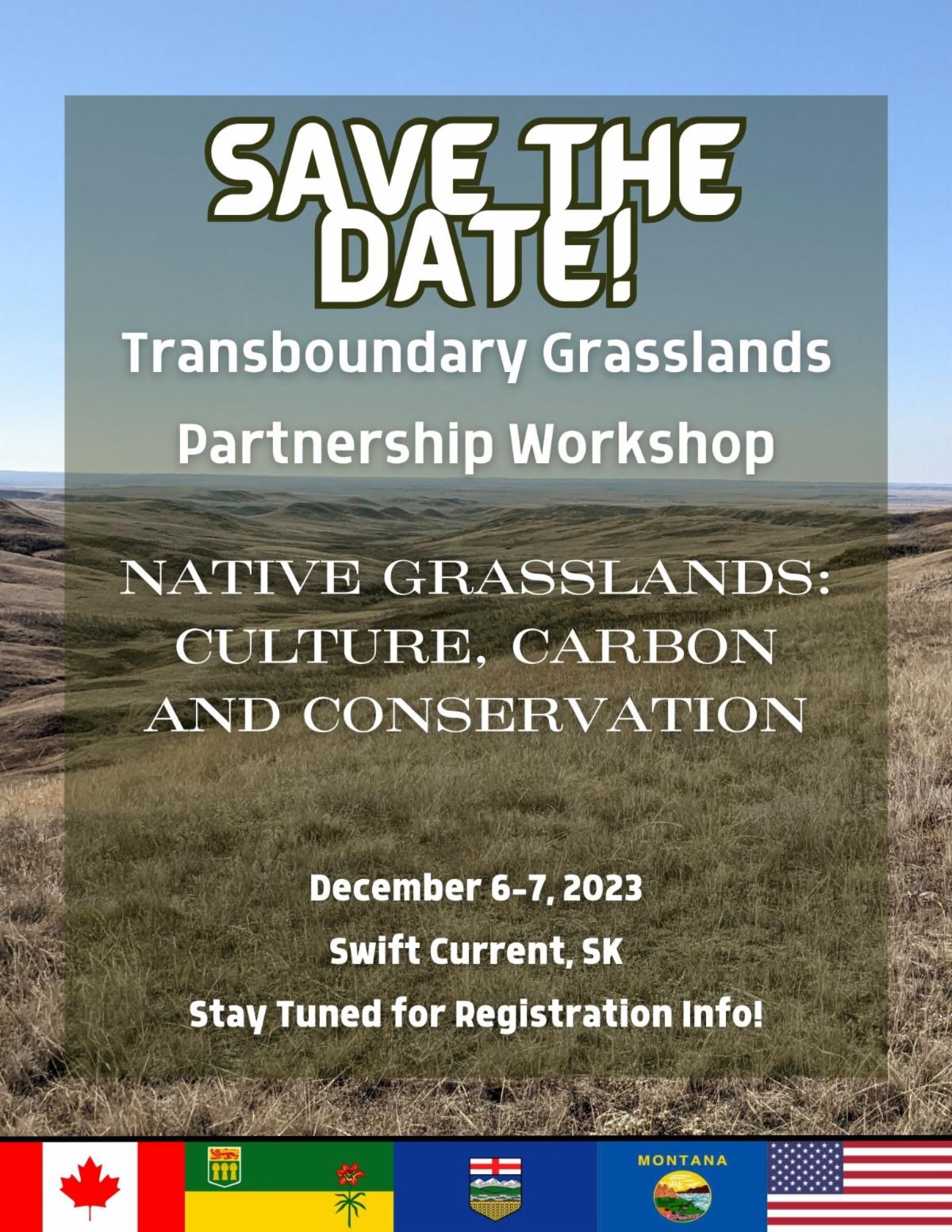
We're gearing up for a busy Fall and Winter here at PCAP. We're involved with planning two large workshops, the first being the Transboundary Grassland Partnership Workshop in Swift Current in December. Registration will be available on the SK Stock Growers Foundation website and should open later this month. Stay tuned for more information!
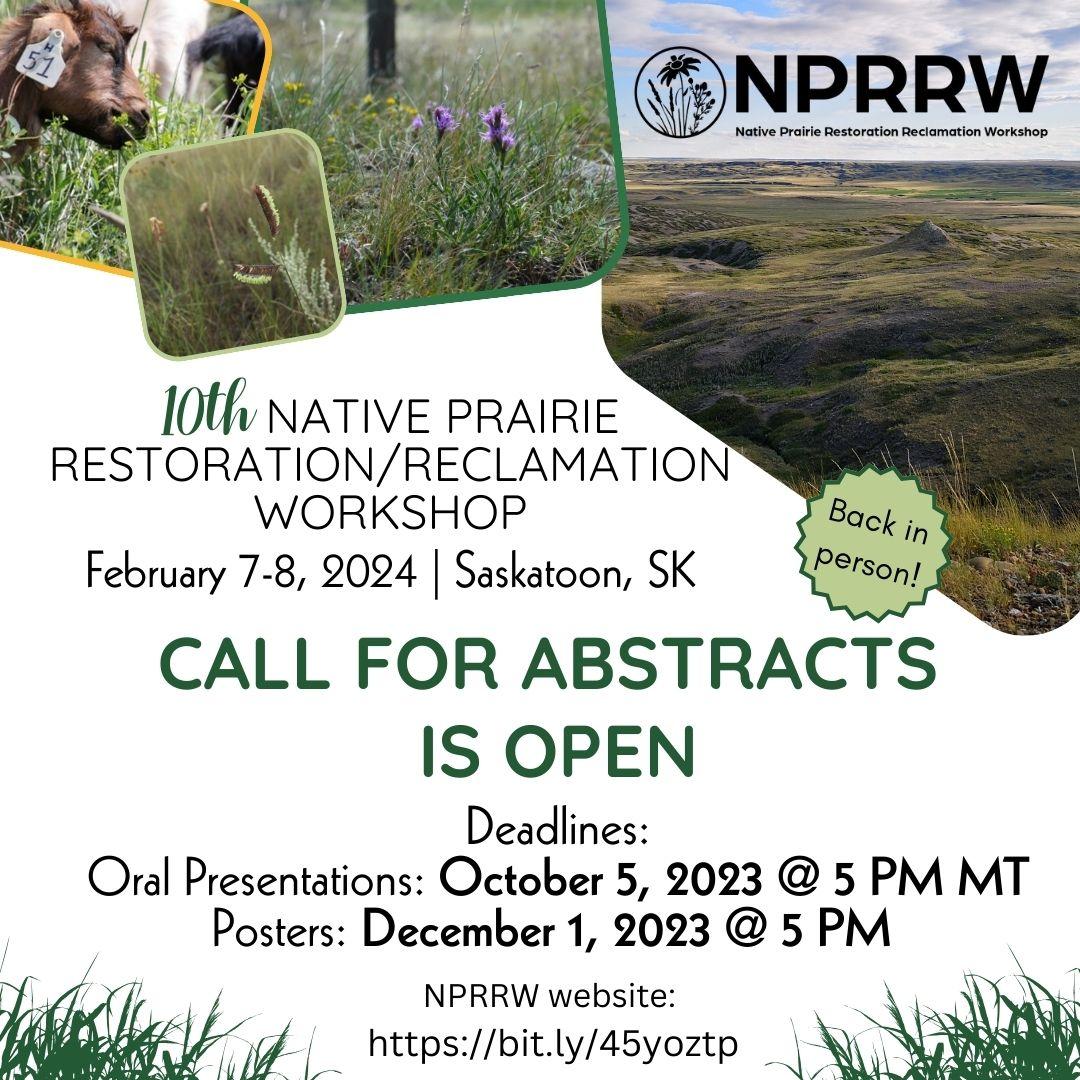
We are also planning the 10th Native Prairie Restoration/Reclamation Workshop in February 2024 in Saskatoon! We're very excited to be back in person, for the first time since 2020. The call for abstracts is now open, you can find the online forms to submit an abstract on the PCAP website, here. The deadline for presentation abstracts is October 5th!
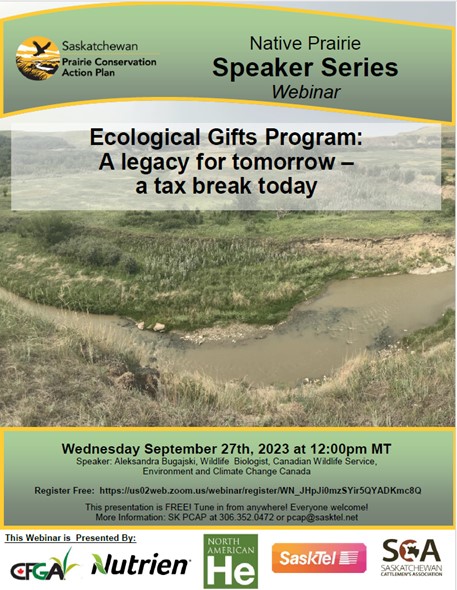
The September Native Prairie Speaker Series webinar is about the Ecological Gifts Program with Aleksandra Bugajski, Wildlife Biologist with Canadian Wildlife Service, ECCC. You can register here.
The August Native Prairie Speaker Series was about monitoring of migratory birds with Jordan Rustad from the Last Mountain Bird Observatory. You can see the recording of Jordan's webinar on our YouTube Channel.
And finally, we would like to thank our sponsors for their generous support: Canadian Forage and Grasslands Association, K+S Youth+Us, North American Helium, Nutrien, Saskatchewan Cattlemen's Association, SaskEnergy, SaskPower, SaskTel, SaskWater, Wildlife Habitat Canada and Environment and Climate Change Canada, as well as the continuous support of all the PCAP Partners.
Carolyn Gaudet, SK PCAP Manager
pcap@sasktel.net
| |
Mark your calendars for the 2024 Native Prairie Restoration/Reclamation Workshop!
The 10th Native Prairie Restoration/Reclamation Workshop is back in person! The workshop will take place February 7-8, 2024 at the Saskatoon Inn and Convention Centre in Saskatoon, SK.
The theme is "Building Bridges to Tomorrow: Restoration and Reclamation For the Future"
The Call for Abstracts is open! The deadline for oral presentations is October 5th, 2023. An extension may be granted if requests for approvals within your organization need more than 4 weeks. Contact Carolyn (pcap@sasktel.net) to discuss.
Call for Presentation Abstracts can be found here.
Call for Poster Abstracts can be found here.
Registration will open in early October, stay tuned for the announcement. We will have registrations costs available online later this month, before registration opens.
|  | |
Employment Opportunities
Nature Saskatchewan is looking for a Habitat Stewardship Coordinator to develop and deliver the Operation Burrowing Owl program. Application deadline is today, September 5th.
Agriculture and Agri-Food Canada is looking for a Perennial Carbon Modeller in Lethbridge, AB. Application deadline is September 8th.
The Royal Saskatchewan Museum is looking for an Indigenous Programs Specialist. Application deadline is September 10th.
The Wilder Institute/Calgary Zoo is looking for a Conservation Program Manager (Whooping Crane) and a Conservation Program Manager (Vancouver Island Marmot). Job postings will remain active until suitable candidates are found.
| |
My Grasshopper Teacher
Submitted by John Wilmshurst & Tracey Etwell, Canadian Wildlife Federation
Who hasn’t spent too much time watching Netflix in the last two years. One of our favourites last year was “My Octopus Teacher”, the story of a filmmaker discovering an amazing undersea world that he lived near but never explored. The prairie insect world is very much like that—an extraordinarily rich world at our feet that we know little about.
For the past couple of summers, a team of local students and insect biologists from Canadian Wildlife Federation, Carleton University, and Agriculture and Agri-food Canada have been sampling insects on native rangelands in southwestern Saskatchewan. This is part of the Weston Foundation funded, Multi-taxa Project that is managed by the Saskatchewan Stockgrowers Foundation, with our partners South of the Divide Conservation Action Program (SODCAP) and Birds Canada. We have been working together to measure plants, birds, and bugs on native rangelands. The idea is to see how birds and insects respond to the plant composition and habitat changes that occur when grazed. By participating in SODCAP's new Living Lab project, we will also help clarify how grazing can both benefit prairie species and contribute to the fight against climate change.
Our sampling crew this summer was fantastic. Guided by Dr. Behnam Motamedinia from Carleton University, our four-person team consisted of three Saskatchewan youth (Tanner Stevens from Avonlea, Janna Hewitt from near Kyle and Rico Szechtman-Pintos from Regina) and our crew-leader (Broden Boothman from Edmonton). They sampled four ranches, all in the southwest, and collected thousands of insect samples in the same plots where plants and birds were surveyed. We are looking mainly for native bees, big-headed flies, true hoppers and grasshoppers, all with jobs to do in the prairie ecosystem as pollinators and pest predators. These samples are shipped to a lab for identification and data will be used to answer biodiversity questions about grazing management.
The sampling was a success, but our greatest win was with our crew. While a few had worked with bugs before, all were amazed at the diversity and abundance of insects they collected. They learned to get down close to the ground to see the small wildlife that contribute to the beauty of the rangeland. If we could teach all Canadians to experience the world this way, how much more appreciation we would have for our world. Grasshoppers have something to teach us too.
| 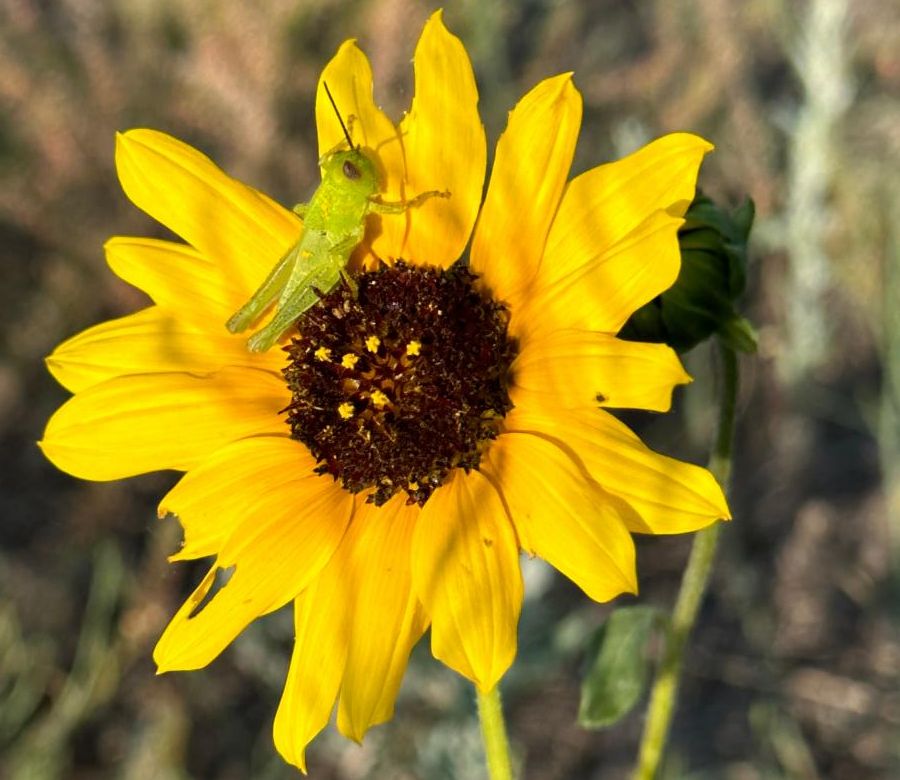 | Rudbeckia and grasshopper. Photo credit: Tanner Stevens | |
Partner Spotlight:
University of Regina
The growing legacy of the U of R herbarium
by Katie Doke Sawatzky
The George F. Ledingham Herbarium and its collection of specimens—some 70,000 dried plants, flowers, mosses and lichen—has been a gem of the University’s biology department for decades, but regrettably it remains relatively unknown to the outside world. That is about to change.
Mel Hart, associate dean of Science: Student experience and engagement, is spearheading a project to digitize the entire collection over the next five to ten years, making the data from each specimen available on the Global Biodiversity Information Facility (GBIF), a free and open global online database.
The Ledingham legacy
George F. Ledingham dedicated his life to the collection and study of Saskatchewan’s plant life. George was born on his family’s farm in 1911 near Boharm, Saskatchewan, attained his undergraduate, graduate, and doctorate degrees in science during the Great Depression in Saskatoon and Wisconsin. He worked his way up in the Biology department at Regina College from assistant professor in 1946 to chair of the department in 1969, when it was known as the Regina Campus of the University of Saskatchewan. Retiring in 1978, four years after the University became an independent degree-granting institution, Ledingham taught until 1983.
Throughout his career, this Indiana Jones of biology gathered specimens from all over Saskatchewan and around the world. Ledingham has received awards from Environment Canada and the Canadian Parks Service for great acts of service.
“Although he retired in 1978, George continued working in the herbarium, coming into the University several times a week right up until a few months before his death in 2006,” says Hart. His dedication to the work he did is just one part of why the Ledingham Herbarium is such a special place.
While the plants are dried and laid out on acid-free paper, the moss and lichen collections are contained in small envelopes in cardboard boxes that once held Hush Puppies, Italian-made shoes, rice cakes, and biscuits. Pulling out the specimens and reading the immaculate cursive of the labels makes one feel they’ve gone back in time.
A new generation of botanists
Two biology students, Ellaissa Andrade and Bazil Rehman are tasked with transcribing the written information found on each of these labels into digital files. They are also getting ready to create images of each specimen with a new high-resolution scanner the faculty received earlier this spring.
The herbarium holds other records of Ledingham's work, including numerous journals in which he noted his findings and daily work, boxes of slides that document his research travels, and three filing cabinets packed with documents that range from his teaching notes to his efforts to establish conservation areas in the province.
While the dried specimens within the herbarium are indications of past life, the ongoing work to preserve Ledingham's legacy is creating new resources and opportunities for students and the wider community.
"Once the collection and the associated materials are available in a digital format on GBIF, that really allows accessibility for anyone anywhere to tap in and see what we have to offer," Hart says.
Note: Above is an excerpt that is part of a larger story published in the Degrees Magazine, you can find the full story here.
| |
Stay tuned for news about our upcoming Native Prairie Speaker Series webinars! | |
Ecological Gifts Program: A legacy for tomorrow – a tax break today
Speaker: Aleksandra Bugajski, Environment and Climate Change Canada
Wed September 27, 2023 at 12 PM MT
Register here
More information
Save the date!
Wetland conservation is for the birds: foraging, diet, and insecticide exposure in prairie swallows
Speaker: Mercy Harris, MSc Candidate, U of S
Thursday October 12 at 12 PM MT
Register here
More information
Please visit our Native Prairie Speaker Series webpage regularly for upcoming topics, dates, and registration details.
| |
Prescribed Fire & Targeted Grazing Monitoring Workshop
September 11-12, 2023
Beaver Creek Conservation Area, near Saskatoon, SK
Paddle Canada Lake Introduction Tandem Canoe Course
September 15-16, 2023
Wascana Lake, Regina, SK
Paddle Canada Lake Canoe Intermediate Tandem Course
September 15-17, 2023
Wascana Lake, Regina, SK
Nature Saskatchewan Fall Meet
September 22-23, 2023
Indian Head, SK
Remote First Aid
September 22-24, 2023
Regina, SK
South of the Divide Conservation Action Program AGM
September 28, 2023
Val Marie, SK
Annual MFGA Conference
Nov 13-15, 2023
Brandon, MB
Canadian Western Agribition
November 20-25, 2023
Regina, SK
Transboundary Grassland Partnership Workshop
December 6-7, 2023
Swift Current, SK
Native Prairie Restoration/ Reclamation Workshop
February 7-8, 2024
Saskatoon, SK
| |
SK PCAP has two free education programs available.
See more information here!
| |
2023/24 Education Programs:
Presenting Sponsors:
| |
Carolyn Gaudet, Editor, Saskatchewan Prairie Conservation Action Plan Newsletter | |
|
SK PCAP gratefully acknowledges financial support in 2023-2024 from:
Canadian Forage and Grassland Association, Ducks Unlimited Canada, Environment and Climate Change Canada, North American Helium, Nutrien, Parks Canada - Grasslands National Park of Canada, K+S youth+us, Saskatchewan Cattlemen's Association, Saskatchewan Ministry of Agriculture, Saskatchewan Ministry of Environment - Fish and Wildlife Development Fund, SaskEnergy, SaskPower, SaskTel, SaskWater, University of Regina, University of Saskatchewan - College of Agriculture and Bioresources, Water Security Agency and Wildlife Habitat Canada.
SK PCAP gratefully acknowledges in-kind support for 2023-24 from:
Agriculture and Agri-Food Canada - Science and Technology Branch, Canadian Parks and Wilderness Association, Environment Canada - Canadian Wildlife Service, Friends of the Royal Saskatchewan Museum, Meewasin Valley Authority, Native Plant Society of Saskatchewan, Nature Conservancy Canada, Nature Saskatchewan, Parks Canada - Grasslands National Park, Prairie Wind & Silver Sage, Ranchers Stewardship Alliance Inc., Redberry Lake Biosphere Region, Saskatchewan Association of Rural Municipalities, Saskatchewan Association of Watersheds, Saskatchewan Bison Association, Saskatchewan Burrowing Owl Interpretive Centre, Saskatchewan Cattlemen's Association, Saskatchewan Environmental Society, Saskatchewan Forage Council, Saskatchewan Ministry of Agriculture, Saskatchewan Ministry of Environment, Saskatchewan Ministry of Energy and Resources, Saskatchewan Ministry of Parks, Culture and Sport, Saskatchewan Stock Growers Association, Saskatchewan Stock Growers Foundation, Saskatchewan Wildlife Federation, SaskEnergy, SaskOutdoors, SaskPower, Society for Range Management - Prairie Parkland Chapter, South of the Divide Conservation Action Program Inc., University of Regina, University of Saskatchewan - College of Agriculture and Bioresources.
| | | | |