|
From The Editor
Helen Colby, PhD
| |
Thank you to all the contributors to this issue of the newsletter! We have a new, regular section, “From the Field,” with articles from members. In this issue Jenny Spencer reflects on the wide variety of opinions laypeople have about cancer screenings. Ryan Suk provides insightful commentary on the crucial role of decision-making science in an increasingly AI-enabled world. Kine Pedersen describes the foundational work on cervical cancer prevention that came out of a collaboration started at SMDM more than a decade ago, and Carlo Federici provides an overview of the SUSTAIN-HTA Initiative which will present beta versions of the project’s new tools for the SMDM community to engage with at the annual conference in June.
|
From The President
Beate Jahn, PhD
| |
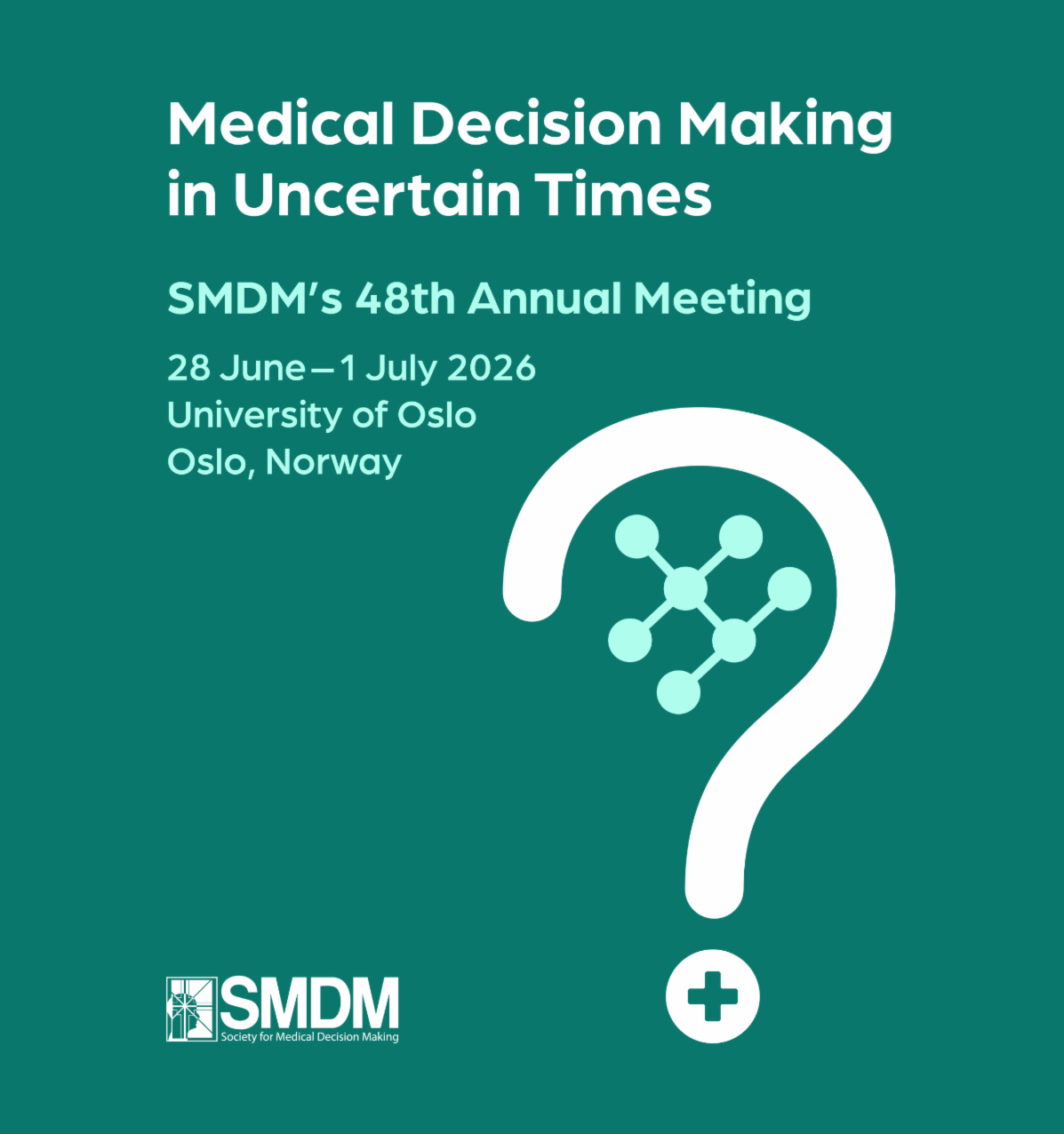
Even if the weather’s unpredictable and our next meeting theme is “Medical Decision Making in Uncertain Times,” there’s a 100% chance of a successful meeting in Oslo - so pack a lightweight rain jacket and your sensitivity analyses.
| |  |
From the Oslo Meeting
Co-Chairs
Emily Burger, PhD &
Torbjørn Wisløff, MSc, PhD
| The scientific program for the 2026 SMDM Annual Meeting in Oslo is coming together beautifully, reflecting both the breadth and depth of our field. We are excited to share that a total of 485 abstracts have been accepted across oral and poster presentations, alongside 9 scientific symposia, 2 supported symposia, and 5 invited symposia. |
| | |
Everyone has an opinion about cancer screening
by Jenny Spencer, PhD
| |
I’m chatty and I talk to a lot of strangers. Inevitably, I am asked what I do. When I answer that I research cancer screening, I am usually treated to some very strongly held opinions about the topic. These opinions are often well-earned, perhaps the product of supporting close family members through diagnosis and treatment or their own experiences with scary abnormal findings, but these opinions also reflect some common misunderstandings around cancer screening guidelines.
| |
How SMDM collaborations and decision modeling informed cervical cancer prevention policies in Norway
by Kine Pedersen, PhD
| |
Medical decision making often requires acting in the face of incomplete, evolving, and sometimes conflicting evidence. Over the past decade, my work has focused on using disease simulation models to inform cervical cancer prevention policies in the context of technological and epidemiological change, within the context of Norway.
|
| | |
In an AI-Focused Era, the Case for Decision Science
by Ryan Suk, PhD, MS
| |
When I recently gave a guest lecture on decision modeling and economic evaluation, a senior colleague asked me, “Do you do this with AI?” I remember pausing for quite a while, partly because I was not entirely sure what the question meant. But I was also struck by something deeper… how quickly, in this moment, many forms of rigorous analytic work are being absorbed into one broad and often blurry conversation about AI.
| |
Bridging Innovation and Practice in HTA: The SUSTAIN-HTA Initiative
by Carlo Federici, PhD
| |
Health Technology Assessment (HTA) is facing increasing pressure to adapt to a rapidly evolving landscape of health technologies, policy requirements, and methodological expectations. Advances such as precision medicine, smaller target populations, and more complex evidence generation pathways are challenging traditional HTA approaches. In this context, the SUSTAIN-HTA project has been launched as a Horizon Europe Coordination and Support Action (2024–2027) to help bridge the gap between methodological innovation and real-world HTA practice.
| | | |
FROM THE HISTORIAN
Scott B. Cantor, Ph.D.
| | | | In Memoriam: Morris Raker | I was skimming through the “Class Notes” section of the latest issue of the Yale Alumni Magazine. The last entry in the for the class of 1957 was the following: “In Memoriam: Morris Raker died on March 15, 2025. His family has directed that no class obituary appears.”(1) Perhaps the family did not wish to share more info about their deceased loved one. I will provide some important background information about Raker here. | | | |
All are welcome!
Cost-Effectiveness and Decision Modeling using R Workshop
25-27 June, 2026
University of Oslo
| | | Kick-off Your SMDM 2026 Experience with a Hands-On Workshop for Decision Modeling in R | Join the Decision Analysis in R for Technologies in Health (DARTH) workgroup, in partnership with the University of Oslo, in a hands-on workshop happening June 25-27 2026. This workshop will cover building decision tree, cohort, and microsimulation models and conducting sensitivity analyses during three days of live coding sessions and hands-on exercises. You are expected to have a basic understanding of decision modeling and R. A pre-course module will be provided to brush up on your R basics. This workshop is a unique opportunity to improve your skills in developing health economic models in R and to expand your network within SMDM. | | | A Mayo Clinic invitation! Join our research team | |
|
We, a group of researchers from Mayo Clinic's Department of Emergency Medicine, including myself, plan to conduct a study on medical providers' decision-making regarding the indication for extracorporeal life support (eCPR) in patients with out-of-hospital cardiac arrest. We are currently seeking a collaborator who is an expert in medical decision-making.
| |
| | |
Assistant/Associate/
Full Professor, Pharmacoepidemiology/
Pharmacoeconomics
Department of Clinical Pharmacy, School of Pharmacy, University of California, San Francisco
The Department of Clinical Pharmacy at the University of California, San Francisco (UCSF) invites applications for a tenure-track or in-residence faculty position at the Assistant, Associate, or Full Professor level in pharmacoepidemiology or related fields.
| |
| | | |