|
|
What's new this month:
- Input Needed: SPEER HVAC Survey
- Upcoming Webinars/Events
- Noteworthy
- SPEER Resources & Webinar Archive
- What We're Reading
| | | Input Needed: SPEER HVAC Survey | | | |
Attention contractors and other HVAC professionals!
SPEER is conducting a survey about evaluating, repairing, and replacing ductwork in existing single-family homes over the past 2 years. Ductwork includes any type of product or assembly that transports conditioned air to or from an air handler or furnace.
This survey is for research purposes and not connected in any way to any commercial enterprises. The results will help educators and energy efficiency incentive programs identify the practical skills, tools, and equipment needed to effectively evaluate, repair, and replace ductwork in existing homes.
We appreciate your input! Head here for the survey.
| | |
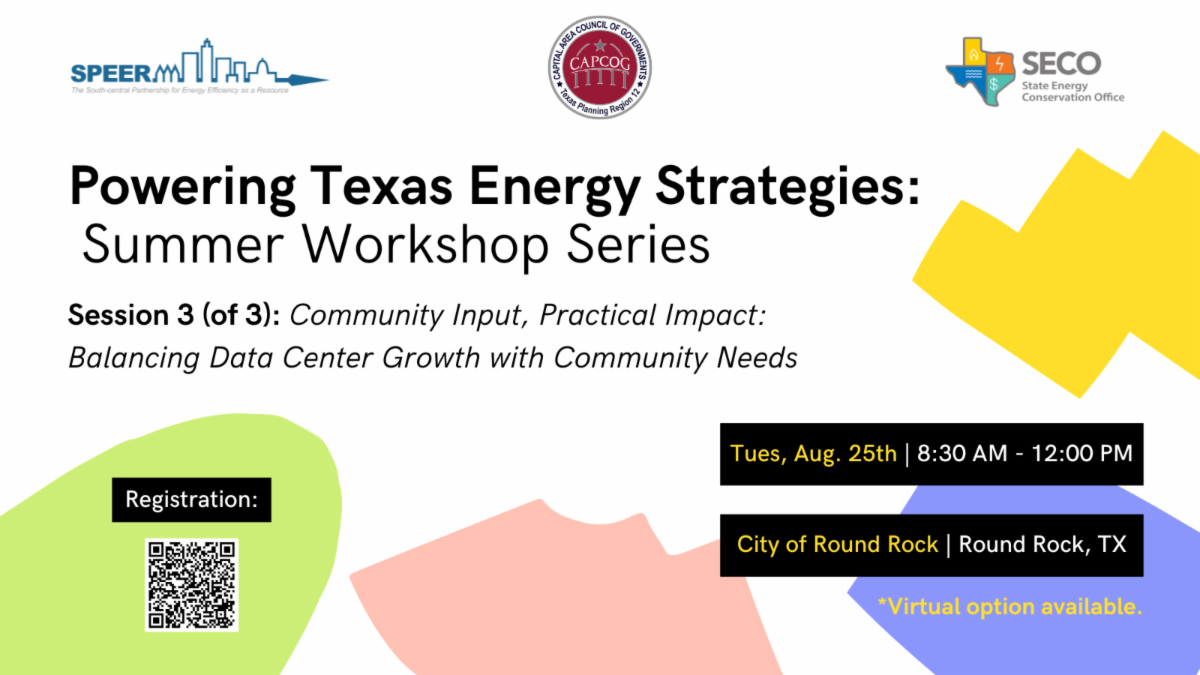
Powering Texas Energy Strategies: Summer Workshop Series
Part 3: Community Input, Practical Impact: Balancing Data Center Growth with Community Needs
August 25 from 8:30 am - 12:00 pm
City of Round Rock, 3400 Sunrise Rd., Round Rock, TX 78665
Join us for the third installment of the Powering Texas Energy Strategies: Summer Workshop Series. This hybrid workshop will take a deeper look at one of the highest-interest topics identified through participant surveys: the growth of data centers and their implications for communities, with a focus on zoning, environmental impacts, and community engagement.
Presenters:
These workshops are presented in partnership with the Capital Area Council of Governments, the State Energy Conservation Office (SECO), and SPEER.
| |
Beyond the Data Center: Building the Community around Data Centers
September 22 at 10:30 am
Data centers are among the most efficient buildings ever constructed, yet they are frequently located in rural communities with limited resources for energy code enforcement, plan review, inspections, and workforce development. As these facilities attract rapid residential and commercial growth, hundreds of surrounding buildings, including homes, apartments, schools, hotels, restaurants, warehouses, and public facilities, may be constructed without the same focus on energy performance.
This session explores how expanding the sustainability conversation beyond the data center creates lasting environmental, economic, and community benefits. Participants will examine why investments in energy code implementation, commissioning, third-party verification, inspector training, and regional technical capacity can produce decades of reduced energy consumption, improved grid resilience, and lower infrastructure costs. The presentation also compares the marginal efficiency gains achieved inside highly optimized data centers with the much larger cumulative opportunity represented by surrounding community development.
Key Takeaways
- Recognize the hidden energy impacts of development surrounding large data centers
- Identify practical strategies for strengthening local capacity through training, plan review, inspections, and public-private investment
- Explore how coordinated community development supports long-term energy efficiency, resilient infrastructure, and sustainable economic growth
| | | |
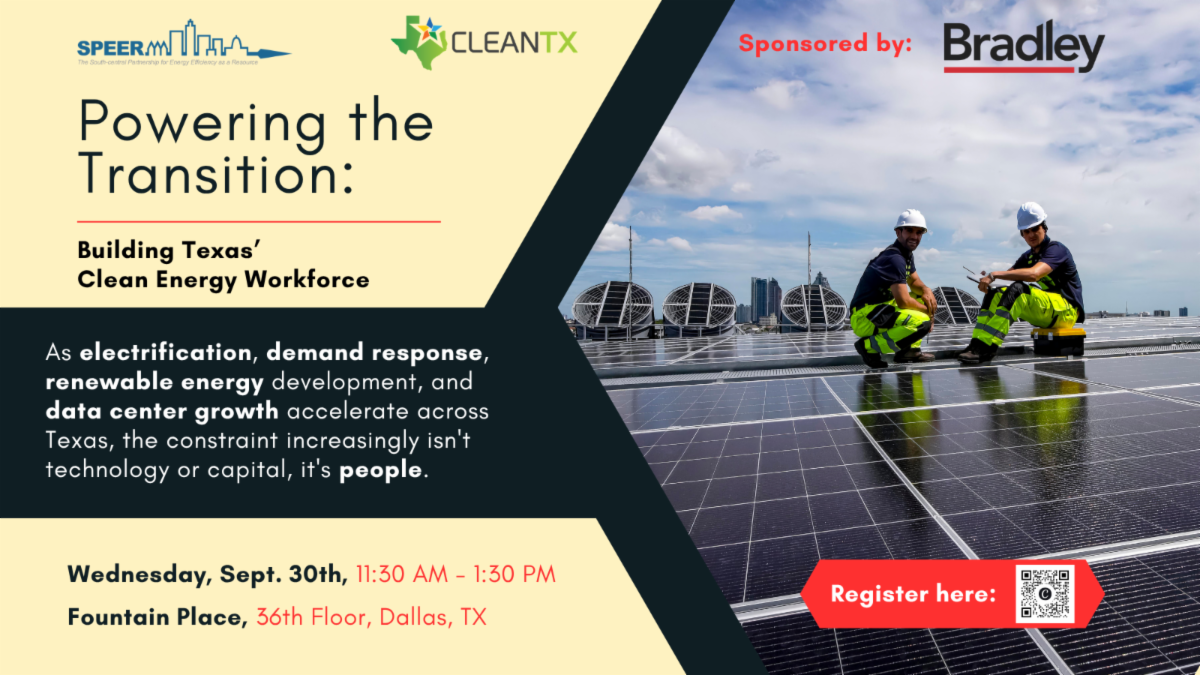
Powering the Transition: Building Texas' Clean Energy Workforce
September 30 from 11:30 am - 1:30 pm
CleanTX and SPEER are convening a joint luncheon and workshop in Dallas on the workforce behind the energy transition. As electrification, demand response, renewable energy development, and data center growth accelerate across Texas, the constraint increasingly isn’t technology or capital, it’s people.
This session brings together educators, contractors, and industry to talk candidly about how we’re building the talent pipeline: the training and credentialing programs preparing workers today, the apprenticeship and labor standards attached to federally supported projects, and the gaps that still need closing. We’re keeping the format conversational and the panel practical, with plenty of room for audience discussion.
Sponsored by: Bradley
| | | SPEER is looking for others with a passion for our Energy Conservation Code and is open to hosting a webinar for you. | | SPEER Resources & Webinar Archive |
| | | |
In Case You Missed It!
Did you miss our recent webinar, Heat Pumps & the Modern Energy Code?
Heat pumps are becoming an increasingly important part of residential construction, offering builders an efficient way to improve comfort, reduce energy consumption, and meet the demands of today's energy codes.
This session provides a practical overview of heat pump technologies, how they operate, and why they are gaining popularity in new construction. Attendees will explore how heat pumps can support energy code compliance, improve building performance, and provide long-term value for both builders and homeowners.
| |
Check out all the resources we have on our website, including a link to our YouTube page with hours of video training content! |
| | |
Does Radiant Cooling in a Humid Climate Make Sense? — Energy Vanguard
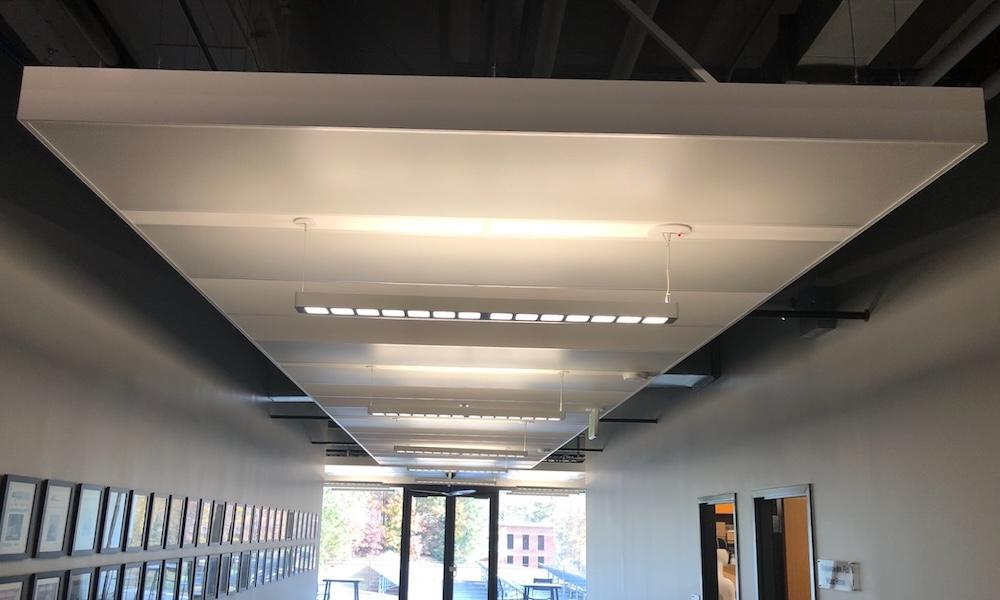
When we think about cooling a commercial building, we typically think about moving large volumes of conditioned air through ductwork. But what if we separated temperature control from humidity control?
In this article, building scientist Allison Bailes explores radiant cooling using cooled floors, ceilings, or panels to absorb heat from occupants and surrounding surfaces rather than relying entirely on cold supply air. One of the most interesting concepts is that radiant systems can handle the building's sensible cooling load, while a separate dehumidification and ventilation system manages the latent load, outdoor air, and indoor air quality.
Humidity is still the challenge. In hot-humid climates like Texas and Oklahoma, radiant surface temperatures must remain above the indoor dew point to prevent condensation, making humidity monitoring and dedicated dehumidification critical parts of the design.
The bigger takeaway: Energy efficiency doesn't always mean finding a more efficient version of the same HVAC system. Sometimes it means reconsidering how we deliver heating and cooling in the first place—and designing the building, envelope, HVAC, ventilation, and humidity-control systems to work together.
Read the full article at Energy Vanguard
|
| | | | |