|
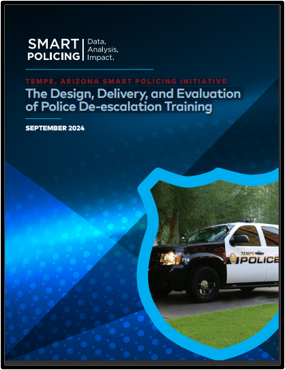
De-escalation training has emerged as a strategy that many believe can reduce the use of unlawful and unnecessary force by police officers. Despite de-escalation’s rapid adoption in policing, its evidence base is both limited and mixed. As a result, key questions about its impact remain unanswered. In 2017, the Tempe, Arizona Police Department (TPD) and researchers from Arizona State University (ASU) received funding through the Bureau of Justice Assistance (BJA) Smart Policing Initiative (SPI) to design, deliver, and evaluate a de-escalation training program. DESIGN The Tempe SPI team customized its own training.
This SPI Spotlight publication highlights the development, implementation, and evaluation of Tempe's efforts and provides a checklist of issues to consider for fellow agencies considering similar programs.
The Tempe team devoted 18 months to curriculum development, centered on three activities:
- Sending officers to attend two dozen different de-escalation trainings to hand-pick what would work for Tempe.
- Identifying and learning from “top de-escalators” in TPD.
- Conducting a departmentwide survey to gather perspectives about de-escalation from all officers.
The SPI team collated information from these activities and worked with curriculum developers to create the training content.
Read the Tempe site spotlight here.
Click here to learn more about the Tempe SPI profile on the SPI website including their full final report and a podcast on findings.
|