|
During the school year they’re at your kids’ middle schools and high schools, keeping the campus safe, mediating disputes, investigating criminal activity, and being good role models for the leaders of tomorrow. But when school shuts down for the summer, where do all the Pinellas County Sheriff’s Office (PCSO) School Resource Officers (SRO) go?
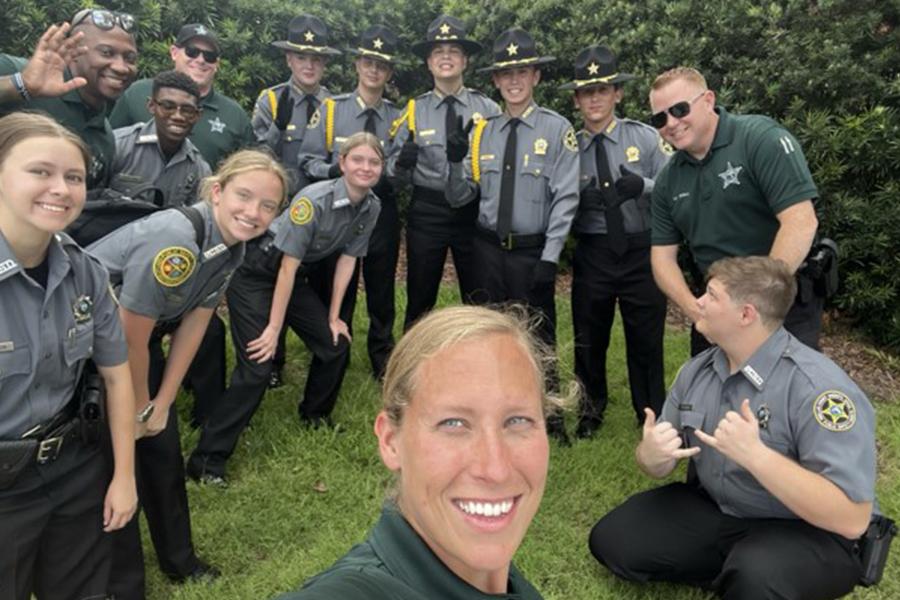
It turns out that many of them find other areas in the agency where they can continue their passion for keeping kids and schools safe. “Several of them are helping with the Cadets over the summer,” said Lieutenant Matt Thornton of the Youth Education Section. The young people in Cadet Unit 900 are learning firsthand about the challenges and rewards of a career in law enforcement, whether that be in patrol, detention and corrections, forensics, or any of the many careers adjacent to law enforcement.
Corporal Chris Jones, Unit Supervisor of the Cadets, said he can’t overstate how valuable the SROs are to his team. “Many of them bring not only law enforcement experience but also a deep, personal investment in youth development.”
Summer is the Cadets’ busiest time, with training, physical fitness challenges, community service projects, and competition at state and national levels. “I enjoy having SROs help with Cadets because they can translate very daunting adult topics into a format children and young adults can comprehend and utilize to complete the very complex scenarios they face during the arduous weeks of competition,” said Lead Cadet Mentor Deputy Chris Thompson.
Deputy Megan Tindall was the Lead Cadet Mentor before she became an SRO, so it is meaningful for her to return for the summer and guide the kids she helped develop through their intense competitions. “These young adults put in so much hard work to become the best versions of themselves – leaders of the future. Assisting them in the summer and seeing them compete shows full circle what their hard work and dedication mean. It’s very humbling and rewarding to see how far they grow even in such a short time.”
Not all SROs go to the Cadets over the summer. Two SROs joined the Mass Casualty Planning Unit (MCPU) which, among other duties, is responsible for making sure private schools are as safe as public schools. Deputy Keith Jackson, who worked at Dunedin Highland Middle School last year, said it is important to him to stay in a role focused on school safety even when school is out of session. “For me, continuing to focus on school safety – even during the summer – is a natural extension of my commitment to this work. While many SROs return to patrol during the break, I felt it was important to stay immersed in school safety initiatives year-round.” The MCPU, with its proactive methods and strategies, is a perfect fit. “I saw working with the unit as a chance to grow and learn more about the larger-scale processes involved in emergency preparedness.”
Deputy Jackson has been conducting site assessments at private schools. “I identify vulnerabilities and provide recommendations to strengthen their preparedness and emergency protocols.” No one knows how schools work, from a safety standpoint, better than an SRO. “My experience gives me a practical understanding of how schools operate day-to-day, including how students and staff move through the campus, where potential blind spots may exist, and what kind of safety culture is present. That real-world perspective is essential in recognizing not just physical vulnerabilities, but also gaps in procedures or communication that could hinder emergency response.”
Deputy John McGonigle, who worked at Dunedin High School last year, is spending his summer helping the MCPU update all the county’s Blue Boxes, which securely hold master keys to the school for use in an emergency such as an active assailant event. “What this unit does directly relates to my job as an SRO,” he said. “I enjoy working with MCPU because it gives me a chance to learn and understand what goes into planning for an active assailant event, what facilities need to do to help prevent an assailant from entering a facility, and what to do if an assailant does gain access to a school campus or other venue.”
“Most SROs go to patrol for the summer,” said Lieutenant Thornton. They stay on day shift, but might move around the county as needed, filling gaps where patrol deputies are on vacation. “It helps patrol out a lot, and I think it’s a good thing that they get a refresher in patrol.”
“The transition can be challenging because school environments are unique – they involve daily interaction with children and educators, and require a very specific kind of communication and conflict resolution skill set,” said Deputy Jackson. But there are definite perks to moving somewhere else in the agency for the summer.
“There are absolutely benefits to switching things up and taking a break from the school,” Deputy McGonigle said. “Whether I am assigned to patrol, MCPU, or any other unit, it helps keep my skills as a deputy sheriff sharp because there are things you do in patrol or other areas that you don’t get to experience in the schools.”
|