The STAN board has been working hard on developing networking and outreach programs for you, our members.
In December, we are launching our
first Professional Development Webinar with guest speaker Connie Wyatt Anderson, who has been teaching high school history and geography on the Opaskwayak Cree Nation since 1992. She has been involved in the creation of student learning materials and curricula at the provincial, national, and international level, and has contributed to a number of textbooks, teacher support guides and school publications.
|
|
|
The Webinar will explore practical tips and applications for incorporating Indigenous perspectives in meaningful way, embedding them into existing school curricula, and informal education programs.
Register now
.
This spring we will host our Annual STAN Conference in Ottawa, and we’d like your input.
Please complete this 3-minute survey to give us a better idea of the content you’d like to see moving forward.
We look forward to engaging with you in the coming months!
In this edition of the newsletter you can learn more about the
NSERC Young Innovators Grant
, the third
Science Literacy Survey, about how you can promote women in STEM during
Women’s History Month, and the
International Science Centre and Science Museum Day (
ISCSMD).
— STAN Board of Directors
|
|
NSERC Young Innovators
Are you part of an organization that hosts a student science or engineering competition?
The NSERC Young Innovators grant supports student participation in science and engineering competitions, where they put their creativity in action and become role models for other youth. Your organization can apply for funding to cover the cost of a youth’s participation in your event, and encourage young scientists and engineers to develop their skills.
NSERC provides organizations with $1,000 to be used toward student participation in a science fair or competition. NSERC Young Innovator grants may be used to cover costs for material and supplies to create the poster/model/demonstration and/or travel, meals, accommodation or competition registration.
Organizations are encouraged to consider using the grant to support youth from groups who are under-represented in STEM, or those who would otherwise not be able to participate. To be eligible for support, students must be enrolled in a Canadian elementary or high school, or the first year of college in Quebec.
There are no fixed deadlines for this grant. Applications must be submitted 2-6 months before the competition in which the NSERC Young Innovator(s) will participate.
For more details about the NSERC Young Innovators grant, please visit
www.nserc.gc.ca
|
|
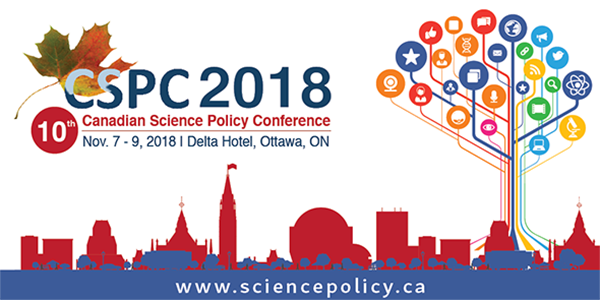
Registration and Program Announcement: The 10th Canadian Science Policy Conference, CSPC 2018!
Registration will include three breakfasts, two lunches, two receptions.
The CSPC 2018 Gala Dinner will be held on Thursday, November 8 at the spectacular Canadian Museum of History.
CSPC 2018 will feature a wide spectrum of topics and pressing issues in science and innovation policy. With more than 700 participants, over 200 speakers, 50 panels, and five symposia, CSPC 2018 will be the biggest yet.
|
|
Join STAN to receive quarterly emails.
|
|
|
The State of Science Literacy in Canada
Our world is rapidly changing. Advances made over a few short decades have allowed us to access a world of information with a few taps on our cell phones, to discover effective treatments for diseases once thought incurable, and to communicate instantly with friends around the globe.
We know that we have science and technology to thank for these advances, but what is our relationship with science and technology as a society?
That’s what the Ontario Science Centre was trying to find out with its third Science Literacy Survey published today.
There are plenty of reasons for optimism found in the survey. Among them, there is widespread agreement (84%) that science and technology improve our lives and fully 83% of respondents want to know more about science and technology.
A striking result is the tension between the widespread recognition (74%) that we need science and technology to solve the complex problems the world faces, and the worrisome result that more than half (54%) of Canadians believe that society is turning away from science. This is, I believe, a fundamental issue for a technology-based society like ours. We need to increase public trust in science to be able to effectively deal with the problems we face.
Canadians are concerned about the societal impact of new technologies such as Artificial Intelligence (62%), large-scale automation (60%), and the internet of things (54%). These results underline the very reasonable question of whether we are ready to deal with the massive societal changes these technologies will bring. It is important that we encourage clear and open public conversations on these issues.
According to the survey 90% of Canadians believe museums and science centres are the most trusted sources of information. The Ontario Science Centre prides itself on being a hub for people to learn more and engage in thoughtful dialogue on the importance of science.
For full Science Literacy Survey results, please visit
SciLitSurvey2018
.
Follow the Ontario Science Centre on
Twitter
and
Faceboo
k
for news and updates, or connect with Dr. Maurice Bitran, PhD, CEO and Chief Science Officer of the Ontario Science Centre, on
LinkedIn
.
Methodology
An online survey of 1,501 Canadians was completed between June 18 and June 26, 2018, using Leger’s online panel. The margin of error for this study was +/-2.5%, 19 times out of 20.
- Maurice Bitran, PhD
CEO and Chief Science Officer, Ontario Science Centre
|
|
Science as a Human Right
STAN members know the value of science in society; evidence-based knowledge and decisions permeate our world and our work. By tapping into STEAM events, you can bring new perspectives to your work and play a bigger role in disseminating science throughout your communities.
Do you have a favourite event that you participate in to raise awareness of STEM? Maybe you should add one this November — the
International Science Centre and Science Museum Day (or ISCSD)! Rolls right off the tongue, right? Okay, perhaps not. Many STAN members are not strictly science centres or science museums so they may not think of this day as theirs but I say
Why not?
November 10 2018 – International Science Centre and Science Museum Day
Science as a Human Right
I’m proposing that STAN members take a look at the message of ISCSMD and the Sustainable Development Goals (SDG) proposed by UNESCO. So many STAN member activities actually tie into this, and the SDGs give them context in a broader plan for a sustainable world.
|
|
Affordable and Clean Energy (SDG 7), Industry, Innovation and Infrastructure (SDG 9); Climate Action (SDG 13); Life Below Water and Life on Land (SDGs 14 and 15); Zero Hunger (food security and agriculture, SDG2); Good Health and Well Being, and Clean Water and Sanitation (SDGs 3 and 6) are all science-based goals. The innovations being applied to challenges faced in achieving sustainability all come from a STEAM approach – that is the intersection of science, technology, engineering and math with creativity and innovation (arts). Even more than STEAM, we must be inclusive by recognizing and incorporating the knowledge of all. That’s where I see SDG17 being so vital.
Naturally, SDG 4 –Quality Education– must include a solid base of science. Not only is a scientifically literate society important in guiding voters and governments to support evidence-based policy, but tomorrow’s jobs will also tie into STEM more than ever before.
So, if you want to be a part of ISCSMD here is a quick primer:
- ISCSMD is November 10 annually
- Each year there is a focus – this year it’s “Science as a Human Right”
- You can find resources and info here: http://www.iscsmd.org/
- Hashtags are #ScienceDay and #ISCSMD
Whether you jump on the ISCMD bandwagon or not, the SDGs represent a framework to help contextualize the value of STEM and the importance of the work that you do. The future, our future, needs science.
Happy ISCSMD Day Everyone!
If you are doing anything to observe ISCSMD let us know and we’ll be sure to tag you in our social media for the day.
|
|
- Sandra Corbeil, STAN President
|
|
|
|
Globe and Mail, Sept 27, 2018
CBC, Oct 18, 2018
National Post, Oct 2, 2018
|
|
U of T News, Oct 18, 2018
Globe and Mail, Oct 3, 2018
CKPG Today, Oct 28, 2018
Trail Times, Oct 20 2018
|
|
Science Needs Women - Celebrating Women’s History Month
Every October we celebrate the achievements of women and girls as trailblazers throughout history. In perfect timing, on October 2it was announced that Canadian Donna Strickland was awarded a Nobel prize for her work with lasers. So quick trivia question for you: How many other Canadian women have been awarded a Nobel in science? The answer: None.
Let’s celebrate this well-deserved recognition. Let’s use this to highlight the need for equity and breaking down barriers. Let’s work towards sharing what women have done, to show young Canadians what they can do. As Malala Yousafzai said, “We cannot all succeed when half of us are held back.”
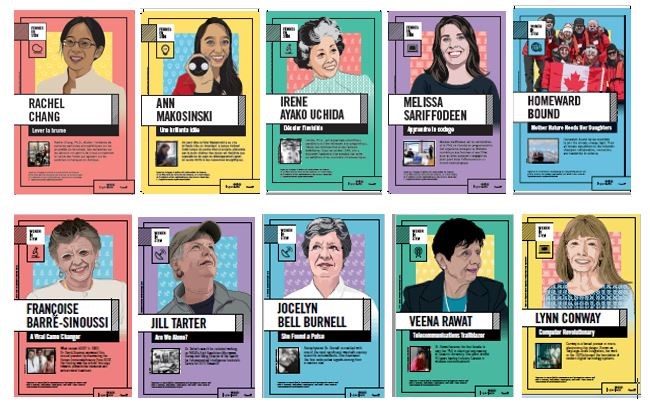
If you’re looking for ways to celebrate women in science this October you may appreciate these FREE posters created by Ingenium – Canada’s museums of science and innovation.
Use them to share the profiles of women from Canada and around the world who’ve made a difference. All are available in English and in French, and are free to download. The latest poster features Donna Strickland. Visit
https://womeninstem.ingeniumcanada.org/.
Science holds the promise of improving our world but we’ll need
everyone’s
contributions.
|
|
|
|
|
|
|