| |
STARR News & Updates
February 2026
| | |
This isn’t a campaign for the sidelines. It’s an invitation.
This month, we launched Fueling the Future February - a bold, collective call to shine a national spotlight on mental health research. For 28 days, we’ll amplify the voices of mental health researchers and advocates, celebrate community partnerships, and push the conversation forward about why mental health research matters.
Join us!
Join us and share, to uplift, to educate, and to remind the world that clinical research saves lives—and that progress only happens when people trust and support it.
We’re asking every site, every partner, every advocate in the STARR community to help carry this message. Share Fueling the Future February with your teams, your volunteers, your networks, your neighbors.
Let’s make February impossible to ignore.
Join us in Fueling the Future of mental health research: learn more and get involved HERE.
| |
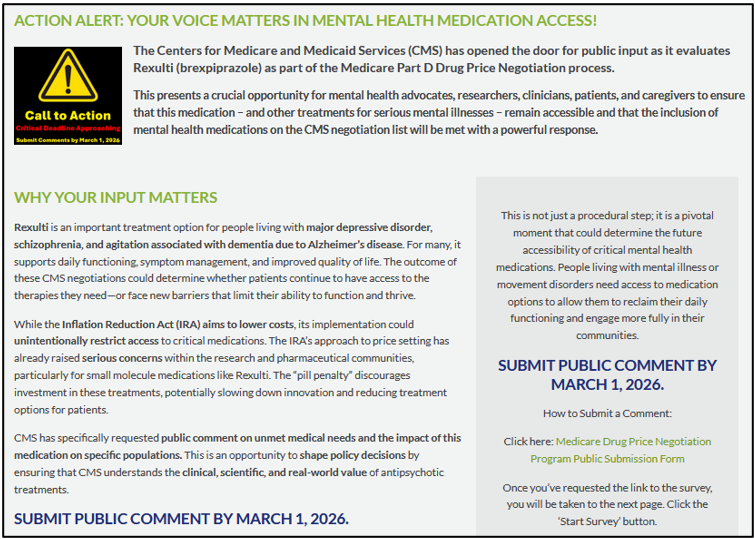
Action Alert: Your Voice Matters in Mental Health Medication Access!
The Centers for Medicare and Medicaid Services (CMS) has opened the door for public input as it evaluates Rexulti (brexpiprazole) as part of the Medicare Part D Drug Price Negotiation process.
This presents a crucial opportunity for mental health advocates, researchers, clinicians, patients, and caregivers to ensure that this medication – and other treatments for serious mental illnesses – remain accessible and that the inclusion of mental health medications on the CMS negotiation list will be met with a powerful response.
CMS has specifically requested public comment on unmet medical needs and the impact of this medication on specific populations. This is an opportunity to shape policy decisions by ensuring that CMS understands the clinical, scientific, and real-world value of antipsychotic treatments.
Visit the STARR's Action Alert page for instructions and the link to submit your comments.
| | |
Neuro-Behavioral Research continued its commitment to community engagement through a recent outreach event at the Shorb Market and Connection Center in Canton, Ohio. Hosted by NBR team members Breanna and Shilpa, the event supported a community hub that provides free, fresh, and healthy food to neighbors several days each week.
During the event, NBR distributed food and T-shirts to more than 250 individuals while sharing information about mental health resources, caregiver support, and free memory testing offered through the Ohio Center for Hope. The team also provided education about ongoing clinical trials at NBR.
The day created space for open dialogue, with many community members sharing personal mental health experiences—reinforcing the importance of trust, presence, and education beyond the clinic.
| | | |
Pillar Bentonville recently joined community partners in celebrating a major milestone for Vantage Point Behavioral Health Hospital—the reopening of its Recovery Unit and the beginning of a new chapter under the leadership of Renee Brown, CEO.
The event highlighted Pillar’s ongoing commitment to community engagement and collaboration with trusted mental health providers. The expanded Recovery Unit represents a meaningful investment in access to care, healing, and long-term recovery for individuals and families in the region.
By showing up to celebrate progress beyond the research setting, Pillar reinforces the importance of partnership across the full continuum of mental health care. Engagements like this reflect Pillar’s belief that advancing mental health outcomes requires strong community relationships, shared vision, and collective support for innovation and compassionate care.
| | | |
The team at CenExel Decatur recently spent time connecting with neighbors from the Nell Hodgson Woodruff School of Nursing at Emory University. By participating in the school’s nursing job fairs, CenExel Decatur continues to build strong relationships with local academic partners and emerging healthcare professionals.
These events provide an opportunity to share information about careers in clinical research, highlight the vital role nurses play in advancing mental health innovation, and showcase the wide range of professional pathways available at the site. CenExel Decatur’s presence reflects a commitment to workforce development, education, and long-term community engagement.
Through ongoing collaboration with institutions like Emory, the team is helping foster the next generation of nurses while strengthening connections between research, education, and patient care.
| | | |
The team at CenExel Hollywood, FL recently participated in a community outreach visit to the Florida Health Care System in Plantation, Florida. The visit focused on introducing CenExel Hollywood’s work, discussing available services, and identifying opportunities to better support patients and collaborate with local healthcare partners.
Team members engaged in meaningful conversations, answered questions, and shared information about how clinical research can complement care within the broader healthcare system. The outreach effort helped increase awareness of the site’s role in advancing treatment options while emphasizing a commitment to partnership and patient-centered support.
By proactively connecting with healthcare organizations in the region, CenExel Hollywood continues to demonstrate its dedication to community engagement, collaboration, and building trusted relationships that benefit both patients and providers across South Florida.
| | | |
Teva reports that AJOVY (fremanezumab) significantly reduced monthly migraine and headache days in children and adolescents, based on Phase 3 SPACE trial results published in The New England Journal of Medicine. The study showed meaningful efficacy with a favorable safety profile in pediatric episodic migraine.
Otsuka receives FDA acceptance and Priority Review for centanafadine, marking an important step toward a potential new treatment option for attention-deficit/hyperactivity disorder (ADHD). The investigational triple reuptake inhibitor targets norepinephrine, dopamine, and serotonin, reflecting continued innovation in neuropsychiatric pharmacology.
LB Pharmaceuticals initiates a Phase 2 trial for LB-102, a promising treatment for bipolar depression, aiming to address unmet needs in mood disorders. LB-102 is a reformulated version of amisulpride designed to maintain antipsychotic efficacy while improving tolerability.
MapLight Therapeutics advances treatment for Alzheimer disease psychosis with FDA Fast Track designation for ML-007C-MA, targeting hallucinations and delusions. ML-007C-MA targets hallucinations and delusions in Alzheimer’s disease psychosis, activating M1/M4 muscarinic receptors while minimizing peripheral side effects. The FDA Fast Track designation highlights the significant unmet need for ADP treatments, with no current FDA-approved options available.
Lipocine reports enrollment and dosing are complete in its Phase 3 trial of LPCN-1154 for postpartum depression, marking a key milestone in advancing treatment options for this underserved condition. LPCN-1154 is an oral neuroactive steroid designed for rapid symptom relief with outpatient convenience.
The FDA has granted Breakthrough Therapy designation to Alkermes’ alixorexton for the treatment of narcolepsy type 1 (NT1). Alixorexton is a novel, investigational, oral, selective orexin 2 receptor agonist in development for the treatment of NT1, narcolepsy type 2 (NT2), and idiopathic hypersomnia. This designation is based on phase 1 and phase 2 clinical data, including positive results from Vibrance-1, a large phase 2 study evaluating alixorexton in 92 participants with NT1.
Neurosterix initiated a phase 1 study for NTX-253 for the treatment of schizophrenia. The positive allosteric modulator of muscarinic M4 receptor will be evaluated for safety, tolerability, pharmacokinetics, and pharmacodynamics in healthy volunteers. Advancement of NTX-253 into phase 1 first-in-human clinical studies is supported by preclinical studies showing antipsychotic-like activity and a favorable safety profile.
Reviva Pharmaceuticals announced the publication of clinical vocal and speech biomarker data from the RECOVER phase 3 clinical trial and the therapeutic potential of brilaroxazine for the treatment of schizophrenia. Brilaroxazine is a new chemical entity with potent affinity and selectivity against key serotonin and dopamine receptors implicated in the pathophysiology of several conditions including schizophrenia. The published findings reinforce the treatment effect of brilaroxazine on negative symptoms and other symptom domains in schizophrenia and support clinician-assessed efficacy outcomes, as well as support the use of speech latency as an enrichment tool that can reduce sample-size and enhance outcomes in clinical trials for schizophrenia.
BioXcel has submitted an sNDA for IGALMI to support outpatient use for the acute treatment of agitation associated with bipolar disorder or schizophrenia, expanding on its current approval in supervised settings. The submission reflects growing confidence in IGALMI’s rapid, noninvasive approach and real-world applicability.
New Phase 3 data analyses suggest lumateperone shows promise for achieving remission in major depressive disorder, according to a recent Psychiatric Times report. Post hoc findings indicate higher remission rates compared with placebo across multiple symptom domains, reinforcing lumateperone’s potential as a differentiated treatment option.
ADHD stimulant medications may influence substance use outcomes rather than increase risk. Evidence suggests that appropriately prescribed stimulant treatment—particularly when initiated earlier—may be associated with reduced rates of substance use disorders over time.
Targeting inflammation may help relieve depression and anhedonia, according to a recent Psychiatric Times review highlighting growing evidence that immune dysregulation contributes to depressive symptoms in a subset of patients. The article summarizes data showing that anti-inflammatory strategies—pharmacologic and lifestyle-based—may improve motivation, reward processing, and mood, particularly in individuals with elevated inflammatory markers. For mental health clinical researchers, this reinforces momentum toward biomarker-informed trials and more biologically targeted approaches to treating difficult-to-resolve depressive symptoms.
A network-based approach using TMS and ketamine may offer new insights into treating depression, neuropathic pain, and substance use disorder. The piece highlights how targeting shared neural circuits—rather than isolated symptoms—could improve outcomes across comorbid conditions.
The Trump administration has blocked FDA fast-track designation for Compass Pathways psychedelic-based mental health treatment, halting an accelerated regulatory pathway that could have shortened time to patient access. According to reporting, the decision reflects heightened political scrutiny of psychedelic therapies despite advancing clinical evidence and prior FDA openness. This development signals potential regulatory uncertainty ahead, underscoring the importance of rigorous data, clear safety frameworks, and sustained engagement with policymakers as psychedelic research continues to mature.
Physical activity is gaining recognition as a meaningful treatment adjunct for schizophrenia spectrum disorders, according to a recent Psychiatric Times review. Evidence suggests structured exercise can improve negative symptoms, cognition, physical health, and overall functioning—areas often insufficiently addressed by medication alone. The findings reinforce the value of integrated, whole-person approaches and point to opportunities for incorporating physical activity into trial design, outcomes assessment, and real-world care models alongside pharmacologic innovation.
Mitochondrial and metabolic health are emerging as critical drivers of psychiatric disorders, reframing how researchers think about mental illness biology. New evidence links mitochondrial dysfunction and impaired energy regulation to conditions such as depression, bipolar disorder, and schizophrenia. The article highlights growing interest in GLP-1–based mechanisms and metabolic interventions as tools to modulate brain function.
A landmark Nature study suggests many psychiatric disorders share common genetic foundations, challenging long-standing diagnostic boundaries. Analyzing data from more than one million patients, researchers found substantial genetic overlap across conditions—most notably between bipolar disorder and schizophrenia—pointing toward biology-based groupings rather than discrete diagnoses.
Childhood ADHD traits predict poorer physical health in midlife, according to a large JAMA cohort study of 10,930 participants. Researchers found that higher ADHD trait levels at age 10 were associated with increased physical multimorbidity, more health conditions, and greater disability by age 46. These associations persisted after accounting for risk factors like smoking, BMI, and psychological distress. This highlights the long-term interplay between neurodevelopmental traits and physical outcomes, suggesting ADHD-informed care and early intervention could influence lifelong health trajectories.
Real-world antidepressant treatment patterns reflect underlying genetic and clinical complexity in major depressive disorder. Analyzing prescription histories and genetic data from more than 12,000 individuals, researchers found that long-term stability on a single antidepressant was associated with better outcomes, while multiple medication changes correlated with broader genetic liability.
Anticholinergic burden may significantly affect cognitive outcomes in people with psychosis. The article highlights evidence linking cumulative anticholinergic exposure to worsening attention, memory, and executive function—domains already vulnerable in psychotic disorders.
Mental disorders are significantly associated with increased risk of acute coronary syndrome (ACS), according to a systematic review and meta-analysis. Across multiple studies, depressive disorders, anxiety, PTSD, and sleep disorders were linked to higher ACS risk, with PTSD and sleep disorders showing the strongest associations. The findings reinforce the importance of addressing sleep and stress-related pathology in study design and outcomes, highlighting cardiovascular health as a critical consideration in long-term psychiatric care and intervention strategies.
Biohaven's BHV-7000 did not achieve its primary endpoint in an MDD study, showing no significant symptom reduction compared to placebo. BHV-7000 did not demonstrate a reduction of depressive symptoms as measured by change in the Montgomery Åsberg Depression Rating Scale (MADRS) over 6 weeks compared with placebo. However, trends favoring BHV-7000 were observed in some clinically relevant subgroups, including participants with more severe depression at screening and baseline, on primary and secondary outcome measures.
People aged 14 to 20 are more often being diagnosed with psychotic disorders, including schizophrenia, compared with those born earlier, a large Ontario study examining 30 years of data suggests. Why isn't known. The co-authors suggest several possible reasons for the increases: older parental age, socioeconomic- and migration-associated stress and an increase in some negative childhood experiences like abuse in more recent decades, but said there likely isn't a single explanation. The study authors suggested that substance use — including cannabis, stimulants, hallucinogens and synthetic drugs — is a leading possibility contributing to the rising rates over 20 years.
| | |
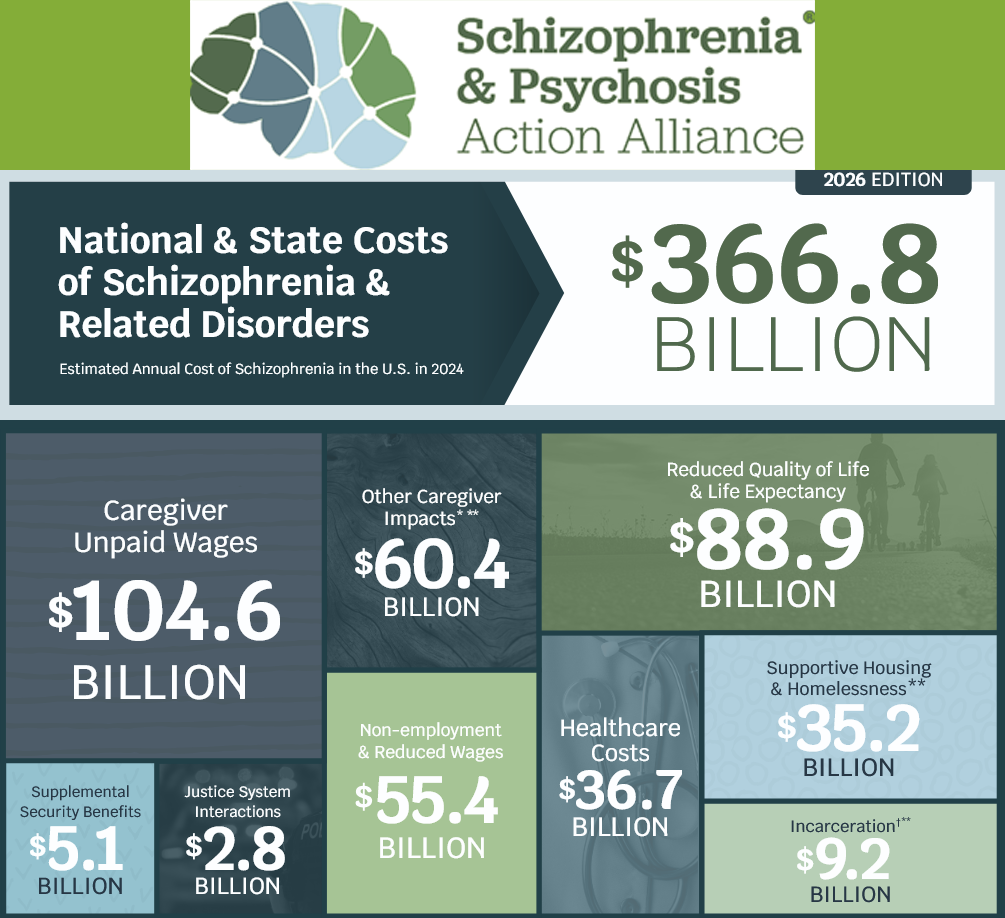
A new study published by the Schizophrenia & Psychosis Action Alliance (S&PAA) in JAMA Psychiatry estimates that schizophrenia costs the United States $366.8 billion annually, offering the most comprehensive and current assessment of the disorder’s economic impact, including a detailed state-by-state breakdown. Importantly, the analysis shows that medical costs represent only a fraction of the total burden. The majority of costs stem from lost productivity, unemployment, premature mortality, caregiving demands, and reliance on public systems such as housing, disability services, and the criminal justice system.
The study underscores how gaps in effective, timely treatment ripple far beyond the healthcare system, placing sustained strain on families, employers, and state budgets. Caregivers alone provide an estimated 36 hours of unpaid support per week on average, often absorbing significant out-of-pocket expenses and lost income. These nonmedical costs are core drivers of the overall economic burden, not secondary effects.
These findings strengthen the case for continued investment in schizophrenia research, earlier intervention, and therapies that meaningfully improve real-world functioning—outcomes that matter to patients, families, payers, and policymakers alike.
_______________________________________
| |
The Schizophrenia & Psychosis Action Alliance has launched the Solutions Series - a new national, multi-city event series focused on moving beyond conversation to action. Each gathering will bring together people with lived experience, families, clinicians, researchers, advocates, policymakers, and community partners to co-design practical, real-world solutions to the most urgent challenges in schizophrenia and psychosis care.
Each gathering focuses on one high-impact challenge. No matter your role, your perspective is part of the solution.
Check out the events that are currently scheduled, with more sessions and locations to be announced.
_______________________________________
| |
A new report from the Sorenson Impact Institute presents a social and economic impact monetization framework designed to quantify the full value of mental health and substance use disorder services within an academic mental health institute. Moving beyond traditional healthcare cost analyses, the framework captures downstream benefits such as reduced hospitalizations, improved functioning, increased workforce participation, caregiver burden reduction, and avoided public-sector costs across housing, criminal justice, and social services.
Importantly, this work complements the Schizophrenia & Psychosis Action Alliance’s (S&PAA) national cost-of-illness studies, which quantify the scale of schizophrenia’s economic burden. While S&PAA highlights the magnitude of costs when care falls short, the Sorenson framework helps demonstrate the return on investment when effective mental health services are delivered—making the value of intervention visible to funders, policymakers, and health system leaders.
_______________________________________
| | |
The American Brain Coalition submitted comments to NIH in response to the proposed reorganization of the Division of Program Coordination, Planning, and Strategic Initiatives (DPCPSI). Our comments focused on the establishment of the Office of Research Innovation, Validation, and Application (ORIVA), whose mission includes a specific commitment to advancing scientifically valid alternatives to research with animal models. ABC’s comments focused on the irreplaceable nature of animal models for neuroscience and encouraged NIH to continue to support the ethical and well-regulated use of animal models in research where they continue to contribute to groundbreaking discoveries. Read more on ABC's position and why this matters to the community.
At the end of 2025, the NIH released a framework for Engaging the public as Partners in Clinical Research, developed by the NExTRAC ENGAGE Working Group in
collaboration with the NIH Office of Science Policy. Dr. Jay Bhattacharya, NIH Director, publicly endorsed the framework, marking a significant step toward embedding patient and community partnership into the nation’s clinical research enterprise.
In ARPA-H news, BIOGAMI: Rewriting protein “grammar” to stop neurodegenerative disease before it starts. BIOmolecular Grammar for protein Aggregation Modulation and Intervention (BIOGAMI) is the latest ARPA-H program looking at how to eliminate neurodegenerative diseases by detecting and controlling the earliest stages of protein misfolding and clumping before lasting damage occurs.
| |
Check out the recent AwareNow interview with Ann Corcoran of the National Shattering Silence Coalition, as she reflects on the organization’s mission to dismantle stigma surrounding serious mental illness through education, advocacy, and lived-experience storytelling. Corcoran emphasizes that silence and misunderstanding remain major barriers to care, treatment engagement, and public support for mental health research. She highlights the importance of changing narratives—from fear and misconception to empathy, accuracy, and hope—and calls for stronger collaboration across advocacy, research, and policy communities. For mental health clinical researchers, the interview reinforces how stigma directly shapes participation, trust, and outcomes—and why pairing scientific progress with public education is essential to lasting impact.
| |
The January 2026 issue of Psychiatric Times has been released and includes a great article by Dr. Peter Weiden on the first year of real-world use of xanomeline/trospium. The feedback suggests a promising new chapter in schizophrenia treatment, marked by strong and consistent efficacy for positive symptoms and no newly identified safety concerns. Many clinicians and patients report better symptom control than with prior dopamine-based therapies, reinforcing optimism around this first-in-class, nondopaminergic approach.
At the same time, early adoption revealed important implementation challenges. In some cases, enthusiasm led to rapid prescribing without sufficient attention to medication-switching principles, contributing to higher discontinuation rates. Experts emphasize that success depends on careful cross-titration, individualized dosing, proactive management of anticholinergic effects, and clear patient education.
Emerging real-world data—including case reports and inpatient analyses—show meaningful benefits for some patients, including those with complex comorbidities. However, unfamiliar side-effect profiles and status quo bias toward dopamine antagonists have slowed uptake. Overall, the first year underscores both the clinical potential of xanomeline/trospium and the need for continued education to support confident, effective use in practice.
Read the article (and the whole issue!) HERE.
| | |
February 23-28 is BrainHealth Week!
Join our friends in Texas for the annual five-day event that offers daily science-based tools to inspire brain-healthy habits that can be incorporated into our daily lives.
The events might be in Texas, but we can all benefit from the tips and tools!
Sign up for the updates and challenges HERE!
| | |
Thank you for reading!
If you have questions, comments, or would like to submit an item to be included in an upcoming newsletter, please email erica@thestarr.org.
| | |
The STARR Coalition | www.thestarr.org
LEAD WITH HEART.
| |
| How did you like this email? | | | | | | |