The STARR News: April 2022 |
|
April is
National Volunteer Month
We LOVE our clinical trial volunteers and this is the month to make sure that they know it!
We all know that without volunteers, clinical studies cannot proceed. But it may interest you to know that APPRECIATING THE VOLUNTEER ALSO HELPS WITH STUDY RETENTION.
Building study participant identity helps connect a patient's sense of self to their participation in the study. It requires a shift from treating a participant as a study subject to focusing on their role as a partner and scientific contributor to the clinical trial.
When a participant makes a study part of their personal identity, they are proud to share that "I'm an medical hero" or "I'm helping to fight mental illness." Once an individual has embraced this identity, staying in the study is a point of pride and leaving the study is far less likely.
Incorporating deeper patient-engagement and gratitude has been shown to increase participant satisfaction and feelings of involvement, which are associated with better compliance.
Be sure to show your volunteers some extra appreciation this month! ❤
|
|
April is
Stress Awareness Month
Stress Awareness Month has been recognized every April since 1992. Learning to cope with our stress and finding healthy ways to deal with these situations can go a long way in living a healthy and positive life.
While stress is often unavoidable, there are ways to manage it so that it doesn’t negatively impact your physical and psychological well-being. Just as stress affects everyone differently, ways to effectively manage stress will vary from person to person. However, there are some commonly agreed-upon techniques:
-
Get regular exercise. Just 30 minutes of walking every day can help boost your mood and improve your health. Small amounts of exercise add up, so don’t be discouraged if you can’t do 30 minutes at one time.
-
Eat healthy, regular meals and stay hydrated. A balanced diet and plenty of water can improve your energy and focus throughout the day. Also, limit caffeinated beverages such as soft drinks or coffee.
-
Make sleep a priority. Stick to a schedule, and make sure you’re getting enough sleep. Blue light from devices and screens can make it harder to fall asleep, so reduce blue light exposure from your phone or computer before bedtime.
-
Try a relaxing activity. Explore relaxation or wellness programs or apps, which may incorporate meditation, muscle relaxation, or breathing exercises. Schedule regular times for these and other healthy activities you enjoy such as journaling.
-
Set goals and priorities. Decide what must get done now and what can wait. Learn to say “no” to new tasks if you start to feel like you’re taking on too much. Try to be mindful of what you have accomplished at the end of the day, not what you have been unable to do.
-
Practice gratitude. Remind yourself daily of things you are grateful for. Be specific. Write them down at night, or replay them in your mind.
-
Focus on positivity. Identify and challenge your negative and unhelpful thoughts.
-
Stay connected. Reach out to your friends or family members who can provide emotional support and practical help.
NIMH has more information available HERE.
April is the month to recognize your stress and stressors and take the time to learn some new coping mechanisms. ❤
|
|
Karuna Therapeutics
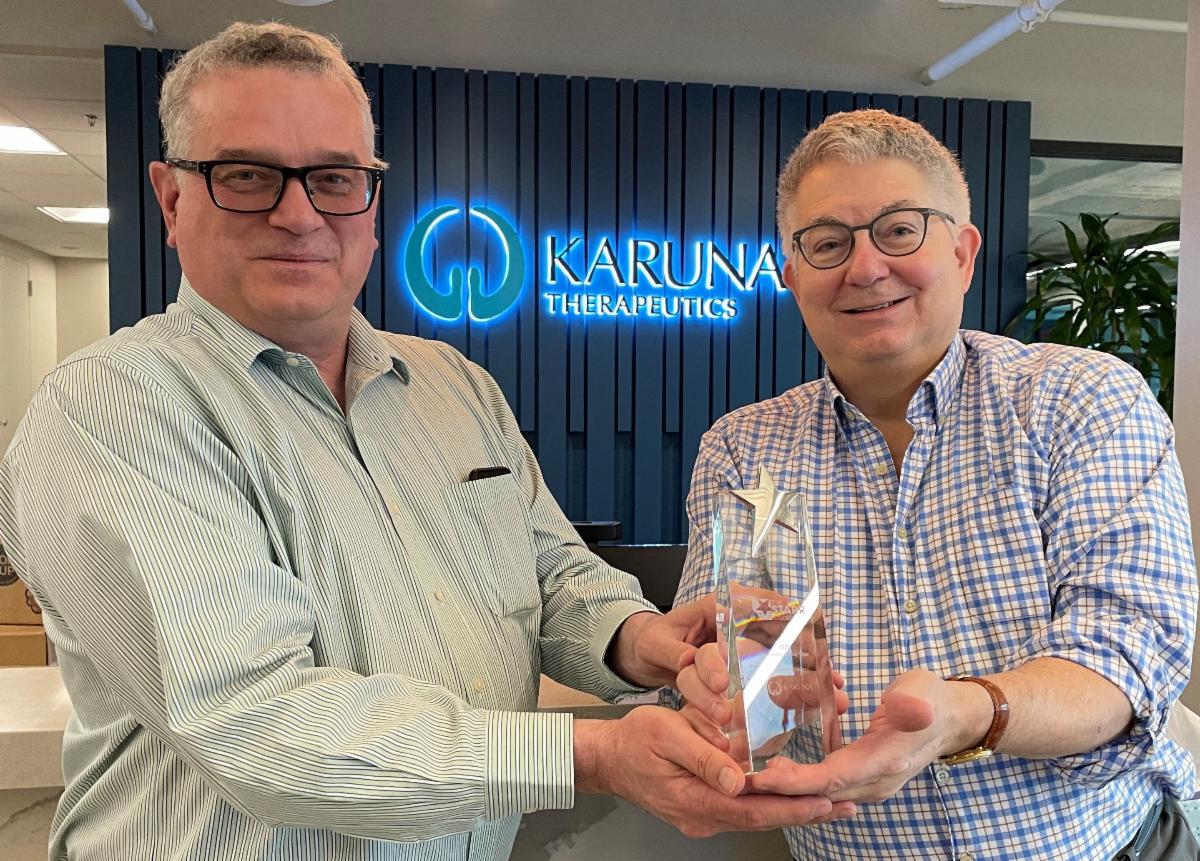
won the 2021 STARR Sponsor of the Year Award!
Karuna Therapeutics, a clinical-stage biopharmaceutical company driven to create and deliver transformative medicines for people living with psychiatric and neurological conditions, is led by a team uniquely steeped in neuroscience and motivated to responsibly study and deliver medicines that may offer substantial improvements to those living with schizophrenia and other neuropsychiatric conditions. Karuna’s leaders understand that current treatments do not sufficiently relieve the burden that people with psychiatric and neurological conditions experience day-to-day, and have made it their mission to develop medicines that can make a meaningful difference in their lives.
Given Karuna’s contributions to mental health research and the fact that a company as young and relatively small as Karuna would put patient advocacy in the forefront of their mission to create new therapies for mental health treatments should come as no surprise to anyone familiar with the leadership team. They have deep expertise in bringing new therapies to people living with mental illness, as well as acute understanding that they have a responsibility as researchers to engage with patients and advocates on how those medicines should be developed.
Adam Simmons, Director, Clinical Program Management at Alkermes, which was last year’s STARR Sponsor of the Year Award winner, presented this year’s award to Dr. Peter Weiden, Vice President, Medical, at Karuna Therapeutics.
Congratulations to Karuna Therapeutics!
|
|
Check out the write-up on all of the winners on the STARR website HERE.
|
|
Project RockSTARR Advocacy Ace Awards
The RockSTARR Advocacy Ace Awards are given to individuals whose screened volunteers have designated the most donations to their local advocacy organizations. We'll feature our Advocacy Aces throughout the year.
|
|
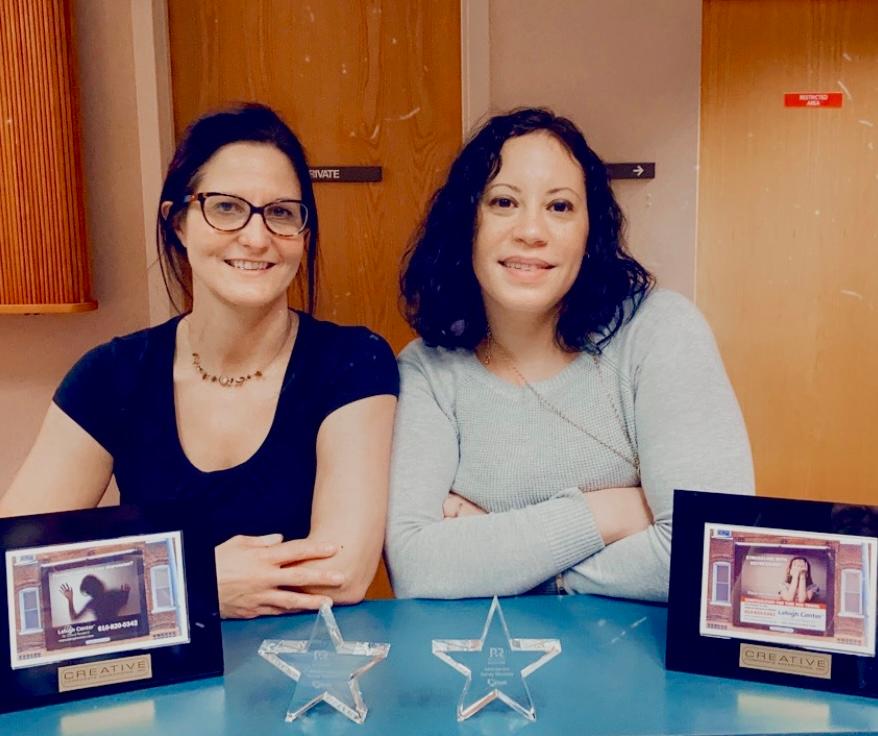
This month, we're spotlighting Nicole Tesche and Sandy Martinez, of Lehigh Center For Clinical Research in Allentown, PA. Together, Nicole and Sandy raised over $800 in donations for their local DBSA, NAMI and MHA chapters through the RockSTARR program. The checks will be delivered to the site to take to the local DBSA, NAMI and MHA offices to help build those relationships.
Thanks for your great work, Nicole and Sandy!
|
|
Study Retention Considerations
Excerpted from the Datacubed blog post “Three ways to increase patient engagement in curative oncology trials” by Elias Boroda, Ph.D. and Marie Onakomaiya, Ph.D., MPH, published February 23, 2022
|
|
Behavioral science points to three research-based ways to increase participant engagement in clinical trials:
'1. Set expectations.
Neurobehavioral research has found that people don’t experience rewards and losses in a vacuum, but rather in relation to a given reference point or expectation. For example, imagine two patients arriving at a clinic for a visit.
To the first patient the study staff says, “We’ll be with you in just 15 minutes.” Instead, 30 minutes pass before the participant sees a doctor. The participant will experience this delay as a significant, subjective loss.
To the second patient the study staff says, “We have some bad news, and we’re really sorry. You’ll have to wait here for 45 minutes.” But after just 30 minutes, the participant is called back. This participant will experience the same 30-minute wait in a much more positive light.
Consider how you can set and communicate expectations to increase rewards and minimize perceived losses.
'2. Reward participation.
Rewarding participants is another tool for encouraging compliance. These rewards should be designed based on the neurobiology of decision-making. The human brain has several learning circuits, each of which is best engaged at a specific timeframe relative to the learning event in question.
Think about a task like completing an instrument It’s vital to reward participants immediately after the task is completed. But it’s also important to reward them at longer timescales as well;– for example, when a participant reaches a certain study milestone. Even the anticipation of receiving a larger reward at the end of the study can be very motivating. In addition, rewarding participants at staggered intervals reduces their perception of the “cost” associated with compliance.
'3. Promote "identity lock."
Behavioral science research confirms what humans intuitively understand: People take significant pride in being part of a social group. In a curative oncology trial, this desire can help strengthen participant engagement through a concept known as “identity lock.”
When someone comes to see participation in a trial as part of who they are, they become less likely to abandon it. Moreover, being part of this social group comes with social norms – certain behaviors that are required to remain in the group. In a [curative oncology] trial, participants and study staff become part of a social group, and compliance with study endpoints becomes a social norm for remaining in this group. Fostering this sense of purpose and active participation makes compliance less onerous. Done effectively, it can even make it more difficult to be non-compliant.
Fully excerpted from https://www.datacubed.com/three-ways-to-increase-patient-engagement-in-curative-oncology-trials/#more-10121
|
|
Advocacy Spotlight:
National Federation of Families
The National Federation of Families is a national family-run organization linking more than 120 state and local affiliates and national partners focused on the issues of children and youth with emotional, behavioral, or mental health needs and substance use challenges and their families.
Members of the National Federation come from all walks of life. Emotional, behavioral or mental health needs and substance use challenges cut across all income, educational, geographical, racial, ethnic, and religious groups. They are found among all families - single and two-parent households, birth, adoptive, kinship and foster.
|
|
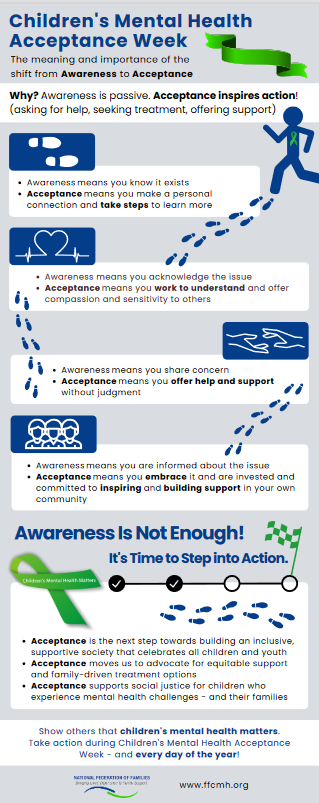
The National Federation of Families is one of the leading organizations behind National Children’s Mental Health Awareness Day, creating a week-long event, from May 1st - 7th. After 17 years, the Federation is re-defining the CMHA campaign: Previously, Children's Mental Health Awareness, the "A" now stands for Acceptance.
This significant shift to "acceptance" speaks more directly to our goal for the campaign - to eliminate prejudice and discrimination that individuals with a mental illness diagnosis or symptoms experience.
In preparation for Children's Mental Health Acceptance Week (CMHW), the Federation has developed a toolkit of resources with information, events ideas and graphics to help celebrate this important event. You can find the toolkit HERE.
Children's Mental Health Acceptance Week is May 1st - 7th.
|
|
Feature Article from an Individual Living with Schizophrenia |
|
THANK YOU GRATITUDE
By Douglas Meron
Gratitude I gracefully grab your hand, you helped me see the lay of the land.
Gratitude you put my life into perspective, allowing me to be overly objective.
Thank you for my experiences that I label good or bad, I remember you even when I’m sad.
I’m thankful for every breath I take; I’m thankful for the day when I awake.
I love you with all my heart, not matter where I am you give me a fresh start.
I wish I could pass you to everyone who does not see, what you mean to me.
If ever should I lose you, bite my tongue and take me back to where I begun.
Gratitude I humbly hear your call. I may stumble but with you I shall not fall.
|
|
Douglas Meron is 44 years old and lives with schizophrenia. He graduated from University of California Riverside in three years with honors in 1998 and has worked in accounting and tech support. He had his first psychotic episode in 2001.
Over the years, Douglas has kept a journal of his life and his episodes with schizophrenia. In 2017, he received Volunteer of the Year from the Jonathan Tarr Foundation. He is a poet and writer and is currently working on his first book.
Douglas is happy to share his story. If you would like to contact him, please email Mallory@thestarr.org and she will connect you.
|
|
ACRP 2022 is being held April 22-25 in Orlando, Florida. The Association of Clinical Research Professionals (ACRP) invites clinical research professionals to join them to learn strategies, best practices, and creative solutions for improving clinical trial quality and advancing your career. Learn more here.
SOBP's 2022 Annual Meeting is being held April 28-30 in New Orleans. The Society of Biological Psychiatry meeting program will focus on alternative and transformative frameworks for understanding psychiatric illnesses, and present enhanced and newly emerging tools for measurement and manipulation. Within these frameworks and with these tools, techniques and experimental designs are illustrated that can enhance understanding of psychiatric illness and elucidate the biological pathways and markers of illness processes. Learn more here.
SCRS Diversity Site Solutions Summit is being held in Austin, Texas, on May 20th, 2022. This is SCRS' inaugural diversity meeting and will feature critical content for research sites as regulatory and sponsor directives require more inclusion of diverse populations in clinical trials. Learn more here.
APA 2022 Annual Meeting is being held May 21-25 in New Orleans, with this year's theme being Social Determinants of Mental Health. The American Psychiatric Association is offering a new Clinical Updates Track with practical pearls of wisdom; a Research Track hosted by NIDA, with sessions also from NIAAA and SAMHSA; and a special Technology Track to help you stay up to date on the major changes to clinical practice brought about by the pandemic. Learn more here.
|
|
ASCP 2022 Annual Meeting, May 31-June 3, Scottsdale, Arizona, brings together over 1200 academic and industry investigators, research pharmacists, and clinicians to address a number of timely issues relevant to clinical research in psychiatry, including the translation of research into practice, the importance of regulatory issues, and pharmacogenetics and other means to personalizing interventions. For more information, visit www.ASCPMeeting.org.
|
|
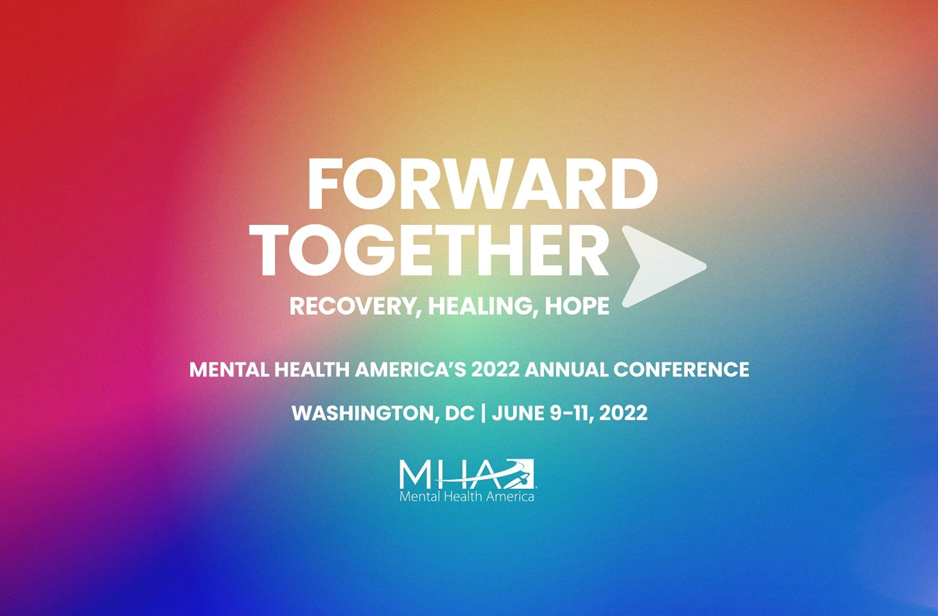
Mental Health America’s (MHA) 2022 Annual Conference, Forward Together: Recovery, Healing, Hope, will take place in Washington, DC from June 9-11, 2022. The event will bring together hundreds of MHA affiliates, peers, providers, government officials, media, and key stakeholders from across the country to explore the intersecting equity issues that exist in mental health. The 2022 conference will be offered in a hybrid format consisting of an in-person event which will be live-streamed to a virtual platform for remote attendees to access, allowing us to reach supporters across the globe. Learn more here.
|
|
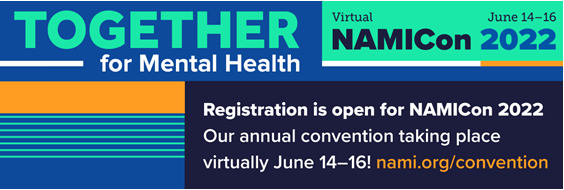
NAMICon 2022, Together for Mental Health, will be held June 14-16, 2022, and has shifted to a Virtual Only format. Learn more here.
The 8th Annual BRAIN Initiative Meeting will take place from Tuesday, June 21 – Wednesday, June 22, 2022. Everyone with an interest in BRAIN and neuroscience research is welcome as we aim to continue building this vibrant and cross-collaborating community. This forum will provide space to discuss exciting scientific developments and potential new directions, and to identify areas for collaboration and research coordination. It is anticipated that this event will be a hybrid format, stay tuned for further details. Learn more here.
|
|
April is
National Minority Health Month
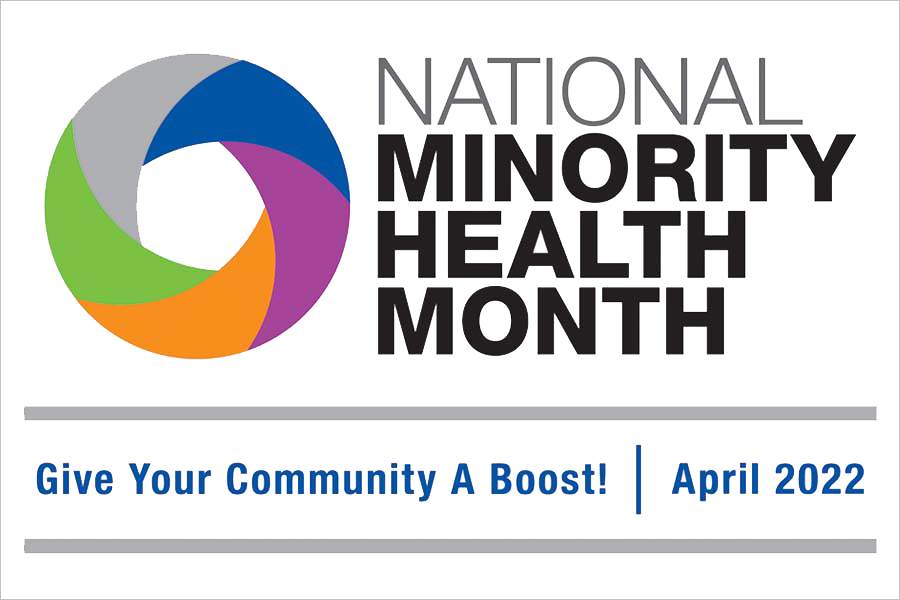
April is National Minority Health Month (NMHM), a time to raise awareness about health disparities that continue to affect people from racial and ethnic minority groups and encourage action through health education, early detection, and control of disease complications. Learn more about NMHM.
The theme for this year’s National Minority Health Month is Give Your Community a Boost! The theme focuses on the continued importance of COVID-19 vaccination, including boosters, as one of the strongest tools we can use to protect communities from COVID-19, which has disproportionately affected communities of color. CDC data show that some racial and ethnic minority groups — particularly Black or African American, Hispanic or Latino, and American Indian or Alaska Native people are at increased risk of getting sick, having more severe illness, and dying from COVID-19. Give Your Community a Boost! also supports the many other efforts happening in communities across the country to advance health equity.
Educate yourself about minority health disparities and consider ways that you can make a difference! ❤
|
|
Neurocrine Biosciences is pleased to share a 2022 Advocacy Toolkit for your reference in preparation for Tardive Dyskinesia Awareness Week (May 1 – 7). This toolkit is comprised of digital assets, media resources and statistics on mental health and facts about tardive dyskinesia (TD). You may also use the content in the toolkit for your social media and related activities for Mental Health Awareness Month in May.
One Mind invites you to watch their newest documentary short film that was created in collaboration with Liberty Mutual Insurance. The film amplifies the voices of homeless youth in Boston and the challenges they face, including the impact on their mental health, as they aspire to a future off the streets. Watch it at onemind.org.
|
|
The STARR Site Certification was created to help advance mental health clinical research by promoting community engagement, empathy, and communication between research sites, staff, patients, and advocacy groups, as well as providing support for best practices around working with advocacy, suicide prevention, and other areas that enhance clinical research. |
|
|
Everything The STARR Coalition does comes from our stakeholders looking to make positive change.
The STARR Coalition is a 501(c)(3) nonprofit organization, our Tax ID # is 47-4634007.
|
|
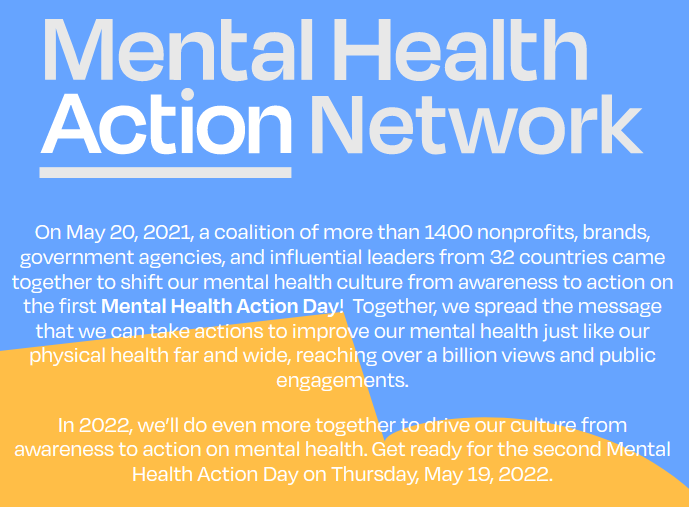
Just a reminder: May is right around the corner! If you haven't already started planning for Mental Health Awareness Month, we can help. Check out our Mental Health Awareness Month resources page and feel free to use our #MHAM graphics and links: Mental Health Awareness Month page.
|
|
The STARR Coalition is a 501(c)(3) nonprofit organization, our Tax ID # is 47-4634007.
|
|
The STARR Coalition | phone: 501-725-8890 | www.thestarr.org |
|
SHARE, CARE, AND BE KIND. |
|
|
|
|
|
|