|
Briefs on Artificial Intelligence in STEM Education Research
In light of NSF's focus on artificial intelligence, this newsletter features a three-part series of briefs that were inspired by the question, “What are the essential considerations for researchers and developers who are designing, studying, and using AI in K–12 STEM classrooms?”
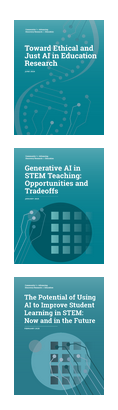
Toward Ethical and Just AI in Education Research
The first brief of the series offers guidance to researchers and developers for responsible AI research and implementation in educational settings. The brief describes an ethical artificial intelligence in education (AIED) framework and a set of tools to support inclusive and equitable AIED research and development.
Generative AI in STEM Teaching: Opportunities and Tradeoffs
The second brief of the series examines how GenAI may shape STEM classrooms in the near future and identify promising trajectories for integrating GenAI into STEM teaching, including the potential for personalized teaching approaches. They reaffirm the essential role of teachers and emphasize the need to include teachers in the design, development, and study of GenAI tools that are intended to benefit STEM education.
The Potential of Using AI to Improve Student Learning in STEM: Now and in the Future
The third brief explores how artificial intelligence (AI) can serve as a transformative learning partner in K–12 STEM education through AI's potential to offer personalized support, scaffold cognitive and metacognitive processes, and enhance student motivation and collaboration. Additionally, the authors consider how AI can promote access to STEM learning, while also addressing the need to identify and mitigate biases in AI system development to ensure broad and effective application.
CADRE Learning Series
In a related CADRE Learning Series, we heard from the authors of the briefs described above and engaged in discussions on the Ethical Use of AI in STEM Education Research and the potential of Generative AI in STEM Teaching and Learning: Now and in the Future.
View the recordings and slides.
|