|
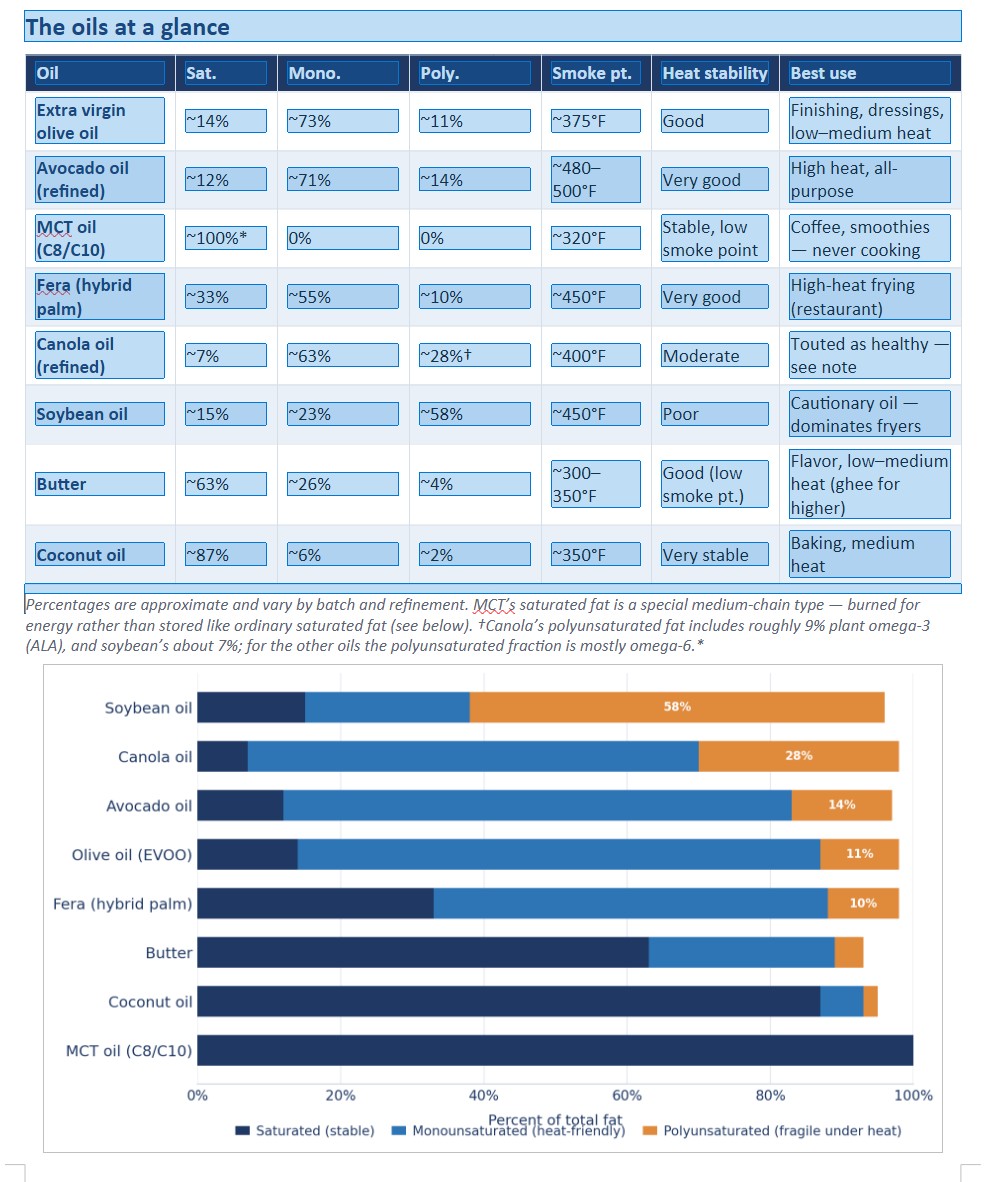
Oils ranked by their fragile (polyunsaturated) fraction. Soybean and canola carry the most heat-sensitive fat; olive, avocado, and Fera are mostly heat-friendly monounsaturated fat; coconut, butter, and MCT are mostly stable saturated fat.
The single most useful lesson in this table is one almost nobody gets right: smoke point and heat stability are not the same thing. Soybean oil has a high smoke point yet poor stability — it forms harmful compounds quickly under sustained heat, which is exactly why it’s the wrong oil for the deep fryers it dominates. Butter and MCT oil, by contrast, have low smoke points but are chemically stable saturated fats. So don’t choose a cooking oil by smoke point alone; for health under heat, what matters most is low fragile-PUFA content and using each oil for the job it’s suited to.
How to choose healthy oils: a Shape-Up buying guide
Think of your oils in three jobs — plus one special case — because no single oil does everything well.
1. For finishing and low heat: real extra virgin olive oil
This is the oil with the deepest evidence for health, used the way Udo would insist: fresh and unheated, or gently warmed. Use it on salads, vegetables, fish, and to finish a dish.
How to buy it so you get the real thing:
-
Look for a certification seal. In California, the strictest is the COOC seal (California Olive Oil Council). Nationally, the NAOOA Certified seal means the oil is pulled off store shelves and lab-tested at least twice a year. European PDO/PGI marks verify origin and quality.
-
Find a harvest or pressing date, not just a "best by" date, and choose oil within 12–18 months of harvest. Good producers are proud to tell you when the olives were picked.
-
Buy dark glass or tin, never clear plastic — light wrecks oil fast.
-
Avoid suspiciously cheap bottles and vague labels like "pure," "light," or "packed in Italy" with no real origin.
-
Brands that consistently certify and publish harvest dates include California Olive Ranch, Cobram Estate, Lucini, and certified warehouse-store options like Kirkland Signature (NAOOA certified). For something special, seek out a COOC-certified single-estate California mill. (One myth I bought into and have dropped: the "put it in the fridge to see if it’s real" test is unreliable — even the olive oil association calls it misleading. Certification and harvest date are what matter.) Good to know!
2. For everyday and higher-heat cooking: stable, verified oils
For sautéing, roasting, and the occasional fry, you want oils that resist oxidation — meaning higher in monounsaturated or saturated fat and lower in fragile polyunsaturated fat.
-
Verified avocado oil is excellent for higher heat. Buy brands that publicly test their purity. Chosen Foods and Marianne’s were the two brands that passed the UC Davis testing and continue independent fatty-acid profiling; if a private label can’t show third-party testing, assume the worst.
-
High-oleic oils (high-oleic sunflower or safflower from reputable brands) are bred specifically for heat stability.
-
Traditional stable fats — real butter, ghee, and for those who use them, tallow — are genuinely heat-stable and have been part of the human diet for millennia. Used in reasonable amounts as part of a whole-food diet, they are not the villains the low-fat era made them out to be.
-
A note on a new entry: Fera "fruit oil," now appearing in restaurants, is essentially a high-oleic hybrid palm oil — a legitimate, more heat-stable frying oil, though it’s a foodservice product, not a pantry bottle, and not categorically "cleaner" than good avocado or olive oil. Useful to know if you see "clean-fried" on a menu.
3. For essential fats: get them fresh, and get omega-3 from the right place
This is the heart of Udo’s teaching. The truly essential fats — the omega-3s especially — must come fresh, cold, and protected. Use cold-pressed flax, walnut, or fresh nut and seed oils only unheated, kept in the refrigerator in a dark bottle, and used up quickly.
One honest correction to Udo, though: he leaned heavily on flax oil for omega-3, and we now know the body converts flax’s plant omega-3 into the forms it actually needs (EPA and DHA) very poorly.
So the most reliable omega-3 source is fatty fish — salmon, sardines, mackerel — or a quality, fresh, third-party-tested fish oil. Whole nuts and seeds (walnuts, chia, ground flax) are wonderful foods; just don’t count on them to do the job of fish.
4. A special case: MCT oil for your morning coffee
I recommend a teaspoon of MCT oil in morning coffee, and it deserves its own category because it behaves like no other oil on the list. MCT stands for medium-chain triglycerides — and good MCT oil is made of just two of them: C8 (caprylic acid) and C10 (capric acid), fractionated from coconut.
Here’s what makes it special. Most dietary fat is long-chain and takes a slow route through the lymphatic system. MCTs skip that line entirely — they travel straight to the liver via the portal vein and are converted into ketones within about 15 to 30 minutes. Ketones are a clean-burning fuel the brain readily uses, which is why MCT oil is often called "brain fuel."
C8 is the standout: it produces roughly three times more ketones than C10, so it’s the most efficient of the two. There’s promising research on ketones and brain energy — including in mild cognitive impairment — though for healthy adults it’s best thought of as clean, quick energy rather than a proven cognitive cure.
Two practical rules:
-
Never cook with it. Its smoke point is low (~320°F). MCT oil is a finishing oil — coffee, tea, smoothies, dressings — not a frying oil. Its nearly 100% saturated fat looks alarming on a label, but it’s a medium-chain type that’s rapidly burned for fuel, not the long-chain saturated fat the old guidelines worried about.
-
Start with a teaspoon. Larger amounts too soon can upset the stomach. A teaspoon in your coffee is the right place to begin — exactly the dose I suggest.
Storage, regardless of the oil
Cool, dark, tightly capped, and away from the stove — heat next to the burner is a slow killer of oil quality. Buy bottle sizes you’ll finish in a couple of months, not a year. An oil that smells like crayons, putty, or "old" is rancid; trust your nose and throw it out.
A word on canola: touted everywhere, but I’m not sold
No oil gets a warmer reception from mainstream nutrition than canola. It’s in restaurant fryers, salad dressings, and most processed food, and it’s stamped "heart-healthy" almost everywhere. Members ask me about it constantly, so let me give the honest, two-sided answer — because canola doesn’t fit neatly into anyone’s story, including mine.
First, in fairness, what’s actually true in canola’s favor: on paper its fat profile is good. It has the lowest saturated fat of any common oil (~7%), it’s high in the same heat-friendly monounsaturated fat as olive oil (~63%), and it’s unusual among vegetable oils in carrying a plant omega-3 (ALA). It is not a high-omega-6 oil like soybean or corn — its omega-6 is moderate. And the "canola is toxic" stories online — that it’s industrial lubricant, that erucic acid poisons you — are myths; modern canola is bred to remove erucic acid and is not toxic. I won’t repeat things that aren’t so.
But here’s why I’ve never recommended it, and why I think the health halo is overstated:
-
It’s one of the most heavily processed oils there is. Conventional canola is extracted with the chemical solvent hexane, then refined, bleached, and deodorized at high heat. That deodorizing step does something that matters: it converts some of canola’s fragile fats into trans fats. Samples have measured up to roughly 3–4% trans fat — and a bottle can still legally read "0g trans fat," because anything under half a gram per serving rounds to zero. That is exactly the processing damage this whole article is about.
-
Its omega-3 is its most fragile feature — and heat destroys it. The plant omega-3 (ALA) canola is praised for oxidizes even faster than omega-6, breaking down 12–15 times more readily under heat. Frying canola strips out the very omega-3 used to sell it, while generating breakdown products. The oil’s best selling point is largely undone by the cooking it’s marketed for.
-
It’s a dominant restaurant fryer oil, which compounds every problem in the eating-out section above.
-
It’s almost always genetically modified (over 90% of the North American crop) and carries glyphosate-residue concerns, if those matter to you.
-
The "heart-healthy" claim rests mainly on cholesterol-lowering — and as we covered earlier, a lower cholesterol number on a lab test has not reliably translated into longer life or fewer heart attacks. That claim is also heavily promoted by an industry with a great deal to sell.
You might reasonably ask: if heat is the problem, is canola fine as long as you don’t cook with it? It’s a fair question, and temperature genuinely matters — canola stirred cold into a dressing is a far gentler thing than canola fried and reused for hours. But here’s the catch that keeps me cautious even then: much of canola’s damage is done at the factory, before you ever open the bottle. The high-heat deodorizing step has already created trans fats and oxidation in conventional refined canola. So the only version I’d call reasonably healthy is a narrow one — cold-pressed, unrefined canola used unheated — and even then I’d reach for olive oil first. Refined canola, hot or cold, has already spent part of its health budget before it reaches your kitchen.
So my honest bottom line on canola is the same as the rest of this article: the canola molecule isn’t poison, and I won’t pretend it is. But conventional canola is a textbook case of a fragile oil damaged by industrial processing and then abused by high-heat reuse — and there’s simply no good reason, other than its cheap price, to seek it out when you can reach for real olive oil, verified avocado oil, or a stable traditional fat that’s cleaner, less processed, and doesn’t need a marketing campaign to convince you it’s healthy. I held that view back when canola was the darling of the very Heart Association chapters I served in, and I hold it still.
What I believe is happening — and what I can’t yet prove
Now let me step past the studies and tell you plainly what I believe, after more than forty years of watching people’s bodies up close and a quarter century of following the science of how diet shapes us at the cellular level. I was drawn to this in 2001, when my interest in epigenetics led me into the integrative-health world at UC Irvine, and I hold these views more strongly today than I did then.
I believe there is a real relationship between the industrialized modern diet — refined oils very much included — and the rising tide of metabolic and inflammatory disease in this country. Obesity, type 2 diabetes, fatty liver, food allergies, and several autoimmune and inflammatory conditions are climbing in ways our longer lifespans do not fully explain. And one trend in particular gives me pause: while overall cancer death rates have fallen — thanks to less smoking, earlier detection, and better treatment, which is real good news — the incidence of certain cancers in younger adults has been rising, early-onset colorectal cancer among them, for reasons no one has yet pinned down. Diet, the microbiome, and environmental exposures are squarely among the suspects under investigation.
My framework for understanding this is epigenetics and the microbiome. What we eat does more than feed us: it speaks to our genes, turning their expression up or down, and it cultivates — or starves — the trillions of microbes that train our immune system and govern much of our inflammation. A diet built on fragile, heavily processed, repeatedly heated oils and ultra-processed food is, I believe, quietly reprogramming us, our genes, in ways that erode vitality across a lifetime, and perhaps across generations.
Let me be honest about the line between what I know and what I believe. The framework is real science; the specific causal claims are not yet proven, and they certainly can’t be reduced to any single ingredient. What I’m describing is a conviction, strengthened over twenty-five years — not a settled fact — and I’d rather show you exactly where that line falls than pretend I’ve crossed it. But when the mechanisms are this plausible and the trends this consistent, I think the wise course is to act on the side of fresh, whole, minimally processed food, and to treat the fragile, refined, over-heated oils as the rare exception — long before the studies catch up to tell us we were right.
Remember: The famous campaign by R.J. Reynolds' "More Doctors Smoke Camels Than Any Other Cigarette," which ran from 1946 to 1952. While it was studied and many health professional warned that smoking was unhealthy, it wasn't concluded in the U.S. until 1964 with the landmark Surgeon General's report (Smoking and Health) reviewed thousands of studies and officially concluded that smoking causes lung cancer and is a serious health hazard.
Healthspan is not lifespan — and Shape-Up has stood on that since 1982
Let me close the science with the question I care about most, and the one that is hardest to answer honestly.
When I opened Shape-Up in 1982, I built it on a single principle: long-term health and fitness — helping people stay strong, capable, and well for as many years as possible. Not merely more years on the calendar, but more good ones. I have not budged from that in over forty years, and it turns out the science finally has a name for the distinction I was making.
There are two different things that get carelessly lumped together: lifespan, how long you live, and healthspan, how long you live well — free of frailty, metabolic disease, and decline. They are no more the same than smoke point and heat stability are the same property. You can stretch one without touching the other.
This matters enormously for the seed-oil question, because it’s exactly where most of the debate quietly cheats. Here’s the honest picture, both sides.
The case that the seed-oil era harmed our health deserves to be taken seriously. The exposure is enormous: American soybean-oil intake rose more than a thousandfold over the last century, dietary linoleic acid roughly tripled, and that shift is now stored in our bodies — the linoleic acid in Americans’ fat tissue has climbed about 136% in fifty years. That parallels the chronic-disease epidemic, and there’s a plausible mechanism: in excess, linoleic acid forms oxidized byproducts and may impair the way our cells produce energy. That is not a fringe idea, and I won’t wave it away.
But honesty cuts both ways, so here’s where the strong version falls short. Correlation is not causation, and the last century changed everything at once — sugar, calories, ultra-processed food, and how little we move — so you cannot pin the trend on a single fatty acid. And the cleanest individual-level data actually runs the other way: people with more linoleic acid in their blood and fat tend to die less often, not more. That’s a real finding, and I won’t bury it to win an argument.
So how do I reconcile those? Through the very distinction you’d insist on — lifespan versus healthspan. Nearly all the reassuring data measures death and heart attacks. That’s lifespan. Very little of it measures healthspan — the slow erosion of metabolic health, energy, strength, and clarity that decides whether your seventies and eighties are vigorous or diminished. The damage people worry about with oxidized, overheated oils is exactly the kind that would wear down healthspan quietly, without necessarily shortening the lifespan a death certificate records. So "studies show seed oils don’t increase mortality" can be perfectly true and still miss the point, because it answers the lifespan question while the one that matters for aging well — healthspan — has barely been studied the right way.
I won’t tell you the science has proven that refined seed oils steal our healthy years; it hasn’t, and anyone who says otherwise is selling something. But I will tell you the question has scarcely been asked properly, and that everything we do know — the fragility of these oils under heat, the damage of industrial processing, the documented buildup in our tissues — points in a direction worth respecting. When the evidence is incomplete, I would rather err toward fresh, whole, minimally processed fats and reserve the fragile, heavily refined, repeatedly heated ones for rare occasions. That isn’t fear of a molecule. It’s the same long-term-health principle Shape-Up was founded on in 1982, applied to what we now understand about oils.
The bottom line after 40 years
I’ve watched the fitness and nutrition world chase one fat villain after another for half a century — cholesterol, then all fat, then saturated fat, now seed oils. Every one of those crusades had a grain of truth wrapped in a great deal of oversimplification. The deeper truth Udo Erasmus pointed me toward in 1986 still stands:
It was never really about the fatty acid. It’s about whether the oil reaches you fresh and whole, or damaged and degraded. Fresh, real, well-stored oils — and the whole foods that contain them — heal. Oils wrecked by hydrogenation, industrial refining, repeated frying, and fraud do harm. Choose your oils the way you’d choose any partner in your long-term health: insist on knowing where it came from, demand that it be fresh, and don’t be fooled by a pretty label.
That’s a message I was willing to stand behind in a room full of skeptical cardiologists in the 1980s. Four decades and a lot of research later, I’m more confident in it than ever — and now I can give you the brands and the tests to act on it.
A personal note — please don’t put this off
I’ll close with something personal, because it matters more than any oil on the list above.
I lost my wife of 42 years to colon cancer. By the time it was found, it was already stage 4, and though we fought it with everything we had, late is late. Colon cancer is quiet — it often gives no warning until it has already advanced, which is exactly why waiting until you feel something is the wrong strategy. The hopeful part is that when it’s caught early, it’s one of the most treatable cancers there is.
So here is my one direct ask of every member reading this. If you’re 45 or older and at average risk, get screened. If colon cancer runs in your family, or you have any warning signs like bleeding or a change in your normal habits, talk to your doctor about screening sooner. You have options — a colonoscopy, or simpler at-home stool tests your doctor can order. Pick one. Don’t keep putting it off the way so many people do.
I can’t change what happened. But if these few sentences move even one of you to schedule the screening you’ve been postponing, then her memory will have done something good — and that would mean more to me than I can say.
A note on health conditions
This and other articles are for general education, not personal medical advice. If you have heart disease, diabetes, or another condition — or take medications affected by diet — talk with your own physician about what’s right for you. Bring this article along; it makes for a good conversation.
Sources and further reading
-
Erasmus, U. Fats That Heal, Fats That Kill (1986; revised editions).
- Marklund et al. (2019) and the global biomarker consortium analyses on circulating linoleic acid and mortality/cardiovascular risk.
- Ramsden et al., recovered-data analyses of the Sydney Diet Heart Study and Minnesota Coronary Experiment (the basis of the "seed oils harm" argument — and its limitations).
-
Blasbalg et al. (2011), Am J Clin Nutr — historical rise of seed-oil and linoleic acid consumption in the U.S.
-
Guyenet & Carlson (2015), Advances in Nutrition — ~136% increase in adipose-tissue linoleic acid in U.S. adults over half a century.
- Narrative reviews of linoleic acid, oxidized linoleic acid metabolites (OXLAMs), and chronic disease.
-
Seppanen & Csallany (2004), JAOCS — toxic aldehyde 4-HNE in food fried in thermally oxidized soybean oil.
- University of Guelph and international restaurant fryer-oil surveys on total polar compounds; European/Indian/Japanese/Chinese 25–27% TPC limits (no equivalent U.S. standard).
-
Harvard T.H. Chan School of Public Health, The Nutrition Source — canola oil processing and trans-fat formation during deodorization.
- UC Davis avocado oil purity studies (2020, 2022) and the 2024 Codex Alimentarius avocado oil standard.
- Olive oil verification: California Olive Oil Council (cooc.com) and North American Olive Oil Association (aboutoliveoil.org).
|