|
May Newsletter Highlights:
Understand how state funding helps house families in Sacramento, register for upcoming listening sessions and resource fairs, donate during this year's Big Day of Giving, apply for funding to deliver housing services for youth, & more!
| | |
When Shelter Isn’t Enough: Building Pathways to Housing
A Message from Peter Bell, Chief Strategist, Sacramento Steps Forward
At the March Continuum of Care Board meeting, I shared an update on how state Homeless Housing, Assistance, and Prevention (HHAP) funding has been used across our system and the outcomes we’re seeing. The follow-on discussion focused on one simple question: how are these dollars creating impact in our community?
It’s a question being asked beyond that room. Across the state, there are growing questions about homelessness spending: we’ve invested billions of dollars, and yet the problem still feels as visible and urgent as ever.
At a system level, that means investing across prevention, response, and rehousing. Each plays a different role in helping people avoid homelessness, meet immediate needs, and ultimately move into permanent housing.
In Sacramento and beyond, a significant portion of that investment has gone toward expanding emergency shelter capacity, a critical part of the system, and one of the most visible responses. But there still aren’t enough beds for everyone who needs one, and reduced funding will make it harder to sustain and expand shelter capacity.
That creates a bottleneck between homelessness and long-term housing.
If we can’t move people into and out of shelter fast enough, we have to ask a harder question: what else should we be doing?
This is what HHAP funding was designed to support: flexible, multi-year funding that allows communities to test approaches, learn what works, and adjust in real time. Our region’s All In Sacramento plan guides our local approach, laying out strategies for investment across prevention, response, and rehousing.
One strategy we’ve been piloting is Coordinated Access Navigation (CAN). Currently staffed by eight navigators, the CAN team provides short-term, housing-focused case management directly to people experiencing unsheltered homelessness. This model meets people where they are, whether living in an encampment or sleeping in their car, and helps them navigate a complex system into shelter and, in some cases, directly into permanent housing.
Since 2022, the CAN team has worked with over 2,500 households. Over a third have successfully connected to shelter or housing programs, with that rate increasing to 55% since 2025. To date, more than 230 people have moved directly from unsheltered situations into permanent housing.
In one instance, a woman and her daughter experiencing housing instability were uncomfortable entering shelter. The CAN team worked with them to find an alternative, securing a temporary motel stay, completing housing applications, and ultimately supporting their move into permanent housing.
These successes point to something important. Sustained engagement converts system capacity into housing outcomes.
If we can’t get people into shelter to access services, we bring the services to them.
Maintaining flexible funding like HHAP is critical. It allows communities to keep adjusting, refining, and building a system that actually moves people into housing. As funding becomes more restrictive, interventions like case-carrying outreach, which are showing real results, become harder to sustain.
This is why we work with partners each year to ensure our community remains eligible for this funding and that it’s used to drive real housing outcomes. A key part of that work is Sacramento’s plan to address homelessness, shaped through ongoing community input and collaboration.
To learn more or get involved in the next iteration of the plan, visit our website and sign up to stay connected.
With deep gratitude,
Peter Bell
| | | | |
Continuum of Care Meetings
Get involved in our local Continuum of Care (CoC), which leads our regional planning, coordination, and funding to resolve homelessness. This month's meetings include:
-
CoC Board: In-person on Wednesday, May 13, 8:00 to 9:30 a.m.
| | | | |
Join the 2026 National Conference on Ending Homelessness and Capitol Hill Day
The 2026 National Conference on Ending Homelessness (Wednesday, July 8) and Capitol Hill Day (Thursday, July 9) will bring together service providers, system leaders, advocates, and people with lived experience of homelessness to learn from each other, discuss best practices, and share new innovations in the field.
Registrants will have the opportunity to attend roundtable discussions, plenaries, and workshops focused on emerging issues surrounding homelessness. Capitol Hill Day, an opportunity to engage your Members of Congress and their staff through face-to-face meetings, will occur on day two of the conference.
| | | | |
Targeted Homelessness Prevention Listening Session: Spotlight on Lived Experience Perspectives
In partnership with Right at Home, Homebase is hosting a listening session for individuals with lived experience of homelessness or housing insecurity that are interested in discussing homelessness prevention. Join the virtual session on Friday, May 15 to learn more about this session, offer your perspective on how communities can best prevent homelessness, and hear from other people with lived experience from across the country.
| | | | |
Older Adult Resource Fair set for May 8 at Hart Senior Center
Hosted by the City of Sacramento’s Youth, Parks, and Community Enrichment Department, the Older Adult Resource Fair will take place Friday, May 8 from 10:00 a.m. to 1:00 p.m. at the Hart Senior Center (915 27th St.). Older adults are invited to connect with local programs, healthcare, transportation, and other services that support independent, active living, all in one place. The event is free to attend and brings together a range of community partners offering information, resources, and support.
| | | | |
Be Part of Big Day of Giving to Boost Community Capacity
Sacramento’s Big Day of Giving provides an infusion of funding for the many nonprofits that make our community stronger and more compassionate.
With continued declines in federal, state, and local funding, many service providers are financially challenged to meet community needs. These include those that serve our neighbors with food, shelter, health, and much more.
While SSF primarily focuses on long-term solutions, we work hand-in-hand with local partners to prevent homelessness, expand access to housing, and address root causes.
Your donation to this work helps ensure everyone in Sacramento has a safe place to call home. Flexible contributions allow agencies to respond quickly and effectively to the urgent needs of individuals and families at risk of or experiencing homelessness.
Thank you for your partnership and generosity!
| | Updates & Progress Points | | | | |
Get Funding to Help Deliver Housing Services to Promote Stability for Sacramento's Youth
Sacramento Steps Forward has released a Request for Proposals (RFP) to operate a Transition Age Youth (TAY) Rapid Rehousing (RRH) program supporting young people experiencing or at risk of homelessness.
Funded through the state’s Homeless Housing, Assistance and Prevention (HHAP) Program, this opportunity will award up to $897,219 to a qualified provider to deliver housing-focused services that promote long-term stability for youth in Sacramento.
Applications are due May 11, 2026.
Providers interested in applying are encouraged to review materials as soon as possible. Have questions? Contact RFP@sacstepsforward.org.
| | | |
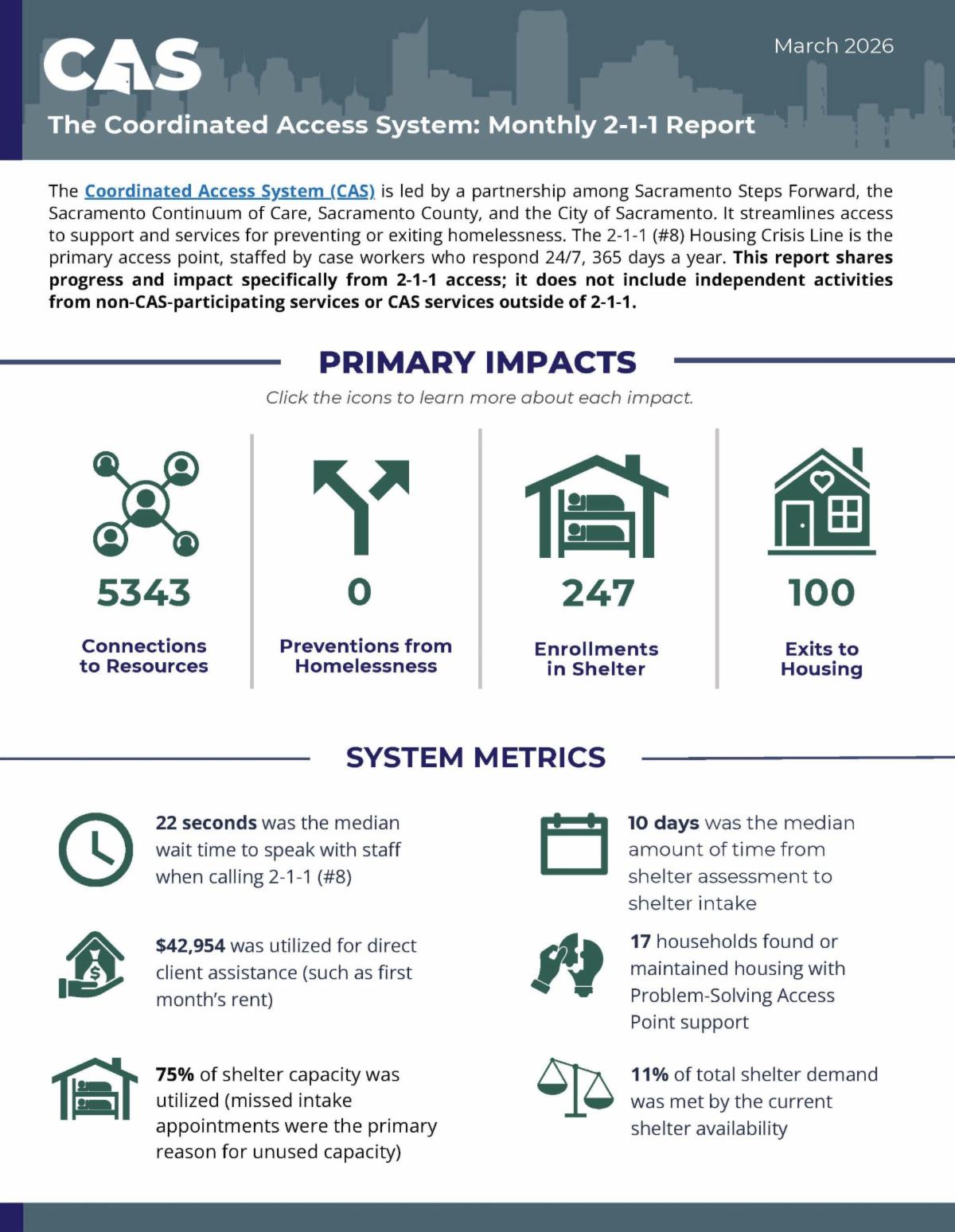
The Coordinated Access System: March Data
The 2-1-1 line connected more than 5,300 people to resources in March, with an average wait time of just 22 seconds. This month, shelter entries increased with 247 households entering shelter, up by 23 households from February. Housing placements also increased, with 100 households moving into housing, 19 more than the previous month.
Problem-solving support helped 17 households say housed with direct financial that plays a key stabilizing role. Prevention outcomes were low this month, reflecting limited program availability. With two new PSAP agencies onboarded, we’re optimistic this will strengthen prevention efforts in upcoming months.
At the same time, demand for shelter continues to outpace supply, with only 11% of need currently met. The average 10-day timeline from assessment to intake points to ongoing opportunities to improve flow through the system.
Want to learn more about the CAS? Sign up for our new monthly CAS newsletter!
| | Opportunities & Resources | | |
Supportive Housing Insights from Across the Country
Tenants, service providers, public agencies, funders, and housing partners from across the country contributed to Building a Stronger Future for Supportive Housing: Lessons Learned from Nationwide Community Conversations, a national report developed by the National Alliance to End Homelessness and Corporation for Supportive Housing. Drawing from these perspectives, the report highlights what is working, outlines key challenges, and offers practical insights to help inform your work, guide local decision-making, and support the long-term sustainability of supportive housing.
| | | |
New Housing Law Fact Sheets to Inform Affordable Housing Decision-Making
The California Department of Housing and Community Development (HCD) created Housing Law Fact Sheets to assist local staff, elected officials, and planning bodies in implementing key state housing laws. The collection of 22 fact sheets provides summaries of statutory requirements and policies, practical guidance for implementation, and highlights of recent legislative amendments. Each fact sheet is designed to serve as a standalone reference tool, offering accessible information to support housing-related decision-making.
| | | |
New Financial Empowerment Hub for Young People
Created by Point Source Youth, the Financial Empowerment resource hub brings together practical tools to help young people, especially those navigating housing instability, build capacity to manage their day-to-day lives. The hub includes tips and webinars on budgeting, credit, careers, income, and housing, recognizing how financial decisions directly shape housing access and long-term stability. For more personalized support, the WorthIt tool offers tailored, step-by-step guidance to help users make informed choices and plan their next steps with confidence.
| | | |
Approaches to Strengthen Outreach and Engagement
The City of Sacramento’s April 10 Homelessness Response Report shares three techniques outreach workers can use to strengthen engagement with people experiencing unsheltered homelessness: person-centered, trauma-informed, and strengths-based approaches. These methods support trust-building, reduce barriers to accepting services, and contribute to increased shelter placements. Read the full article to explore how these techniques are being applied in the field and what they could look like in practice.
| | | |
Local Homelessness Response Job Openings
Interested in being part of the homelessness response system through hands-on, community-based work? A current opening includes a Community Health Worker role focused on in-field engagement, care planning, and connecting people to services and housing resources. Explore the opportunity, and apply if it’s a fit!
Know of other career opportunities for people interested in being part of this work? Send them our way to share with our community by using the button below.
| | | |
May Wellness Tip: Keep a "One Thing Done" Practice
In homelessness response work, it’s easy to focus on what’s still unresolved. A “one thing done” practice shifts that focus by naming one meaningful action you took that day. It could be making a connection, following up with a client, or showing up with patience in a difficult moment.
Taking a minute to recognize that action helps ground your work in progress, not just outcomes. Over time, it can build a stronger sense of impact and reduce the mental weight of everything still in motion.
Do you have a completion practice when you end your day? We’d love to hear about it! Use the button below to share what works for you.
| | | |
Share Your Work: Be Featured as a Provider
Help us highlight the great work happening across Sacramento! We’re inviting providers to share their progress, challenges, and opportunities for collaboration to be featured in our upcoming newsletters and other communications. This is a chance to showcase your impact, inspire new partnerships, and help shape the conversation around homelessness response. Fill out the form below to share your story and connect with the broader community.
| | | | | |