August 2026

SACRAMENTO STEPS FORWARD

MONTHLY NEWSLETTER


August Newsletter Highlights:

Welcome our new CEO, understand how Sacramento manages its Continuum of Care, review an independent evaluation of the Coordinated Access System, learn about the impact of Case Conferencing, respond to our communications survey, and more!


From the SSF Board:

Announcing Our New CEO 


"To our Sacramento community,  


On behalf of the Board of Directors of Sacramento Steps Forward (SSF), I am pleased to share that we have selected a new CEO to steward the organization. Dr. Trent Simmons is stepping into the role effective August 5, 2026.  


Trent brings exceptional skills, expertise, and demonstrated leadership to guide SSF into its next chapter. He is a highly qualified and dedicated leader who has more than four years of experience working with SSF, complemented by impressive formal training and robust expertise in teaching, data analytics, research, and systems management.  


The Board has full confidence in Trent’s ability to provide strong, steady leadership for Sacramento Steps Forward, and in collaboration with our partners.


As always, I deeply value the trust, dedication, and commitment we share with you in fulfilling this work. 


On behalf of the SSF Board of Directors,


Cassandra Jennings 

Chair, Board of Directors 

Sacramento Steps Forward"


GET TO KNOW OUR LEADERSHIP TEAM ➜


The Work of Managing

a Continuum of Care 


A Message from Dr. Trent Simmons, Chief Executive Officer, Sacramento Steps Forward


Sacramento's response to homelessness depends on coordination among public agencies, service providers, people with lived experience, and community partners, each playing an important role. As local governments and the Continuum of Care (CoC) consider the future of a new governance structure, it's worth understanding where federal requirements end and local decision-making begins. 


The Sacramento Continuum of Care (CoC) is one of approximately 400 such U.S. Department of Housing and Urban Development (HUD) designated communities across the country. Depending on the community, a CoC’s geography can be a single city, a single county, a multi-jurisdictional partnership, or an entire region or state. 


Every CoC is required to carry out a set of responsibilities to coordinate a community's response to homelessness. These include operating a governance structure, administering the Homeless Management Information System (HMIS), coordinating the Point-in-Time (PIT) Count, running a coordinated entry system, and managing the local funding competition, among others.  


However, a CoC is not an organization. It’s composed of volunteer board members, providers, and community partners, but has no staff or organizational structure of its own. It needs dedicated professional capacity to translate the priorities and policies of its membership into coordinated action.  


So, who carries out the work of the CoC? Each community answers that question differently. Some CoCs are managed by the organization that coordinates the CoC and submits its annual HUD funding application (known as the Collaborative Applicant). Others split responsibilities across multiple agencies or establish contracts for administrative and technical assistance. And others, like the Sacramento CoC, designate an organization to provide staffing capacity for the work of the CoC. This is how Sacramento Steps Forward (SSF) was created in 2011 by local elected leaders. 


SSF carries multiple administrative roles: Collaborative Applicant for HUD funding, HMIS Lead for data management, and CoC Lead Agency for fulfilling core administrative responsibilities. Those responsibilities include conducting the PIT Count, supporting the CoC Board and its committees, and monitoring compliance with federal, state, and local requirements. While some of this work is mandated by HUD, much of it is not. Many responsibilities are designated and decided locally.  


Beyond this existing work, as Sacramento considers how to best manage its homelessness response system, there are opportunities for Sacramento to pursue additional HUD designations to maximize efficiency, impact, and funding, including: 


  • Unified Funding Agency (UFA) status which would bring additional funds for program monitoring and subrecipient compliance, while consolidating fiscal administration across the system.  


  • High-Performing Community (HPC) status to unlock the use of additional funding for homelessness prevention and broaden the fund sources that providers can use to meet match requirements.  


The CoC and its administration exist to support the essential work of providers, partners, and outreach teams in serving community members. As Sacramento’s decision-makers consider the future of its governance structure, understanding what HUD requires and what Sacramento has chosen to build is where that conversation should start. 


We look forward to supporting this conversation in the months ahead. 


With appreciation,


Dr. Trent Simmons


LEARN WHAT IT TAKES TO ADMINSTER A CoC ➜


Events & Invitations


Continuum of Care Meetings


Get involved in our local Continuum of Care (CoC), which leads our regional planning, coordination, and funding to resolve homelessness. This month's upcoming meetings include:


Recap from the August CoC Board Meeting


The Sacramento Continuum of Care (CoC) Board meeting was held on August 5 and included nominating new CoC Board members and discussing findings from the recent Coordinated Access System (CAS) Evaluation with the consulting agencies who completed the independent evaluation.


REVIEW MEETING RECORDING & MATERIALS ➜


Updates & Progress Points


Coordinated Access System Evaluation Finds Strengths and Opportunities


An independent evaluation of Sacramento's Coordinated Access System (CAS), completed in July 2026, found that the system is effectively connecting individuals and families to housing, shelter, and supportive services through a consistent, community-wide process. The evaluation identified strengths including equitable outcomes across demographic groups, continuous operational improvements, and strong collaboration.


It also identified opportunities to strengthen communication with households, expand leadership from people with lived experience, and enhance support for households with higher-acuity needs. Sacramento Steps Forward and our partners will use these findings to guide ongoing improvements, despite the demand for housing and shelter exceeding availability.


Case Conferencing: The Power of Coordinated Problem-Solving


Case conferencing is a structured, collaborative approach to resolving homelessness and is considered a best-practice tool across the nation. It brings together service providers to address housing and service challenges for individuals and families experiencing homelessness. Through a coordinated team approach in Sacramento, case conferencing has increased the success of securing housing and supports for the most vulnerable clients, increasing the effectiveness of our homeless response system.


Learn more about how it is helping people become and stay housed in Sacramento below.  


The Coordinated Access System:

June Data


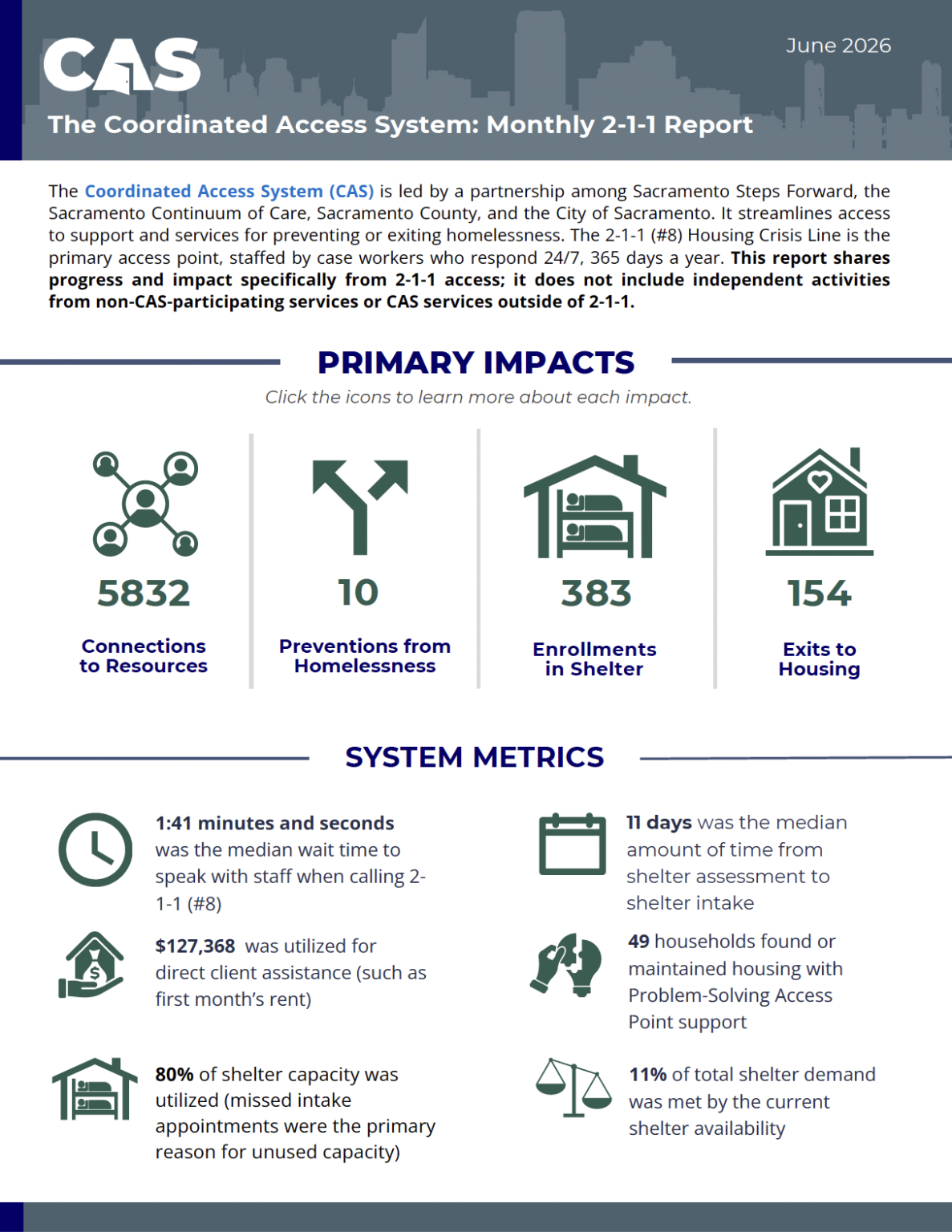
In June, we saw a continuation of the strong momentum from May, with gains across several key measures of housing stability. Connections to resources increased to 5,832 (up from 5,702 in May), exits to permanent housing rose to 154 (up from 119), and Problem-Solving services helped 49 households (up from 44) find or maintain housing.


Behind these numbers are real people whose lives were impacted through coordinated support. One person was a 56-year-old man experiencing homelessness who came to the 2-1-1 team seeking emergency shelter while facing significant barriers, including having no phone and experiencing short-term memory loss, which made communication and service coordination especially challenging.


His goal was to find a safe place to stay where he could begin focusing on his health and stability. Despite these obstacles, the 2-1-1 team remained persistent through in-person communication, ongoing outreach, and coordination with community partners to secure an appropriate shelter placement. He was successfully connected to shelter, providing him with a safe and stable environment where he could begin establishing a routine, focus on his well-being, and take the first steps toward long-term stability.


Want to learn more about the CAS? Sign up for our CAS newsletter!


Opportunities & Resources


Help Shape Sacramento Steps Forward Communications


We're looking for your feedback on how Sacramento Steps Forward communicates with you! Whether you utilize our website, newsletters, meeting materials, emails, or social media, your input will help us better understand what's working, what could be improved, and how we can make it easier for you to find the information you need.


New Resource: What is Transitional Housing?


In light of the current environment for funding and federal priorities, our homelessness response system must shift to reconsider transitional housing (TH) as an intervention for people experiencing homelessness. This document from the National Alliance to End Homelessness helps explain how to apply the lessons learned from TH models of the past to create more effective interventions today, as part of an overall approach to solving homelessness.


Inflation & the Perception of Homelessness Funding


Over the last decade, funding for homelessness services increased by 96%. But when adjusted for inflation, that growth drops to just 43%. This distinction matters: Providers across the country know firsthand how the funding is insufficient to meet the crisis. Read the full snapshot from the National Alliance to End Homelessness on inflation's impact below.


July Wellness Tip: Look Back from the Outside


Some moments stay with you long after the conversation ends, especially when you are part of the homelessness response system. When you find yourself replaying a difficult interaction, try asking yourself, "What would I say to a colleague in this same situation?"


Studies on psychological distancing have found that viewing a challenge from an outside perspective can help reduce rumination and support clearer thinking. It doesn't make the situation any less difficult, but it can help you approach it with a little more perspective.


Do you have a completion practice when you end your day? We’d love to hear about it! Use the button below to share what works for you.


Share Your Work: Be Featured as a Provider


Help us highlight the great work happening across Sacramento! We’re inviting providers to share their progress, challenges, and opportunities for collaboration to be featured in our upcoming newsletters and other communications. This is a chance to showcase your impact, inspire new partnerships, and help shape the conversation around homelessness response. Fill out the form below to share your story and connect with the broader community.


Facebook  Instagram  LinkedIn  X