February 2017
Spotlight

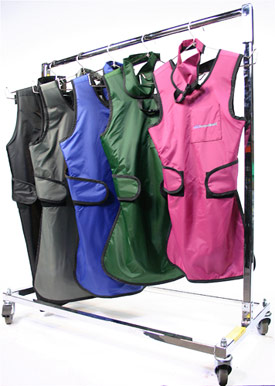
According to the International Atomic Energy Agency (IAEA), lead aprons are the most effective personal radiation protection means and should be worn by everyone in a room with fluoroscopy. If you're responsible for lead aprons in a bioskills lab, you need to make sure that aprons are regularly inspected to ensure that lab personnel, as well as training event participants are adequately protected. It's important to
lead apron rack photo
be familiar with the mandates of local, state and national x-ray boards. While there are no set government standards to use for the testing procedures there are three primary methods for inspecting lead aprons:
  1. Visual inspection - begin by laying the apron out on a clean flat surface and then look for obvious tears, scratches, bumps, and other imperfections.
  2. Tactile inspection - the apron may be laid out flat, or may be hang on an apron rack. Use your hands to check for creases or any thinning of the lead.
  3. Fluoroscopy inspection - use a fluoroscope on manual mode to inspect suspect areas. This may also uncover some defects overlooked in a physical inspection.
Pass/Fail Inspection
There are currently no government standards for determining whether a lead apron passes or fails inspection, though there are some industry norms. Here are guidelines from "X-ray Aprons - Inspect to Protect!" by Cone Instruments:
  • For a single apron with a .50 lead/lead equivalency, tears of more than 5.4 cm in length are cause for rejection. Smaller perforations or cracks in the edges can result in rejection as well, depending on the length and width of the apron as compared to the size of the defect.
  • Thinning of the lead and the outer protective layer of the apron also warrants rejection. Thinning is determined by measuring thickness in relation to the size of the apron.
  • Broken apron closures (Velcro, buckles or ties) that cannot be repaired warrant an inspection failure.
  • Defects near certain organs would cause an apron to be rejected: 1.7 cm tear over the gonads, 1.8 cm tear over the thyroid, etc.
 
Track Inspection Results
It's important to keep a record of all inspections performed on each apron. This can be as simple as an Excel spreadsheet, or utilizing tracking software such as SmartTrack offered by Infab.

Disposal of Lead Aprons
Lead aprons that are damaged or have outlived their useful life can be a hazard to the environment and should not be disposed of in the trash. Consult a local recycling company, hazardous waste carrier or handling company, or your local landfill to understand the proper disposal method. The apron manufacturer may also offer assistance on disposal.

Proper Storage of Lead Aprons
One of the best ways to maintain the integrity of your lead aprons is by proper storage. Aprons should be laid flat or hung on an apron rack. Lead aprons should never be folded or draped over the back of a chair or similar apparatus as this will cause the lead to break down and crack.

Sources:

Tools of the Trade

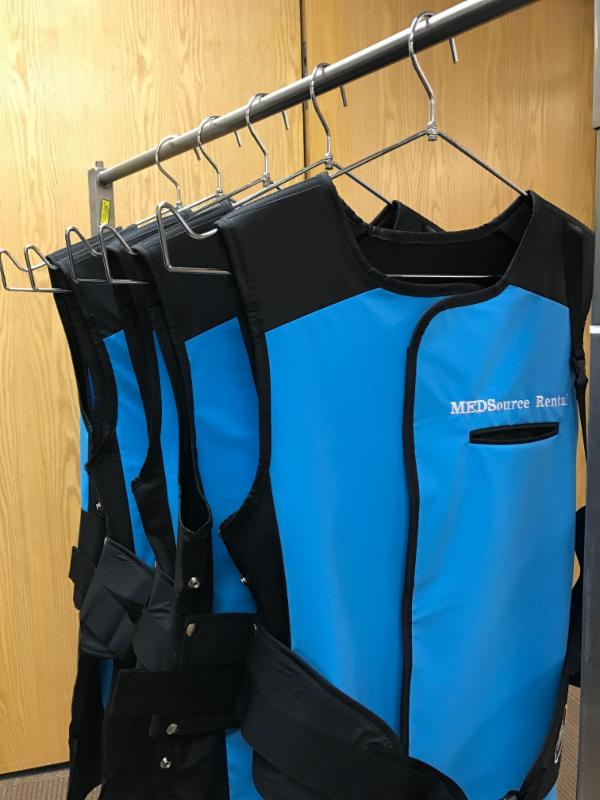
We're expanding our inventory of lead aprons to include a full wrap-around style:
  • .25m Pb in front (.50m Pb at overlap)
  • .25m Pb in back
  • Cool Wear moisture wicking fabric
  • Includes thyroid collar and adjustable waist belt
  • Designed for exceptional fit and comfort
  • Ideal for situations where there are multiple C-arms in the room and exposure can come from multiple directions
We also have 120+ frontal protection aprons in color-coded sizes ranging from Small thru XX-Large.  Lead apron racks that can hold 20-25 aprons are also available. Call us today at 303-750-5357 or email us and request a quote.

Lab Profile: Pacific American Life Science Learning Center
       Two Locations in Southern California:

      SAN DIEGO
         IRVINE
5286 Eastgate Mall
San Diego, CA 92121
11801 Mitchell S
Irvine, CA 92614
10+ Stations with C Arm
20 stations without

7 Stations with C Arm
10 Stations without


Contact: Rebecca Bollens  858-622-0792 x2
Lab email: info@lslclab.com
 

Pacific American Life Science Learning Center boasts years of experience as a premier bio-skills surgical training center.  Located In both San Diego and Irvine, each lab is  conveniently  located near airports.  At each  facility they can accommodate both small private labs but also large regional meetings as well. Classroom style seating with AV support is available at each site and state of the art equipment throughout. Each also includes a wet lab and sterilizer. In the reception area, they can accommodate most administrative needs and computer support.  Catering and shuttle assistance available at competitive rates.  Pacific American Life Science Learning Center prides itself on maximum customer service and execution of a flawless event.  Contact them today to book your next training event! 

You can find more information about Pacific American Life Science Learning Center and other bioskills labs at www.bioskillslabs.com. Registration is free! Whether you want to promote your lab, or are working in the industry and are looking for a lab, we welcome your participation.
MEDSource logo

7012 S. Revere Parkway, Suite 150
Centennial, CO 80112
303-750-5357
888-747-1190
Email us