Issue 659 - March 21, 2026 | | |
IN THIS ISSUE
- Sales Tax Not Under Consideration
- State Revenue Growth Lags Proposed Spending
- Skyrockets in Flight? Not in Delaware!
- Proposal Would Remove Bureaucratic Barrier to Healthcare Expansion
- Leading Health Advocates Urge Lawmakers to Prioritize Workforce Growth
| | |
Sales Tax Not Under Consideration
A discussion at a recent public forum between Kent County business owners and local lawmakers inadvertently led to speculation about Delaware adopting a sales tax.
State Sen. Dave Lawson (R-Marydel) joined other Kent County state legislators for the Central Delaware Chamber of Commerce (CDCC) Legislative Luncheon. The annual event allows entrepreneurs to ask local elected leaders for their positions on issues and legislation moving through the General Assembly. Each official responded to three questions posed by the CDCC’s Legislative Affairs Committee and three from the audience.
One of the questions posed to all the lawmakers concerned Delaware's personal income tax, pending proposals to increase rates on higher earners, and ways to make the tax more equitable.
After several of his colleagues offered their opinions, Sen. Lawson floated the idea of a sales tax replacing, or significantly curtailing, the levy on income. The senator later indicated that he raised the topic to generate discussion and insights, not as an initiative to pursue.
The comments led to multiple news stories that sparked speculation about Delaware losing its marketing moniker as "The Home of Tax-free Shopping."
"Last week, I was asked to participate in a panel discussion [and] the idea of imposing a sales tax was discussed," Sen. Lawson said in a statement released this week. "[While] I did initiate that conversation...some of the reporting to this point has, to put it nicely, lacked important context, so I would like to elaborate on what was said.
"To be clear, I do not support a sales tax, especially not on top of the various taxes already on the books," Sen. Lawson continued. "I am not authoring a bill to implement one."
Delaware is currently one of only five states that do not charge a tax on retail purchases, and the only one located in the Mid-Atlantic region. The other four states are Alaska, Montana, New Hampshire, and Oregon. Alaska and Montana allow municipalities to levy their own sales taxes.
| | |
State Revenue Growth Lags Proposed Spending
The Delaware Economic Financial Advisory Council (DEFAC) issued its latest state revenue estimate earlier this week for the upcoming fiscal year.
This estimate is the third in a series of five, which collectively play a major role in determining state spending. By law, Delaware budget writers can appropriate no more than 98% of expected state revenue.
For Fiscal Year 2027, which starts July 1, the non-partisan group determined that the amount of spendable money flowing into the state’s coffers will be $7.132 billion.
While that is an increase of $34 million from the previous estimate made three months ago, it is $113 million lower than the total spending the governor recommended in January in his four annual appropriations bills: the General Fund Operating Budget, Capital Budget (a.k.a., the Bond Bill), a one-time Supplemental Appropriations Bill, and the Grants-in-Aid Bill.
The next revenue forecast, scheduled for May 18, is arguably the most influential of the series. Legislative budget writers will use this estimate to draft the state's spending plans, setting them, more or less, into their final forms. The measures will be slightly tweaked in late June to align with the last revenue forecast.
| | Skyrockets in Flight? Not in Delaware! | |
Since 2018, when Delaware broke its long-standing ban on fireworks, a wide variety of pyrotechnics have been sold at dozens of stores and pop-up outdoor locations throughout the state.
However, many of the products being purchased violate state law. A bill (House Bill 63, as amended) passed by the State House of Representatives earlier this week aims to address confusion over the state's nebulous fireworks law.
Under the Delaware Code, fireworks may only be sold 30 days before Independence Day, the third day of Diwali (a religious festival occurring between mid-October and mid-November), New Year's Eve, and New Year's Day. And they can only be used on those four holidays.
Perhaps the most confusing aspect of the current law is which types of fireworks are legal in the First State.
According to material published by the Delaware State Fire Marshal, permitted products are limited to "ground-based fireworks," including spinners, fountains, jumping jacks, ground blooms, and sparklers. Aerial and explosive fireworks of any type are still banned, including bottle rockets, firecrackers, Roman candles, and "any other device that explodes or shoots into the air."
House Bill 63, as amended, would require disclosures to consumers at the time of sale, advertising disclaimers, establish retail and wholesale permits, and mandate inventory safety inspections.
The Fire Marshal would use funds generated from registration and inspection fees to ensure compliance, provide education, and raise public awareness.
The bill passed 38 to 1 in the House and is awaiting consideration by the Senate Corrections & Public Safety Committee.
| |
Proposal Would Remove Bureaucratic Barrier to Healthcare Expansion
The author of a bill filed in the House of Representatives this week says his proposal would help Delaware meet its increasing need for healthcare services.
"Delaware is growing fast, getting older, and our healthcare system is already behind," said State Rep. Bryan Shupe, the prime sponsor of House Bill 318.
The measure seeks to remove the requirement that hospitals secure government permission to expand, purchase equipment, or build new facilities.
Healthcare organizations considering a significant project must currently submit a "letter of intent" to the Delaware Health Resources Board, which evaluates the proposal and holds hearings to determine whether it serves the public interest. If it approves, the board issues a Certificate of Public Review (CPR), which allows the initiative to move forward.
This approach is common in the U.S., with most states operating Certificate of Public Review or Certificate of Need (CON) programs. Supporters say the formal review ensures public scrutiny of health care developments and focuses on balancing concerns for access, cost, and quality.
However, Rep. Shupe and other critics maintain that the mechanism is an outdated bureaucratic device that significantly slows the building of critical healthcare infrastructure and hinders Delaware healthcare providers from addressing service gaps.
Rep. Shupe said Delaware is already behind the curve, noting our state has the 5th-oldest and 6th-fastest-growing population in the country. He said healthcare organizations need to be given the freedom to be more responsive and to make their own resource-allocation decisions — without government interference.
While more than 30 states have CPR and CON programs, the landscape is actively shifting. In 2023–2024 alone, at least 22 states reportedly passed legislation modifying such programs. Three years ago, South Carolina repealed nearly all its CON requirements. Georgia, Iowa, Oklahoma, and Washington created exemptions specifically for psychiatric facilities, while Iowa, Tennessee, and Massachusetts commissioned studies to evaluate if their CON programs are still effective
House Bill 318 has been assigned to the House Health & Human Development Committee for consideration.
| | |
Leading Health Advocates Urge Lawmakers
to Prioritize Workforce Growth
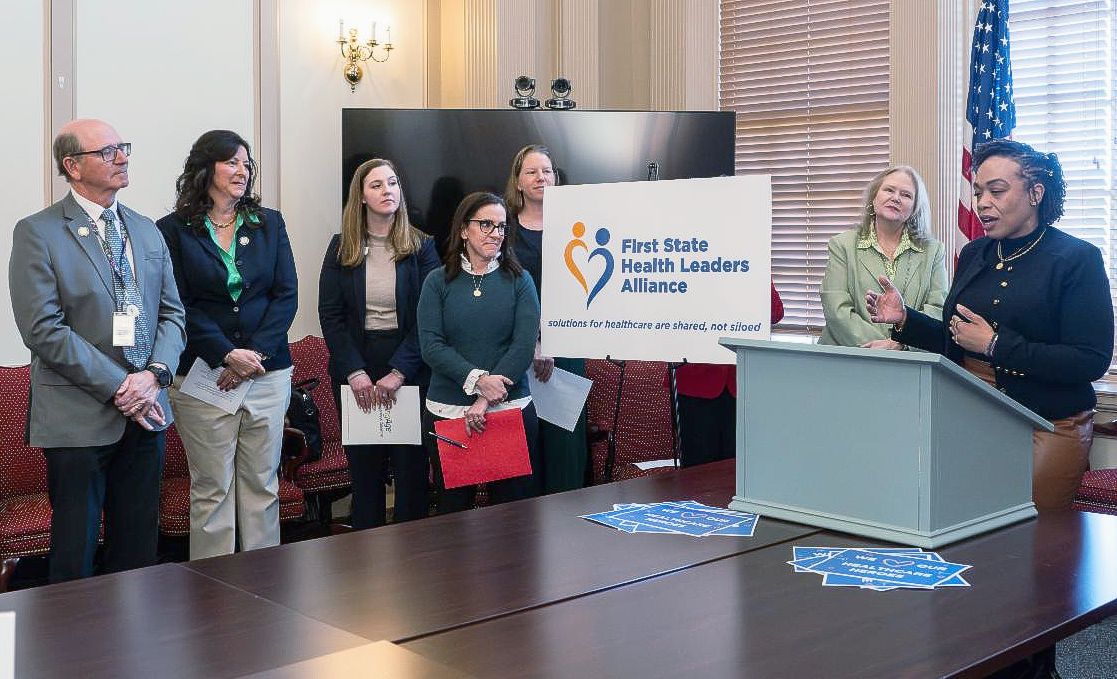
Members of the First State Health Leaders Alliance (FSHLA) advocated at Legislative Hall this week to promote their initiatives to support and expand Delaware's healthcare workforce.
Alliance members, including the Delaware Healthcare Association, the Delaware Nurses Association, the Delaware Pharmacists Society, and the Medical Society of Delaware, held a call-to-action event on Tuesday, highlighting the need to:
- Support comprehensive data collection to better define healthcare professional shortages.
- Target resources into incentives to recruit, educate, and retain healthcare workers.
- Invest in programs that cultivate interest in health careers at a young age.
- Work collaboratively to protect healthcare workers and support violence mitigation and de-escalation strategies.
The advocates were joined by multiple lawmakers, including Speaker of the House Melissa Minor-Brown (D-New Castle), State Rep. Valerie Jones Giltner (R-Georgetown), and State Rep. Jeff Hilovsky (R-Long Neck, Oak Orchard) — all three of whom have spent their careers as medical professionals (see photo).
“As a nurse, I know our healthcare workers don’t back down from any challenge," Speaker Minor-Brown said. "It’s ingrained in our DNA to fix problems and make a difference... In order to have a strong Delaware, we need a strong healthcare workforce."
Rep. Jones Giltner, noted that it was fitting that Tuesday's advocacy day coincided with Health Workforce Well-Being Day. "One of the main ways in which we can support our workforce is to invest in creating the safest environments possible for them. We must start here. Only with a protected workforce can we, as a state, achieve our healthcare system goals of providing quality healthcare to all our citizens."
| | | | |