|
Abstract
In industry and construction, scaffolds are one of the most prevalent means of access for work at height. Yet, they can introduce significant hazards to those workers operating on scaffold platforms. This article explores the regulatory framework surrounding scaffolding, identifies common hazards, and discusses the physiological risks associated with suspension trauma, also known as orthostatic intolerance, if a worker were to take a fall on a personal fall arrest (PFA) system. Additionally, this article presents a framework of Emergency Action Plans (EAPs) tailored for scaffold rescue. By integrating regulatory standards, hazard awareness, and structured rescue protocols, organizations can strengthen workplace safety and reduce the risks associated with falls from heights.
Introduction
Scaffolding can be broken down into two categories based on its construction: supported and suspended scaffolds. Suspended scaffolds are typically constructed of one or more platforms suspended by wire rope, while supported scaffolds consist of one or more platforms supported by rigid, load-bearing members. While there is significant variation in what fits the definition of scaffolding, which also includes stilts, aerial lifts, and scissor lifts, we will focus on the most prevalent type found in industry and larger construction projects, which is system scaffolding. System scaffolding is an engineered, modular scaffold system composed of standards, ledgers, diagonal bracing, planking, couplings, and ledgers that are connected using built-in, pre-determined locking mechanisms, such as wedges or latches. There is a great variety of proprietary locking systems, with ring lock systems that use rosettes on the standards and cup lock being some of the most prevalent. While the hazards associated with scaffolding are universal, this article will focus on system scaffolding in particular in relation to the EAPs put forward.
Scaffold Regulatory Framework, Standards, and Associations
In the United States, OSHA 29 CFR 1926 Subpart L is OSHA’s construction standard that covers the design, construction, use, and safety requirements for scaffold systems. ANSI is the voice of U.S. voluntary standards and conformity. ANSI/ASSE A10.8 is the standard that establishes safety requirements for the construction, operation, maintenance, and use of scaffolds, and ANSI/SAIA A11.1 contains procedures for testing and rating scaffold components and assemblies. Finally, ANSI/ASSP Z359 is the fall protection and fall restraint standards that address fall protection equipment and systems. The primary association involved with scaffolding is the Scaffolding and Access Industry Association, and within SAIA, the Scaffolding, Shoring, and Forming Institute (SSFI), which is a SAIA committee of leading manufacturers of scaffolding and scaffolding components. SSFI focuses on the technical aspects and safe use of scope products.
Scaffold Hazards
Each class of scaffold has its own unique hazards associated with its use; however, universally across all scaffolding, the four most common hazards are: Falls, collapse of the scaffold, being struck by falling tools, work materials, or debris, and finally, electrocution due to proximity of overhead powerlines, with falls being the most common hazard. As falls are the most common hazard associated with scaffolding, we should be aware that the physiological state of suspension trauma can result from being passively suspended in a harness and being unable to self-rescue.
Suspension Trauma
The idea of suspension trauma, shock leading potentially to death, induced by hanging passively in a harness, has been around for many years. It has been variously called orthostatic intolerance, harness pathology, and harness hang syndrome. Suspension trauma has become the most common name despite the lack of true trauma in most cases. The underlying physiology of suspension trauma results from being immobile in a vertical orientation, which, of note, was reproduced on tilt tables in a clinical setting without a harness. The patient’s immobility disrupts normal venous return because normally the leg muscles act as a pump returning the blood to the heart. If a patient cannot move, this pumping action stops, and the blood naturally pools in the legs. This pooling of the blood leads to poor venous return, which continues to the cascade of reduced cardiac preload, then decreased cardiac output, and most significantly to cerebral hypoperfusion, resulting in fainting and ultimately death. Secondary complications associated with prolonged poor venous return from the legs, ischemia in the leg muscles that can cause rhabdomyolysis and consequently “toxins” (myoglobin and potassium) upon reperfusion that can stress the kidneys and the heart. Clinical manifestations of early suspension trauma include dizziness, nausea, pallor, sweating, tunnel vision, and tingling or numbness of the legs. As suspension trauma progresses, weakness increases, along with lightheadedness until it reaches the critical stage of syncope, and ultimately, if circulation is not restored, circulatory collapse, and death. Post-rescue risk associated with suspension trauma includes arrhythmias from the release of potassium and renal failure from myoglobin, both associated with rhabdomyolysis. Risk factors after a fall include harness design, with sit harnesses being the most resistant and allowing more movement, immobility, duration, environmental and physiological stressors, and lack of training and rescue capability. Historical misconceptions regarding “rescue death” or “suspension syndrome death” have long been prevalent and most stem from Seddon’s studies for the United Kingdom’s Health and Safety Executive (HSE), which relied heavily on the pathology proposed at the 2nd International Conference of Mountain Rescue Doctors in 1972. Seddon suggested that victims might die suddenly if placed flat after rescue due to the theory that the rapid return of pooled blood would overload the heart or cause fatal arrhythmias. Seddon’s recommendations based on his gathered reports were to keep patients upright or semi-recumbent for a period after rescue and gradually lower them to a supine position. Evidence-based medicine does not support these fears of rescue death and instead supports the following shock management principles. The safest and most effective approach to suspension trauma is to remove the patient from suspension as fast as possible, laying them in a supine position is fundamental to improve venous return and brain perfusion as fast as possible, and beginning standard resuscitation. Management of suspension trauma requires immediate rescue priorities of minimizing suspension time by rapid rescue and encouraging patients to move their legs or utilize suspension straps. After rescue on the ground, place the patient in a supine position to restore venous return. Assess airway, breathing, and circulation, administer oxygen if available, and be prepared for sudden cardiac arrest, using CPR and defibrillation if needed. If available, establish IV access and provide fluids. Monitor for arrhythmias, metabolic acidosis, and electrolyte disturbances, and watch for compartment syndrome in extremities and in the hospital setting. Closely watch kidney function. Prompt rescue is the ultimate treatment for suspension trauma, and emergency action planning is the key to being able to perform a prompt rescue.
Situation for a Rescue to Occur
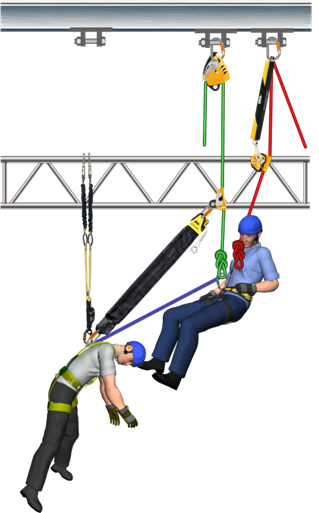
Workers may need to be rescued from height on scaffolding for several reasons; however, this article focuses on following a fall from scaffolding where the worker is suspended in their harness. If a worker falls next to the scaffolding and is both conscious and uninjured, the rescue should be straightforward. They most likely should be able to recover themselves, or be helped by their fellow workers. However, if the fallen worker is injured, unconscious, and/or suspended in mid-air, rescue is going to be more difficult.
Risk Assessment / Rescue Preplan
The following points need to be taken into consideration by the employer when preparing the risk assessment and rescue preplan before commencing work on site:
· Can the work at height be avoided?
· What type of scaffold will be used?
· Can falls be prevented?
· Has the correct choice of PFA been selected
· Who takes responsibility for the rescue?
· Is there an employee/skill mismatch?
Rescue Planning Flow Chart
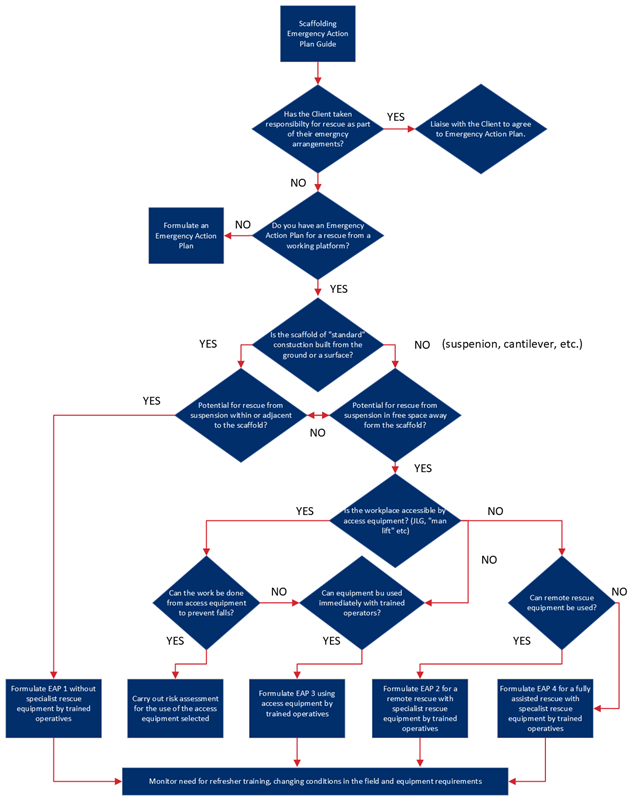
Rescue planning must be an integral part of the job and must not be reliant on emergency services. When planning for rescue, consideration should be given to the type of situation from which a patient may need to be rescued and the type of PFA system the patient might be using. The rescue planning flow chart (Figure 1) provides guidance on the steps involved in preparing for and planning a rescue of someone injured on a working platform or suspended in a harness after a fall.
Figure 1
Scaffold Emergency Action Plan Guide
|