|
The foundation will hire a site supervisor for the center, four to six educators and four staff for agricultural and livestock work. Their concept is designed around having one school bus load of 60 children at a time come to the farm to learn about the outdoors. The maximum number of buses would be three on one day. They might also offer field trips for children enrolled elsewhere in a summer camp or in an after school program. The foundation offers customized programs as requested by the teachers that could include art, agriculture and farm animals. Their target audiences are schools within a 45-minute bus ride. Most of the teaching would be outdoors and would move inside the building in case of bad weather.
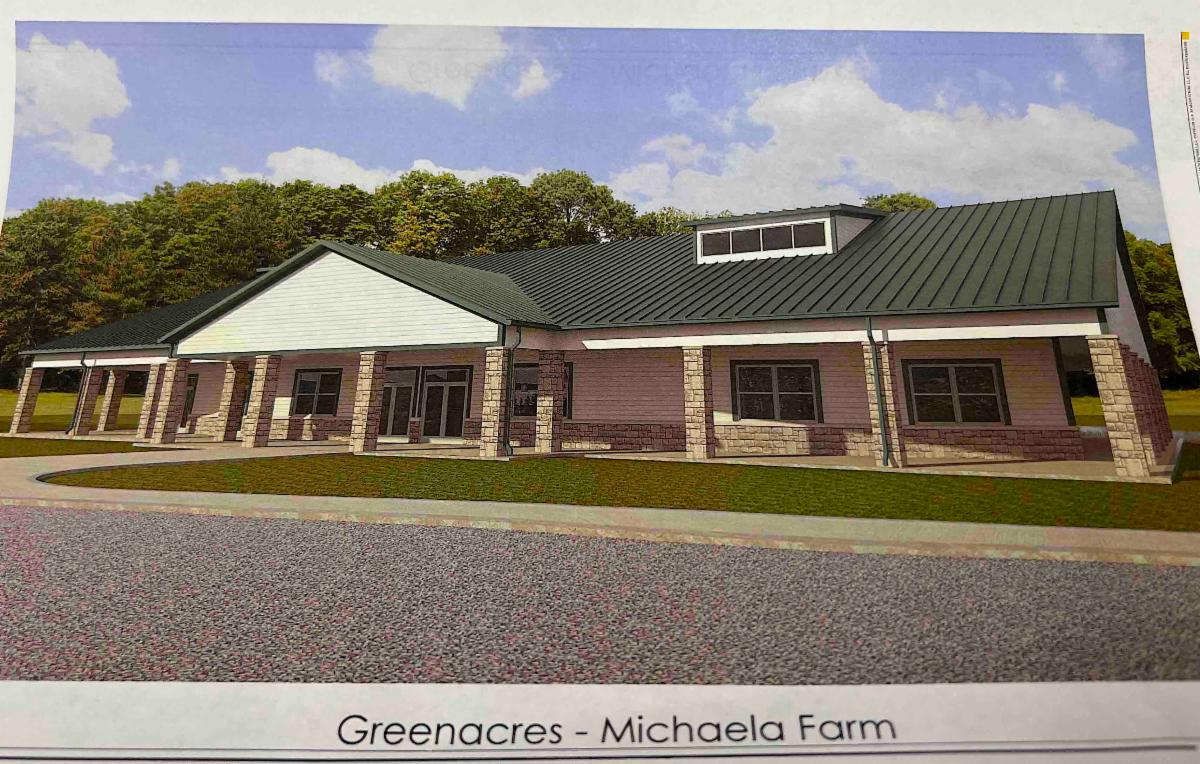
Beginning in 2023, Greenacres Foundation plans to build a 6,000 square foot educational center with a 4,000 square foot wraparound porch on the corner of St. Mary’s Road near an existing pond. They have operated a similar center in Cincinnati, Ohio since 1988 and have another location in Brown County, Ohio. In 2024 in phase two, they will add a greenhouse and a pole barn for equipment storage.
At this time they have no plans for the area near the historic brick barn. They talked about the older buildings needing repairs. The foundation has already received the necessary approval from the Town of Oldenburg.
PUBLIC COMMENT AND QUESTIONS
Some nearby property owners had not received the certified letters mailed to them; therefore they were not aware of plans on file at the government center. Neighbors Carrie Riesner and Daniel Eckstein had questions about the building, landscape buffers, security, impact on traffic and number of visitors to the center.
Mr. Randolph and his staff answered the questions and explained the foundation’s “good neighbor policy”. He said, “Our goal is to make sure the neighbors are treated with the respect they deserve. They were here first. We are not trying to impose anything on them. We are trying to bring something good for the neighborhood - good for the children.”
He apologized that not everyone was notified and he offered personal tours. He also apologized that the cattle “got out” the night before and pledged to correct the problem.
LIMIT ENVIRONMENTAL DAMAGE
A key tenet of the foundation is to limit the number of visitors and limit the number of buildings in their new construction to protect the natural resources of Michaela Farm. He estimated about 6,000 to 8,000 school children and teachers per year will visit the educational center and the same number will visit the historic barn.
Greenacres will not pave walkways, but will allow children to experience dirt and mud. They will install “dark sky lighting” fixtures so as to not bother the neighbors. They will capture rainwater from roofs into a cistern and will use it to water livestock and perhaps to flush toilets.
The farm will not be rented out for private events or weddings, said Mr. Randolph.
APC ASKS QUESTIONS & VOTE
APC member and County Surveyor Rob Seig said he was in favor of the plan. Nevertheless, he pointed out some technical issues and observed that part of their plan was “cut and pasted” from another project, because it referred to zoning standards in Ohio and Oldenburg, not Franklin County. He wants Greenacres to submit plans for storm water and erosion control and was told the final plans would be ready by December 31, 2022. The Greenacres staff will have their architect work with the APC and with Mr. Seig. Other APC members received answers to their questions about the cistern and the use of the property.
Greenacres President Carter Randolph asked the APC to approve the general concept of a “unit development plan” for Michaela Farm so that they could move forward with the final drawings and with hiring a contractor. At first the APC seemed hesitant to make a decision. APC President Bob Braun talked about “giving a nod” and “waiting to see” more information.
APC member Daryl Kramer said that the APC should allow the concept and the placement of the buildings. He motioned to allow “unit development” for the main building and the driveway with the provision that Greenacres’ construction permits would be issued later. The vote was unanimously in favor. Click to read general information about unit development from the county’s zoning code.
According to Greenacres Foundation’s website. “It was founded in 1988 and was Louis and Louise Nippert’s gift to the community. Combining their love of the land and farming with their appreciation of Cincinnati’s classical arts, Greenacres provides educational programming to over 30,000 local students annually while preserving and generatively farming over 1,200 acres in the Greater Cincinnati area.”
“BEATING A DEAD HORSE”
The APC received a request from the county commissioners to amend the zoning code and to give a “farm exemption”. No one was present to explain the request and APC members took turns discussing what the commissioners might have in mind. They were concerned about the safety of buildings being constructed with no inspections.
Mr. Seig had earlier talked to the commissioners for clarification and he said that they want the following:
· No inspection of new farm buildings and
· No fee for a permit for farm buildings.
Mr. Seig said that there is a misunderstanding among government officials and among the farming community that they do not need building permits. He added that farmers are being told, “Just go ahead and do it.” Mr. Seig said that is incorrect. The current zoning code requires a permit, but there is no fee and no inspection. The commissioners want the county to be informed about new buildings so the county assessor can tax them.
APC board member Daryl Kramer said the inspection issue is “dead” if the commissioners don't want it. APC President Bob Braun advised that they stop “beating a dead horse” on this issue.
“PROPOSALS SHOT DOWN”
The APC worked for months to reach agreement on correcting the zoning code and getting the wording exactly right. In October, their proposals were sent to the county commissioners for final approval. Board President Braun asked, “Were all of our proposals shot down [by the commissioners]?” The answer was “yes”. The commissioners rejected changes that would have required a notification of neighbors by certified mail and a public hearing before certain businesses could receive a building permit. These include farm implement supply, machinery sales and service areas or building (new or used), mini warehouses, self-service storage facilities and commercial seasonal hunting and fishing lodges. The commissioners want APC Director Cindy Orschell to continue make the decisions about granting permits for these businesses. The commissioners saw no need for public input or further review that might delay a business from opening.
HIRE A WIND/SOLAR CONSULTING ENGINEER
The APC directed Ms. Orschell to secure prices from engineering consultants so the APC can hire one of them to do the required review of alternate energy plans. This issue came up when the school corporation applied for a solar permit. Their request was rejected, because their plans were incomplete. The applicant for a wind or solar project must pay a base fee to the APC plus the cost of the engineering consultant’s review.
The APC also talked about rewording the zoning code to separate the regulations for intermediate solar from those for larger commercial solar installations. They hope to clear up some confusion in the code.
CONSOLIDATION OF LOTS
In spite of recent proposals being rejected by the commissioners, the APC will move forward with another proposed change to the zoning code. Mr. Seig wants to allow the consolidation of subdivision lots by administrative review without requiring a hearing. Under the current zoning code an owner who wants to consolidate two lots must file a petition and attend two zoning board hearings that are 30 days apart.
$1,000 FINE FOR VIOLATOR
Each meeting, the APC reviews a report of zoning code violations. They were successful in getting a court-ordered judgment for a fine of $1,000 against a violator on Stipps Hill Road. However, the APC’s attorney was not present and no one was sure how they would collect the fine to pay for the necessary cleanup of the property.
“BARNOMINIUMS” NOT PERMITTED
APC member Christine Rains, who represents the town of Brookville, wanted to know why permits for “barnominiums” are being denied. Ms. Orschell acknowledged that living in barns is popular now, but said that the state’s building code does not allow residences in pole buildings without a foundation. She advised having an architect prepare a plan that followed the zoning code before applying for such a permit.
The next monthly meeting will be Tuesday, December 14, 2022 at 7:00 pm. Call the APC office at 765-647-5731 for information to view the meeting remotely via Zoom.
Reported by Sara Duffy
|