|
`
Greetings!
When we exchange The Sign of Peace during the liturgy, right after the Lord's Prayer and before the Communion Rite, we gift each other with the same peace that Christ gave his disciples. Whether we shake hands, hug, wave, bow, or do whatever else may be customary in our respective communities, the meaning is the same: we acknowledge that we SEE the worshippers next to us (or near us), that we see Christ in them, and that we extend his peace -- "the peace of God that surpasses all understanding" (Phil 4:7)-- to each person that we greet. When done consciously, with full awareness of its significance, The Sign of Peace is a beautiful ritual that unifies the community, reminding us of Christ's Presence in our midst. Unlike the so-called peace the "world" offers, this peace is not based on mutual deterrence, weapons of mass destruction, intimidation, or the stockpiling of armaments; rather, St. Paul tells us that it comes from rejoicing in the Lord, no matter the difficulties we might be facing. The Peace of Christ, then, is a state of being that is constant rather than transitory; it "guards our hearts and minds," allowing us to hope even when everything around us may seem to be in a state of disintegration. "No storm can shake our inmost calm...."
Elizabeth
+++
SCRIPTURE READINGS
Jesus said to his disciples:
“Those who love me will keep my word,
and my Father will love them,
and we will come to them and make our home with them.
Those who do not love me do not keep my words;
yet the word you hear is not mine
but that of the Father who sent me.
“I have told you this while I am with you.
The Advocate, the Holy Spirit,
whom the Father will send in my name,
will teach you everything
and remind you of all that I told you.
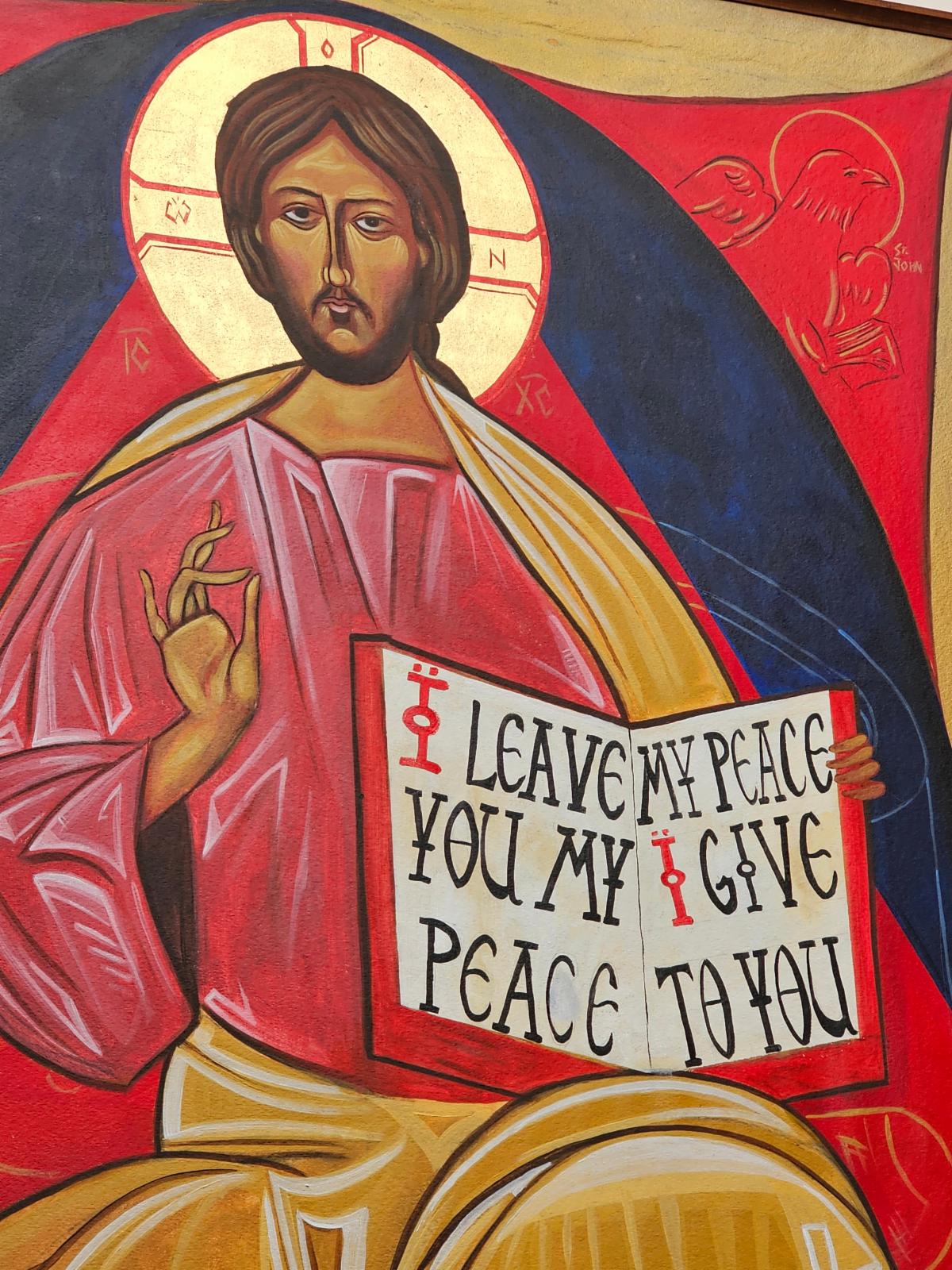
Peace I leave with you; my peace I give to you.
Not as the world gives do I give it to you.
Do not let your hearts be troubled or afraid.
John 14:23-29
"Do not let your hearts be troubled." These words not only appear in today's Gospel, but they also mark the beginning of Jn 14, bracketing a number of important themes as Jesus prepares his disciples for his departure. In fact, without reading what has come before, it is difficult to understand Jn 14:27, for the disciples are troubled -- and profoundly so. Jn 14 begins right after Jesus predicts that one of his disciples will betray him, informs his disciples that he will soon be leaving them, and tells Peter that he is going to deny him three times. We can only imagine the consternation and grief around the Last Supper Table as the disciples try to make sense of Jesus' words. Jesus' response is pastoral, "Do not let your hearts be troubled" (Jn 14:1). He urges his friends to have faith, explains that there are many dwelling places in his Father's house, and promises that he will return to take them there.
His words, however, fail to pacify his friends. Thomas wants clarity: "Master, we do not know where you are going; how can we know the way?" (Jn 14:5). For his part, Philip asks for an epiphany: "Master, show us the Father, and that will be enough for us" (Jn 14:8). Even when Jesus assures his disciples that he will not leave them orphaned and that the Holy Spirit will be their Advocate, teacher and guide, the disciples are still disturbed. Judas (not Judas Iscariot but another disciple), asks: "Master, then what happened that you will reveal yourself to us and not to the world?" (Jn 14:22). "Be at peace!" says Jesus. "Do not let your hearts be troubled or afraid! (Jn 14:27).
"Do not let your hearts be troubled." These words are the central message of today's Gospel; they are words that resound across two millennia, right to the world of today-- pastoral words, words of hope, words of encouragement. No matter how dire the circumstances in which we find ourselves, no matter how powerful the forces of evil seem to be, yet God's love will prevail. In this chapter, Jesus distinguishes between his "real" friends and "the world." Those who love him will keep his commandments and, like his disciples, will remain in him and in the Father, at home in the Trinity. Conversely, those who do not love him --those driven by worldly ambitions, false promises, and the lust for power-- will be unable to see him. Having rejected the Way, the Truth, and the Life to serve "the ruler of the world" (Jn 14:30), their idea of peace is to control the masses via threats, coercion, and tests of loyalty:
What they know
are limits and restrictions,
brick walls without doors,
concrete cells sans windows.
for them, life is function,
rote and predictable;
their god, Big Brother,
omniscient, omnipotent,
the feared puppeteer
who pulls the strings
this way and that,
jerking obedience
from wooden manikins...
EAS, "Nazareth Sequences," 1989
In contrast, Jesus is Peace, and the gift he gives is nothing less than the gift of himself.
+++
QUESTIONS FOR REFLECTION
- What do you think Jesus meant by "the world" in John 14?
- How does the peace that the "world" offers differ from the peace of Christ?
- What troubles you the most right now, and how does Jn 14 help you move beyond fear towards hope?
-
How do the readings from the Acts of the Apostles and from Revelation strengthen your faith?
|