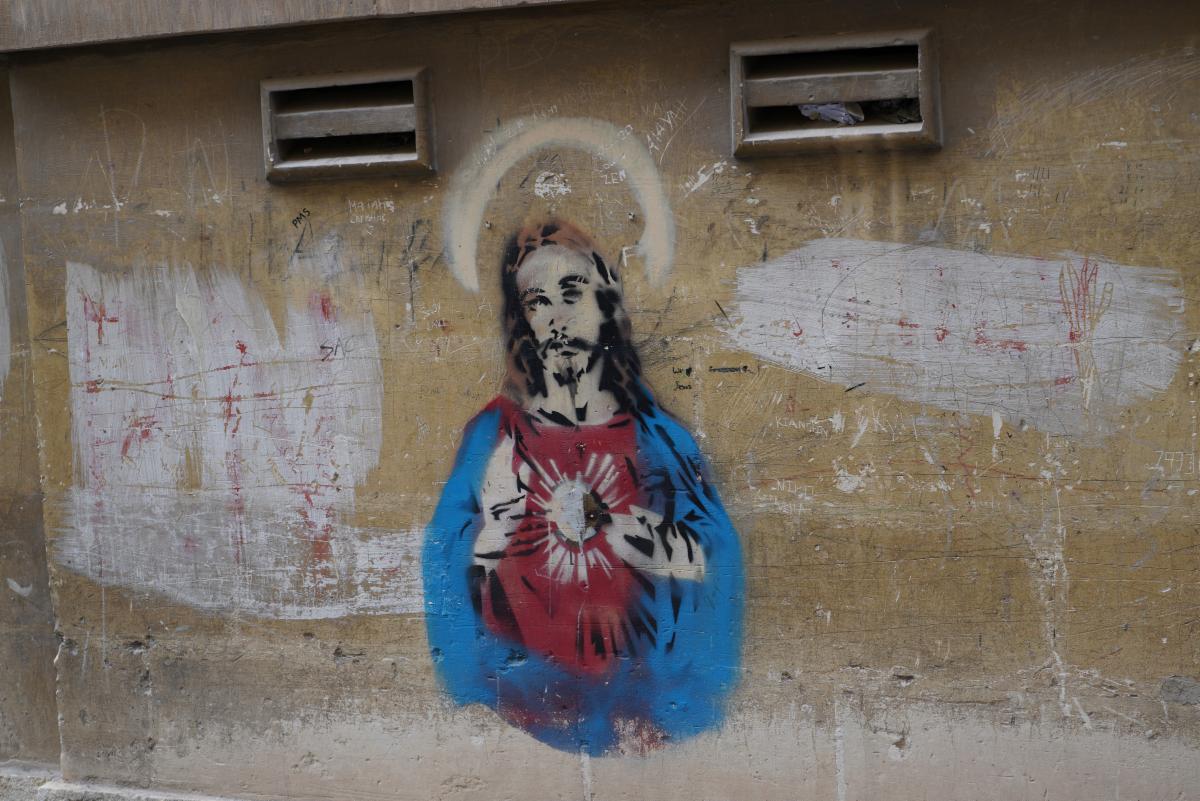
"Let us pray together that nations move toward effective disarmament, particularly nuclear disarmament, and that world leaders choose the path of dialogue and diplomacy instead of violence." Pope Leo XIV | |
from Pilgrims at Heart
Elizabeth-Anne Stewart, 1993
We are experts at locking doors. Our sense of self-preservation extends beyond locking car doors and front doors to locking the doors to our hearts. Just as effectively as we keep out thieves and vagabonds from our property, so we sometimes keep out those who try to extend friendship, if only we would let them. Sometimes, we even succeed in locking out God.
We are so familiar with the biblical invitation, "Knock and the door will be opened to you" (Mt 7:7-8), that it seems strange to think of God knocking on our doors instead. In Jn 20:26, Jesus, fresh from the tomb, doesn't even bother to knock but breaks through the closed doors of the upper room and through his disciples' fears. In his presence, they find belief and direction, the courage to move back into the world. From this point on, life must be all open doors, while locks and bolts become relics of the past. How blessed we are that God's love is stronger than all the barricades we are so good at building!
+++
| | Available on Amazon
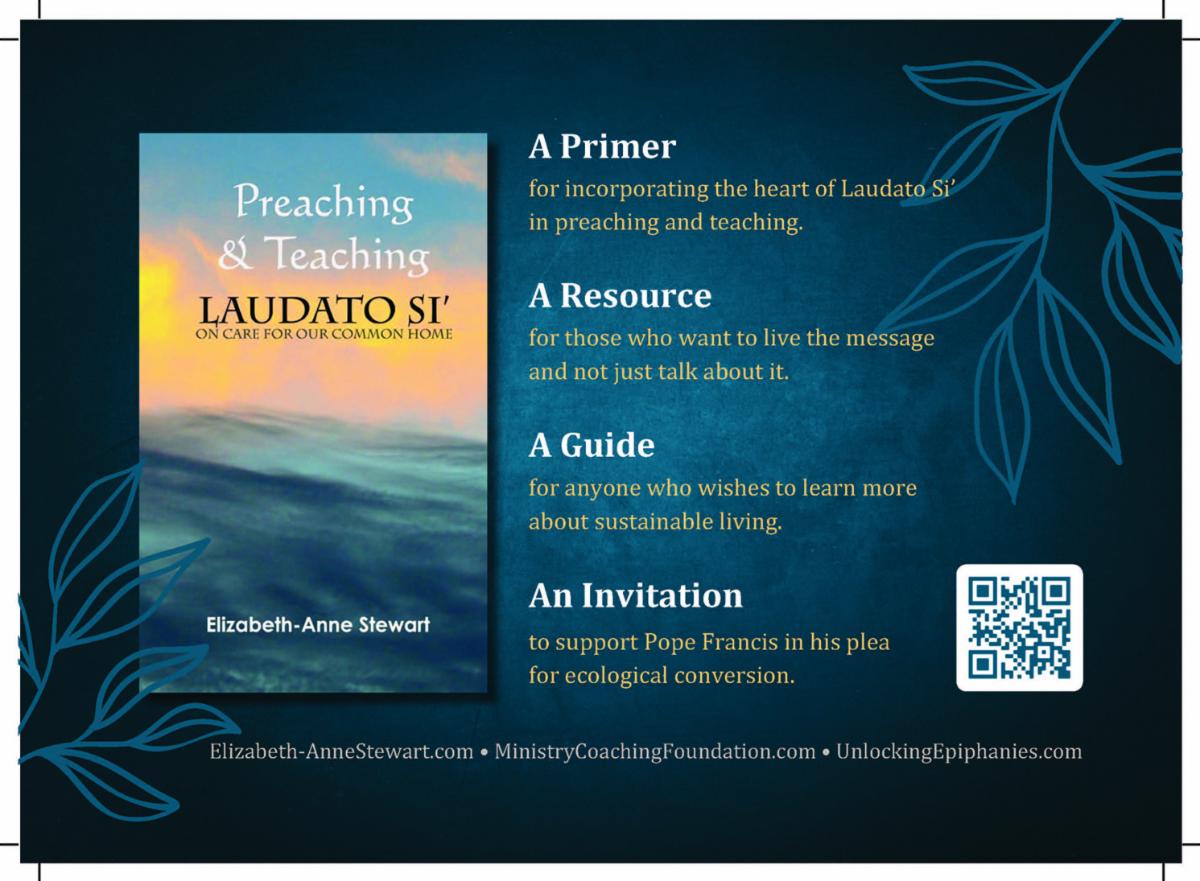
A resource for promoting ecological conversion.
| |
+++
UPCOMING WORKSHOPS
"Merton's Fourth & Walnut Epiphany."
International Thomas Merton Society, Indianapolis Chapter
July 16th, 2:00-4:00 p.m.
All Saints Episcopal Church,
Indianapolis, IN
+++
Archdiocese of Chicago Liturgy Formation
Workshops
St. Paul VIth, Riverside
April 21, 27 & 29. 6:30-8:30 p.m.
St. Daniel the Prophet, Chicago
May 2, 6:00-8:00 p.m.; May 5 & May 8, 6:30-8:30 p.m.
St. Elizabeth Seton, Orland Park
August 24, 26, 27. 7:00-9:00 p.m.
| |
QUESTIONS FOR REFLECTION
- Are you presently in a season of belief or disbelief?
-
How do you live your faith?
- What "signs" have you experienced in your life that help you believe?
- What types of situations tend to undermine your faith?
+++
| |
Greetings, SBT Readers!
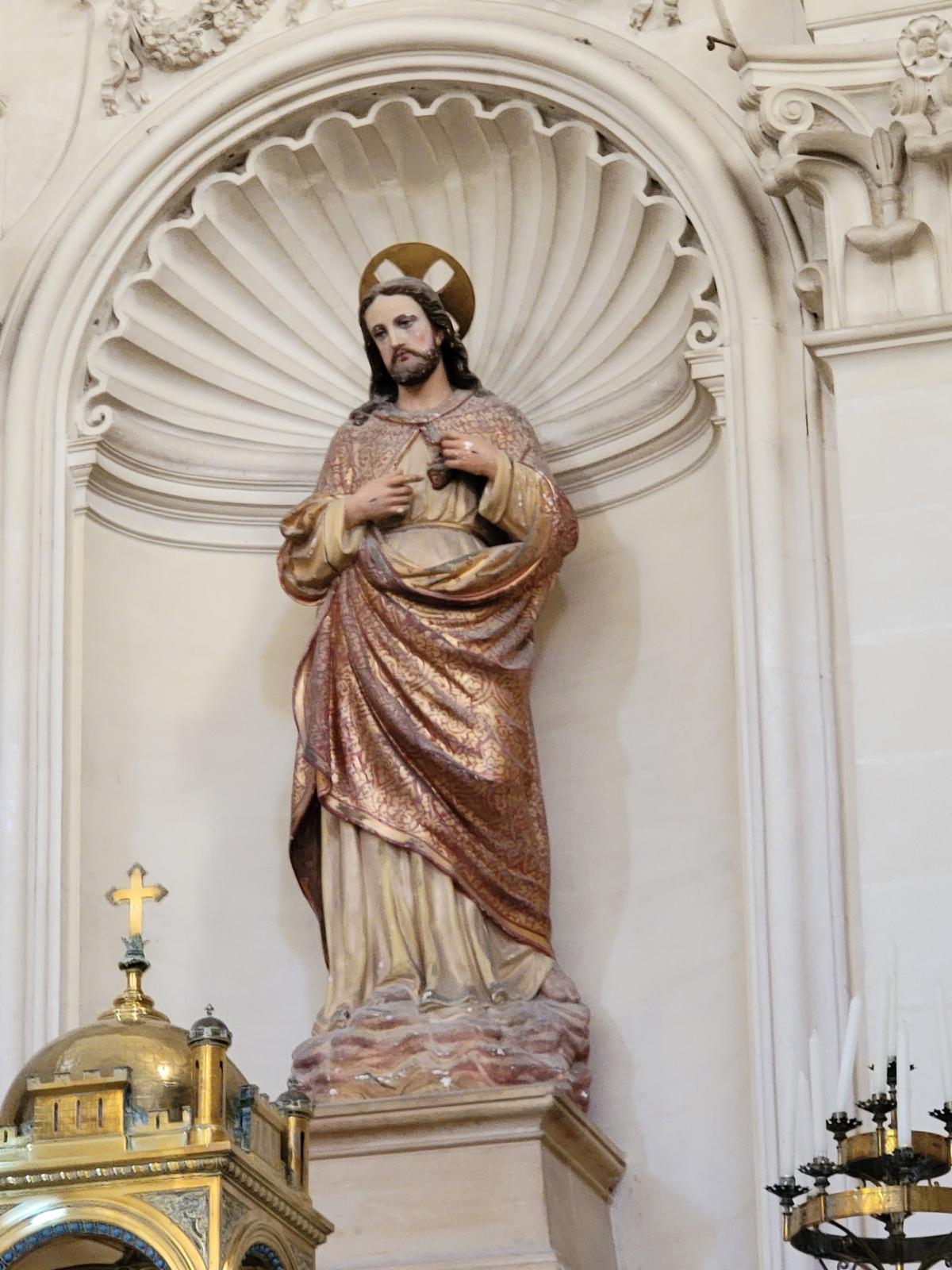
The dust is visible on this statue of the Sacred Heart, and though the chipped paint points to better days, the message hasn't changed in the decades since my years as a boarder at the Convent of the Sacred Heart, St. Julians, Malta. Situated behind the tabernacle in the school chapel, overlooking the main aisle, the time-worn statue embodies the mission of the Society of the Sacred Heart, that is," to discover and reveal God's love in the heart of the world through the service of education." Founded in 1800 by St. Madeleine Sophie Barat, the Society is dedicated not only to teaching and spiritual formation but also to promoting justice, peace, and the integrity of creation. The wellspring for this mission is Love, and the portal into Love is the pierced Heart of Christ.
As a work of art, the statue is rather dated, reflecting pre-Vatican II piety. This Jesus is more Aryan than Mediterranean, more refined than peasant, more feminine than masculine. Nevertheless, he exudes gentleness and compassion, inviting the beholder to follow the Way, the Truth, and the Life, that is, the Christian path. This is the Jesus who preaches forgiveness and love of enemies, the Jesus who feeds the hungry and heals the afflicted, who welcomes sinners while upholding the Torah's teachings on befriending the widow, the orphan, and the alien.
He is also the Jesus who contradicts those who would hijack his message and his Personhood, thereby contorting him into a god of war or the god of prosperity. This Jesus wears no armor, wields no weapons, makes no threats; instead, he points to his heart -- his wounded Heart. To enter, one must lay down pride, hatred, violence, deception, manipulation, exploitation, cruelty, the desire for revenge, and every sense of entitlement. The entrance ticket is neither worldly success, military might, nor world domination; only those who live by Love and for Love can enter the wounded Heart of Christ, and there find mercy.
Eastertide Blessings,
Elizabeth
| |
LINK TO SCRIPTURE READINGS
Thomas, called Didymus, one of the Twelve,
was not with them when Jesus came.
So the other disciples told him, “We have seen the Lord,” but he replied,
“Unless I see the mark of the nails in his hands
and put my finger into the nail marks
and my hand into his side, I will not believe.”
Now, a week later, his disciples were again inside
and Thomas was with them. Jesus came, although the doors were locked, stood in their midst and said, “Peace be with you.”
Then he said to Thomas, “Put your finger here and see my hands; take your hand and put it into my side. Do not be unbelieving, but believe.”
Thomas answered, “My Lord and my God!”
Jesus said to him, “Have you come to believe because you have seen me? Blessed are those who have not seen and have believed.”
Jn 20:19-31
It is no accident that John's Gospel ends with Thomas the Doubter's profession of faith. Of course, we are used to reading the Epilogue (Jn 21) as the conclusion of the Gospel, but all the scriptural evidence indicates that John originally intended Chapter 20 to be the final word. This chapter is the evangelist's Easter proclamation; it is the Gospel of the empty tomb, the Risen Christ's appearance to Mary Magdalene, the descent of the Holy Spirit on the disciples, and, of course, Thomas' words, "My Lord and my God!" (Jn 20:28). Whether Thomas actually touches the wounds of Christ is irrelevant; what is important is that upon seeing the marks of the nails, he recognizes Jesus' divinity. He sees and believes, and the Gospel ends as it began, with the proclamation that "the Word was God" (Jn 1:1). After the Prologue, there are subsequent professions of faith (e.g., John the Baptist, Jn 1:34; Nathaniel, Jn 1:49), but Thomas' words resonate the loudest. "My Lord and my God!" is not just a post-Resurrection statement of faith, but also a Q.E.D. to the entire Gospel. Just as it used to be customary to write Q.E.D. or "Quod Erat Demonstrandum" ("that which was to be demonstrated") after proving a mathematical or philosophical theory, so "My Lord and my God!" affirms that everything recorded in John's Gospel-- every teaching, every miracle, every encounter-- proves that Jesus is the Holy One of God.
Thomas' words offer the gift of faith to those who have not seen what he has seen. Jesus gently chides his friend for basing his faith on physical proof, but Thomas' initial disbelief helps us wrestle with our own doubts. After all, if Doubting Thomas can believe, then we can trust in his testimony. At our best moments, we, too, can say with conviction, "My Lord and my God!" And at our worst? At moments when God seems to have taken off for another galaxy, and there is nothing but chaos on every front, at least we have a simple mantra we can repeat until we do believe again. It is a prayer that can carry us through the best and worst of times, wherever we happen to be and whatever we happen to be doing...
| |