|
+++
SCRIPTURE READINGS
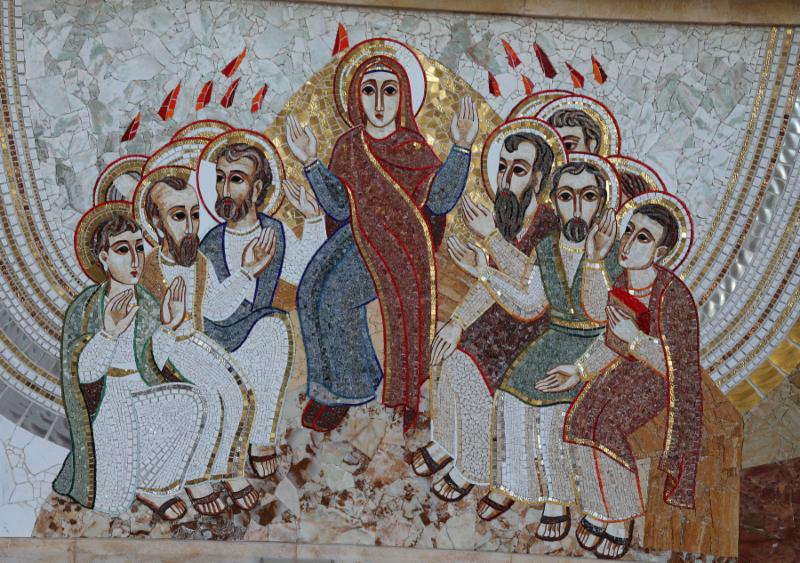
On the day of Pentecost, when they were all gathered in one place, suddenly there came from the sky a noise like a strong driving wind, and it filled the entire house. Then appeared what looked like tongues of fire, which parted and came to rest on each one of them. And they were all filled with the Holy Spirit and began to speak in different languages, as the Spirit enabled them.
Now there were devout Jews from every nation under heaven
staying in Jerusalem. At this sound, they gathered in a large crowd, but they were confused because they each heard their own language.
Astounded, they asked,
"Are not all these people who are speaking Galileans?
Then, how do we each hear them in our own language?
We are Parthians, Medes, and Elamites, inhabitants of Mesopotamia, Judea and Cappadocia, Pontus and Asia, Phrygia and Pamphylia, Egypt and the districts of Libya near Cyrene, as well as travelers from Rome, both Jews and converts to Judaism, Cretans, and Arabs, yet we hear them speaking in our own languages of the mighty acts of God."
Acts 2:1-11
The multitude of nations listed in Acts 2:1-11 often presents a challenge to lectors, especially to those who are proclaiming the text for the first time. Many of the names are not only unfamiliar to a modern assembly but difficult to pronounce; moreover, if one is trying to proclaim Luke's account of the day of Pentecost with energy, the effect can be akin to reading a tongue-twister or something from Dr. Seuss. Challenging as the list of nations might be, however, it emphasizes the amazing phenomenon witnessed by the crowd. Although each geographical region was home to a variety of languages and dialects, each person present could understand the disciples' proclamation. You could say that all the languages of the world were represented on that day of Pentecost; you could also claim that the multiplicity of tongues amounted to a single language -- the language of the Spirit!
And what language does the Holy Spirit speak? As a young child living in England, I assumed God spoke English; after all, there was a tradition reflected in William Blake's poem, Jerusalem, that the Child Jesus traveled to Britain, accompanied by Joseph of Arimathea. Blake's opening lines--"And did those Feet in ancient time/ Walk upon England's mountains green"-- convinced me that English was the Trinity's native tongue, especially when I listened to Parry's rousing setting to the beloved anthem. Only when I understood that Jerusalem was a social commentary about the devastating effects of the Industrial Revolution ("the Satanic mills") did I begin to question God's linguistic preferences.
So what language does the Spirit speak? From the beginning of time, the Spirit hovered over all creation, a mighty wind sweeping away darkness, summoning light from the abyss. The Spirit's language, then, is a language accessible to all, regardless of national origin; it is a language which transcends the narrowness of nationalism, geographical boundaries and petty self-interest, opening the listener to God's all-inclusive perspective. It is a language of fire, igniting hearts with a love so fierce that it extends to peoples everywhere, especially the poor, the suffering, the marginalized; it is also a language of Truth, a prophetic language that rails against injustice, manipulation, deception, distortion, and all the sins of double-speak, fraudulent claims and propaganda.
Western Christianity may have tamed the Holy Spirit into a Comforter and Guide, but the Feast of Pentecost is about Divine Intoxication. Leaving the safety of the upper room, the disciples burst into ecstatic speech, surrendering to that Voice that resounded through them, with no regard for their safety or what others might think of them. Under the influence of the Holy Spirit, they spoke with a passionate intensity that had nothing to do with book knowledge or other forms of acquired knowledge. God's Word became their Word and as a result of Peter's preaching, around 3,000 people were baptized into the Christian community.
So how does the Holy Spirit speak in us? Here, we have to be discerning. We need to distinguish between our ego wants and what God desires, between societal expectations and divine inspiration, between human folly and God's wisdom, between the glamor of evil and the call to integrity, between the lure of idolatry and the call to serve God and God only. The language of the Holy Spirit is consistent-- the question is, are we willing to speak the same language, or are we citizens of Babel, devoted to false gods and their empty promises?
|