|
SCRIPTURE READINGS
But because he wished to justify himself, he asked Jesus,
"And who is my neighbor?"
Jesus replied, "A man was attacked by robbers
as he was traveling from Jerusalem to Jericho.
They stripped him, beat him, and went off leaving him half-dead. A priest happened to be going down the same road,
but when he saw him, he passed by on the opposite side.
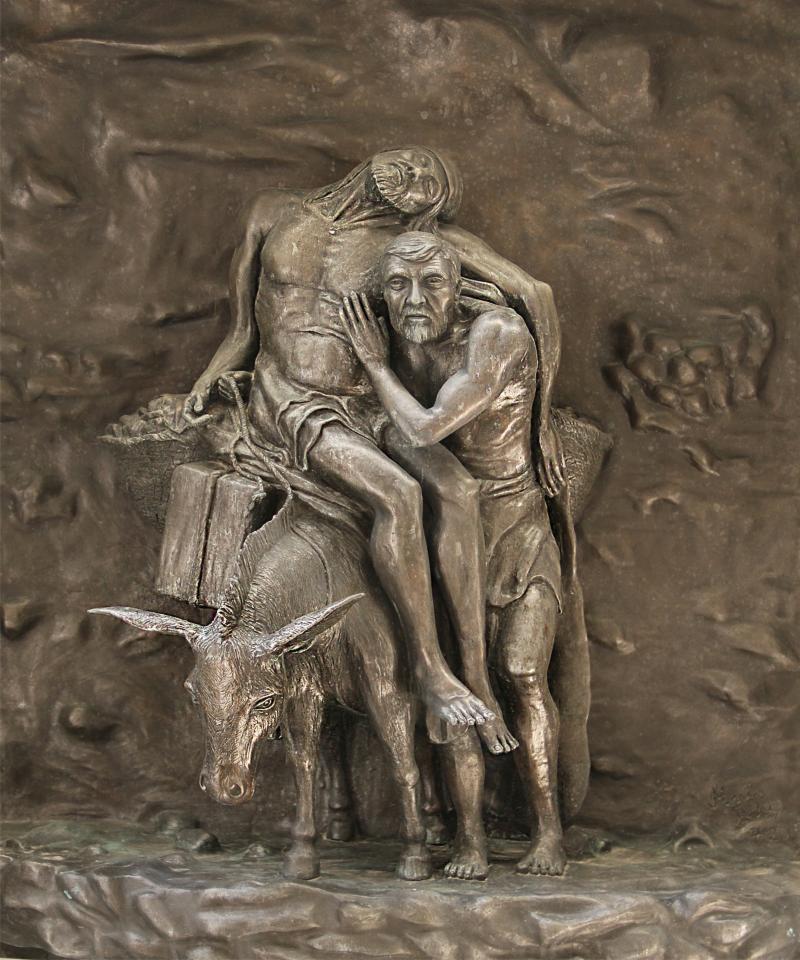
Likewise, a Levite came to the place, and upon seeing him, he passed by on the opposite side. But a Samaritan traveler who came upon him was moved with compassion at the sight. He approached the victim, poured oil and wine over his wounds, and bandaged them. Then he lifted him up on his donkey, took him to an inn, and cared for him.
The next day, he gave two silver coins to the innkeeper with the instruction, 'Take care of him. If you spend more than what I have given you, I shall reimburse you on my return.'
Which of these three, in your opinion, was neighbor to the robbers' victim?" He answered, "The one who treated him with mercy." Jesus said to him, "Go and do likewise."
Luke 10:25-37
The Parable of the Good Samaritan presents three ways of seeing-- or, as the case may be, of not seeing. The "object" in the story is the robbers' victim, an innocent traveler en route from Jerusalem, the holy city, to Jericho, a hub of commerce and agriculture. The sharp descent from the Judean hills to the Jordan valley, together with the rough terrain, meant that the seventeen-mile journey was a challenge for the most intrepid of travelers; it also offered opportunities for marauding bandits who preyed on passers-by. For the robbers in Jesus' parable, their victim was merely a dollar sign (or a symbol of shekels/ denarii). Not content to merely rob him, they stripped him, beat him, and left him for dead. What motivated such cruelty? We know nothing about the robbers' nationality or religion, nor about those of the traveler, though scriptural commentaries tend to assume he was Jewish. There may have been class hatred involved, a resentment against the "haves" of society, but this is just guessing. All that is certain is that the robbers were incapable of seeing their victim's humanity. Instead, they unleashed all their sadistic fury upon him before disappearing with his possessions.
Then, along came two religious figures: the priest (representative of ritual and sacrifice) and the Levite (possibly a cantor and/or temple assistant). Both men, upon seeing the grievously wounded traveler, crossed the road. What did they see? Again, like the robbers, these representatives of religion failed to see the traveler as a human being; instead, they saw an inconvenience, a bleeding "thing" that might delay them or, worse still, make them ritually impure. As Maurice Ryan points out, the man was not yet dead, so the prohibition against touching a corpse (Num 19:16) did not apply; however, it is possible that neither of the two got close enough to see if the injured man were dead or alive, or perhaps they feared he might die in their company. In either case, the traditional view that the priest and Levite placed ritual purity over compassion would still stand-- which is why they crossed the road. Another possibility, of course, is that, terrified of being attacked, they failed to stop for fear of becoming victims themselves.
And then we come to the surprise factor in the story: that a Samaritan would see the robbers' victim and respond with an abundance of mercy and compassion. He saw not only with his eyes but also with his heart; unlike the religious representatives, he did not see the injured man as a problem to be avoided but as a human being in a desperate situation. Though some commentators (cf. Ryan) minimize the significance of the Samaritan being a Samaritan, the parable would lose its punch if we glossed over this fact. Jesus never calls the Samaritan "good" but merely lists all his actions, from binding the victim's wounds to caring for him at an inn. For Jesus' audience, the very idea that a despised Samaritan would demonstrate such love would have been incomprehensible; in fact, the idea of a "good Samaritan" would have been an oxymoron.
The Parable of the Good Samaritan challenges us to see with eyes of compassion, to look beyond differences, and respond with mercy. It defines "neighbor" as "whoever is in need of "Love in action," regardless of whether the person lives next door, or in our home, or is a stranger we encounter in some deserted place. "Love in action" goes beyond mere pity or sending prayer emojis. Instead, it calls us to the messy task of binding another's wounds, even if it interrupts our schedules, causes inconvenience, and impacts us financially. "Love in action" involves nothing less than self-sacrificing love, the very mercy of God...
+++
QUESTIONS FOR REFLECTION
-
In what ways do you find The Parable of the Good Samaritan challenging?
- Who are some of the "neighbors" in your life who are in need of "Love in action"?
- To what extent does The Parable of the Good Samaritan summarize Jesus' teachings on Love?
- Who have been some of the "Good Samaritans" in your life?
|