|
18 December 2025 — “We Can Do It!” Modern-Day Rosies and the Red Oak Victory Revival
This past summer a cool thing happened, and as we steam our way from 2025 into 2026, we wanted to make sure to share it with our NMHS readers who might not have heard about it when it happened. California’s Richmond Museum Association held a two-week event that really multitasked, shining a spotlight on a museum ship in our priceless historic fleet, the contributions of women in the war effort in World War II, and the immense importance of the skilled workforce needed to build and maintain our maritime assets today. That project: Red Oak Victory Revival.
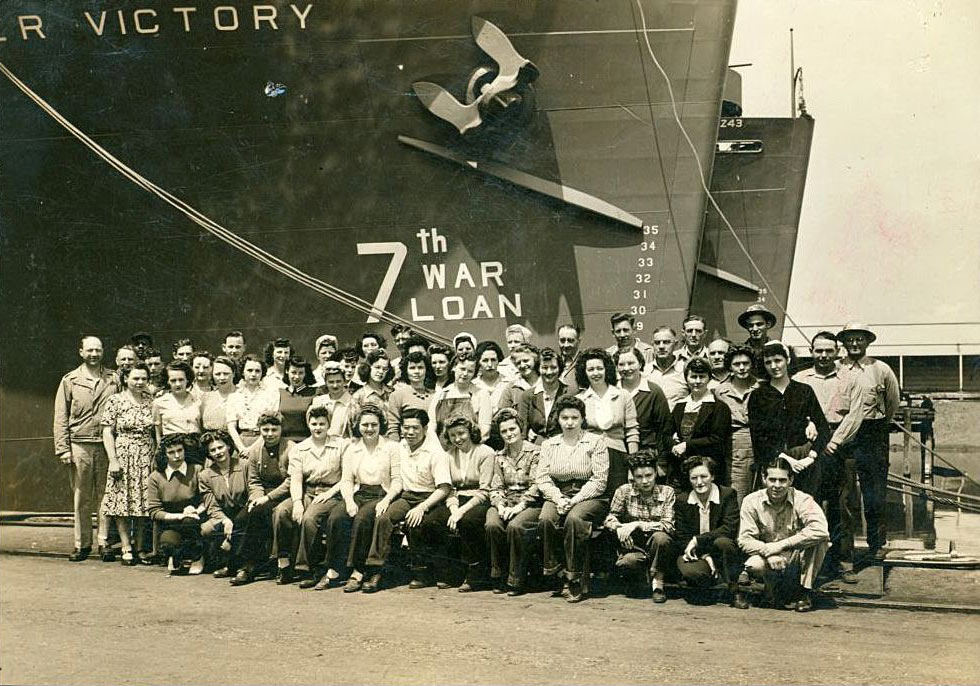
| Workers at the Kaiser shipyard pose in front of their handiwork. | Rennae Ross, a business agent and member of the Local 549 of the International Brotherhood of Boilermakers, Iron Ship Builders, Blacksmiths, Forgers and Helpers, AFL-CIO, was touring Richmond’s museum ship Red Oak Victory with colleagues, and they were taken with the idea of a group of Boilermaker women applying their skills to help restore the vessel. The idea had a certain symmetry to it; after all, when the ship was built at the Kaiser shipyard in 1944, women composed about 27% of its workforce, symbolized by the national icon of “Rosie the Riveter.” The idea shaped an event, spanning from 18–29 August, where a group of “modern-day Rosies”—women who are skilled welders and other tradespeople—worked alongside members of the ship’s volunteer support crew, tackling specific projects to improve Red Oak Victory’s condition, like repairing and restoring rusted railings and deck plating, and replacing the galley exhaust stack. | This local news footage gives you a glimpse of the Red Oak Victory Revival. | As it happens, 2025 also marked the 25th anniversary of the Rosie the Riveter Trust, philanthropic partner of the Rosie the Riveter/WWII Home Front National Historical Park. The park is a collection of historic sites related to the Richmond shipyard and its role in war production during that period, like the building that once housed the Ford Motor Company Assembly Plant (the largest assembly plant on the West Coast), along with an educational center and the Rosie the Riveter Memorial, recognizing the women who answered the call to join the wartime workforce as male workers were called to serve in the military. The special two-week Red Oak Victory event celebrated the contribution of those tradeswomen and the continuity of building upon their efforts. | Above: The song “Rosie the Riveter” was one of the many ways in which women in the wartime workforce were celebrated.
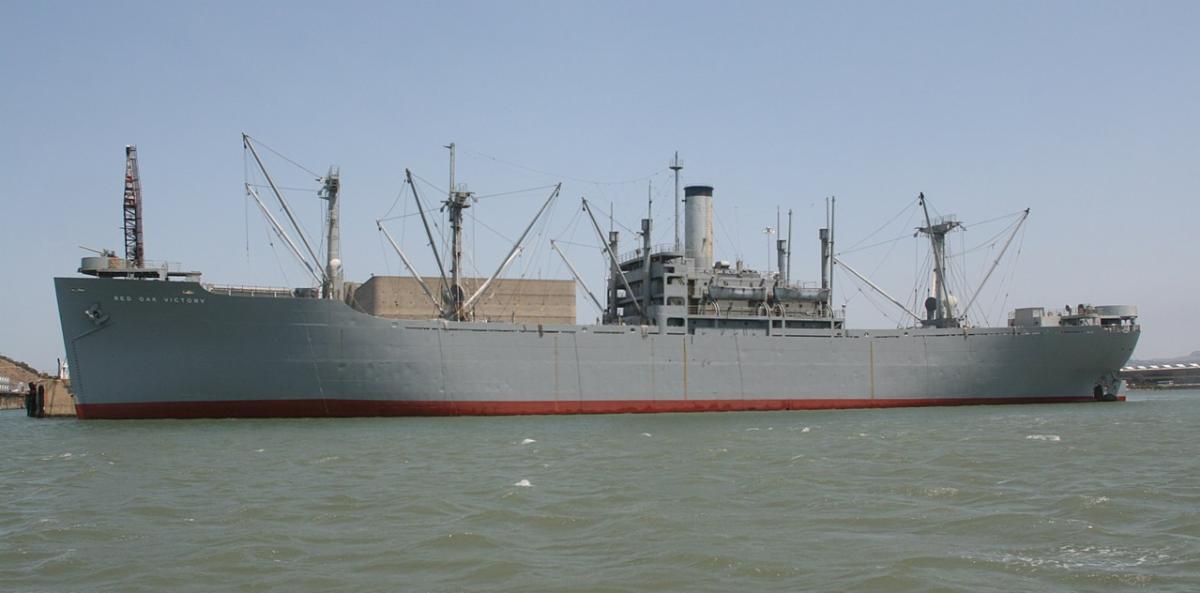
Below: J. Howard Miller’s image of Rosie on a poster for the War Production Co-Ordinating Committee gave us the iconic image we have of the character today, with her determined expression, blue coveralls, and red-and-white kerchief. PD | For the stewards of Red Oak Victory, the Revival is not just that special event in August, but a years-long path to an overall restoration of the ship. Phase I, the August project, solidified collaborations, established relationships with new volunteers, and brought in financial and in-kind donations towards the ship’s first fundraising target. Phases II and III foresee further welding and superstructure painting, and a stint in a shipyard for hull cleaning, painting and inspection of the hull. It is hoped that community project grants will fuel these efforts. | | A guided tour of Red Oak Victory created for the Longest Night of Museums live broadcast on 18 May 2023 sponsored by World of Warships. | Red Oak Victory was built in Kaiser Corporation’s Permanente Metals Corporation Shipyard #1, one of Kaiser’s four shipyards in Richmond, California, operating during the Second World War. She was launched on 9 November 1944 and commissioned USS Red Oak Victory on 5 December. Her name honored the town of Red Oak, Iowa, which had the highest per-capita casualty rate of any American community in World War II. She served in the Pacific through the rest of the war, supplying the US fleet with cargo and ammunition. She was decommissioned in May of 1946. Her civilian service took her to Japan, Korea, Cuba, Pakistan, India, and Singapore, as well as American ports like Anchorage, Tampa, Mobile, and New Orleans. In the mid 1960s she carried military supplies for the Military Sea Transport service to Vietnam, Japan, and the Philippines; she joined the Maritime Administration Reserve Fleet in Suisun Bay in 1968. In recognition of the integral role that the shipyards played in the history of the City of Richmond, the Richmond Museums Association rescued the ship from eventual scrapping, acquiring her from the US Maritime Administration in 1996. Today, she is one of just three surviving Victory ships; Lane Victory serves as a museum ship in Los Angeles, California, and American Victory is in Tampa, Florida. | | Red Oak Victory in 2013, just two years after a 2011 restoration. Photo: Leonard G. via Wikimedia Commons | | |
The two-week Red Oak Victory Revival event last August brought widespread attention to a noteworthy museum ship, and it wove our history into a new chapter of the American story for new generations. The organizers also forged new partnerships and reinforced working relationships with people and institutions in the maritime and heritage communities. As we set our plans and goals for 2026 and beyond, we think that the Revival set a fine example of what we can achieve.
Extra Credit
She Lives Rent-Free on an Old World War II Cargo Ship
“Meet Winnie the Welder” (Heinz History Center)
Sea History Today is written by Shelley Reid, NMHS senior staff writer. Past issues can be read online by clicking here.
| | | | |