|
31 October 2024 — The Spruce Goose—A wartime project that still captures the imagination
As we greet the month of November this weekend, we thought it would be fun to look back on an eventful November day back in 1947. Around noon on 2 November a pilot, 19 flight crew members and 15 observers and members of the press clambered into an experimental flying boat—an airplane with a hull rather than landing gear, designed to take off from, and land on, the water’s surface—for taxi test runs to see how she handled on the water. Why was the press even interested? The flying boat in question was the Hughes H-4 Hercules, known to most of the world—much to the frustration of her designer—as the Spruce Goose. The test run was newsworthy because that designer, sitting in the pilot seat for the test runs, was the enigmatic millionaire/movie producer/aviator Howard Hughes, the plane was built of wood composite rather than metal, and it was just so darned big. It weighed 250,000 pounds empty. It was 218 feet long and five stories high, and its total wingspan was 320 feet (longer than a football field). Just one wing was longer than the 120 feet distance that the Wright brothers traversed in their first controlled, sustained flight back in 1903.
The pilot guided the craft through two taxi runs, and discharged most of the press to file their news stories. Pleased with the performance, the pilot initiated another run, requesting that the flaps be lowered to 15 degrees. Much to the astonishment of those aboard, as well as the follow-boat and observation helicopter, the plane rose into the air, and flew about 25 feet above the water’s surface (some accounts say it was closer to 70 feet) for under a minute. That brief-but-breathtaking flight demonstrated that the Hercules could truly be called a flying boat.
|
 | The Spruce Goose’s brief moment in the air was captured on film. | The very first proposal of a flying boat like the Hercules was a 1942 confidential memo written by a member of the US War Production Board’s planning committee, F. H. Hoge Jr. The memo explored the possibility of developing large-scale flying boats as a means of transporting personnel and equipment over the Atlantic, because German U-boats were sinking so many ships making the transit. Large flying boats had two significant advantages over their land-based counterparts for this type of task; they wouldn’t need landing gear, a savings that could allow more weight allotted to cargo, and they could land in harbors, in areas where no suitable landing facilities for giant airplanes were yet available. Industrialist Henry Kaiser, who established seven shipbuilding yards for the war effort and oversaw innovations in the production process that enabled them to reduce the production time of ships like the Liberty ships from months to a matter of days, was a vocal public advocate of the idea. The problem was, Kaiser had no experience with airplanes. He found himself partnered with aviation designer Hughes. In November of 1942 their newly-founded Kaiser-Hughes Corporation entered into a contract with the United States’ Defense Plant Corporation to design and build three prototype flying boats, each capable of transporting two Sherman tanks, or their weight equivalent. |
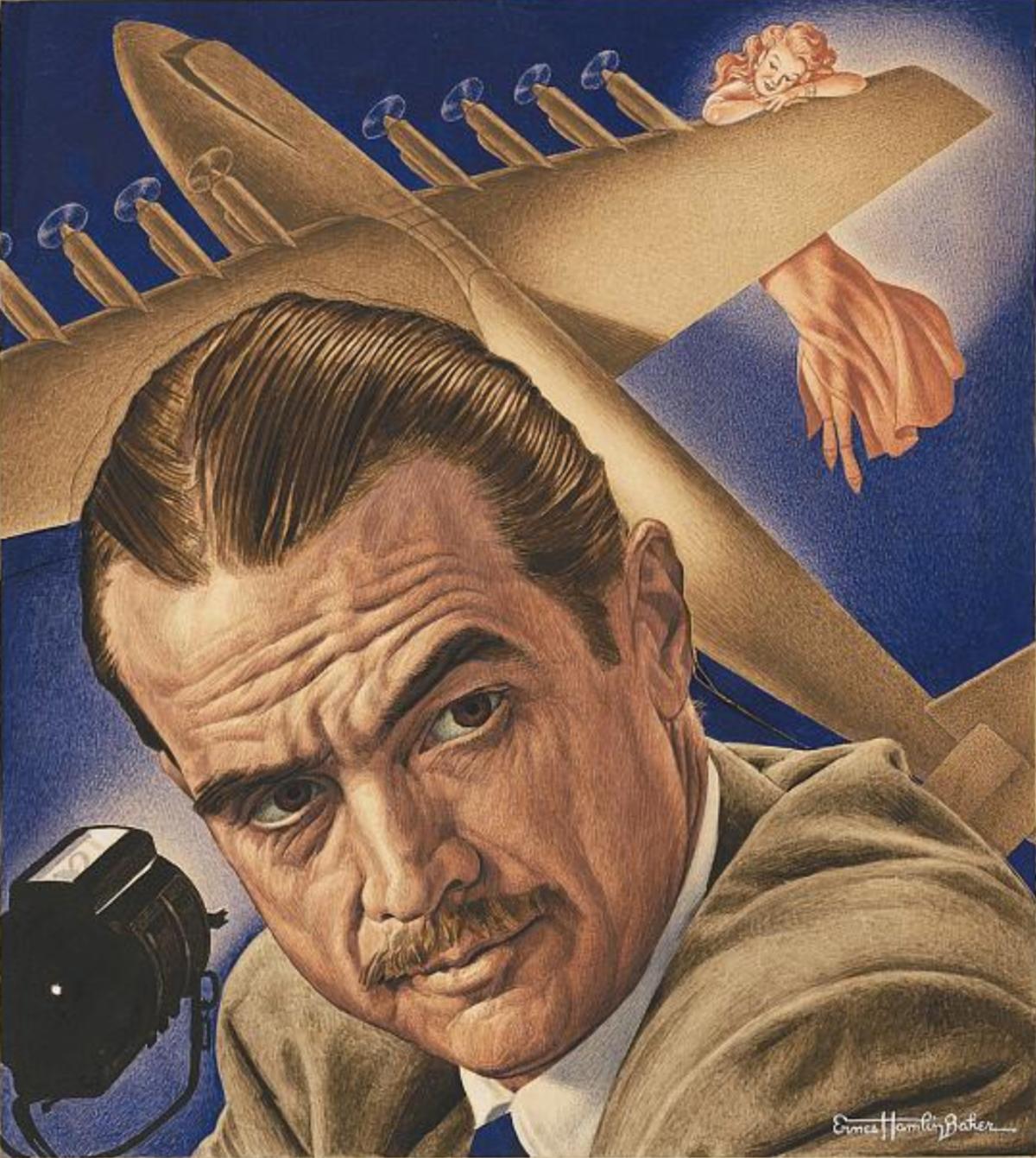 | Time magazine put this image of Howard Hughes on its cover in 1948. Pictured behind him is his flying boat, along with representations of the movie-making business and a lovely women, two of his other well-publicized interests in the day. PD, Time Magazine via Wikimedia Commons. |
|
The complex systems in the seaplane, like the 120-volt redundant direct current (DC) electrical system and the flight control and safety systems, with their multiple layers of redundancy, would eventually earn it the designation as an American Society of Mechanical Engineers Historic Landmark in 2002. By 1944, however, issues like the mounting cost, Hughes’s insistence on overseeing even the smallest details, and the decision on whether to switch construction from wood to aluminum as the material became more readily available, caused tensions between Hughes, Kaiser, and the government. In addition, German U-boats were causing far fewer losses of cargo ships in the Atlantic by this point in the war. In March the government contract was renegotiated, with the target of one finished flying boat instead of three, and Kaiser left the project.
In June of 1946 the individual pieces of the flying boat were moved from the plant in Culver City, California, to an assembly and dry dock site on Terminal Island. The logistics were impressive; law enforcement from the State of California plus ten cities and towns coordinated to block off streets and direct traffic, and linesmen from the power and telephone companies accompanied the hull, cutting lines that couldn’t be moved and then quickly reconnecting them once it had passed. One right-angle turn in the road was so tight that the truck with the hull had to wiggle an inch at a time to negotiate through, taking a full hour. When the pieces reached their destination in Terminal Island, the process could be begun to put everything together.
|
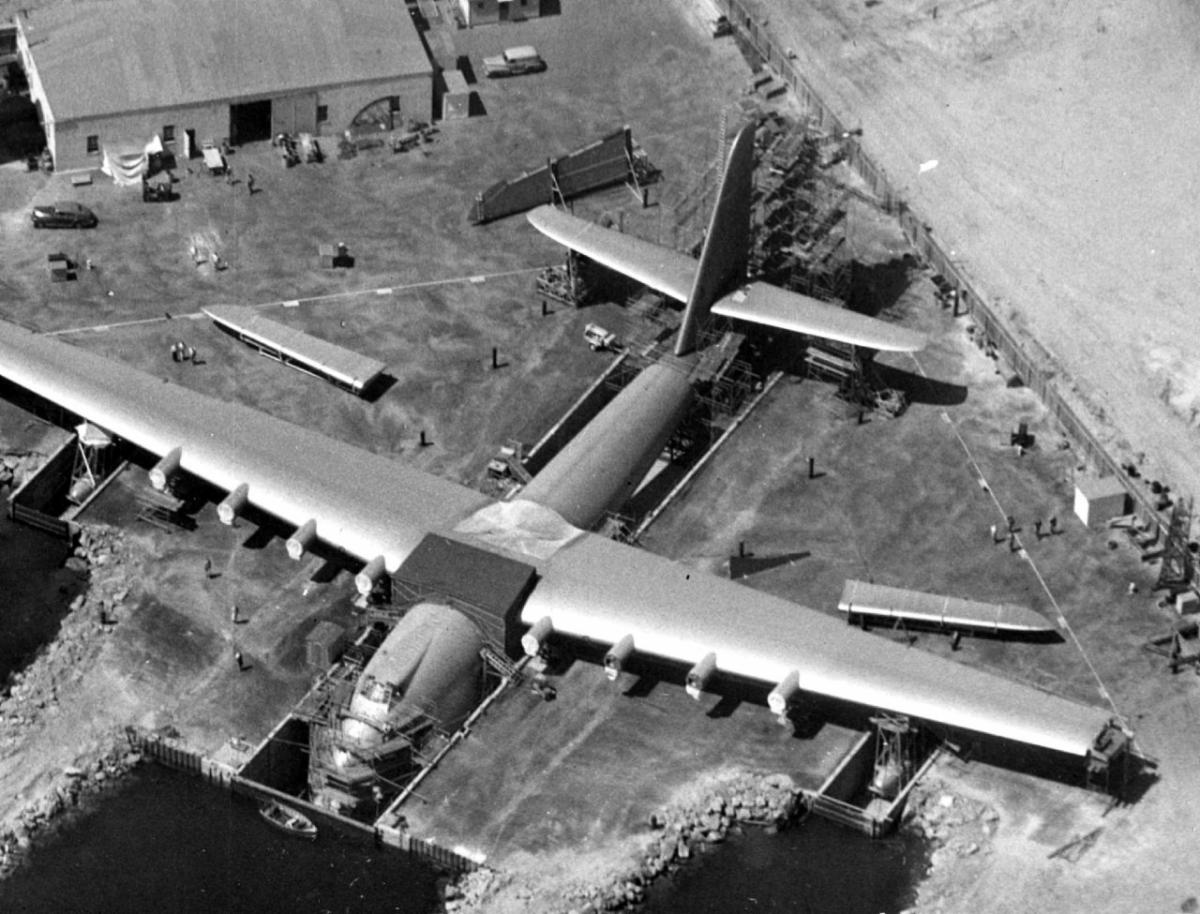 | A special dry dock structure had to be constructed for the H-4 Hercules for its final assembly in Terminal Island. Image: PD, San Diego Air & Space Museum Archives via Flicker Commons. |
|
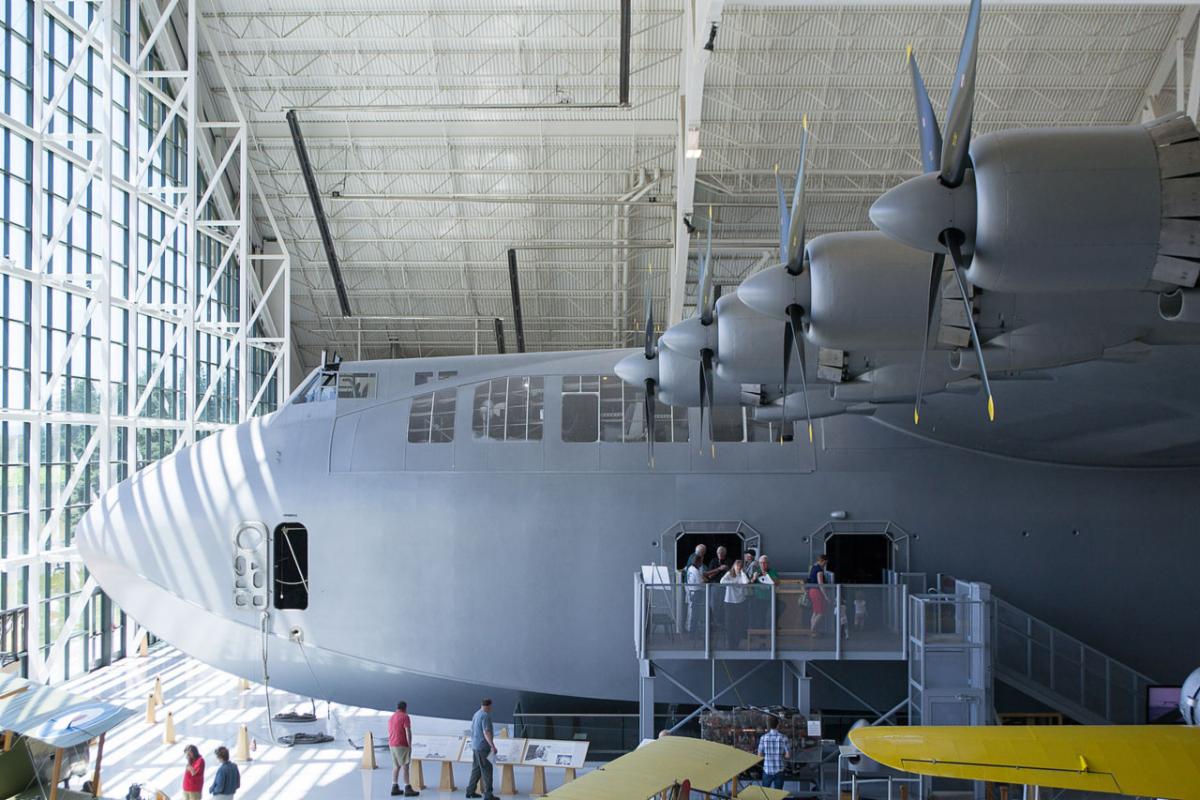
The Spruce Goose can be seen today at the Evergreen Aviation and Space Museum, the crown jewel in its rich collection of historic aircraft and rockets, landers, drones, and other space equipment. Photo: PD, courtesy Visitor7 via Wikimedia Commons. | |
|
After that famous test “flight,” the Hercules was kept at Terminal Island, and Hughes continued to tinker and work on tests and improvements on the craft. With the war over, the government wasn’t really interested in the flying boat, but Hughes felt it was a useful learning lab. The failure of a nearby earthen dike in 1953 caused a flood of mud and water into the hangar, damaging the Hercules. Hughes paid for its careful restoration, and then continued to pay $1 million per year until his death in 1976 for its upkeep in a state of flight-readiness. After his death, the plane was donated to the non-profit Aero Club of Southern California (ACSC), and a massive geodesic dome was constructed in Long Beach, where she was opened for display in 1983. However, the attraction wasn’t deemed sufficiently profitable by its owner, the Disney Corporation, and the Hercules was adopted by the Evergreen Aviation and Space Museum in McMinnville, Oregon. And if you thought it was an undertaking to get the components of the Spruce Goose a few miles from Culver City to Terminal Island, just imagine what it took to break up the craft into 38 pieces, crate the smaller parts and shrink-wrap the larger ones, send them on barges up the coast, wait for the inland water levels to be just right, and then float them upriver under bridges and then squeezing them through a lock. Once in McMinnville, the craft underwent nearly a decade of painstaking restoration. Today it is the crown jewel in the Evergreen Museum’s collection. The Hughes Flying Boat barely spent any time in the water, and even less time in the air, but it certainly has a one-of-a-kind story to tell.
Extra Credit
“Howard Hughes’s Spruce Goose could fly, Glyndwr University flight sim shows”
How the Spruce Goose was Moved to Oregon
Yogi and the Magical Flight of the Spruce Goose (cartoon)
Sea History Today is written by Shelley Reid, NMHS senior staff writer. Past issues can be read online by clicking here.
| | | | |