|
Dear Community:
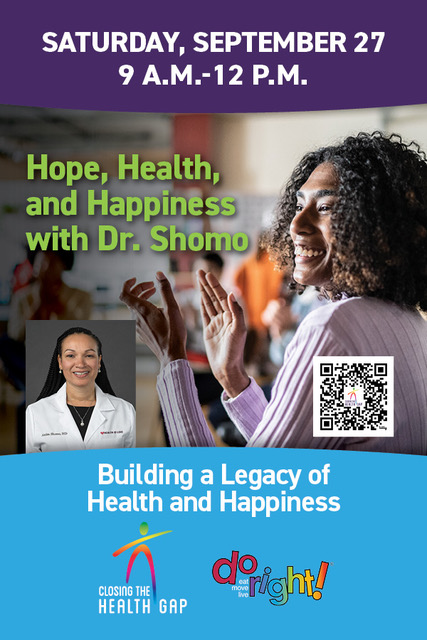
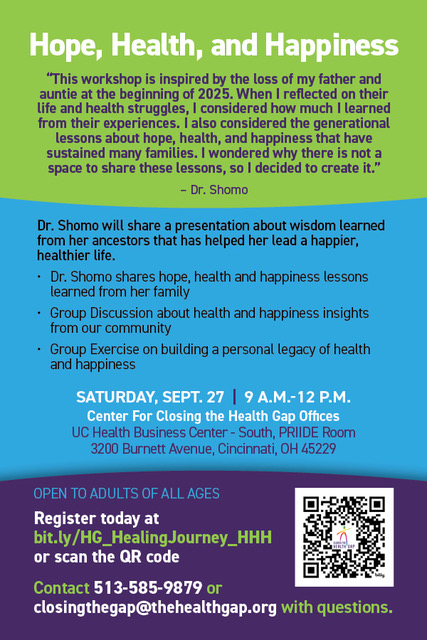
I’m thrilled to invite you to a powerful and uplifting event hosted by Closing the Health Gap! It's called "Hope, Health, and Happiness with Dr. Shomo" and it's happening Saturday, Sept. 27, from 9 a.m.–12 p.m. at our offices (UC Health Business Center – South, PRIIDE Room, 3200 Burnet Ave., Cincinnati, OH 45229).
At this deeply personal gathering, Dr. Shomo will share timeless wisdom from her ancestors – lessons that have shaped her journey toward a healthier, happier life. Together, we’ll:
- Hear Dr. Shomo’s inspiring family stories of hope and resilience
- Engage in a group discussion on health and happiness insights from our community
- Participate in an interactive exercise to begin building our own legacies of wellness and joy
This event perfectly reflects our “We Must Save Us” mantra, empowering one another to thrive. Register today and join us in creating lasting change. And blessings to all of you for a safe and healthy week ahead!
Renee Mahaffey Harris
President & CEO
| |
Gillibrand Introduces Legislation To Address Racial Disparities In Health Care Access
U.S. Senator Kirsten Gillibrand (D-NY) announced the introduction of the Health Access Innovation Act, legislation to fight racial disparities in health outcomes by expanding access to preventative health care in underserved communities. The bill would establish a new grant program to provide federal funding to faith- and community-based organizations located in medically underserved areas. Grants would help cover the cost of providing preventative care – including free or low-cost health screenings, vaccinations, family planning services, and mental health services – hiring community health workers, and expanding capacity. Gillibrand is calling for $50 million for this program to be included in the Fiscal Year 2026 government funding bill. Representative Nikema Williams (D-GA-05) introduced companion legislation in the U.S. House of Representatives.
Social determinants of health drive inequities in health outcomes seen across racial and ethnic groups. A lack of access to high-quality health care has long fueled health disparities affecting Black Americans. Black Americans are disproportionately affected by conditions like asthma, high blood pressure, diabetes, heart disease, and Alzheimer’s disease. Black women are over three times more likely than white women to die from pregnancy-related complications, and Black infants face the highest mortality rate of any group. During the COVID-19 pandemic, Black individuals were hospitalized and died at significantly higher rates than white Americans. To help address these persistent health inequities and chronic disease challenges, it is vital to expand access to culturally and linguistically appropriate care to meet diverse communities’ needs.
The Health Access Innovation Act would help address the lack of access to care by awarding grants to faith- and community-based organizations with a proven track record of addressing health inequities. Eligible organizations would be located in federally designated Medically Underserved Areas (MUAs) or Health Professional Shortage Areas (HPSAs), geographic areas and populations that have limited access to primary care services.
READ THE FULL PRESS RELEASE HERE
| | Fall Festivals in Forest Park and Mt. Auburn! | |
Data investigation: Childhood vaccination rates are backsliding across the U.S.
For more than a half-century, vaccines have had remarkable success eradicating the most lethal and devastating childhood infectious diseases, saving millions of lives and ushering in a relative golden era of global public health. But now, America is dangerously backsliding.
The vast majority of counties across the United States are experiencing declining rates of childhood vaccination and have been for years, according to an NBC News data investigation, the most comprehensive analysis of vaccinations and school exemptions to date.
This six-month investigation, done in collaboration with Stanford University, gathered massive amounts of data from state governments and archives of public records reaching back years or decades. The data focused on core childhood vaccines that, together, regard someone to be "up to date" on immunizations; these are the measles, mumps, rubella, polio, whooping cough and diphtheria shots. With the help of infectious disease researchers at Stanford, NBC News filed scores of requests for documents, including materials obtained under the Freedom of Information Act, and wrestled different types of data into a standardized format to map and compare rates across thousands of counties.
| |
A Call for Broadening the Lens on Health Disparities
For decades, efforts to study and address health disparities in the United States have focused to a large extent on outcomes according to race and ethnicity, with an emphasis on comparatively poorer outcomes for people of color. This long-standing approach has revealed substantial burdens that impact quality of life for minoritized racial and ethnic groups and developed the foundation for important research and policy efforts to advance the health of all communities, regardless of racial or ethnic background.
Yet, this steady focus has created an unintended consequence: advancing the public misperception that health disparities are only a concern for people of color. The reality is far different and quite sobering. Health disparities exist in a wide variety of forms, affecting many more Americans than previously considered—perhaps 50 percent of the US population or more. This includes approximately 82 million people who reside in rural areas and 37 million people who live in poverty (FHFA, 2024; US Census Bureau, 2025). Therefore, it is crucial to expand the lens on health disparities—not only in terms of what is studied and how policies are targeted, but also in terms of how disparities are discussed and how public understanding and support for actions meant to address them are shaped.
|
Florida’s move to end vaccine mandates may deepen skepticism in Black communities, health experts warn
Kiva Williams lives in Tampa, Florida, but she’s worried the state is going to turn into the "wild, wild West." Florida officials announced their intent to end all vaccine mandates this month, which would make it the first state to terminate the well-established and constitutionally upheld practice of requiring certain vaccines for schoolchildren.
"I’m a parent who cares about health and lessening overall sickness," Williams said. The mom of three said she has always taken her kids to get their vaccinations – not only to comply with the state’s school requirements but because she also feels at peace knowing the vaccines can prevent her kids – and their classmates – from getting seriously ill from diseases such as measles, mumps, polio and hepatitis B.
Measles, one of the world’s most contagious infectious diseases, can cause serious complications – such as blindness, pneumonia or encephalitis, swelling of the brain – and even turn deadly, especially in children younger than 5. It can also kill years down the line. The worst form of the polio virus causes nerve injury that can lead to paralysis, difficulty breathing and death. Hepatitis B is an illness linked to liver disease and cancer. The state’s move has left Williams worried that some parents — particularly in Black families, who historically face distrust in medicine and hurdles to health care access – will opt out of getting their children vaccinated, leading to an increased risk of exposure to illness at Florida schools.
|
Displacement, health outcomes, and the human rights of people experiencing homelessness in the USA
The USA is currently experiencing multiple overlapping economic and public health crises: rising costs of housing, increased homelessness, and record drug overdose mortality. In many urban areas, people who are homeless have become increasingly visible, often congregating in so-called encampments. The public reaction and policy response to this increased visibility has been largely punitive and carceral.
Jurisdictions across the USA have adopted policies of forced displacement, often carried out by law enforcement officers and sanitation workers, and enforced via threat of fines, arrest, or both. The widespread adoption of these policies—especially given the 2024 US Supreme Court decision (City of Grants Pass v Johnson)—represents a violation of international human rights law. Public health professionals should use the framework of international human rights to fight against these harmful policies.
|
The role of housing markets in producing respiratory health disparities
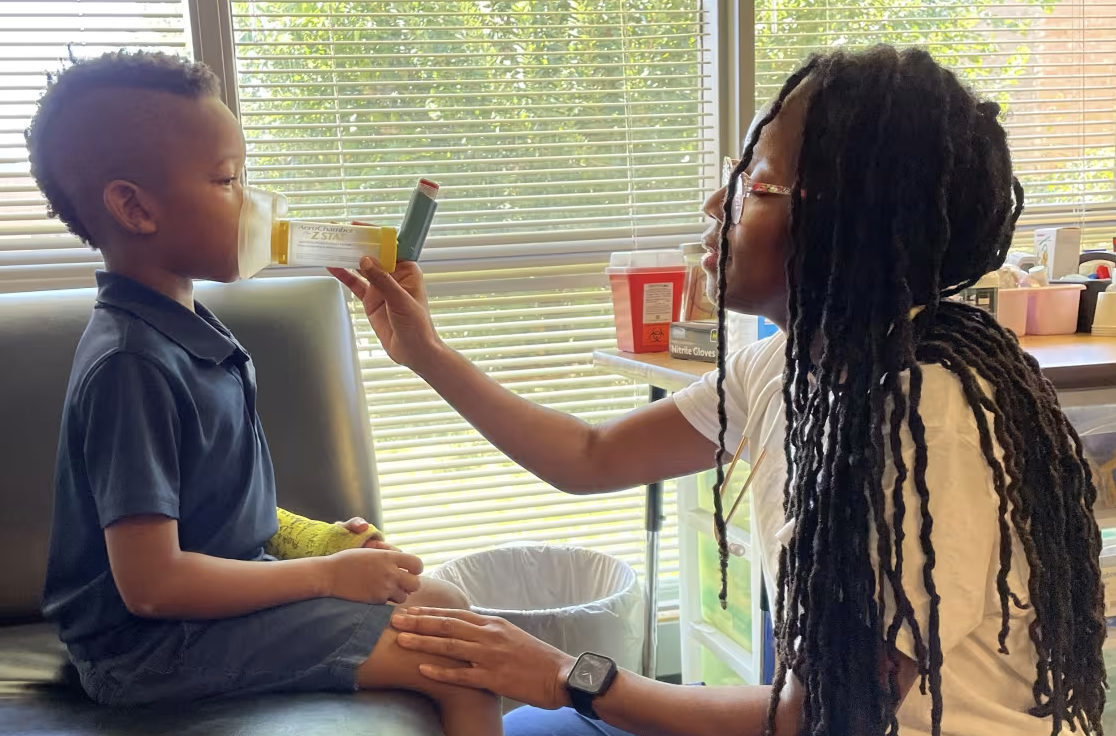
Asthma is a chronic lung disease affecting an estimated 27 million people in the United States. It is much more prevalent and severe among Black, Hispanic, Indigenous, and working-class communities. Substandard housing disproportionately exposes poor people and communities of color to pests, mold, poorly regulated temperatures, and psychosocial stress. This role of housing as a driver of respiratory health disparities is well-established.
However, less attention has been paid to the economic and political forces that produce the current distribution of substandard housing, which enables this unequal exposure and disease burden to persist. This review examines how harmful conditions arise from the political, legal, and economic relationships that govern housing’s production, maintenance, and distribution in the United States. We review emerging evidence that identifies power relations—most importantly the landlord-tenant relationship—as the motor that creates and reproduces disparities in exposures and the downstream disparities in asthma burden.
| | | | |